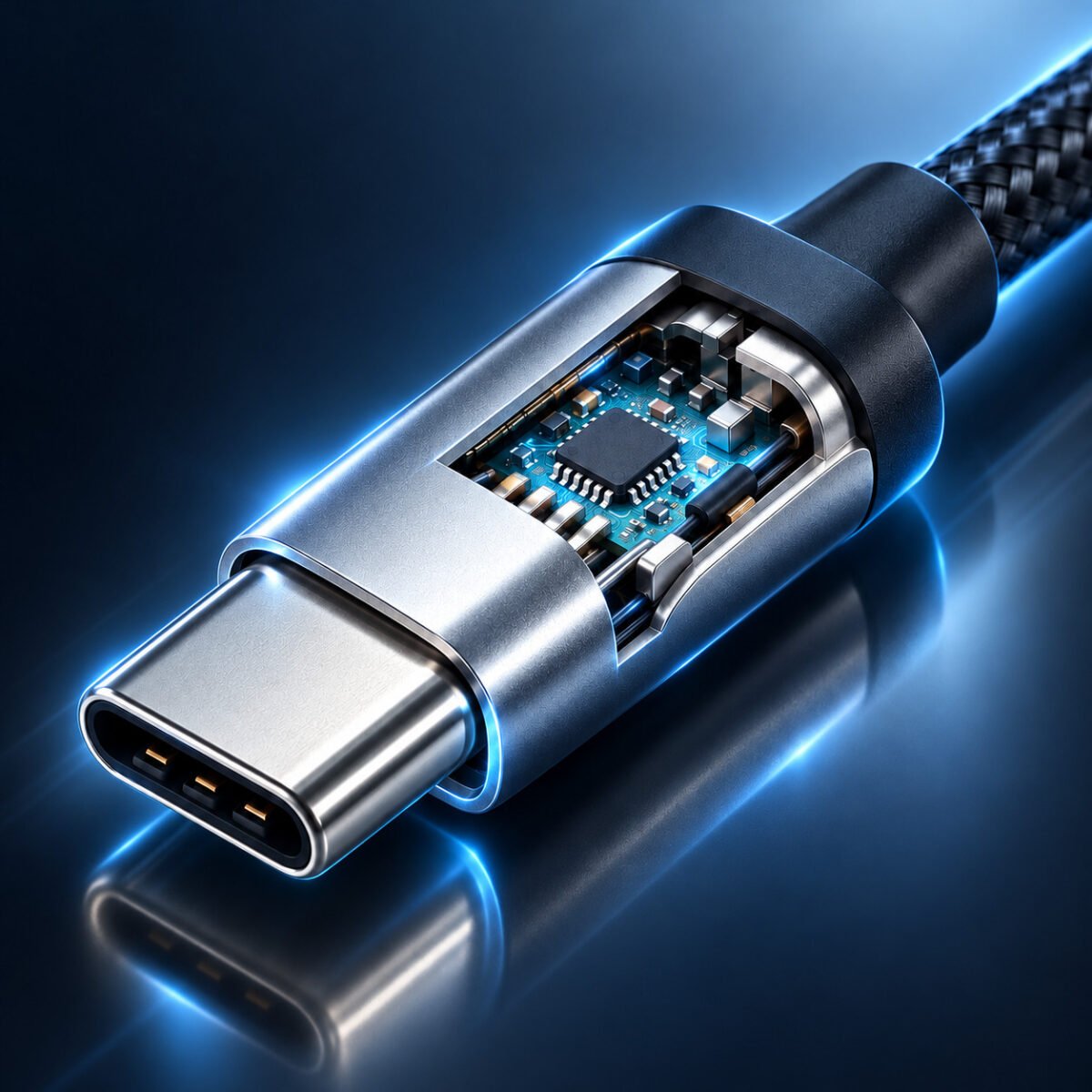


USB Cable Markings Explained: Complete Guide to USB-IF Logos, Power Ratings, and Certifications
USB Cable Markings Explained: Complete Guide to Certification Logos
What do the markings on USB cables actually mean? For B2B buyers, importers, and quality control teams, understanding USB-IF certification logos, power ratings, AWG wire gauge numbers, and safety certifications is essential for verifying cable specifications.
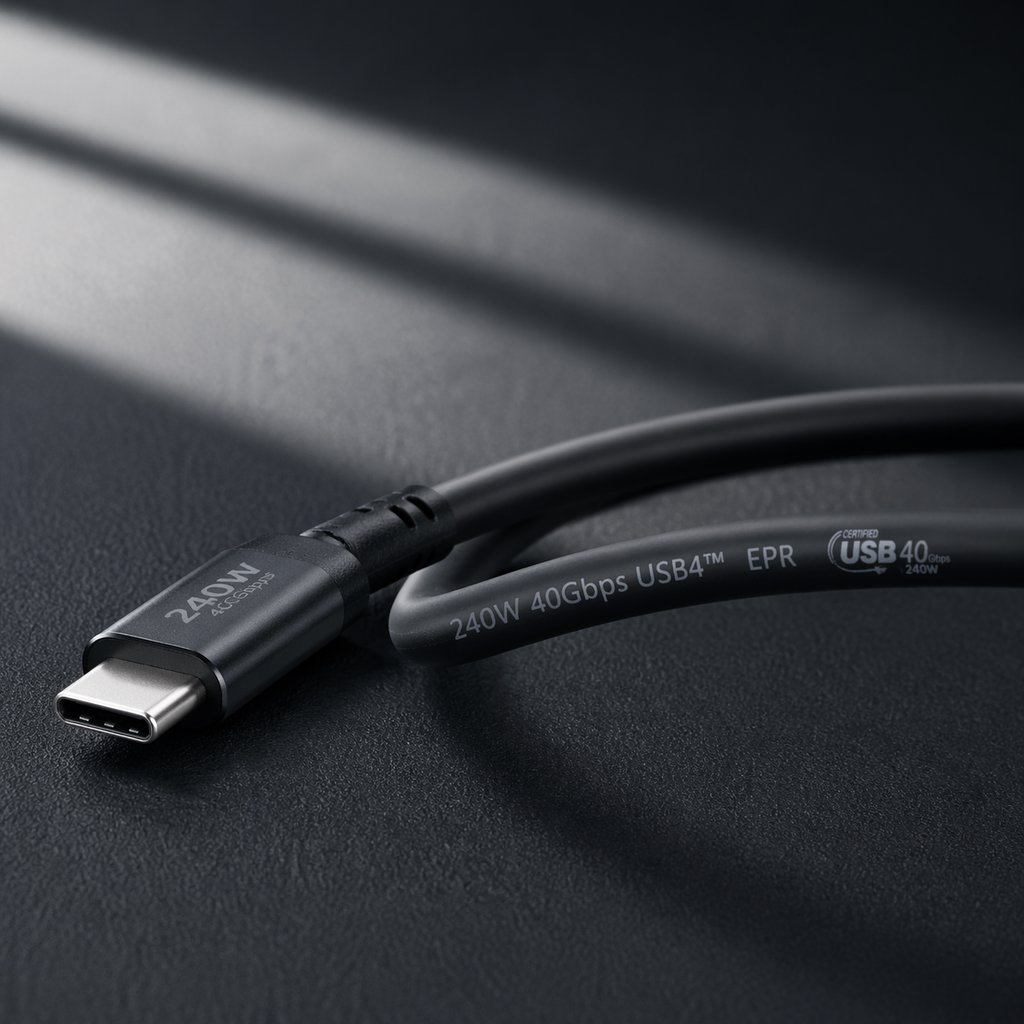
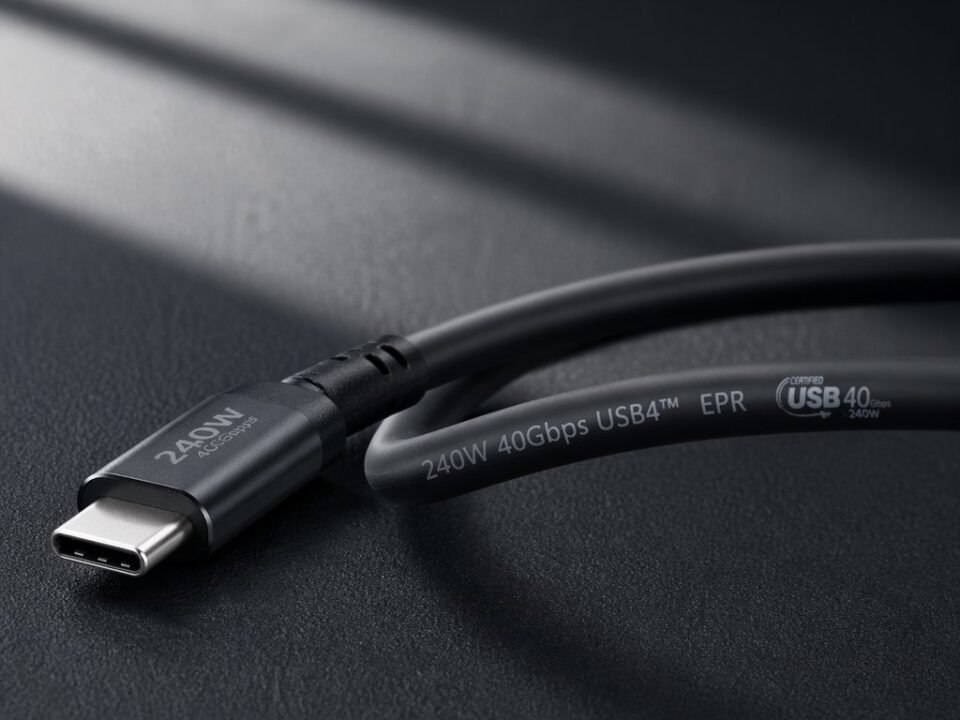
USB-C cable with printed markings showing power rating (240W) and data speed (40Gbps)—critical information for B2B verification.
USB cable markings explained — this comprehensive guide breaks down every symbol, number, and certification mark printed on USB cable jackets. For B2B buyers evaluating USB cable markings explained in detail, understanding these visual indicators is foundational to profitable sourcing decisions. Two cables with identical connectors often have completely different capabilities. The key to distinguishing them lies in the markings printed directly on the jacket. This guide covers USB-IF certification logos, AWG wire gauge numbers, EPR labels, and regional safety certifications.
Table of Contents
- Why USB Cable Markings Explained Matters for B2B Buyers
- USB Cable Markings Explained: Complete Power and Speed Certification Logos
- Thunderbolt and MFi Certification Marks Explained
- Technical Specification Markings: AWG, EPR, Speed, and Material Codes
- Safety and Environmental Certification Marks by Region
- How to Verify Cable Authenticity Using Markings and Testing
- Real-World Application: Markings by Device and Use Case
- Common Counterfeit Markings and How to Spot Them
- USB Cable Markings Explained: Complete B2B Inspection Checklist
- Regional Certification Requirements for Global Export
- Future Marking Standards: What's Changing in 2026-2027
- Summary and WJWSY Sourcing Support
1. Why USB Cable Markings Explained Matters for B2B Buyers
On the surface, most USB-C cables look nearly identical. They share the same oval connector and similar braided or TPE jackets. However, the capabilities hidden inside can vary dramatically—from 60W charging with USB 2.0 speeds to 240W power delivery with 40Gbps data transfer and 8K video output. The markings printed on the cable jacket are the manufacturer's declaration of these capabilities. Furthermore, they serve as the first line of defense against specification mismatches.
For B2B buyers, these markings serve five critical functions. First, they provide immediate visual verification during incoming quality control without specialized equipment. Second, they help prevent costly specification mismatches that lead to returns. Third, they demonstrate compliance with USB-IF, CE, FCC, and other regulatory requirements. Fourth, they serve as a permanent record of intended capabilities. Finally, they enable warehouse staff to quickly sort inventory by specification.
For a deeper understanding of how these power levels relate to charging protocols, refer to our USB PD version differences guide.
1.1 The Three Sources of Cable Markings
- USB-IF Certification Logos: Official marks from the USB Implementers Forum indicating verified performance tiers through independent laboratory testing. These logos carry legal weight and require product listing in the public Integrators List.
- Manufacturer Technical Specifications: Power ratings (60W/100W/240W), speed ratings (5Gbps/10Gbps/20Gbps/40Gbps), AWG wire gauge numbers, and EPR capability indicators. These are self-declared and should be verified through testing.
- Safety and Environmental Certifications: CE, FCC, UKCA, PSE, RCM, RoHS, REACH, and other regulatory compliance marks required for legal sale in specific markets.
1.2 The Cost of Ignoring Cable Markings
Failing to verify cable markings during procurement can result in significant financial exposure. Consider a shipment of 10,000 cables ordered as "100W USB-C fast charging cables" that arrive with 60W markings. The unit cost difference is approximately $0.40-$0.80 per unit. More importantly, selling 60W cables as 100W will generate customer returns and negative reviews. The total cost of a single Amazon FBA return averages $7-$12. Consequently, a 10% return rate on 10,000 units represents $7,000-$12,000 in direct costs alone.
2. USB Cable Markings Explained: Complete Power and Speed Certification Logos
The USB Implementers Forum (USB-IF) has introduced a unified labeling system that combines power and speed ratings into clear, consumer-friendly logos. These logos are the most reliable indicator of a cable's certified capabilities because they require independent laboratory testing and ongoing compliance monitoring.
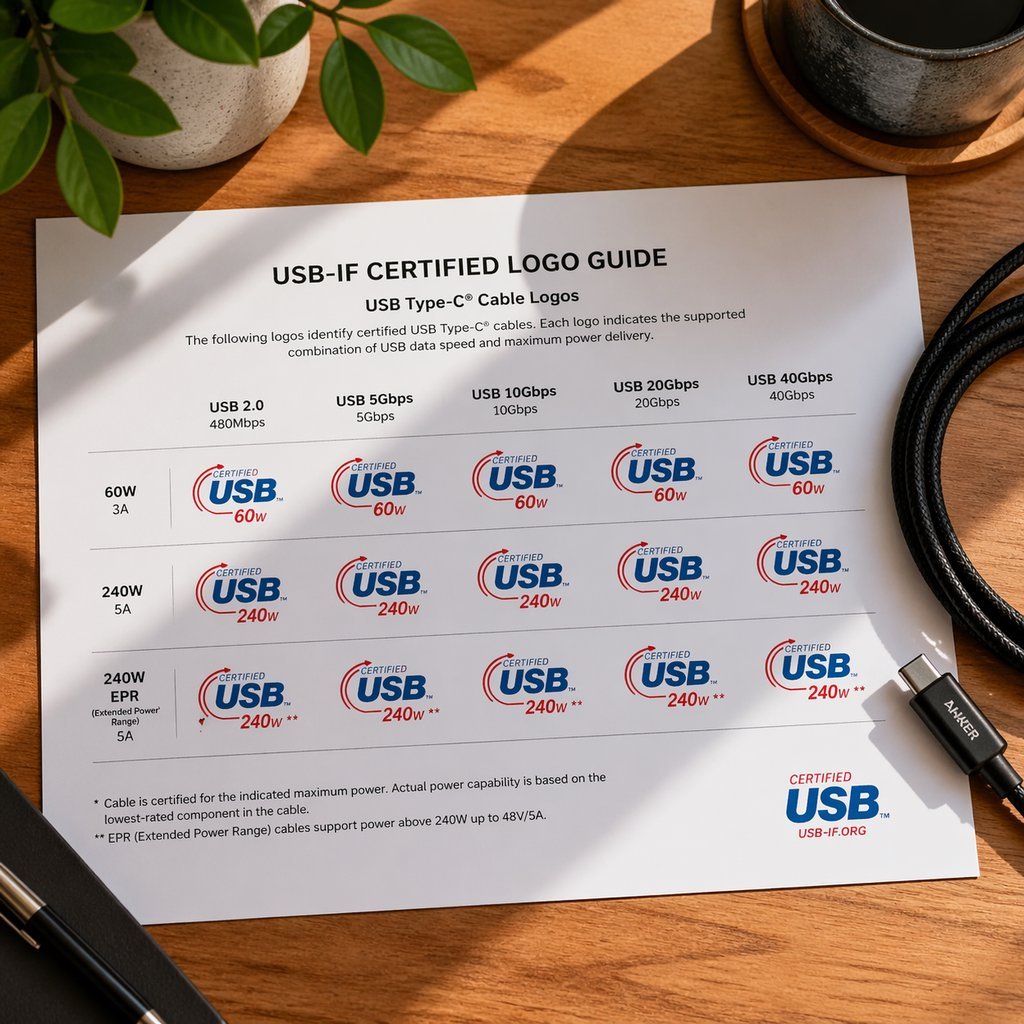
USB-IF unified certification logos combine power (watts) and speed (Gbps) into a single, easy-to-read label system.
2.1 Combined Power and Speed Logos: The Complete Matrix
The latest USB-IF certification system combines both charging power and data transfer speed into a single unified label. As a result, this system eliminates the confusion of separate power and speed ratings. The full matrix of available certification combinations includes:
| Logo Combination | Power Rating | Speed Rating | Typical Cable Type | Primary Application |
|---|---|---|---|---|
| 40Gbps / 240W | 240W (48V/5A) | 40Gbps (USB4 Gen 3) | Premium active USB4 cable | Gaming laptops, 8K video |
| 40Gbps / 100W | 100W (20V/5A) | 40Gbps (USB4 Gen 3) | Thunderbolt 4 passive | Professional docking stations |
| 40Gbps / 60W | 60W (20V/3A) | 40Gbps (USB4 Gen 3) | Thunderbolt 3 passive | High-speed data, standard charging |
| 20Gbps / 240W | 240W (48V/5A) | 20Gbps (USB4 Gen 2) | High-power USB4 cable | Power-hungry devices |
| 20Gbps / 100W | 100W (20V/5A) | 20Gbps (USB4 Gen 2) | USB4 Gen 2 full-featured | Balanced performance |
| 20Gbps / 60W | 60W (20V/3A) | 20Gbps (USB4 Gen 2) | Entry-level USB4 cable | Cost-effective high-speed data |
For a deeper understanding of cable specifications, refer to our USB-C to USB-C cable complete guide.
2.2 Standalone Power Certification Logos
For cables that prioritize charging over data transfer, USB-IF offers standalone power certification logos. The 240W Charging Logo identifies cables certified for Extended Power Range (EPR) operation at up to 48V/5A. The 100W Charging Logo indicates 5A current support at up to 20V. Meanwhile, the 60W Charging Logo indicates standard 3A charging capability suitable for smartphones.
2.3 Logo Usage Rules and Placement Requirements
USB-IF certification logos follow strict usage guidelines that B2B buyers should understand. Color versions are approved exclusively for packaging and marketing. Black versions are designated for printing on the cable body itself. The logo must be reproduced at a minimum legible size. In addition, products using these logos must be listed in the public USB-IF Integrators List with a valid Test ID (TID) number.
3. Thunderbolt and MFi Certification Marks Explained
3.1 Thunderbolt Certification: Intel's Premium Standard
Thunderbolt 3 and Thunderbolt 4 cables carry the distinctive Thunderbolt logo—a lightning bolt design with the number 3 or 4. This certification is managed by Intel and represents a higher tier of performance verification than standard USB-IF certification. Thunderbolt certification guarantees 40Gbps data transfer. It also ensures support for dual 4K displays or single 8K display at 60Hz. Additionally, it requires PCIe data tunneling and mandatory 100W power delivery on Thunderbolt 4 cables.
Thunderbolt cables are backward compatible with USB-C and USB4 devices. However, they will operate at the maximum speed supported by the connected device. A Thunderbolt 4 cable connected to a USB 3.2 Gen 2 device will function perfectly but at 10Gbps rather than 40Gbps.
3.2 MFi Certification for Apple Accessories
MFi (Made for iPhone/iPad/iPod) is Apple's proprietary certification program that remains active even with USB-C adoption. MFi-certified cables display the "Made for iPhone" badge on packaging and often include a small serialized marking near the connector. The absence of MFi markings is a significant red flag. Non-certified cables frequently trigger warning messages and may be limited in functionality.
3.3 Comparing Certification Requirements
| Certification | Managing Body | Factory Audit | Per-Unit Chip | Logo Usage | Primary Market |
|---|---|---|---|---|---|
| USB-IF | USB Implementers Forum | No | None | After compliance testing | Universal USB ecosystem |
| Thunderbolt | Intel Corporation | No | None | After Intel validation | Premium high-performance |
| MFi | Apple Inc. | Yes (required) | Yes (~$3/unit) | After full certification | Apple device ecosystem |
4. Technical Specification Markings: AWG, EPR, Speed, and Material Codes
Continuing with USB cable markings explained, this section covers technical specifications printed directly on the cable jacket. These markings reveal power ratings, AWG wire gauge, speed capabilities, and material composition.
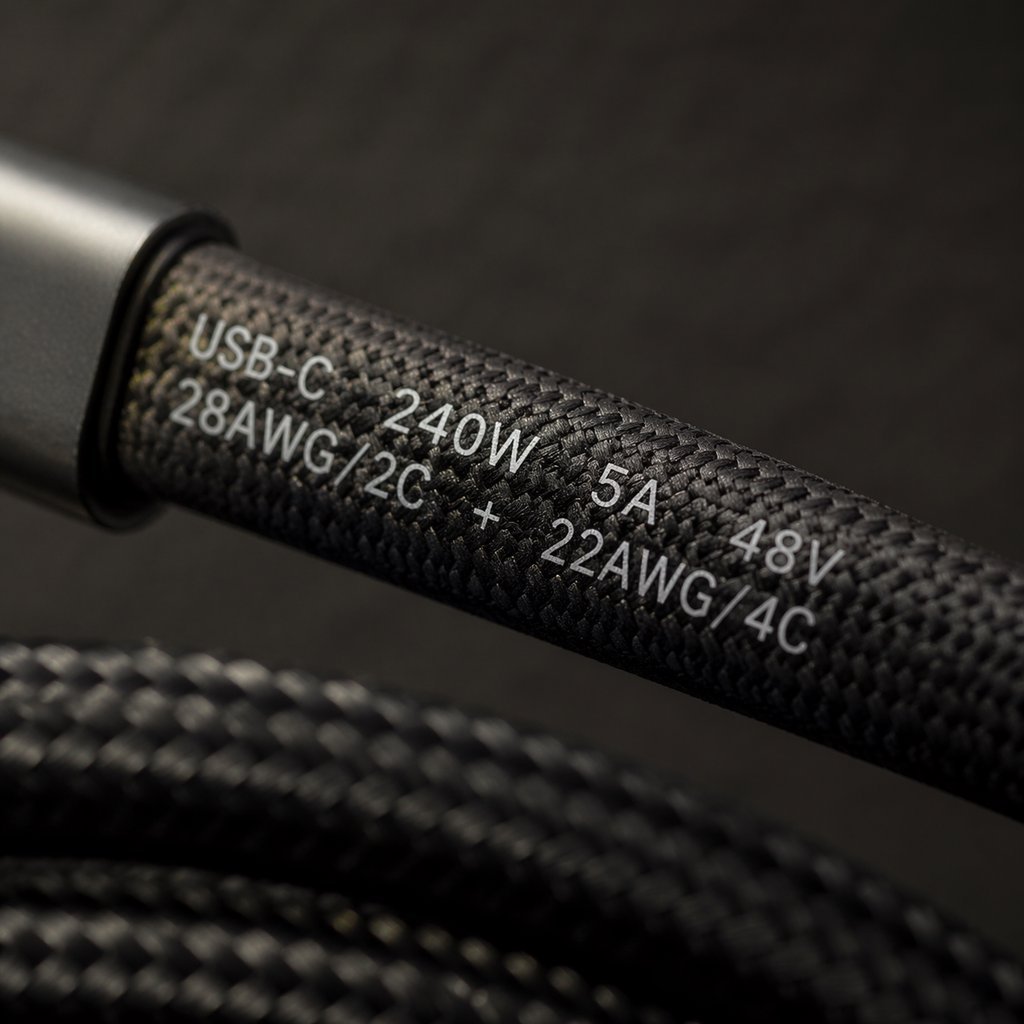
USB cable jacket showing AWG wire gauge specifications, power rating, and certification markings.
4.1 Power and Current Markings: Complete Reference
Cables display their maximum power and current ratings directly on the jacket. Understanding the relationship between these numbers is essential for B2B verification. Common markings include:
- 60W / 3A: Standard charging cable with 3A current limit. It typically uses 24AWG or thicker power conductors. Suitable for smartphones and tablets.
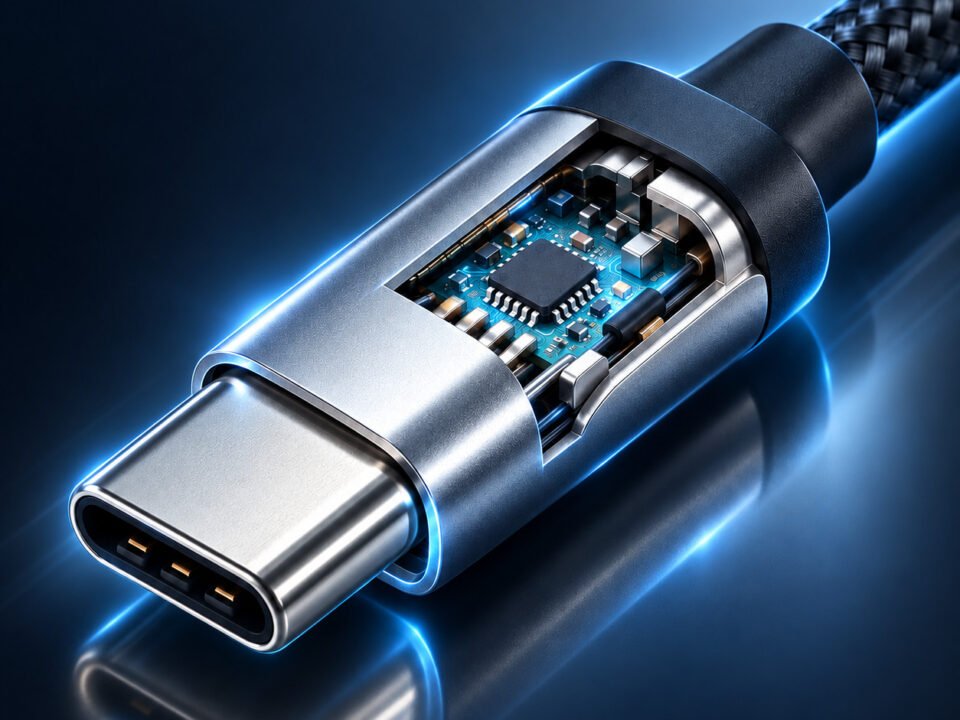
- 100W / 5A: High-power cable with 5A current support. It requires an E-Marker chip and 22AWG power conductors minimum. Suitable for ultrabooks up to 100W.
- 240W / 5A EPR: Extended Power Range cable with 5A current and 48V voltage capability. It requires EPR-specific E-Marker programming and 21AWG power conductors.
- EPR Ready / EPR Certified: Indicates the cable has been certified for Extended Power Range operation above 20V.
4.2 Speed and Protocol Markings: Understanding the Numbers
Data transfer speeds are printed using standardized notation. Therefore, understanding the following reference is essential:
| Printed Marking | Actual Speed | USB Specification | Internal Construction |
|---|---|---|---|
| USB 2.0 / 480Mbps | 480 Mbps | USB 2.0 | D+/D- wires only |
| USB 3.0 / 5Gbps | 5 Gbps | USB 3.2 Gen 1 | One SuperSpeed pair |
| USB 3.1 / 10Gbps | 10 Gbps | USB 3.2 Gen 2 | Two SuperSpeed pairs |
| USB 3.2 / 20Gbps | 20 Gbps | USB 3.2 Gen 2x2 | Two pairs dual-lane |
| USB4 20Gbps | 20 Gbps | USB4 Gen 2 | Two coaxial pairs |
| USB4 40Gbps | 40 Gbps | USB4 Gen 3 | Four coaxial pairs |
| Thunderbolt 3 / 40Gbps | 40 Gbps | Thunderbolt 3 | Four coaxial pairs |
| Thunderbolt 4 / 40Gbps | 40 Gbps | Thunderbolt 4 | Four coaxial pairs |
4.3 AWG Wire Gauge Markings: What the Numbers Reveal
American Wire Gauge (AWG) markings reveal the thickness of internal copper conductors. Lower AWG numbers indicate thicker wire and lower electrical resistance. For power delivery, understanding AWG is essential:
- 21 AWG (0.72mm): Required for 240W EPR cables. It provides minimal voltage drop at 5A current.
- 22 AWG (0.64mm): Standard for 100W cables. It offers adequate current handling for 5A with acceptable voltage drop.
- 24 AWG (0.51mm): Common in 60W cables. It is suitable for 3A current but marginal for 5A applications.
- 26-28 AWG (0.40-0.32mm): Found in budget cables. These are only suitable for charging at 15W-30W.
For more context on cable construction, see our USB Type-C cable advantages guide.
4.4 Environmental and Material Markings
Several markings indicate cable materials and environmental compliance:
- LSZH / LSOH: Low Smoke Zero Halogen. Required for marine, aircraft, and confined public spaces.
- PVC: Polyvinyl Chloride. Standard jacket material for consumer cables.
- TPE: Thermoplastic Elastomer. Offers better environmental profile with softer feel.
- RoHS: Restriction of Hazardous Substances. Mandatory for EU market access.
- REACH: Registration, Evaluation, Authorization of Chemicals. Required for EU market.
- VW-1: Vertical Wire flame test rating. Standard requirement for consumer electronics.
5. Safety and Environmental Certification Marks by Region
Safety certifications are mandatory for market access in most regions. Therefore, they should be present on compliant cable packaging or documentation.
| Marking | Region | Legal Requirement | Verification Method |
|---|---|---|---|
| CE | European Union + EEA | Mandatory for all electronic products | Declaration of Conformity |
| UKCA | United Kingdom | Mandatory post-Brexit | UK Declaration of Conformity |
| FCC | United States | Mandatory for EMC | FCC ID or Supplier's Declaration |
| PSE | Japan | Mandatory for electrical appliances | PSE mark with issuing body code |
| RCM | Australia/New Zealand | Mandatory for EMC and safety | National database registration |
| KC | South Korea | Mandatory for electronics | KC certification number |
| RoHS | EU + globally adopted | Mandatory for EU | Lab testing documentation |
| UL Listed | North America | Voluntary but recommended | UL file number verification |
For a detailed comparison of certification requirements, refer to our USB-IF vs MFi certification guide.
5.1 Understanding CE Marking Requirements for Cables
CE marking on USB cables indicates compliance with the EU's Electromagnetic Compatibility (EMC) Directive and RoHS compliance. The CE mark must be affixed by the manufacturer or importer who takes legal responsibility. Importers must maintain a Technical File including test reports and a Declaration of Conformity.
6. How to Verify Cable Authenticity Using Markings and Testing
USB cable markings explained must be combined with technical verification. While visual inspection provides initial screening, counterfeit markings are common. The following protocol combines visual checks with instrumental testing.
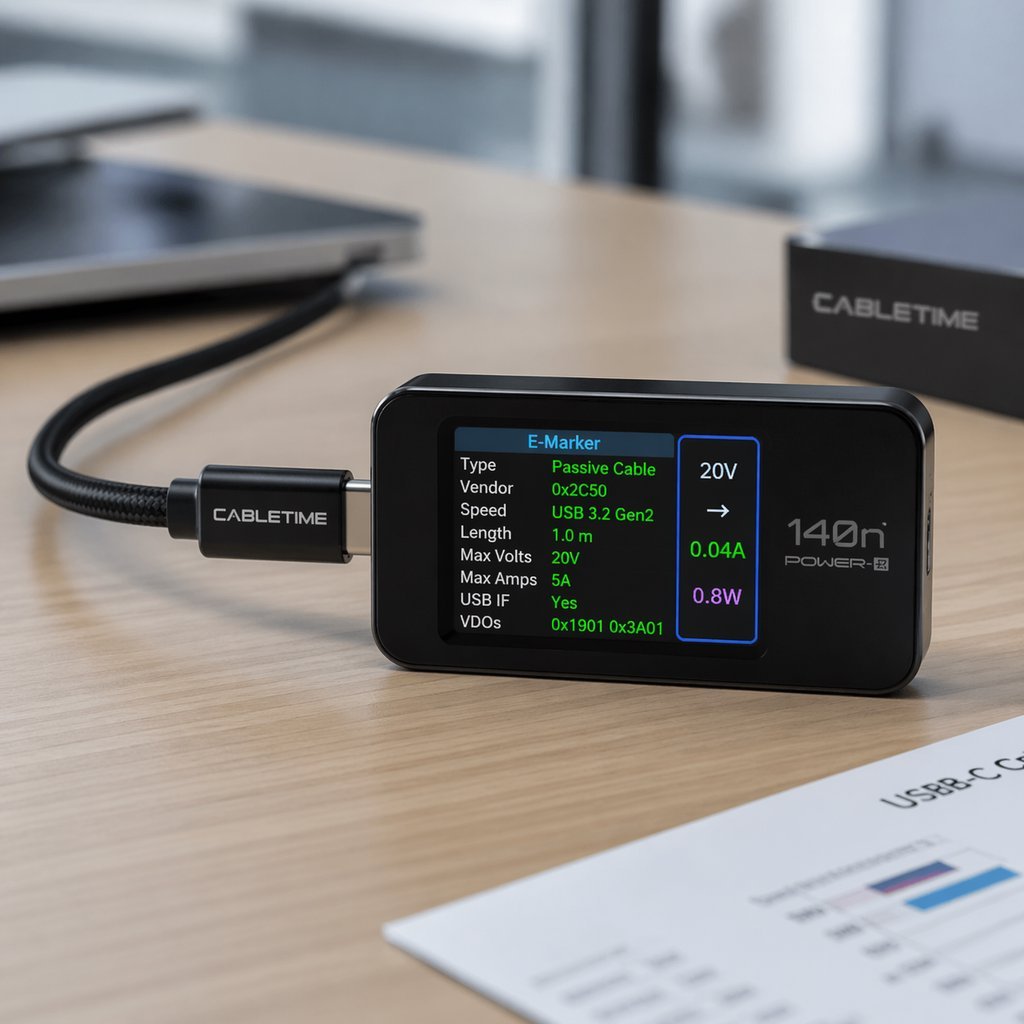
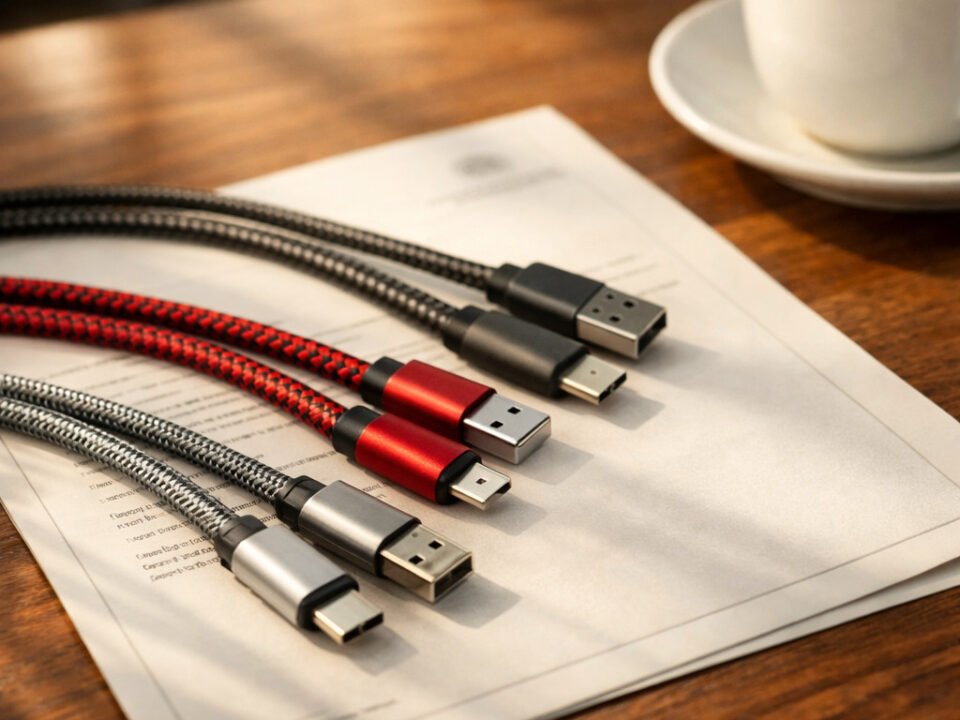
Using a USB-C power meter to verify E-Marker data provides definitive confirmation of cable capabilities.
6.1 Visual Inspection: What Genuine Markings Look Like
- USB-IF certification logo is crisp with clean edges—not blurry or pixelated
- Power and speed ratings are printed in clear, consistent font
- Black version of the USB-IF logo is used on the cable body
- AWG and power markings are printed along the cable jacket
- Safety certifications appear with correct formatting
- Batch codes or date codes enable traceability
6.2 Common Counterfeit Markings and Their Indicators
- Missing or blurry certification logos: Genuine logos are printed with precision.
- Inflated power ratings: "100W" marking on a cable with 28AWG conductors is impossible.
- USB 3.0 markings on USB 2.0 cables: When cut open, these lack SuperSpeed data pairs.
- 5A claim without E-Marker: A USB-C power meter reveals the absence of an E-Marker.
- Logo present but not in Integrators List: Search the public database to verify.
- CE mark with incorrect proportions: Genuine marks have specific dimensional ratios.
For a comparison of connector types, see our Lightning connector differences guide.
6.3 Technical Verification Protocol
Step 1: E-Marker Data Readout — Connect cable to USB-C power meter. Verify E-Marker presence, 5A flag status, and EPR support indication.
Step 2: Load Testing — Apply rated current for 30 minutes. Monitor voltage drop and connector temperature.
Step 3: Data Speed Verification — Test with external SSD. Speeds should achieve at least 80% of theoretical maximum.
Step 4: Video Output Testing — Verify stable 4K@60Hz or higher output without flickering.
7. Real-World Application: Markings by Device and Use Case
Different applications require different cable capabilities. Understanding which markings matter for each use case helps B2B buyers match inventory to customer needs.
Smartphone Daily Charging
Priority Markings: 60W/3A or higher, USB-IF 60W/100W logo, 24AWG or thicker.
Acceptable: USB 2.0 data speed for charging-only use.
Red Flags: No power rating marking, extremely thin cable.
B2B Inventory: High-volume, cost-sensitive SKU.
Laptop Power Delivery (65W-100W)
Priority Markings: 100W/5A, USB-IF 100W logo, 22AWG conductors, E-Marker required.
Acceptable: USB 2.0 data if exclusively for charging.
Red Flags: 60W-only cables will cause slow charging.
B2B Inventory: Mid-volume premium SKU.
Gaming Laptop (140W-240W)
Priority Markings: 240W/5A EPR, USB-IF 240W logo, 21AWG conductors, EPR E-Marker.
Acceptable: Must support full 48V EPR.
Red Flags: Standard 100W cables will limit charging.
B2B Inventory: Low-volume premium SKU.
External SSD / High-Speed Data
Priority Markings: 10Gbps, 20Gbps, or 40Gbps; coaxial construction.
Acceptable: 60W power delivery is usually sufficient.
Red Flags: USB 2.0 cables result in 30-40 MB/s transfers.
B2B Inventory: Clearly differentiate speed tiers.
4K/8K Monitor Connection
Priority Markings: DP Alt Mode support, 10Gbps+ speed rating, full-featured designation.
Acceptable: 40Gbps for dual 4K or 8K.
Red Flags: Charge-only cables will not transmit video.
B2B Inventory: Label "video-capable" clearly.
Multi-Port Docking Station
Priority Markings: 100W or 240W power, 40Gbps Thunderbolt 4 or USB4 speed.
Acceptable: Active cable for lengths >0.8m.
Red Flags: Passive cables >0.8m may fail at 40Gbps.
B2B Inventory: Bundle appropriate cable with dock.
8. Common Counterfeit Markings and How to Spot Them
When USB cable markings explained are counterfeited, B2B buyers must know how to spot fakes. The prevalence of fake certification logos has increased as USB-C adoption has grown. Understanding common patterns protects your supply chain.
8.1 The "100W" Marking on 60W Cables
One of the most common counterfeit practices is printing "100W" or "5A" on cables that lack the internal construction to safely deliver that power. These cables typically use 24-26 AWG conductors and may lack an E-Marker chip. Consequently, when subjected to 100W load, voltage drop exceeds 0.5V and connectors heat dangerously. B2B buyers can identify these by cutting open a sample and measuring conductor diameter.
8.2 Fake USB-IF Certification Logos
Counterfeit USB-IF logos appear on many non-certified cables. These logos may be blurry, incorrectly proportioned, or printed in color directly on the jacket. The definitive verification method is checking the USB-IF Integrators List. If the supplier cannot provide a TID number, the logo is counterfeit.
8.3 USB 2.0 Cables Marketed as SuperSpeed
Some manufacturers print "USB 3.0" on cables that contain only USB 2.0 wiring. When cut open, these lack the SuperSpeed pairs required for 5Gbps operation. B2B buyers can verify by testing data transfer speeds with an external SSD.
8.4 Mismatched AWG Claims
Some cables claim "22 AWG" but actually use thinner 26-28 AWG wire. B2B buyers can verify by stripping the jacket and measuring conductor diameter with calipers. 22 AWG measures approximately 0.64mm; 26 AWG measures only 0.40mm.
9. USB Cable Markings Explained: Complete B2B Inspection Checklist
Use this comprehensive checklist during incoming quality control to verify cable specifications against purchase orders.
9.1 Visual Inspection Checklist
- USB-IF certification logo present and clear — verify TID in Integrators List
- Power rating matches order specification — 60W, 100W, or 240W clearly printed
- AWG marking confirms conductor thickness — 22AWG minimum for 100W; 21AWG for 240W
- Speed rating matches order specification — verify against table in Section 4.2
- Safety certifications present — CE, FCC, RoHS with correct formatting
- Jacket material marking present — LSZH, PVC, or TPE as specified
- Batch code present — enables traceability for warranty investigations
- No contradictory markings — claims should be consistent throughout
9.2 Technical Verification Checklist
- Read E-Marker data from sample units — confirm 5A flag for 100W+ cables
- Verify USB-IF TID in Integrators List — if certification logo present
- Perform load testing at rated current — 30-minute test, monitor temperature
- Test data transfer speeds — verify at least 80% of rated maximum
- Test video output if claimed — verify stable 4K@60Hz or higher
- Cut open one sample per batch — inspect internal construction and AWG
9.3 Documentation Verification Checklist
- USB-IF certification documentation — TID number and test reports
- CE Declaration of Conformity — signed and dated for EU market
- RoHS and REACH test reports — lab documentation confirming compliance
- FCC Supplier's Declaration — required for US market
- Batch test reports — supplier's internal QC documentation
- Warranty and defect rate guarantee — written quality commitment
Recommended Sampling Plan: For orders under 5,000 units, test 5-10 samples including one destructive teardown. For orders 5,000-20,000 units, test 20-30 samples with 2-3 teardowns. For orders over 20,000 units, implement ANSI/ASQ Z1.4 with AQL 1.0 for critical defects.
10. Regional Certification Requirements for Global Export
B2B buyers exporting cables to multiple regions must understand varying certification requirements. Non-compliance can result in customs rejection or fines.
10.1 North America Requirements
- United States: FCC Part 15 mandatory. UL or ETL certification recommended. California Prop 65 warning if applicable.
- Canada: ISED compliance mandatory. CSA or UL certification recommended.
- Mexico: NOM certification required for electrical products.
10.2 European Union Requirements
- CE Marking: Mandatory. Requires EMC Directive and RoHS compliance.
- RoHS: Lab testing documentation required.
- REACH: SVHC compliance declaration required.
- WEEE: Registration required in each member state.
10.3 Asia-Pacific Requirements
- Japan: PSE certification mandatory. Circle PSE for most USB cables.
- South Korea: KC certification mandatory.
- Australia/New Zealand: RCM mark mandatory. National database registration required.
11. Future Marking Standards: What's Changing in 2026-2027
The USB-IF continues to evolve certification and labeling requirements. B2B buyers should be aware of upcoming changes.
11.1 Enhanced EPR Labeling Requirements
As 240W EPR adoption increases, USB-IF is implementing more stringent labeling requirements. New markings will include clearer voltage ratings (48V/5A) alongside wattage and mandatory EPR certification logos. These changes aim to reduce the "cable bottleneck" problem.
11.2 USB4 Version 2.0 (80Gbps) Markings
USB4 Version 2.0, supporting 80Gbps data transfer, will introduce new certification logos. These cables will be backward compatible but require new active cable designs. B2B buyers should prepare for new SKUs as this standard reaches market in 2026-2027.
11.3 EU Digital Product Passport Requirements
Beginning in 2027, the EU will require Digital Product Passports for electronics. This will introduce QR code or NFC-based digital markings linking to online compliance documentation. Physical markings will remain, but digital verification will become increasingly important.
12. Summary: USB Cable Markings for B2B Buyers
This USB cable markings explained guide has covered every aspect of jacket labeling—from USB-IF certification logos and AWG wire gauge numbers to regional safety certifications and future marking standards. The following summarizes key takeaways for procurement and quality control teams.
Key Certification Markings
- USB-IF unified logos: Combined power and speed labels (40Gbps/240W) are the most reliable quality indicators
- Thunderbolt logo: Guarantees 40Gbps and video output capability
- MFi badge: Required for full Apple device compatibility
- CE, FCC, RoHS: Mandatory safety and environmental certifications
Key Technical Markings
- Power ratings: 60W/3A, 100W/5A, or 240W/5A EPR—match to device requirements
- AWG wire gauge: 22AWG minimum for 100W; 21AWG required for 240W
- Speed ratings: 5Gbps to 40Gbps—verify with actual testing
- EPR marking: Required for >100W charging applications
Verification Essentials
By combining visual inspection of cable markings with technical verification using a USB-C power meter and load testing, B2B buyers can confidently verify that received inventory matches ordered specifications. In conclusion, this reduces specification mismatches, lowers return rates, and protects brand reputation. The cost of inadequate verification is substantial—a single batch of mislabeled cables can generate return rates exceeding 15%.
Need Certified USB Cables with Proper Markings and Documentation?
WJWSY provides OEM and wholesale manufacturing for USB-C cables with full USB-IF certification, clear jacket markings, and complete compliance documentation. Whether you need 240W EPR cables with 40Gbps speed ratings or cost-effective 60W charging cables, we ensure batch consistency and accurate specifications. Browse our bulk USB-C cable wholesale options or visit our USB-C data cable manufacturer page to learn more.
Explore Manufacturing Capabilities Request Samples and Specifications
For official USB-IF certification information, visit the USB-IF Integrators List. For technical specifications, refer to the USB Type-C specification.
For related technical guides, read our USB PD version differences guide or our quality assurance and certification page.