

Industrial USB Cable Solutions for Harsh Environments
Industrial USB Cable Solutions for Harsh Environments
Standard USB cables are designed for consumer and office environments where conditions are controlled and mechanical stress is minimal. In industrial settings, however, cables are routinely exposed to vibration, dust, moisture, continuous flexing and frequent connection cycles that exceed the mechanical limits of standard cables. Industrial USB cable solutions address these challenges through reinforced construction, sealed connectors, high-flex materials and locking mechanisms engineered for demanding operating conditions.
1. Industrial Environment Challenges
Industrial environments present a combination of mechanical, environmental and operational stress factors that directly affect cable performance and service life. Understanding these challenges is essential for selecting the appropriate industrial USB cable construction.

1.1 Continuous Movement
Many industrial applications involve moving equipment such as robotic arms, linear actuators and conveyor systems. USB cables installed on or near moving machinery are subjected to repeated bending, torsion and flexing cycles. Standard cables with rigid conductors and fixed-strain relief designs are prone to conductor fatigue, insulation cracking and intermittent signal failure when deployed in dynamic applications. High-flex cable constructions with enhanced conductor stranding and specialized jacket materials are designed to withstand these continuous mechanical cycles.
1.2 Vibration
Industrial machinery generates sustained mechanical vibration that transmits through equipment frames and mounting structures directly to cable connections. Over time, vibration can loosen connector contacts, accelerate contact wear and cause intermittent connectivity. Cables deployed near motors, pumps and heavy rotating equipment require reinforced connectors, vibration-resistant contact designs and strain relief structures that absorb mechanical energy rather than transmitting it to the connector interface.
1.3 Dust
Manufacturing facilities, mining operations and material handling environments generate airborne particulate contamination that can penetrate standard connector gaps and accumulate on contact surfaces. Dust accumulation on USB contacts can cause signal degradation, increased contact resistance and intermittent data errors. Sealed connectors with IP-rated gasket designs prevent particulate ingress, maintaining reliable signal transmission in dust-laden environments.
1.4 Moisture
Outdoor installations, washdown areas, food processing facilities and marine environments expose cables to water spray, high humidity and occasional liquid immersion. Moisture penetration into connector interfaces can cause short circuits, contact corrosion and galvanic degradation. Waterproof USB cable constructions feature IP-rated sealed connectors, overmolded cable-to-connector junctions and moisture-resistant jacket compounds designed for sustained wet-environment operation.
1.5 Frequent Connection
Industrial applications such as equipment diagnostics, portable data acquisition and field programming require repeated connect-disconnect cycles. Standard USB-A and USB-B connectors are typically rated for approximately 1,500 insertion cycles, while USB-C connectors are rated for up to 10,000 cycles per USB-IF specifications. For high-frequency industrial use, even these ratings may be insufficient without reinforced connector designs. Industrial-grade connectors with reinforced contact springs, thicker contact plating and robust mechanical housings extend the rated insertion cycle life, reducing connector wear and maintenance frequency in applications requiring frequent connection.
2. Industrial USB Cable Solutions
Industrial USB cable solutions are categorized by the specific environmental and mechanical challenges they address. The following four categories cover the primary industrial cable types, each engineered for a distinct set of operating conditions.
2.1 Rugged USB Cable
Rugged USB cables are designed for industrial environments requiring enhanced mechanical durability without the need for environmental sealing. These cables feature reinforced construction tailored to withstand physical stress, impact and handling in industrial settings.
Key Features:
- Durable Structure: Reinforced overmold strain reliefs, thicker jacket walls and impact-resistant connector housings for mechanical protection
- Conductor Reinforcement: Higher conductor strand count for improved flexural fatigue resistance compared to standard cables
- Shielding: Foil-plus-braid shielding configurations for electromagnetic interference (EMI) protection in proximity to motors, drives and power equipment
- Jacket Materials: PVC, polyurethane (PUR) and TPE compounds selected for abrasion resistance, tear strength and mechanical durability
Rugged USB cables are suitable for factory floor data transfer, equipment programming ports and industrial peripheral connections where mechanical stress is a primary concern and environmental sealing is not required.
2.2 Waterproof USB Cable
Waterproof USB cables are engineered for outdoor and harsh-environment applications where exposure to moisture, water spray or liquid immersion is a constant factor. These cables integrate sealed connector systems and moisture-resistant materials to maintain signal and power integrity in wet conditions.
Key Features:
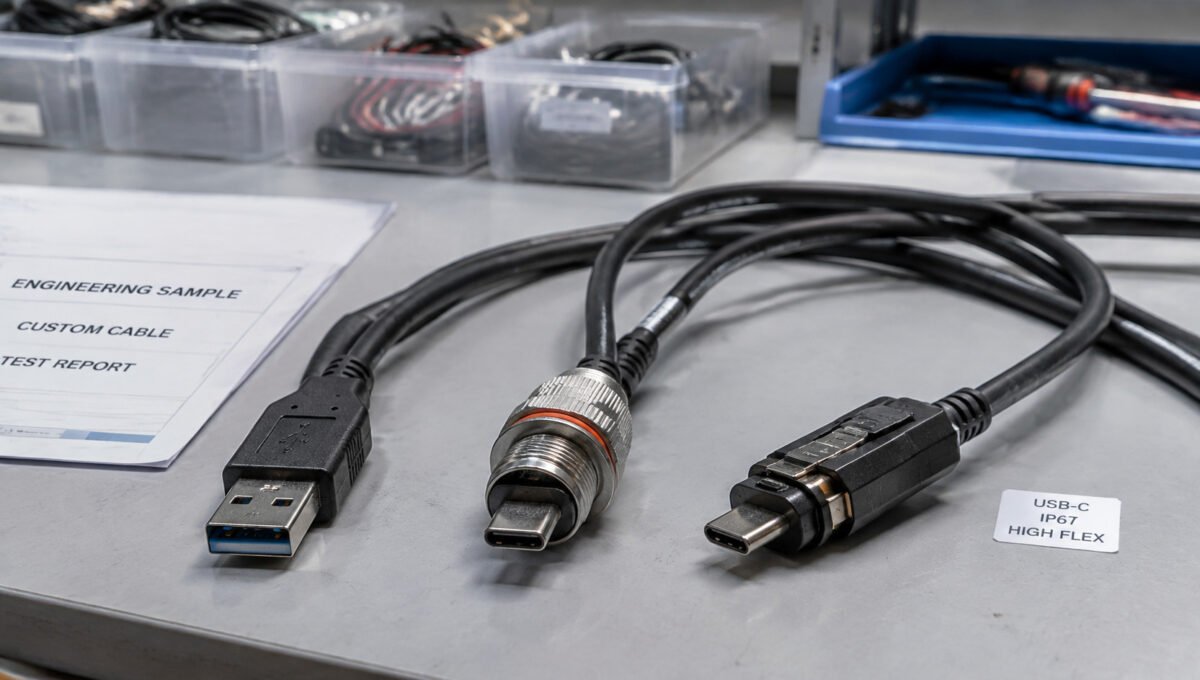
- Sealed Connectors: IP-rated connector systems with gasket seals and threaded or bayonet locking mechanisms preventing liquid and particulate ingress
- Overmolded Junctions: Cable-to-connector interfaces fully overmolded to eliminate moisture migration paths between cable jacket and connector body
- Jacket Compounds: PUR, TPE and specialized PVC formulations with low water absorption and hydrolysis resistance for sustained wet-environment service
- IP Rating Levels: Selected models available with IP67, IP68 and IP69K ratings depending on the specific environmental exposure level
Waterproof USB cables are suitable for outdoor equipment, washdown zones, food processing facilities, marine instrumentation and field-deployed data acquisition systems where liquid exposure is a regular operating condition.
2.3 High Flex USB Cable
High flex USB cables are designed for applications involving continuous or frequent cable movement, including bending, torsion and dynamic flexing cycles. These cables use specialized conductor and jacket constructions to withstand mechanical fatigue that would cause standard cables to fail prematurely.
Key Features:
- Fine-Strand Conductors: Higher conductor strand count per AWG size to distribute bending stress and reduce metal fatigue under repeated flexing
- Flexible Jacket Materials: PUR and TPE compounds engineered for high flexural endurance and low-temperature flexibility
- Foil-Slip Design: Aluminum foil shielding with a bonded slip layer that allows the shield to slide relative to the conductor bundle during flexing, preventing shield fatigue and maintaining EMI performance
- Optional Drain Wire: Tinned copper drain wire for consistent grounding continuity through flexing cycles
- Flex Life Rating: Selected models tested for dynamic flexing endurance per established cable flexing test standards
High flex USB cables are suitable for moving equipment applications including robotic arms, linear motion systems, gantry equipment, cable chain (drag chain) installations and portable device tethers where the cable undergoes continuous or frequent mechanical motion.
2.4 Locking USB Cable
Locking USB cables incorporate mechanical locking mechanisms that secure the connector to the device port, preventing accidental disconnection caused by vibration, cable pull or equipment movement. These cables are designed for industrial applications where connection integrity is critical and accidental disconnection could result in data loss, process interruption or safety hazards.
Key Features:
- Locking Mechanisms: Threaded, bayonet, push-pull and screw-lock designs that mechanically engage the connector to the receptacle, resisting vibration and accidental pull-out forces
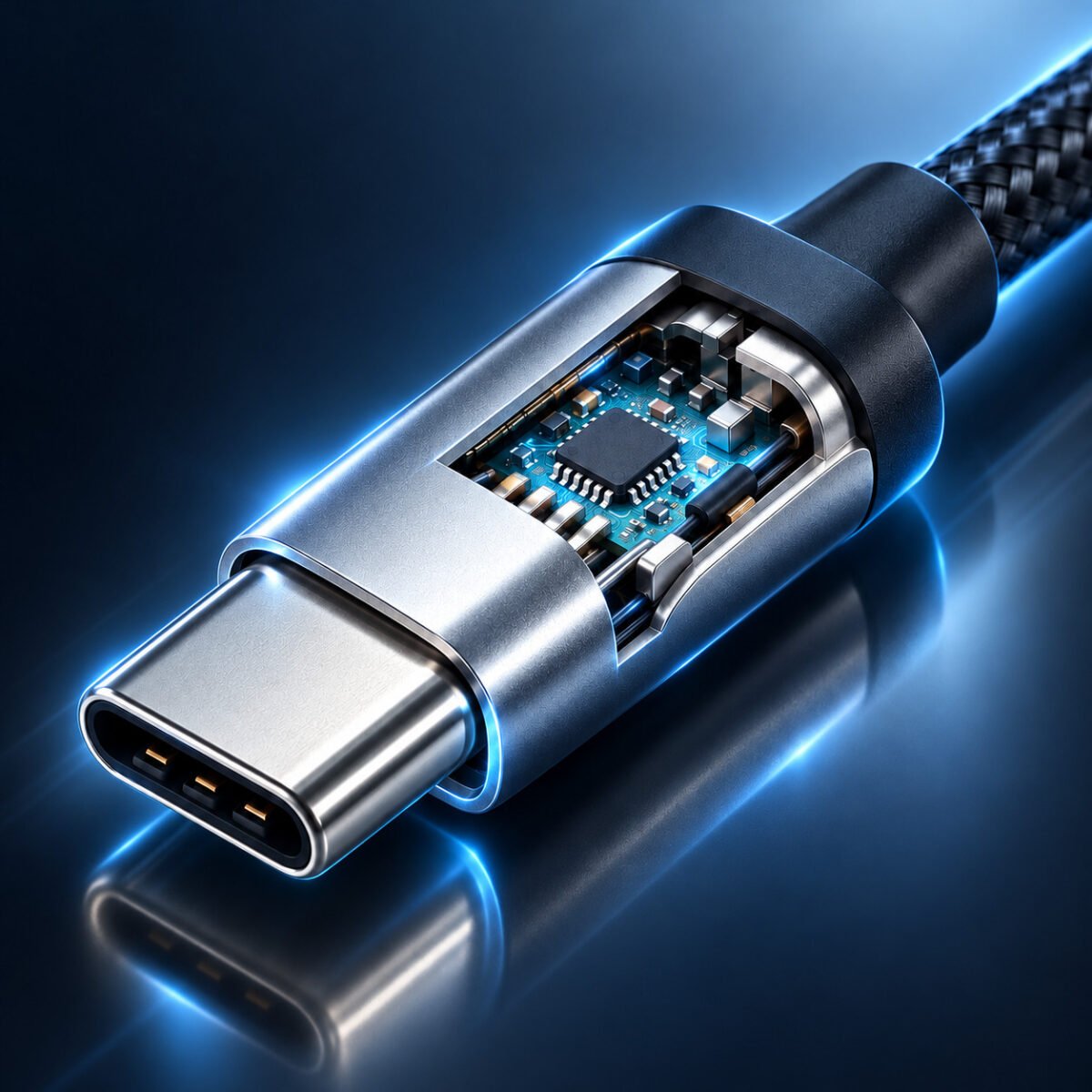
- Reinforced Contacts: Thicker contact plating and stronger contact springs to maintain stable signal contact under vibration and mechanical load
- Strain Relief: Overmolded or braided strain relief boots that absorb axial pull forces, redirecting mechanical load away from the connector contact interface
- Connector Compatibility: Selected models compatible with industrial USB receptacle standards, including locking USB-C and locking USB-B configurations
Locking USB cables are suitable for industrial control panels, machine-mounted equipment, robotic systems and field instrumentation where reliable connection retention under mechanical stress is a functional requirement.
3. Application Industries
Industrial USB cables serve a range of industries where reliable data connectivity under harsh conditions is a functional requirement. The following sectors represent the primary application areas for industrial-grade USB cable solutions.
3.1 Automation Equipment
Automated production lines, packaging machinery and material handling systems use USB connections for sensor data acquisition, controller programming and equipment communication. These environments combine vibration, dust and continuous equipment movement, requiring rugged cable constructions with reinforced connectors and abrasion-resistant jackets. High flex cables are deployed on moving axis systems and robotic handling equipment where cables undergo continuous bending cycles. Locking cables secure critical data connections on control panels where vibration and equipment motion could otherwise cause connector loosening.
3.2 Robotics
Robotic systems, including industrial robot arms, collaborative robots and automated guided vehicles (AGVs), require USB cables for end-effector communication, vision system data transfer and controller programming interfaces. Cables installed on robot arms are subjected to multi-axis bending, torsion and repetitive motion cycles. High flex USB cables with fine-strand conductors and flexible jacket materials are engineered for dynamic robotic applications. Locking connectors prevent cable disconnection during rapid arm movement and vibration. For robots operating in washdown or outdoor environments, waterproof constructions provide the necessary environmental protection.
3.3 Machine Vision
Machine vision systems in quality inspection, sorting and automated optical inspection (AOI) rely on high-speed USB connections for image data transfer from cameras to processing units. USB 3.x cables at 5Gbps to 10Gbps provide the bandwidth required for high-resolution image streaming. In industrial installations, these cables must maintain signal integrity under vibration and EMI from adjacent equipment. Shielded rugged USB cables protect high-speed image data from electromagnetic interference, while locking connectors ensure sustained camera-to-processor connection during continuous production operation. Selected waterproof constructions are deployed in food and pharmaceutical vision inspection where washdown procedures are standard.
3.4 Industrial Control
Industrial control systems, including programmable logic controllers (PLCs), human-machine interfaces (HMIs) and distributed control systems (DCS), use USB connections for programming, data logging and operator interface communication. Control panels and equipment cabinets house dense electronic environments where EMI, vibration and thermal cycling are present. Rugged USB cables with foil-plus-braid shielding protect control data from electromagnetic interference. Locking cables secure programming and diagnostic connections on equipment subject to vibration. For field-mounted control equipment, waterproof constructions provide protection against humidity, dust and occasional liquid exposure.
4. OEM Capabilities
Beyond standard industrial cable product lines, OEM/ODM custom manufacturing capabilities are available to match specific industrial application requirements. Flexible manufacturing supports custom orders for projects of varying production volumes, from prototype development through mass production supply.

4.1 Custom Cable Structure
Internal cable structure can be customized to meet specific electrical, mechanical and environmental performance requirements for industrial data transmission applications.
- Conductor Configuration: AWG gauge selection, strand count and conductor material specified to match the target current-carrying capacity, flex life and signal integrity requirements
- Shielding Design: Foil, braid or foil-plus-braid shielding configurations selected based on the EMI environment, with impedance-controlled pair geometry for USB 3.x and USB4 data rates where applicable
- Jacket Material Selection: PVC, PUR, TPE and specialized compounds selected for abrasion resistance, chemical resistance, flexural endurance, temperature range and UV resistance according to the operating environment
- Multi-Function Integration: Additional conductor pairs or shielded channels for power, control signals or sensor data alongside USB data lines, where applicable to the application
- Flex Life Engineering: Conductor stranding, foil-slip shielding and jacket formulation tailored to achieve target flexing cycle endurance for dynamic applications
4.2 Custom Connector
Connector configuration can be customized to meet specific device interface, environmental sealing and mechanical retention requirements.
- Connector Types: USB-A, USB-B, USB-C and industrial locking connector configurations, with hybrid combinations available for both connection endpoints
- Locking Mechanism Customization: Threaded, bayonet, push-pull and custom locking designs specified to match the target equipment receptacle and vibration resistance requirements
- IP Rating Configuration: Connector sealing level selected from IP65, IP67, IP68 and IP69K ratings based on the environmental exposure level of the application
- Contact Plating: Gold-flash, gold-plated and tin-plated contact options, with plating thickness specified for insertion cycle life and corrosion resistance in the operating environment
- Overmold Design: Custom overmold shapes, colors and surface textures specified to match branding, mechanical protection and equipment integration requirements
4.3 Mass Production
Production capacity is configured to support industrial cable supply requirements from initial project development through high-volume manufacturing.
- Prototype Development: Sample production for design validation, environmental testing and field trial before mass production commitment
- Pilot Production: Small-batch manufacturing for process validation, quality verification and customer approval prior to full-scale production
- Volume Scaling: Production capacity scalable to match project volume requirements, from moderate-quantity industrial projects to large-volume OEM supply agreements
- Quality Assurance: Continuity testing, signal integrity verification, insertion cycle testing and environmental performance validation conducted according to established quality standards
- Supply Chain Integration: Material sourcing, production scheduling and logistics coordination structured to support sustained supply agreements and project delivery timelines
For industrial USB cable inquiries — including environmental requirements, mechanical specifications, connector configuration and production volume targets — suitable cable constructions can be recommended, with samples and a competitive quotation provided based on project-specific requirements.
Need a Custom Industrial USB Cable Solution?
Whether you need rugged cables for factory floor data transfer, waterproof cables for outdoor equipment, high flex cables for robotic arms, locking cables for critical control connections, or fully customized OEM/ODM configurations, our team can help you specify the right solution for your harsh-environment application. From IP67 to IP69K, we support industrial cable projects with competitive pricing and flexible MOQ.