

5 types de chargeurs rapides : comparaison des puissances et des technologies
5 types de chargeurs rapides : comparaison des puissances et des technologies
Fast charging has become an important feature of modern electronic devices. As smartphones, tablets, laptops, and other portable electronics become more powerful, users increasingly expect charging solutions that deliver higher output power in less time.
The development of USB Power Delivery (USB PD), Qualcomm Quick Charge (QC), Programmable Power Supply (PPS), and Gallium Nitride (GaN) technology has expanded the capabilities of modern chargers. Today, charging products are available in different power ratings, from compact 30W adapters to high-power 140W and 240W charging solutions.
However, choosing the fastest charger is not simply about selecting the highest wattage. Device compatibility, charging protocols, cable specifications, thermal management, and power distribution all influence actual charging performance.
For brands, wholesalers, and product developers, understanding these differences is essential when selecting or developing fast charging products.
In this guide, we compare five fast charger power categories, explain their technical characteristics, and examine the factors that influence real-world charging performance.
- 1. Overview of Fast Charging Technology
- 2. Criteria for Evaluating Charger Speed
- 3. Top 5 Fast Charging Charger Categories
- 4. Detailed Features of Different Fast Chargers
- 5. Comparing Fast Charger Power Ratings
- 6. Factors That Affect Real-World Charging Performance
- 7. Future Trends in Fast Charging Solutions
- 8. TFT Display Integration in High-Power Chargers
- 9. Frequently Asked Questions
- 10. Conclusion

1. Overview of Fast Charging Technology
Fast charging technology enables compatible devices to receive electrical power at higher rates than conventional low-power charging solutions.
Traditional USB charging commonly uses a 5V output, while modern fast-charging technologies can negotiate higher voltage and current levels to deliver more power.
For example, a 20W charger may use a different voltage and current combination from a 65W or 100W charger. The charging protocol determines how the charger and connected device communicate and establish compatible power configurations.
Several technologies are widely used in modern fast chargers.
1.1 USB Power Delivery (USB PD)
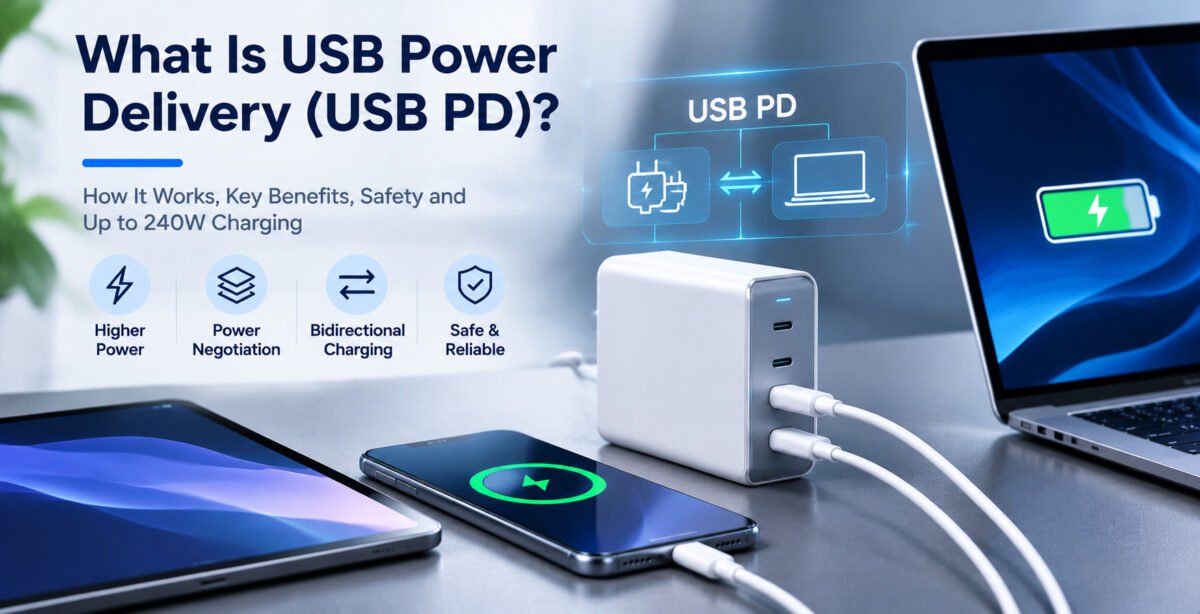
USB Power Delivery is one of the most widely adopted fast-charging standards for USB-C devices.
It allows compatible chargers and devices to negotiate voltage and current configurations according to their power requirements.
USB PD supports a broad range of applications, including:
- Smartphones and tablets.
- Ultrabooks and laptops.
- Portable monitors.
- Gaming devices.
- Other USB-C powered electronics.
USB PD 3.1 introduced Extended Power Range (EPR), extending maximum supported power from 100W to 240W.
The USB-IF has subsequently published USB Power Delivery Specification Revision 3.2, Version 1.2. The 240W maximum capability remains based on the EPR power range introduced with PD 3.1.
This makes USB PD particularly suitable for manufacturers developing chargers for multiple device categories.
1.2 Qualcomm Quick Charge (QC)
Qualcomm Quick Charge is another fast-charging technology used in compatible smartphones and charging products.
Different Quick Charge generations support different voltage and power capabilities.
Quick Charge 3.0 introduced more flexible voltage adjustment, while later generations expanded charging capabilities and interoperability with USB Power Delivery.
Actual charging performance depends on the Quick Charge version supported by both the charger and the connected device.
1.3 Programmable Power Supply (PPS)
PPS is an optional feature of USB Power Delivery that allows compatible chargers to adjust their output voltage dynamically.
Instead of relying only on fixed voltage levels, PPS provides more flexible power adjustment within supported operating ranges.
This technology is particularly relevant to certain Samsung Galaxy fast-charging applications.
Both the charger and connected device must support compatible PPS functionality to use it.
1.4 GaN Fast Charging Technology
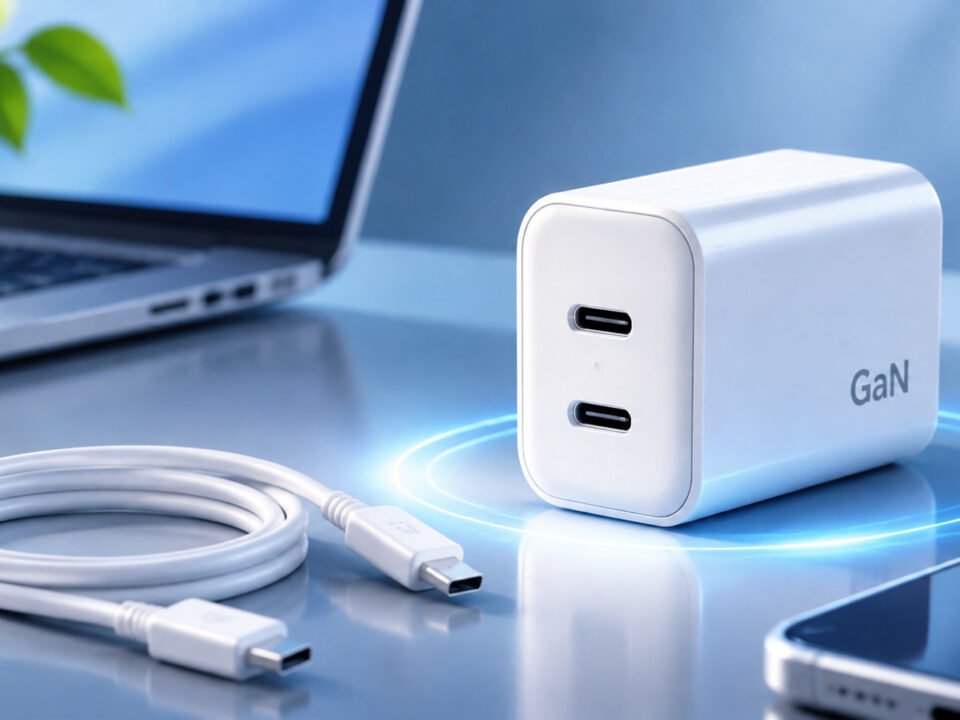
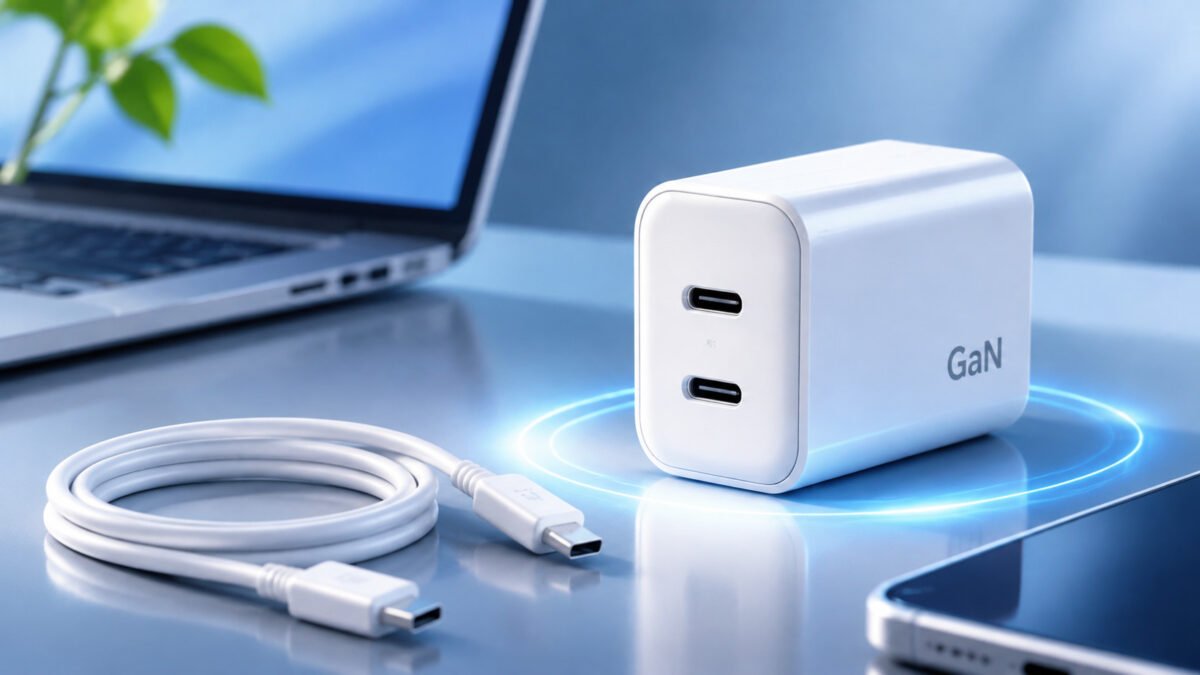
Gallium Nitride (GaN) is a semiconductor material increasingly used in modern charger designs.
GaN power components can support higher switching frequencies and help manufacturers develop compact chargers with higher power density.
This is especially useful for high-output adapters, multi-port chargers, and portable laptop chargers.
However, actual efficiency, temperature, and charging performance depend on the complete circuit design and thermal management system.
2. Criteria for Evaluating Charger Speed
When comparing the fastest chargers, maximum output wattage is only one of several important factors.
A charger with a higher rated output does not necessarily charge every device faster than a lower-powered alternative.
The following criteria provide a more practical way to evaluate charging performance.
2.1 Output Power (Wattage)
Wattage represents the amount of electrical power a charger can deliver.
It is calculated using voltage multiplied by current:
Power (W) = Voltage (V) × Current (A)
Par exemple:
- 5V × 3A = 15W.
- 9V × 3A = 27W.
- 20V × 3.25A = 65W.
- 20V × 5A = 100W.
Higher wattage allows compatible devices to receive more power, but the device must support the corresponding charging configuration.
2.2 Charging Protocol Compatibility
Charging protocols determine how a charger communicates with a connected device and establishes suitable power levels.
Common technologies include:
- USB Power Delivery.
- Qualcomm Quick Charge.
- Programmable Power Supply.
- Other manufacturer-specific fast-charging protocols.
A charger supporting multiple compatible protocols can serve a wider range of devices.
However, supporting several protocols does not guarantee maximum charging speed across every device.
2.3 Cable Quality and Power Rating
Charging cables are another important part of the charging system.
A cable must support the required current and power level to achieve the intended charging performance.
Standard 3A USB-C cables can support up to 60W at 20V.
For applications requiring more than 3A, a compatible 5A cable with an E-Marker chip is required.
For USB PD 3.1 EPR charging above 100W, an appropriately rated EPR cable is also necessary.
2.4 Thermal Management
Fast charging generates heat in both the charger and the connected device.
Excessive temperature can cause charging systems to reduce power output to protect components and batteries.
A well-designed fast charger therefore requires appropriate thermal management, component selection, and protection mechanisms.
2.5 Device Compatibility
The connected device ultimately determines how much power it can accept.
For example, connecting a smartphone designed for 25W charging to a 100W adapter does not automatically result in 100W charging.
The device, charger, and cable must all support compatible charging specifications.
3. Top 5 Fast Charging Charger Categories
Fast chargers are available in several power categories, each designed for different applications.
The following comparison focuses on five common high-performance charger categories rather than claiming a universal ranking of charging speeds.
| Catégorie de chargeurs | Rated Output Power | Applications typiques | Main Technology |
|---|---|---|---|
| 1. Ultra-High-Power Charger | Jusqu'à 240 W | Compatible high-performance laptops and equipment | USB PD 3.1 EPR |
| 2. High-Power Laptop Charger | 140 W | High-performance laptops and compatible devices | USB PD 3.1 EPR |
| 3. 100W Fast Charger | 100 W | Laptops, tablets and smartphones | USB PD SPR |
| 4. 65W GaN Charger | 65W | Laptops, smartphones and tablets | USB PD / GaN |
| 5. Compact Fast Charger | 30W | Smartphones, tablets and portable accessories | USB PD / PPS |
These figures represent charger output capabilities, not guaranteed charging speeds for every device.
3.1 1. Ultra-High-Power 240W Charger
A 240W USB-C charger represents the maximum power capability of USB Power Delivery EPR.
It is designed for compatible high-power applications that require more electrical power than conventional laptop chargers can provide.
Key characteristics include:
- USB PD EPR support.
- Maximum rated output of 240W.
- 48V/5A power configuration.
- Compatible 5A EPR charging cable.
- Advanced power management and protection.
A 240W charger is not necessary for most smartphones or standard tablets. Its main advantage is supporting compatible equipment with significantly higher power requirements.
3.2 2. 140W High-Power USB-C Charger
A 140W USB-C charger is another important category in high-performance charging.
It can support compatible laptops and other devices that require higher charging power.
USB PD 3.1 EPR supports a 28V power profile capable of delivering up to 140W at 5A.
Key characteristics include:
- Up to 140W output.
- USB PD 3.1 EPR compatibility.
- 28V/5A power configuration.
- Compatible 5A EPR cable requirements.
- Suitable for compatible high-performance laptops.
For manufacturers, 140W chargers provide an opportunity to develop premium charging products for professional users and laptop accessory markets.
3.3 3. 100W USB-C PD Charger
A 100W USB-C PD charger is a versatile option for many laptop and mobile-device charging applications.
It provides sufficient power for numerous USB-C laptops while also supporting compatible tablets and smartphones.
Key characteristics include:
- Up to 100W output.
- USB Power Delivery support.
- 20V/5A power configuration.
- Compatible 5A E-Marked USB-C cable.
- Available in single-port and multi-port designs.
For wholesalers and product brands, 100W chargers offer a practical balance between power capability and broad application compatibility.
3.4 4. 65W GaN Fast Charger
A 65W GaN charger is popular for its combination of power output and compact design.
GaN technology enables manufacturers to develop smaller charging adapters while supporting relatively high output power.
Key characteristics include:
- Up to 65W output.
- USB PD compatibility.
- Compact GaN-based circuit design.
- Suitable for many compatible laptops, tablets, and smartphones.
- Available in travel and multi-port configurations.
Because 65W exceeds the standard 60W capability of a 3A USB-C cable at 20V, the cable must support the charger's actual output configuration. A 5A E-Marked cable is required when the charging profile exceeds 3A.
A 65W charger is particularly suitable for users who need one portable adapter for several compatible devices.
3.5 5. 30W Compact Fast Charger
A 30W charger is designed primarily for smartphones, tablets, and other portable electronics.
Although its output is lower than that of laptop-oriented adapters, it can provide fast charging for many compatible mobile devices.
Key characteristics include:
- Up to 30W output.
- USB-C Power Delivery support.
- Compact and lightweight construction.
- Suitable for compatible smartphones and tablets.
- Convenient for everyday use and travel.
For product developers, 30W chargers provide opportunities to create compact charging products for mass-market applications.
4. Detailed Features of Different Fast Chargers
Different fast charger categories have different design requirements.
Understanding these differences helps manufacturers select suitable components, circuit architectures, and product configurations.
4.1 Power Conversion and Circuit Design
A fast charger uses power conversion circuitry to transform AC input into regulated DC output.
The circuit must maintain stable output voltage and current while responding to changing device power requirements.
Important design considerations include:
- Switching frequency.
- Power conversion efficiency.
- Transformer design.
- Component selection.
- Output regulation.
- Electrical isolation.
Higher-power chargers generally require more careful attention to component ratings and thermal performance.
4.2 GaN Components and Compact Design
GaN technology can help reduce the size of power conversion components and support higher power density.
This makes it particularly useful for compact 65W, 100W, and 140W charger designs.
However, a compact housing must still provide sufficient space for thermal management and electrical safety requirements.
4.3 Built-In Protection Features
Safety is essential when developing high-power charging products.
Common protection functions include:
- Overvoltage protection.
- Overcurrent protection.
- Short-circuit protection.
- Overtemperature protection.
- Overpower protection.
The specific protection design depends on the charger architecture and applicable safety requirements.
4.4 Port Configuration and Power Distribution
Fast chargers are available in different output configurations.
Common examples include:
- Single USB-C port chargers.
- Dual USB-C chargers.
- USB-C and USB-A combination chargers.
- Three-port desktop chargers.
- Multi-port GaN charging stations.
For multi-port products, total output power and individual port power allocation must be clearly defined.
When several devices are connected, available power may be redistributed between ports.
5. Comparing Fast Charger Power Ratings
Comparing charger wattage is useful, but it does not provide a complete picture of actual charging performance.
Two chargers with different power ratings may deliver similar results when connected to a device with a relatively low input-power limit.
For example, a smartphone supporting 25W charging may not benefit significantly from a 100W adapter compared with a compatible 30W adapter.
A laptop supporting 100W input, on the other hand, may benefit from a higher-power adapter when its battery and operating conditions allow it.
5.1 Charger Power and Cable Requirements
| Charger Power | Typical Charging Applications | Charging Standard | Cable Considerations |
|---|---|---|---|
| 30W | Smartphones and tablets | USB PD | Compatible USB-C cable |
| 65W | Smartphones, tablets and laptops | USB PD | Cable rated for the negotiated current; 5A E-Marked cable when exceeding 3A |
| 100 W | Laptops and mobile devices | USB PD SPR | 5A E-Marked USB-C cable |
| 140 W | Compatible high-performance laptops | USB PD 3.1 EPR | 5A EPR-rated cable |
| 240 W | Compatible high-power equipment | USB PD 3.1 EPR | 5A EPR-rated cable |
Why Higher Wattage Does Not Always Mean Faster Charging
Actual charging speed depends on several factors:
Device input limits: The device determines the maximum power it can accept.
Battery charging characteristics: Charging power often decreases as the battery approaches full capacity.
Temperature: High temperatures can cause the charging system to reduce power.
Cable specifications: A cable with insufficient current or power capability can limit charging performance.
Power allocation: Multi-port chargers may distribute available output between connected devices.
For these reasons, the best charger is not necessarily the one with the highest wattage. It is the one that matches the requirements of the intended device.
6. Factors That Affect Real-World Charging Performance
The actual performance of a fast charger can differ from its rated output.
A charger may support a maximum power of 100W, but the connected device may only draw that power during certain charging conditions.
6.1 Battery Capacity and Charging Level
Devices with larger batteries generally require more energy to reach full capacity.
However, battery capacity alone does not determine charging speed.
The charging system also controls how much power enters the battery at different stages.
Many devices use a charging curve that gradually reduces power as the battery approaches its upper charge limit.
6.2 Temperature and Environmental Conditions
Temperature has an important influence on charging performance.
If a device or charger becomes too hot, its power management system may reduce output to maintain safe operating conditions.
This is why charging performance can vary depending on ambient temperature, ventilation, and device usage.
6.3 Cable and Connection Quality
Poor-quality cables, damaged connectors, or unsuitable power ratings can affect charging performance.
For high-power applications, manufacturers should verify cable current ratings, connector quality, and E-Marker functionality where required.
6.4 Charger Design and Testing
Reliable charging performance requires more than achieving a rated wattage under ideal laboratory conditions.
Manufacturers should evaluate:
- Output voltage stability.
- Current regulation.
- Power conversion efficiency.
- Thermal performance.
- Protection functionality.
- Compatibility with supported devices.
- Performance under different load conditions.
These tests help ensure that charging products operate reliably under their intended conditions.
7. Future Trends in Fast Charging Solutions
Fast charging technology continues to develop as electronic devices require more power and consumers expect smaller, more versatile charging accessories.
Several trends are influencing the development of next-generation charging products.
7.1 Higher-Power USB-C Charging
USB PD 3.1 has extended USB-C charging to 240W.
The subsequent USB PD 3.2 specification continues the development of the power delivery standard while retaining the 240W EPR capability.
This provides manufacturers with additional flexibility when developing charging products for compatible high-performance laptops and other power-demanding equipment.
As more devices adopt higher-power charging capabilities, compatible EPR chargers and cables will remain important.
7.2 GaN Charger Development
GaN technology continues to influence the design of compact, high-output chargers.
By supporting higher power density, GaN components help manufacturers explore smaller housing designs and more versatile charging configurations.
Future product development will continue to focus on balancing output power, size, conversion efficiency, and thermal performance.
7.3 Multi-Port Charging Solutions
Consumers increasingly use several electronic devices throughout the day.
Multi-port chargers provide a practical way to supply power to smartphones, tablets, laptops, and accessories from one adapter.
Manufacturers are therefore developing products with different combinations of USB-C and USB-A ports, higher total power ratings, and more flexible power distribution.
7.4 Smart Charging and Digital Displays
Digital displays are another product-design direction in the fast-charging market.
Depending on the product design, a display can provide information such as:
- Output voltage.
- Output current.
- Charging power.
- Port operating status.
- Charging activity.
These features can improve product usability and help users understand how their devices are receiving power.
However, display functions should be considered alongside electrical safety, circuit design, and thermal requirements.
8. TFT Display Integration in High-Power Chargers
High-power chargers are no longer designed around output performance alone. Product appearance, user interaction, and additional functions are also becoming important considerations.
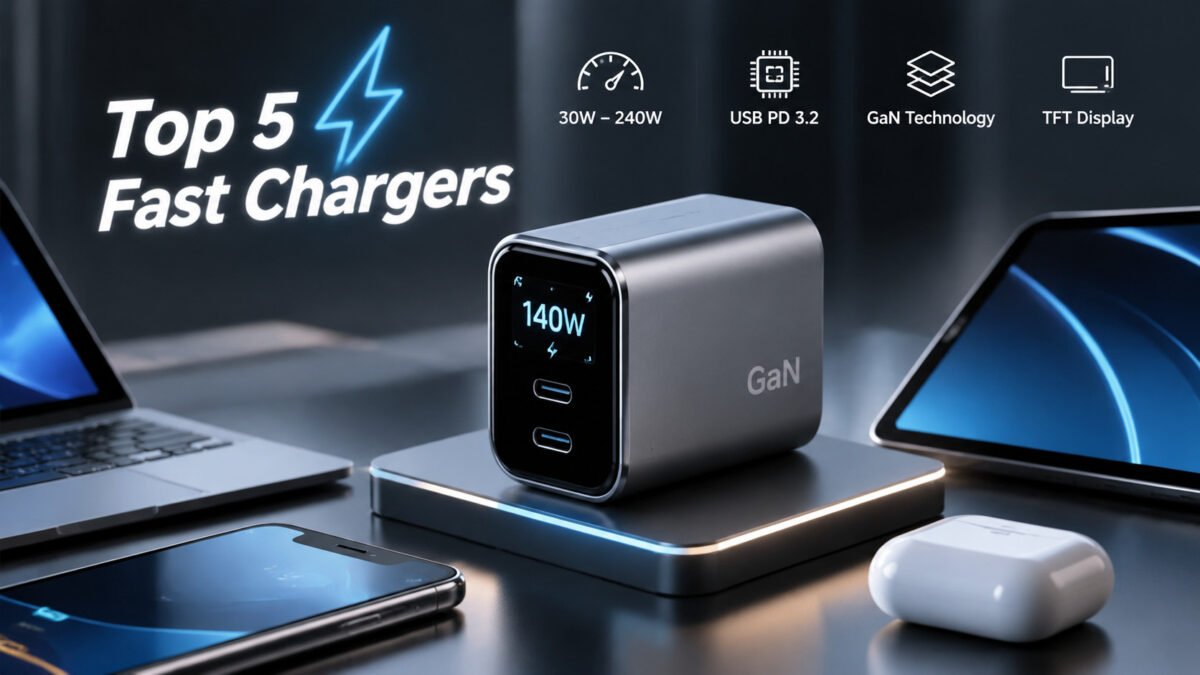
A charger incorporating a TFT display is one example of how manufacturers can combine high-power charging with digital information displays.
8.1 High-Power Charging Capability
A 140W USB-C charger can support compatible high-performance laptops and other devices that require substantial charging power.
With USB PD 3.1 EPR, the charger can provide a 28V output profile at up to 5A.
The connected device must support the corresponding power configuration, and an appropriate EPR cable is required.
8.2 TFT Display Functions
A TFT display can provide information about charging activity.
Depending on the product design, the display may show:
- Charging power.
- Output voltage.
- Output current.
- Port status.
- Device charging information.
This makes the charger more informative and creates additional opportunities for product differentiation.
8.3 Design and Engineering Considerations
Developing a charger with a built-in display requires attention to both electrical and mechanical design.
Important considerations include:
- Display integration and circuit layout.
- Power conversion efficiency.
- Thermal management.
- Housing dimensions.
- Electrical protection.
- Display readability and durability.
For OEM and ODM projects, these features can be considered during product development according to the target market and application requirements.
9. Frequently Asked Questions
What is the fastest charger available?
USB Power Delivery EPR supports up to 240W through compatible chargers, cables, and devices. However, the fastest practical charging solution depends on the power requirements and charging capabilities of the connected device.
Is a 140W charger faster than a 100W charger?
A 140W charger offers a higher maximum output than a 100W charger. However, it will only provide a charging-speed advantage when the connected device supports a compatible higher-power configuration.
Does a higher-wattage charger damage a smartphone?
A properly designed, standards-compliant charger does not automatically force its maximum rated power into a connected smartphone. The device regulates the power it accepts through a compatible charging arrangement.
What is the difference between USB PD and Quick Charge?
USB Power Delivery is a USB charging protocol widely used with USB-C devices. Qualcomm Quick Charge is another fast-charging technology used in compatible devices. Their supported power levels and compatibility depend on the specific versions implemented.
Are GaN chargers better than traditional chargers?
GaN chargers can offer higher power density and more compact designs. However, overall performance depends on the complete circuit design, components, thermal management, and safety engineering.
Can one fast charger charge multiple devices?
Yes. Multi-port chargers can supply power to several compatible devices simultaneously. However, the available output may be distributed between ports, depending on the charger's power allocation design.
Does the charging cable affect charging speed?
Yes. The cable must support the required current and power level. Higher-power USB-C charging may require a compatible 5A E-Marked cable or an EPR-rated cable.
What power rating should I choose for a fast charger?
The appropriate power rating depends on the intended devices. A 30W charger may be suitable for many smartphones and tablets, while 65W and 100W chargers are commonly used for compatible laptops. Higher-power applications may require 140W or 240W solutions.
What certifications should brands consider when sourcing fast chargers?
Certification and regulatory requirements depend on the destination market, product category, and charger design. Buyers should evaluate applicable electrical safety, electromagnetic compatibility, energy-efficiency, and market-specific requirements before selecting a supplier.
Can fast chargers be customized for OEM and ODM projects?
Yes. Depending on engineering requirements, OEM and ODM charger projects can involve customized output power, port configurations, housing designs, product appearance, labeling, and supported charging protocols.
10. Conclusion
Fast charging technology has developed significantly, providing users with more choices across different power ratings and device categories.
From compact 30W adapters to 65W GaN chargers, 100W laptop chargers, and high-power 140W and 240W USB-C solutions, modern chargers are designed to meet increasingly diverse charging requirements.
However, choosing the right fast charger requires more than comparing maximum wattage. Charging protocols, device compatibility, cable ratings, thermal management, and power distribution all influence actual performance.
For brands, wholesalers, and product developers, understanding these technical differences is essential when selecting products or planning new charging solutions.