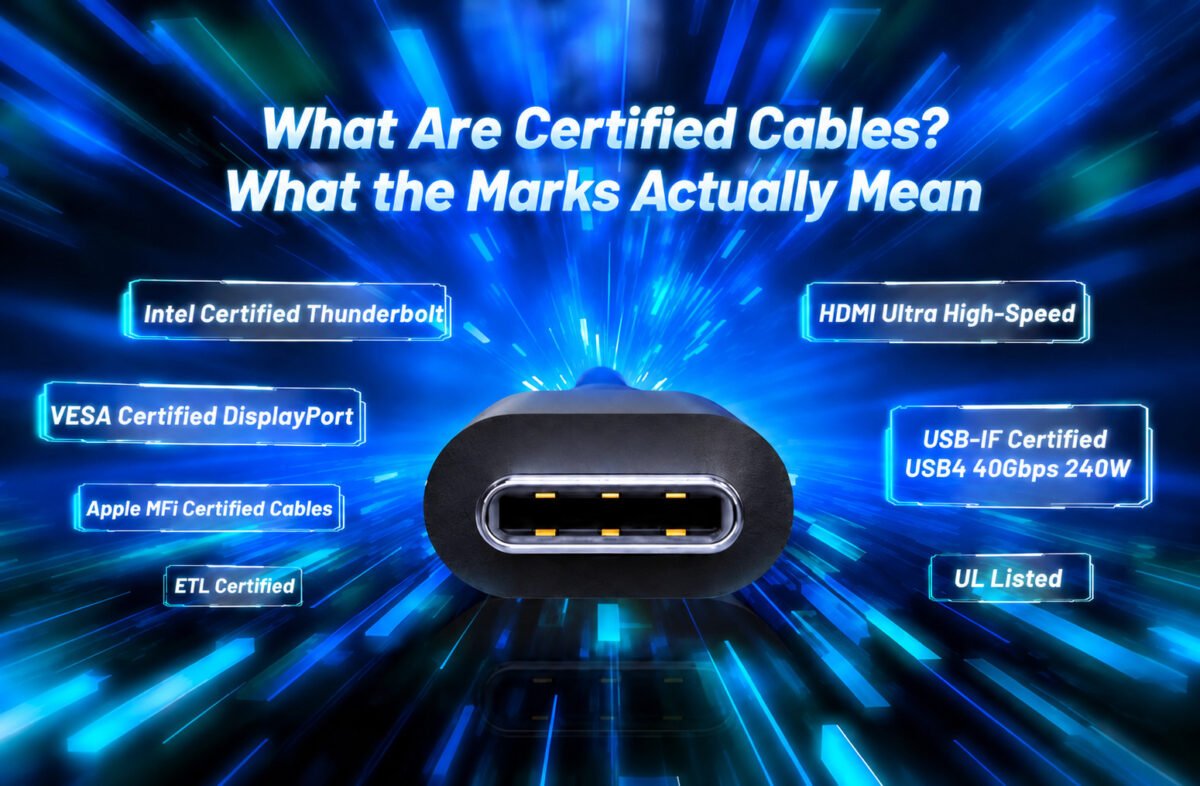
What Are Certified Cables? What the Marks Actually Mean
What Are Certified Cables? What the Marks Actually Mean
In electronics, the phrase "certified cable" points to a specific thing: a cable that has been tested by a recognized standards body and found to meet defined criteria for electrical safety, data transmission, and physical durability. The point of the mark is to tell a buyer that the product was measured, so that a device can be connected without a silent risk of damage or failure.
Certification is not always a necessity. What a cable has to do decides whether a mark matters. In healthcare, industrial control, or any installation where downtime is expensive, certified cable is usually non-negotiable. For everyday use, or where the requirement falls outside what the programs cover — unusual lengths, custom overmolds, a one-off assembly — the alternative is a supplier whose test records can be inspected, even if no official mark applies.
This article covers what cable certification is for, the main types of certified cable, and how to confirm that a cable claiming a mark actually holds it.
One clarification before the detail: certification and quality are related but not identical. A manufacturer with a documented test program can produce excellent cable that carries no mark, because no program exists for that configuration. What certification adds is third-party evidence, and evidence is worth paying for mainly when you cannot inspect the process yourself.
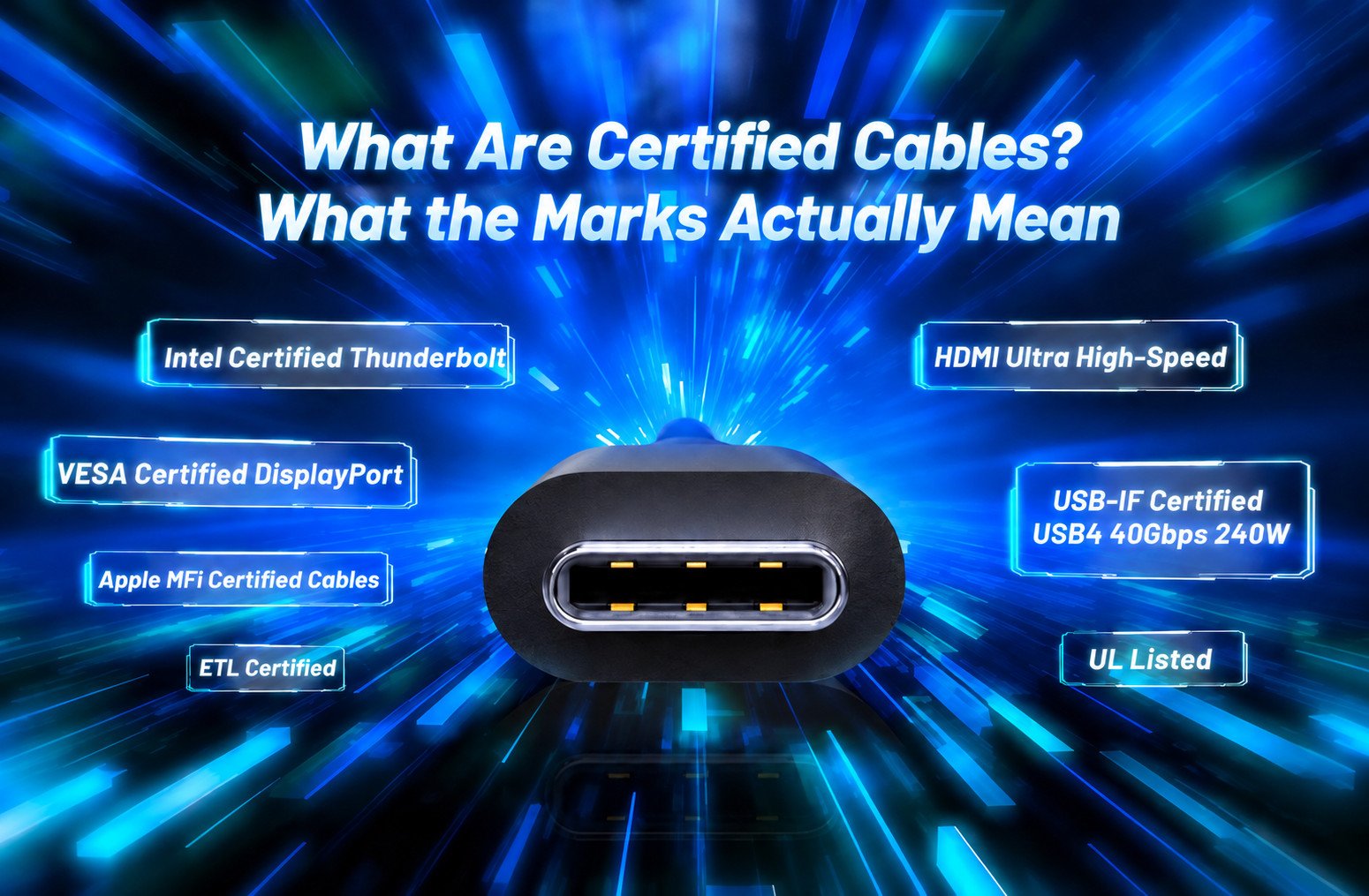
1. The Purpose of Cable Certification
Cable certification serves several purposes that matter to both manufacturers and users. It is not a regulatory hurdle so much as a reference point that makes products comparable.
The first purpose is conformance to industry standards. Those standards exist so that a cable can safely handle the electrical load and the data rate it claims. Certifying a cable is a statement that it was tested against benchmarks set by an industry body, which is what allows a buyer to compare one supplier's claim with another's.
Certification also functions as evidence of reliability. Certified cables are tested for durability, performance under stress, and resistance to heat and moisture. The testing is designed to catch product that passes a bench check and fails in service.
Compatibility is the third purpose, and the one users notice first. With the range of devices in use, a cable has to connect without data loss or signal interference, and certification tests for behavior across interfaces rather than against a single host.
Taken together, certification benefits everyone in the chain. It gives users a way to judge safety and performance before purchase, and it gives manufacturers a common document to build to.
2. Types of Certified Cables
Certification comes from different bodies depending on what the cable does, and the sections below follow that split. Some programs cover video and audio bandwidth, some cover data and power delivery, and some cover electrical safety.
2.1 HDMI Certified Cables
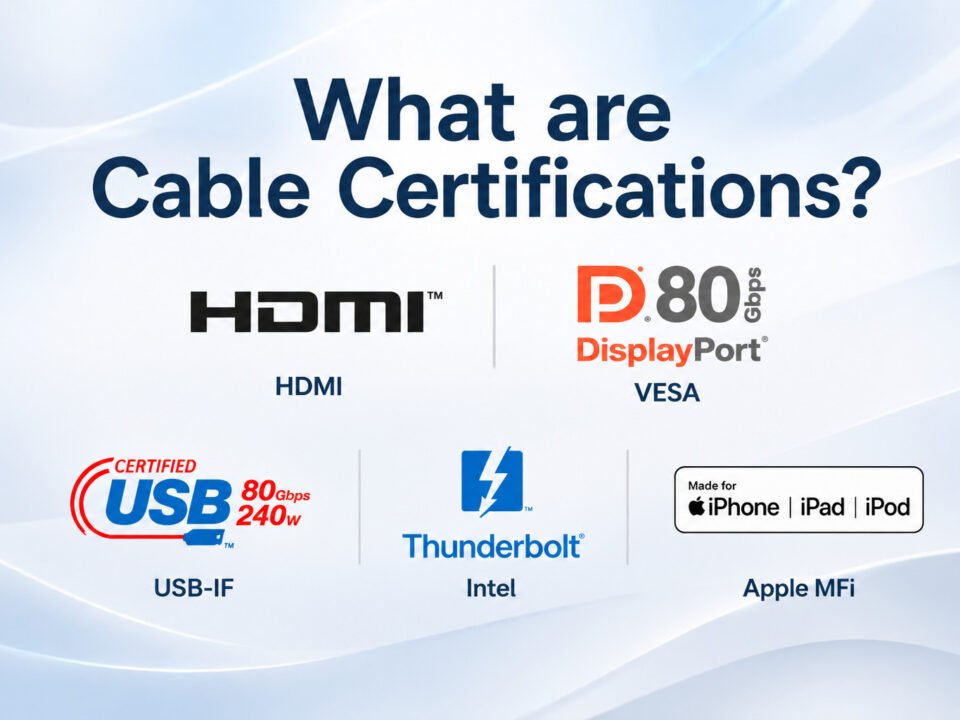
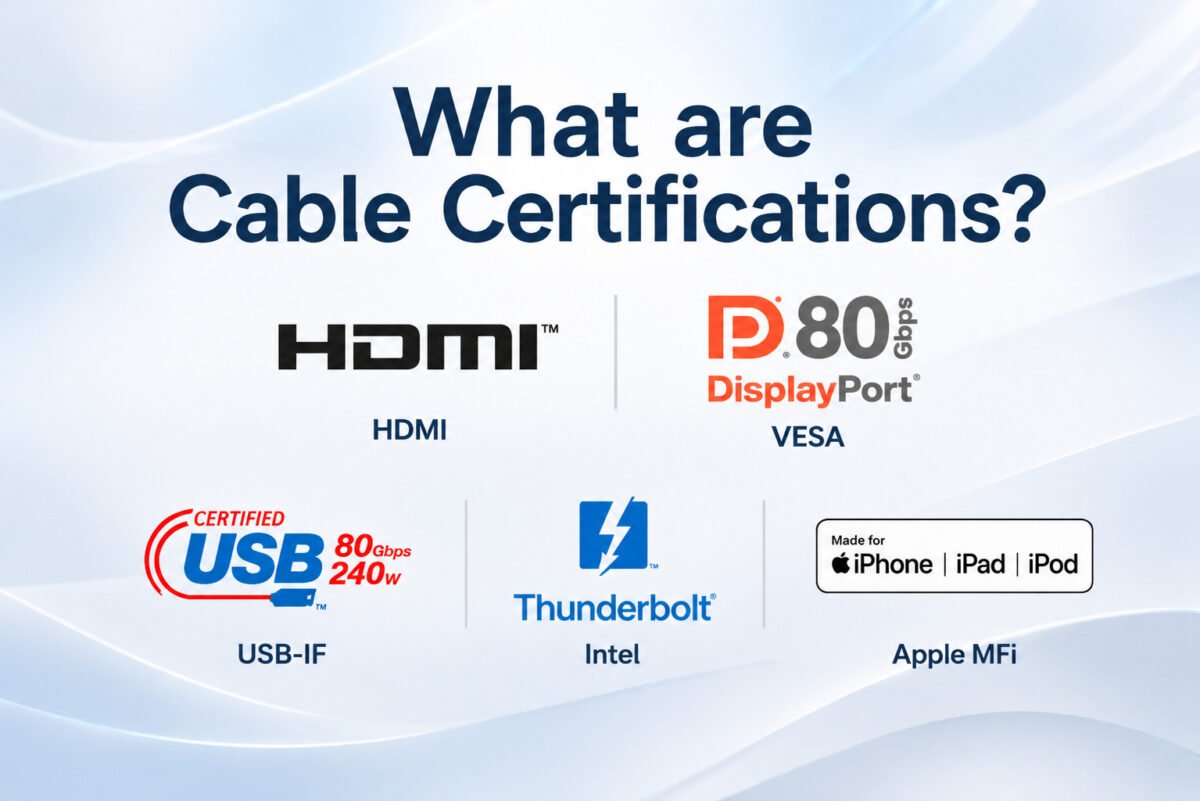
HDMI cables certified under the HDMI program are compliance-tested against the data rates the specification defines, which is what allows them to carry 4K resolution, HDR, 3D video, the Ethernet channel, and the Audio Return Channel. Certified HDMI cables normally ship with an anti-counterfeit label, and the category printed on the jacket tells you which bandwidth tier the cable was tested to.
2.2 Ethernet Certified Cables
Ethernet cable certification separates into two questions that are often confused. A UL listing addresses safety: flame resistance, material quality, and construction. Performance against TIA/EIA categories, including near-end crosstalk and insertion loss, is measured separately by a test lab. A Cat6A cable needs both, and a listing alone does not establish that the cable meets the category it is sold as.
2.3 USB Certified Cables
The USB Implementers Forum administers USB cable certification, testing against the specification for power delivery, data rate, and mechanical durability. Certified cables support the generations and features they are rated for, including USB Power Delivery for charging and SuperSpeed lanes for data. The listing is what makes an advertised 40 Gbps or 240W figure checkable rather than a claim.
2.4 Certified Thunderbolt Cables
Thunderbolt certification is administered by Intel, which developed the interface. The program verifies that a cable can carry the bandwidth the generation requires: 40 Gbps for Thunderbolt 3 and 4, 80 Gbps for Thunderbolt 5, with a 120 Gbps boost mode in one direction on the newest generation. Certified cables are also tested for signal integrity with displays and high-speed storage, which is where an out-of-spec cable usually fails first.
2.5 Certified DisplayPort Cables
VESA certifies DisplayPort cables against the bandwidth tiers of the standard, which is what allows certified cable to carry 8K resolution, HDR, and multi-channel audio at the rates the tier promises. VESA's program issues marks such as DP8K, DP40, and DP80, and certification also covers interoperability with the range of DisplayPort devices a cable will meet.
2.6 MFi-Certified Cables
Apple's MFi program certifies accessories built around Apple's own connector system. MFi cables are tested for electrical and mechanical compliance with Apple's requirements, and the program exists mainly to keep accessories from damaging the device or failing after a software update. A plain USB-C to USB-C cable has no MFi version, because both ends use an open standard.
2.7 Certified Power Cables
Power cables certified by UL or ETL meet published safety standards covering voltage capacity, conductivity, resistance to temperature extremes, and mechanical durability. The testing is aimed at the failure modes that matter in mains wiring: short circuits, overheating, and fire risk under normal operating conditions.
Each certification type covers a different question about the same product. A cable can hold several marks at once, and reading them separately is more useful than treating any single logo as a general endorsement.
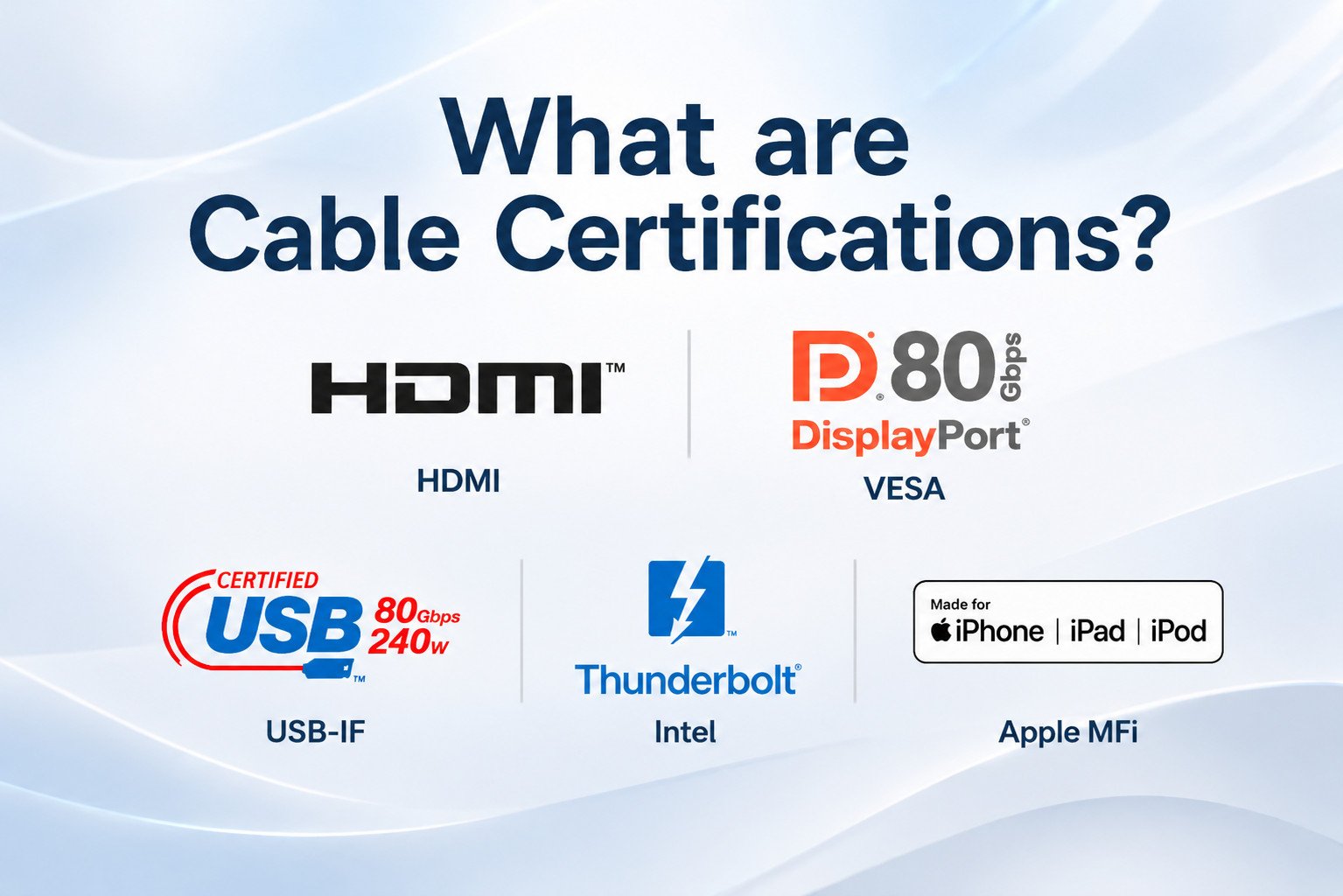
3. Benefits of Using Certified Cables
Certified cables are built to meet the standards their certifying bodies publish, which shows up as predictable performance rather than exceptional performance. For gaming, data transfer, or a home theater, the benefit is signal integrity and bandwidth that hold at the rated value instead of degrading under load. A certified HDMI cable carries the video and audio it was tested for, and a certified USB cable holds its data rate and charging behavior.
Safety is the second benefit, and for power cable it is the main one. Certified power cable and surge protection are assessed for fire resistance, electrical stability, and build quality, which is what separates a product designed to fail safely from one that was never assessed.
Authenticity is the third. Counterfeit and low-quality cable is a real category in this market, and a certification mark with a checkable listing is the simplest defense. Holographic labels and serial numbers help, but a database entry is the part that is hard to fake.
Warranty compliance is the fourth, and the one most often overlooked. Some device makers require certified cable as a condition of warranty coverage, and a non-certified cable in the chain can complicate a claim. For expensive equipment or a professional installation, that condition is worth checking before the cable is specified.
The benefits add up to more than connectivity. Certified cable buys evidence: of performance, of safety, of authenticity, and of compliance with the terms attached to the hardware it connects.
4. How to Identify Certified Cables
Some cable is advertised as certified without being certified. The checks below are the ones that settle the question.
Most certified cable carries a logo on the connector housing, and often specific wording on the jacket, as the certifying organization requires. The logo and the wording are not decoration; they are the claim, and each one can be traced to a listing.
The wording matters most for HDMI, where it encodes the bandwidth tier. Cable sold as Ultra High Speed HDMI is the 48 Gbps tier used for 8K, Premium High Speed HDMI is the 18 Gbps tier used for 4K at 60Hz with HDR, and High Speed HDMI is the older tier, covering 1080p and the lower-bandwidth 4K modes that predate HDR.
USB-IF certified cable carries a logo on each connector that indicates the cable's capabilities, and the logo set is published by USB-IF rather than chosen by the seller. A logo that does not match the published set is the first thing to question.
Thunderbolt cable carries the Thunderbolt mark plus a digit for the generation. The digit is the useful part: a cable rated for one generation is not automatically rated for the next, and the mark states which one applies.
Safety marks answer a different question from performance marks, and they are worth recognizing:
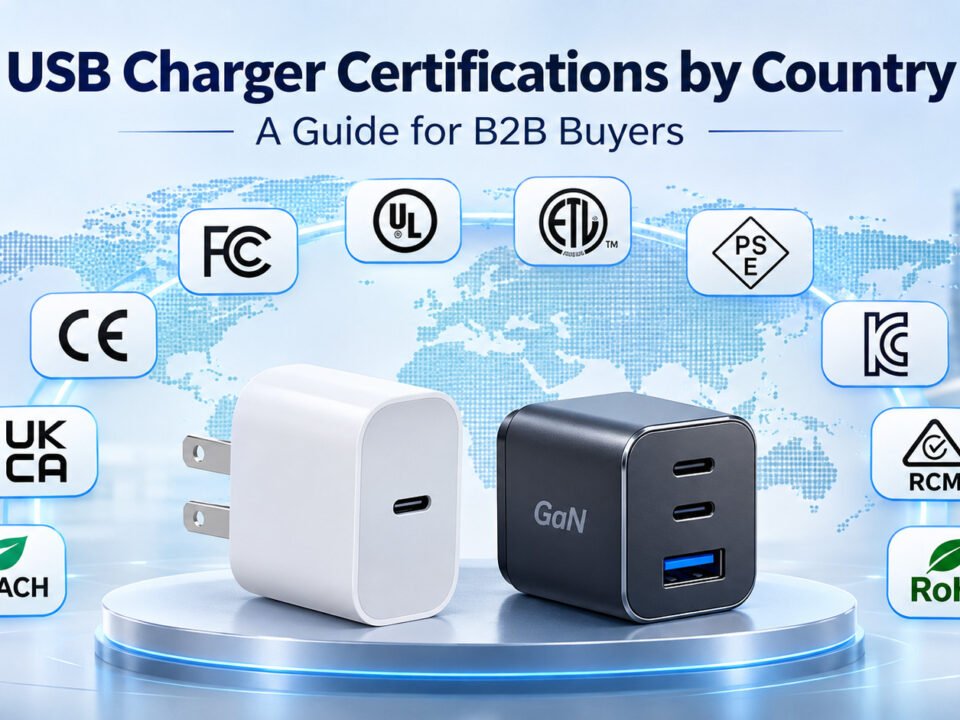
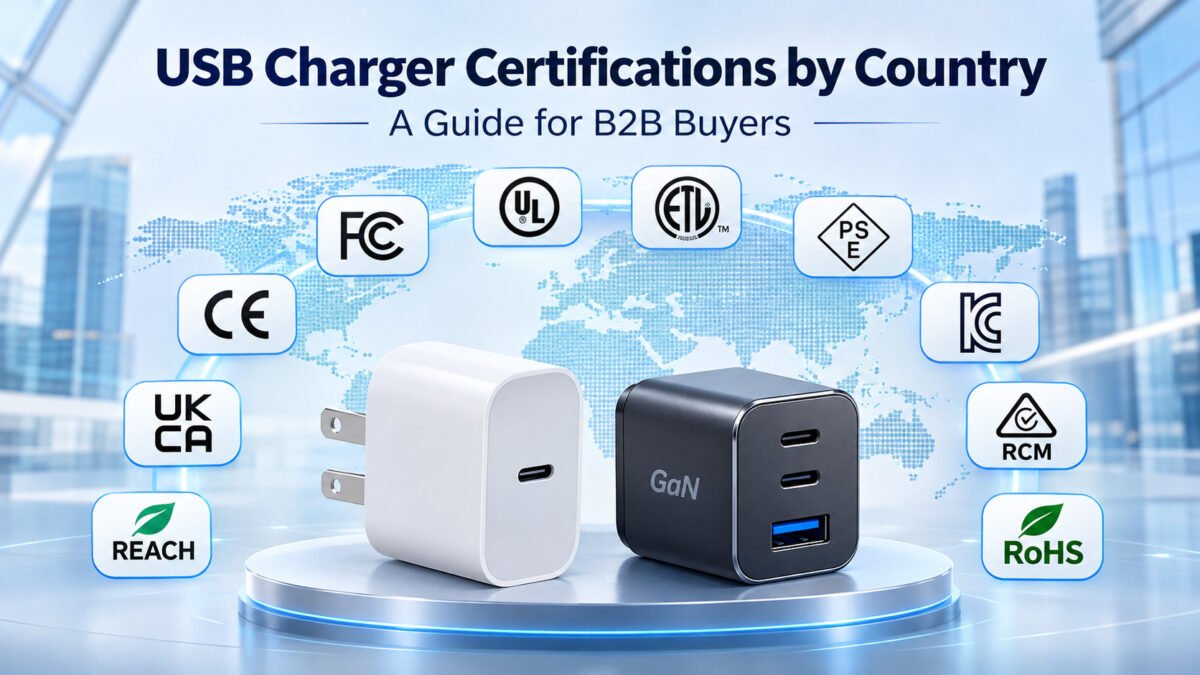
- CE marking — required for products sold in the EU, covering health, safety, and environmental requirements
- FCC declaration — required in the US, covering electromagnetic interference limits
- UL or ETL marks — third-party safety testing, most often seen on power cable, outlets, and surge protection
These marks are stamped or printed on the cable, the device, or the packaging, and each can be cross-referenced against the certifying body's records.
Beyond the logo, the reliable check is the database. Thunderbolt, DisplayPort, USB, UL, and Apple's MFi program each publish a searchable list of certified products. Searching the manufacturer's name returns the products it has registered, which is a faster confirmation than reading a package.
HDMI works slightly differently: certified product usually carries a QR code that an app can scan to confirm the certificate, which closes the gap between a printed label and a real listing.
Used together, the logo, the wording, and the listing answer the question a buyer actually has: not whether the package looks official, but whether the product in it was tested.

5. FAQ
What does "certified cable" mean?
A certified cable has been tested against the standards of a specific industry body and found to meet them, which gives the buyer evidence of quality, safety, and compatibility rather than the seller's assurance.
Are certified cables more expensive?
Yes, because testing, licensing, and quality control all cost money. The premium is usually justified where the cable has to hold a rated bandwidth or carry mains power, and it matters less for a short cable in a low-demand role.
Should you buy a certified cable every time?
Not necessarily. Where a requirement falls outside what the programs cover — unusual length, a custom assembly, a device with proprietary signaling — no certification may exist, and a supplier with documented testing is the practical alternative. For Lightning charging, an MFi cable is worth specifying regardless.
Are certified cables better?
Certified cable is better in the sense that its performance has been verified rather than asserted. Whether it is the better purchase depends on the requirement: most programs certify only certain lengths and configurations, and a well-made uncertified cable can be equally dependable where no program applies.
Certification is evidence, and evidence is only worth the price when the requirement is real. A 0.5m cable inside a desktop enclosure rarely needs a mark; a 3m cable carrying 240W to a laptop, or a run of assemblies going into a fleet of docks, usually does.
That is also why the certificate and the specification are best read together. A test report tells you what a cable passed; the drawing tells you what it is made of, and the second document is what makes the first reproducible on the next order.