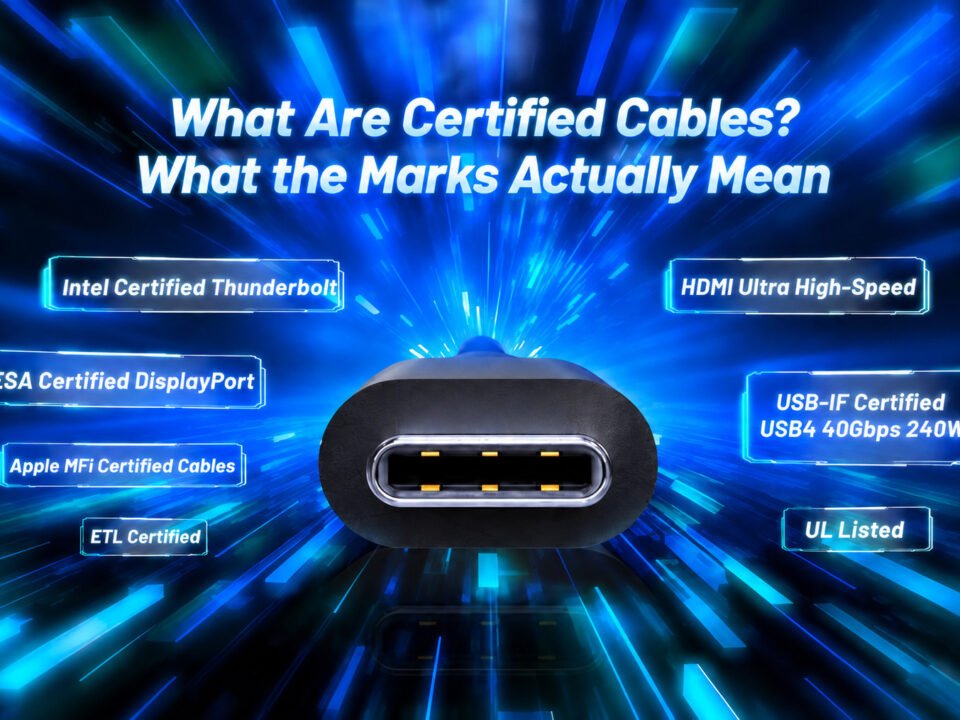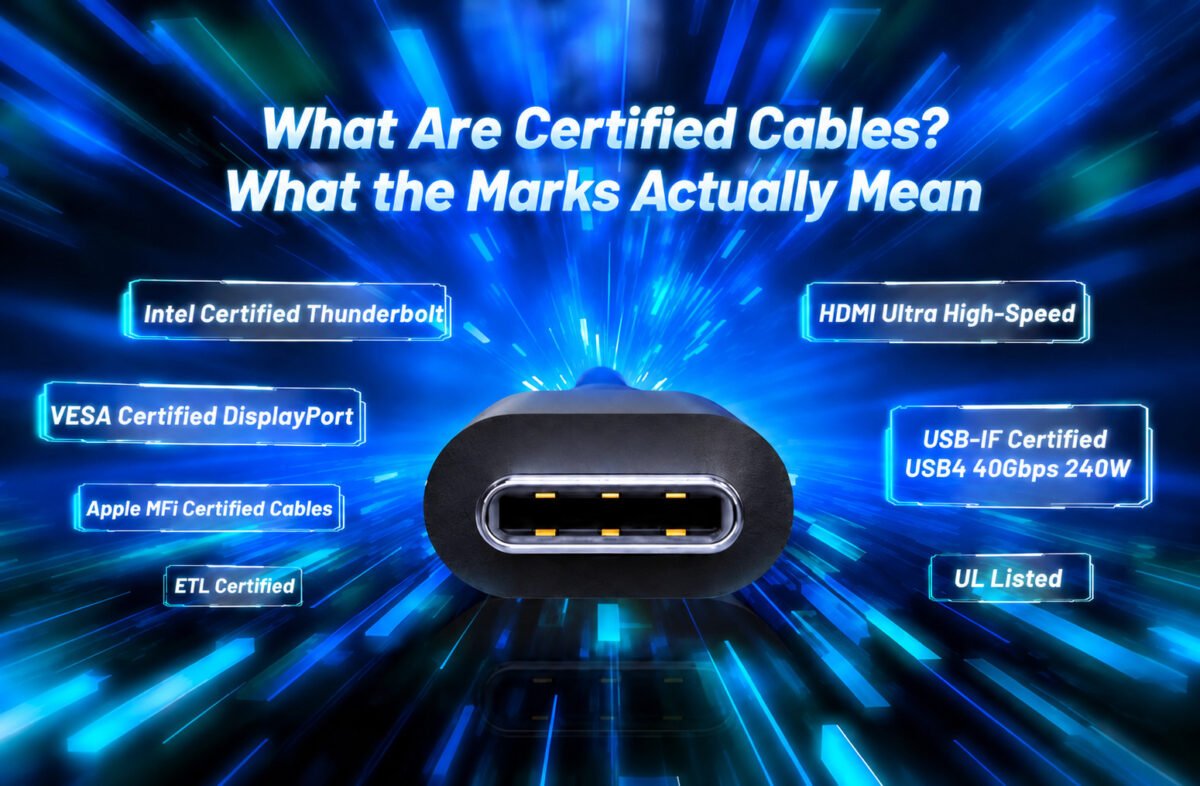
Cable Certifications Guide: HDMI, VESA, USB-IF and MFi
Cable Certifications: HDMI, VESA, USB-IF, Thunderbolt and MFi
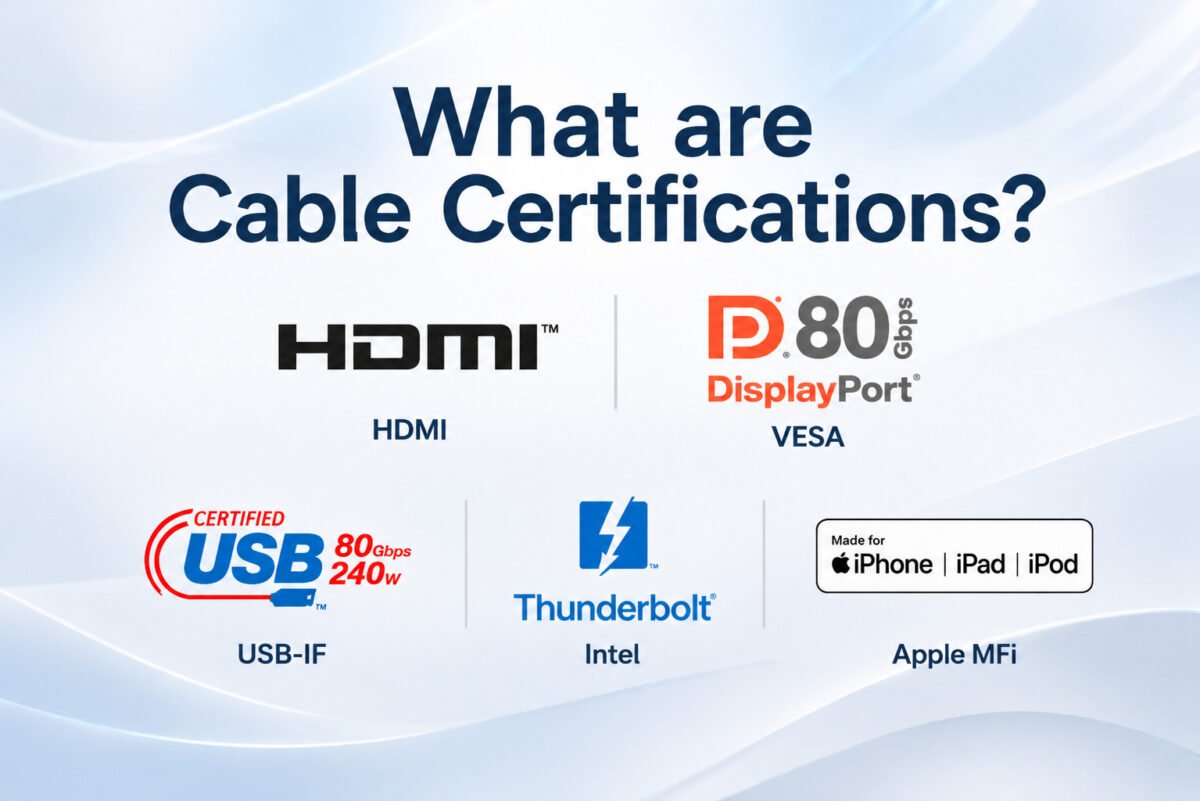
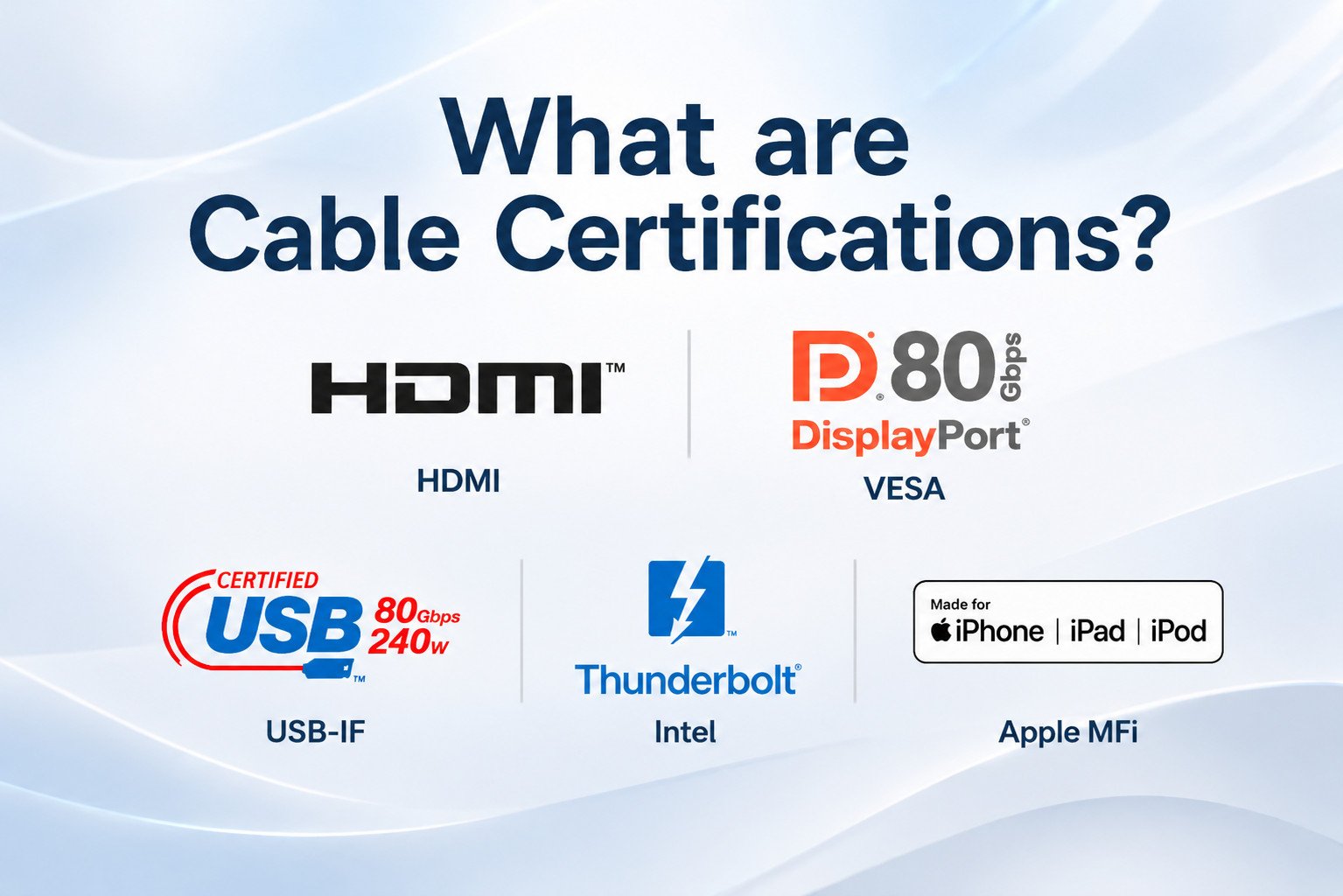
Cable certifications verify that a cable meets a defined set of performance, quality, and safety standards. The marks you see on packaging come from separate programs covering HDMI, DisplayPort, USB, Thunderbolt, and Apple accessories, and each one answers a different question. Knowing what a mark actually verifies is the difference between paying for a guarantee and paying for a logo.
- 1. Understanding Cable Certifications
- 2. What is HDMI Cable Certification?
- 3. What is VESA Cable Certification?
- 4. What is USB-IF Certification?
- 5. What is Intel (Thunderbolt) Certification?
- 6. What is Apple MFi Certification?
- 7. Comparing Cable Certifications
- 8. The Importance and Benefits of Cable Certifications
- 9. Summary
- 10. FAQ
1. Understanding Cable Certifications
A certification is a claim backed by testing. The cable is submitted to the organization that owns the specification, measured against that specification, and listed if it passes. The mark on the package is the manufacturer's proof that the measurement happened, and that the product belongs to a program rather than to a marketing department.
Standards only work when everyone builds to the same document. A certified cable is one that a monitor, a dock, or a phone can rely on without knowing who made it, which is why interoperability holds up across brands that never coordinate with each other. Where a specification leaves room for interpretation, the certification program is what closes it.
For buyers, the practical value is a filter. Uncertified product can be perfectly good or quietly out of specification, and there is little way to tell from the outside. A certification mark narrows the field to cables that have been measured, and for cable assemblies bought in volume it is the cheapest form of incoming inspection available.
2. What is HDMI Cable Certification?
HDMI is the default interface for consumer video, and the HDMI licensing body administers its certification program to keep cables consistent across devices and applications.
HDMI cable certifications fall into four categories:
- Standard
- High Speed
- Premium High Speed
- Ultra High Speed
The categories are bandwidth tiers rather than marketing labels. Standard and High Speed are the older tiers; Premium High Speed is rated for 18 Gbps, enough for 4K at 60Hz with HDR; Ultra High Speed is rated for 48 Gbps, which covers 8K and high frame rates.
Ultra High Speed is the tier that matters for advanced home theater and gaming setups, where the cable has to carry 8K video and HDR without compression. The certification is what separates a cable that can do it from one that merely claims to.
Without certification, the failure modes are familiar: intermittent signal dropouts, reduced image quality, or no picture at all when the bandwidth demand rises. These problems often appear only at the highest resolution, which is exactly when a certified cable earns its price.
A certification mark is a benchmark for cable performance rather than a guarantee of build quality, but it is the benchmark the industry agrees on, and it makes comparison between products possible.
3. What is VESA Cable Certification?
The Video Electronics Standards Association sets the DisplayPort standard, and its certification program covers DisplayPort cables.
VESA certifies DisplayPort cables by bandwidth tier, not by the version number on the box. The program issues marks such as DP8K for HBR3-era cables at 32.4 Gbps, and DP40 and DP80 for the ultra-high-bit-rate cables introduced with DisplayPort 2.1. DisplayPort 2.0 was folded into 2.1 in the branding, so a cable advertised as "2.0 certified" should be read as a claim about the bandwidth it can carry, checked against the DP40 or DP80 mark.
Certified cables are tested for the resolutions, refresh rates, and HDR handling the tier promises, and for the link training that keeps a connection stable at those rates. That matters as display technology moves to higher pixel counts and faster panels, where an out-of-spec cable tends to drop the link rather than degrade gracefully.
For a manufacturer, holding the certification is a statement that the product was designed to the published document rather than to a cost target. For a buyer, it is the difference between a cable that will drive a 4K high-refresh monitor and one that works until the first demanding mode is selected.
4. What is USB-IF Certification?
The USB Implementers Forum certifies USB cables across the range of connectors and generations, from USB-A and USB-C to USB4. The program covers data rate, power delivery, and reliability, which are three separate questions that a single "USB" label does not answer.
Certification is a staged process. Manufacturers submit products for testing against the specification, and a cable may only carry the mark and the listing once it passes. The test results are tied to a specific product, not to a factory or a product family, which is why the compliance folder matters when a cable is specified for a project.
The practical effect is that a certified cable delivers the data rate and the power level it advertises. That sounds modest until a laptop fails to charge at full speed or a drive falls back to a slower mode, and the cable turns out to be the variable that was never checked.
5. What is Intel (Thunderbolt) Certification?
Intel developed Thunderbolt and administers its certification program. Thunderbolt cables are valued for high bandwidth and for carrying data, video, and power on one connector, and the program exists to keep those promises consistent from one product to the next.
Thunderbolt has moved through several generations with different capabilities. Thunderbolt 3 adopted the USB-C connector and opened the standard to a wider range of devices. Thunderbolt 4 raised the minimum requirements rather than the headline speed, mandating 32 Gbps of PCIe throughput, support for two 4K displays or one 8K display, and DMA protection on the host. Thunderbolt 5 lifted the link to 80 Gbps with a 120 Gbps boost mode and raised charging to 240W. A cable rated for one generation is not automatically rated for the next.
Certification is tested at the cable and host level, which is why Thunderbolt products interoperate predictably across vendors. For workstations used for video editing, large file transfers, or multiple external devices, the mark is the closest thing to a guarantee that a cable will hold its rated speed under load.
6. What is Apple MFi Certification?
Apple's MFi program, short for Made for iPhone and iPad, certifies accessories built around Apple's own connectors and protocols. It covers Lightning cables and adapters, including the USB-C to Lightning cable used to charge Lightning-equipped iPhones.
A standard USB-C to USB-C cable has no MFi version, because both ends use an open standard that MFi does not cover. Buyers who see an MFi claim on a plain C-to-C cable should treat it as a labeling error rather than a feature.
Manufacturers in the program must meet Apple's requirements and pass testing for compatibility, so a certified accessory connects without triggering warnings or limiting performance. Uncertified accessories may work, may charge slowly, or may fail after a software update, which is the practical risk the program exists to remove.
7. Comparing Cable Certifications

The five programs differ in scope more than in rigor. HDMI and VESA certify video cables against bandwidth tiers. USB-IF certifies data and power cables across a family of connectors and generations. Thunderbolt certification covers a complete link with mandatory minimums. MFi covers accessories that depend on Apple's connectors and protocols.
They also reinforce one another. A single cable may carry several marks: a USB-C cable can be USB-IF certified and Thunderbolt certified at the same time, and the two marks answer different questions about the same product. The growth of one program tends to raise expectations in the others, because buyers learn to look for evidence rather than adjectives.
Which mark matters depends on what the cable has to do. For a display connection, HDMI or VESA certification is the relevant evidence. For charging and data, USB-IF. For a dock or an external GPU enclosure, Thunderbolt. For an iPhone accessory, MFi.
8. The Importance and Benefits of Cable Certifications
Certification is a safety and reliability measure before it is a performance one. A cable built to a published standard has defined conductor sizes, insulation, and connector ratings, which lowers the chance of overheating, intermittent faults, and the slow degradation that shows up as a loose port two years later.
The second benefit is forward compatibility. A cable certified to a bandwidth tier keeps working as devices move up within that tier, so a Premium High Speed HDMI cable bought for a 4K television still serves when the source changes. The mark describes a capability rather than a specific product pairing.
Certified products also tend to come with warranties and support channels that uncertified product does not, and the mark itself is a defense against counterfeit goods. Counterfeits are a real category in cables, and a logo that can be checked against the certifying body's listing is the simplest way to tell a genuine product from a copy.
Taken together, the marks represent a commitment to a published standard. That is a modest claim compared with what marketing language usually offers, and it is the one that survives contact with a specification sheet.

9. Summary
Cable certifications are what make a crowded market legible. HDMI, VESA, USB-IF, Thunderbolt, and MFi each set a standard for a different part of the cable world, and each issues a mark that can be verified rather than assumed. Reading those marks correctly is the fastest way to buy a cable that does what the packaging says.
10. FAQ
What is the purpose of cable certifications?
Cable certifications confirm that a cable meets established standards for performance, safety, and compatibility, so buyers can rely on the product rather than on the description.
Why are HDMI certifications important?
They guarantee the audio and video bandwidth a cable is sold for, which reduces the risk of signal dropouts, reduced image quality, or a complete loss of picture at high resolution and refresh rate.
How does USB-IF certification affect USB cables?
It confirms that a cable meets the specification for its rated data rate and power delivery, which is what keeps charging speeds and transfer rates predictable across devices.
What are the benefits of using MFi-certified products?
MFi-certified accessories are tested for compatibility with Apple devices, so they connect without warnings, charge at the expected rate, and keep working across software updates.
How can I recognize genuine cable certifications?
Check for the official logo on the packaging and the product listing, then verify the model against the certifying organization's public database. A logo alone is easy to print; a listing is harder to fake.
A certification mark is only as good as the process behind it. The tests a finished cable has to pass define what the assembly must look like inside: conductor gauge, shield coverage, connector plating, and the way the shield is terminated at each end.
For buyers building a program around certified assemblies, the specification and the certification are usually settled together, because changing a conductor or a connector after approval means the testing starts over.