Charger Specifications Explained: Icons, Input and Output
Charger Specifications Explained: Icons, Input and Output
A phone charger carries more printed information per square centimeter than almost any other object its size. Part of it is certification marks, part of it is input and output ratings, and the rest is a model number nobody reads. Charging speed and safety both come out of that small block of text, so being able to decode it is worth the ten minutes it takes.
1. How to Read the Specifications of a Phone Charger
1.1 Icons Explained
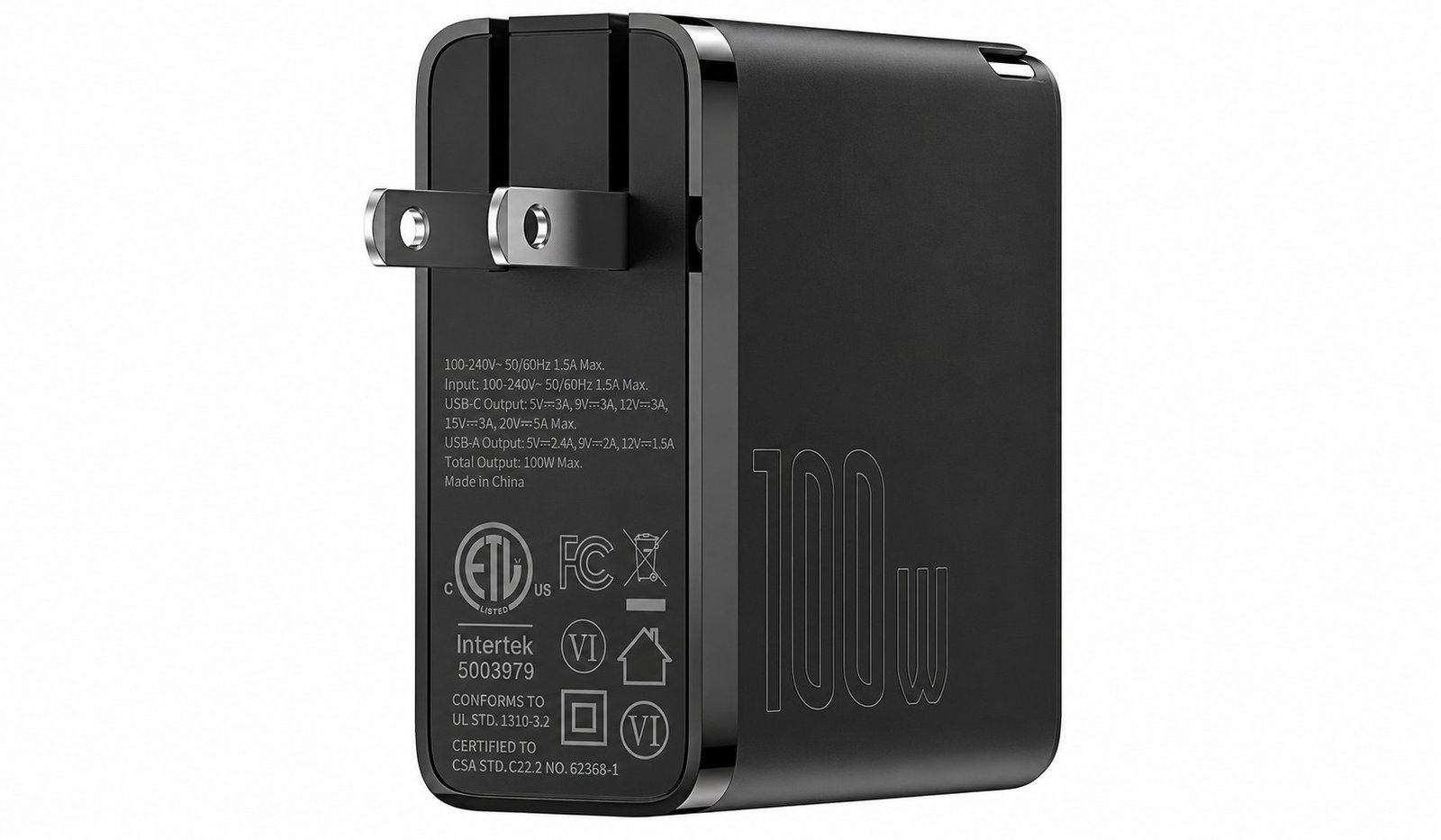
A typical charger body carries a mix of FCC, ETL, a square inside a square, a crossed-out bin, a small house, a circled 10, and a Roman numeral VI. Each one answers a different question, and none of them is decoration.
Double Insulation — The square-inside-a-square mark identifies Class II equipment. Double insulation means the product has two separate layers: working insulation that keeps normal operation safe, and protective insulation that takes over if the first layer fails. Because there are two barriers, Class II equipment does not need a protective earth connection, which is why many chargers ship with two-prong plugs.
DO NOT Dispose (Crossed Trash Can) — The WEEE symbol states that the item does not belong in household waste. Chargers contain components and metals worth recovering and substances that should not enter landfill, so the mark routes them into separate collection and recycling.
Indoor Use Only — The house icon is printed next to the specification text, on models with folding prongs usually on the side where they fold in. It means the charger is not sealed against moisture and is not built for outdoor conditions. Since the unit dissipates heat through its shell, it also needs open air around it and distance from anything flammable. Rain, spills, or long exposure to direct sun can damage the charger and the battery it is charging, and water inside a mains-powered device is a fire risk.
10-Year Reassurance Period — The circled 10 is an environmental protection use period, not a warranty. It states how long the product can be expected to keep the hazardous substances inside it, such as lead, mercury, and cadmium, from escaping under normal use. After that period those materials are considered a potential source of environmental contamination. A charger can keep working past ten years; the mark simply stops covering the environmental side.
FCC Mark — FCC stands for the Federal Communications Commission, the US body that regulates radio-frequency devices. Anything that emits or may emit interference — computers, chargers, wireless equipment — must be tested against FCC technical standards before it can be imported and sold. The mark means that testing took place, not that the charger is safe to touch; safety is covered by a separate mark.
VI Energy Efficiency — The circled V or VI is an energy efficiency level. Level VI is the current requirement for external power supplies in the US and several other markets, and it is stricter than Level V in two places: average efficiency under load, and no-load consumption. A Level VI charger wastes less power when plugged in with nothing attached.
ETL Certification — ETL is a mark issued by a Nationally Recognized Testing Laboratory. It means the product was tested to recognized US and Canadian safety standards, and that the factory is inspected on a continuing basis so the certified design stays the certified design. A charger can carry ETL instead of UL and meet the same safety requirement.
2. Other Types of Certification
CE Certification — CE is the mark required for regulated product categories sold in the European Union. It is a declaration that the product meets the applicable directives, and it is a safety and compliance mark rather than a quality grade. A charger without it cannot legally be placed on the EU market.
RoHS Certification — RoHS stands for Restriction of Hazardous Substances, an EU directive that limits lead, mercury, cadmium, hexavalent chromium, polybrominated biphenyls, and polybrominated diphenyl ethers in electrical equipment, with four phthalates added in the later revision. A charger that fails the limits cannot enter the EU market.
UL Certification — UL refers to Underwriters Laboratories, one of several organizations that test products against safety standards. The important point about UL in the US is that it is not a legal requirement in itself: what the law requires is approval by a Nationally Recognized Testing Laboratory, and UL is one of them while ETL is another. A charger marked ETL is not inferior to one marked UL; both satisfy the same underlying standards.
3. Input and Output Fundamentals
3.1 Input Specifications
Input ratings appear in a fixed format: AC 100V–240V, 50/60Hz, followed by a current figure. It compresses the entire operating envelope of the charger into one line.
The voltage range states what the charger can accept from the wall. Residential single-phase power runs from 100V to 240V depending on the country, at either 50Hz or 60Hz, and a charger rated across the full band works on both systems without a step-up or step-down converter. The input current figure, usually between 0.5A and 1.5A, is what the charger draws at the wall rather than what it delivers; it is higher on 100V than on 240V for the same output power.
The second half of the problem is mechanical. Voltage compatibility does not help if the prongs do not fit the socket, so international travel needs a plug adapter even with a wide-range charger. A design margin of 90V–264V covers sagging and surging local supplies as well as the nominal range.

Recap on input specification:
- Wide-range chargers are rated 100V–240V and work on both 110V and 220V systems. Fixed-range units are rated 100V–120V or 200V–240V.
- A fixed-range charger is built for one grid and is usually smaller and denser for the same output. It is fine as long as it stays in its own region.
- For travel, a wide-range unit plus a plug adapter covers almost every destination.
3.2 Output Specification
Output is where the useful numbers sit. Output power is the product of voltage and current: watts equal volts multiplied by amps. A charger rated 20V at 3.25A delivers 65W; the same body rated 20V at 2.25A delivers 45W.
- The charger converts mains voltage down to one of several outputs, such as 5V, 9V, 12V, or 20V.
- The phone's charging circuit then takes that input down to the cell voltage, roughly 4.2V to 4.4V depending on the cell chemistry.
- That is two stages of reduction, which is why efficiency losses accumulate in the charger, the cable, and the phone's power path.
3.3 Fast Charging Conditions
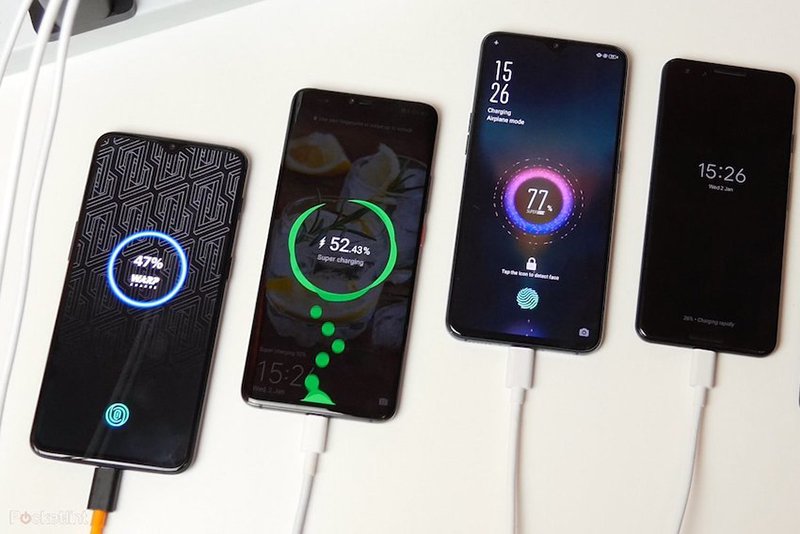
Fast charging requires agreement between three parties: the phone, the charger, and the cable. All three must support the same protocol, and the cable must be rated for the current. If any one of them does not, the link falls back to a slower standard rate even though every plug fits.
4. How a Charger Replenishes a Smartphone
4.1 The Charging Process
- Mains voltage in the 100V–240V range is converted to a low DC output of 5V, 9V, 12V, 20V, or higher.
- The charger supplies that output at a negotiated pair of values, such as 5V at 1A, 5V at 2A, 9V at 2A, or 12V at 1.5A.
- A power management chip in the phone runs the charge in three stages: constant current, constant voltage, and trickle.
- Before sustained charging begins, the charger and phone run protocol detection, temperature checks, state-of-charge checks, and cable measurements.
The constant current stage delivers a fixed current while voltage rises, and it is where most of the capacity arrives. The constant voltage stage holds the voltage at its ceiling and lets current fall. The trickle stage tops off the last few percent at low current. Fast charging, in other words, accelerates the first part of that curve and not the last: the benefit is concentrated between empty and roughly 80%, and is largest below 50%.
4.2 Why It's Not Fast Charging
The meter says 20% and the charge is crawling. The causes are usually one of five things, and they can be checked in order.
Troubleshoot:
- Battery percentage: fast charging applies at low state of charge. The higher the percentage, the slower the accepted rate.
- Phone temperature: a heat control limit reduces current to protect the cell, even when every other condition is met.
- Cable: it has to support the protocol and carry the current. A thin or damaged cable caps the link.
- Protocol mismatch: if phone, charger, cable, charge level, and temperature all look right, unplug and replug before assuming a fault.
- Peak versus average: the rated output applies to a window in the 0–50% range and tapers after that, so a short measurement at 80% will always look disappointing.
Understanding charger specifications comes down to three habits: check the certification marks before trusting the safety claims, match the input rating to where the charger will be used, and read the output in volts and amps rather than accepting the wattage on the front of the box. That last figure is a maximum, and the device decides how much of it to take.
A charger that meets the right standards and matches the device will outlast several cheaper ones that were bought on wattage alone. The label is the only place where those two things can be confirmed before purchase.
The cable belongs in the same check. A charger rated for 65W reaches that figure only through a cable rated for the current, and a cable that cannot carry it turns a fast charger into a standard one without any visible sign.