PD vs QC: Two Fast Charging Standards Compared
PD vs QC: Two Fast Charging Standards Compared
Staying powered has stopped being a convenience and become a precondition for using a phone at all. That is why the charging spec on a box gets read more often than it used to, and why two acronyms keep appearing on it: PD and QC.
Most people have met both without knowing what separates them. The two protocols solve the same problem in different ways, they are not interchangeable, and the difference decides whether a particular phone will charge at its full rate from a particular brick.
1. What is Fast Charging Technology?
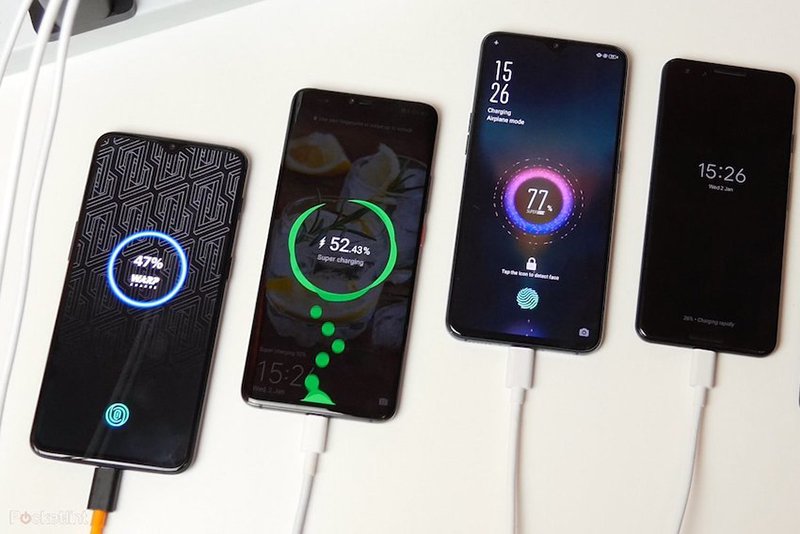
Fast charging raises the power a device accepts above the standard USB level, which shortens the time to a useful charge. Two protocols account for most of the market: Qualcomm Quick Charge and USB Power Delivery.
Both move more energy than a plain 5V connection, but they negotiate it differently, offer different voltage sets, and suit different devices. Reading a charger label without knowing which of the two it speaks is how people end up with a fast charger that charges one phone quickly and another at standard speed.
1.1 How Does Fast Charging Work?
There are only two levers: raise the current, or raise the voltage. Fast charging leans heavily on the second, because raising voltage delivers more power without pushing more current through the same cable and connector.
Power then arrives in three stages, and the shape of those stages explains why a phone charges quickly to 50% and slowly afterwards.
- Stage one is constant current: current is held at its maximum while voltage climbs toward the ceiling. Most of the capacity is delivered here.
- Stage two is constant voltage: voltage sits at its ceiling and current falls away as the cell fills.
- Stage three is trickle: the battery is essentially full, and small amounts of power top it up or replace what the phone is drawing.
1.2 Types of Fast Charging Technology
Fast charging appears in several product forms, and the form is a separate question from the protocol. A power bank, a power strip, and a car charger can each carry the same protocol or different ones.
- Fast-charging power banks, where output matters more than capacity for phones
- Fast-charging power strips, which add USB ports to a fixed outlet
- Fast-charging car chargers, which convert the 12V socket supply

2. What is QC Charging?
Qualcomm Quick Charge is a proprietary fast-charging technology developed by Qualcomm. It was built for devices running Snapdragon processors and delivers more power than a standard USB connection.
QC negotiates over the two data pins that older USB chargers already had, then raises the voltage on the power line rather than pushing more current through it. That is why it needs no special cable and runs over USB-A as readily as over USB-C. Later versions moved to USB-C and adopted PD-style negotiation, but the original design decision is why QC is still common on USB-A ports.
The protocol is licensed rather than exclusive. Any manufacturer can implement it, which is why QC appears in Android phones, tablets, power banks, and chargers from companies that have nothing to do with Qualcomm silicon.
Qualcomm quotes 0–50% in five minutes for QC 5, and support across a large installed base of phones and accessories. Those figures come from the vendor rather than from independent testing, so they describe the best case with a matching device and cable.
2.1 Variations of Qualcomm Quick Charge Technology
The protocol has gone through several revisions, most of which changed how voltage is negotiated rather than how much power is possible.
Qualcomm Quick Charge 1.0
QC 1.0 arrived in 2013 and did not change voltage at all. It raised the current ceiling from the 1A that early USB chargers supplied to 2A at 5V, doubling the power to 10W.
That was enough to cut a full charge to roughly three hours on the phones of the period, against four hours or more from the 5W adapters that shipped with them.
Qualcomm Quick Charge 2.0
QC 2.0, released in 2014, added voltage stepping: the charger offers 5V, 9V, 12V, and 20V, and the phone requests one of them. It works over USB-A, micro-USB, USB-C, and proprietary connectors, which made it adaptable to the hardware of the time.
The power ceilings differ by class:
- Class A over a micro-USB connector: up to 24W, from 12V at 2A
- Class A over USB-C: the same 24W, since the limit is the protocol rather than the connector
- Class B: up to 60W at 20V, which needs a cable and connector rated for it
Qualcomm Quick Charge 3.0
QC 3.0, introduced in 2015, replaced the fixed steps with a continuous range. Intelligent Negotiation for Optimum Voltage lets the phone request any level between 3.6V and 20V in 200mV increments, so the charger can sit just above the battery voltage instead of jumping to the next fixed step.
The finer control is where the efficiency gain comes from. A charger that tracks the cell voltage closely converts less energy into heat than one that steps between fixed levels, and the difference shows up as lower temperature during the middle of a charge.
QC 3.0 kept the same connector flexibility as 2.0, which is why it spread across USB-A accessories rather than requiring a move to USB-C.
Qualcomm Quick Charge 4.0
QC 4.0, announced in 2016, is where the protocol changed direction. It moved to USB-C and adopted USB Power Delivery as the underlying negotiation, so a QC 4.0 charger is also a PD charger rather than one that speaks only a proprietary language.
The fine-grained control that 3.0 introduced was carried forward at a much tighter interval: INOV 3.0 adjusts in 20mV steps, matching the granularity of PPS. QC 4.0 also introduced Dual Charge, which splits the charge current across two parallel power paths so that each path carries half the current, and therefore half the heat. QC 4+, a 2017 revision, added thermal balancing between those paths and a wider set of safety limits.
Because QC 4.0 is built on PD, the two protocols stopped being alternatives at that point. A PD charger with PPS will negotiate close to the same profile a QC 4.0 device expects, which is why the later versions are best understood as profiles within PD rather than as a competing standard.
Qualcomm Quick Charge 5.0
QC 5.0 arrived in 2020 and pushed the ceiling past 100W. It uses a split-cell charge architecture, dividing the battery into two cells charged in series, which halves the current at the battery for the same power and reduces the heat that current would otherwise generate.
Qualcomm's published figures claim 0–50% in five minutes on a phone with a 4,500mAh battery, along with a long list of protection layers:
- Voltage protection at eight levels, with current, thermal, and timer protection at three levels each
- Input overvoltage protection at 25V, with additional cutoffs above 30V
- Support for the same accessory across multiple device implementations
3. What is PD Charging?
USB Power Delivery is an open standard maintained by the USB Implementers Forum. It runs over USB-C, uses the configuration channel to negotiate, and can supply up to 240W under PD 3.1, which is enough for laptops and small monitors.
Because negotiation happens on the CC pin, PD needs a USB-C port at both ends of the connection. A USB-A port has no CC pin, so a PD charger cannot negotiate over an A-to-C cable; that connection falls back to the 5V default or to a data-pin protocol such as QC.
3.1 Power Delivery 3.0
PD 3.0 raised the ceiling to 100W over a single cable and made one adapter able to serve several kinds of device, from a phone to a thin laptop. Two features define it:
- Fast Role Swap, which lets a device switch between supplying and receiving power without interrupting the connection
- Programmable Power Supply, which allows voltage and current to be adjusted in fine steps during a charge instead of jumping between fixed levels
PPS matters more than its name suggests. It is the mode that Samsung's fast charging, and several other Android implementations, actually rely on, so a PD charger without PPS will often charge those phones more slowly than one with it.
3.2 Power Delivery 3.1
PD 3.1, released in 2021, introduced Extended Power Range and raised the ceiling from 100W to 240W. The extra headroom comes from raising voltage rather than current: EPR adds fixed steps at 28V, 36V, and 48V, and 48V multiplied by 5A is where the 240W figure comes from.
Two conditions travel with that number. The cable has to be EPR-rated, which means a 5A electronically marked cable built for 50V, and both ends of the connection have to support EPR. If either one does not, the link stays in standard power range and stops at 100W, which is why a 240W charger can still be capped at 100W by an older cable.
EPR also brought Adjustable Voltage Supply, which spans 15V to 48V in 100mV steps. That is coarser than PPS at 20mV, but it covers a far wider range, and it lets a high-wattage supply track a laptop's input requirement instead of stepping between fixed voltages.
- Fixed EPR voltages of 28V, 36V, and 48V, with current up to 5A
- AVS from 15V to 48V in 100mV steps for devices that need intermediate levels
- Automatic fallback to standard power range when the cable or the device is not EPR-capable
4. PD vs. QC: What are the Main Differences?
Both protocols are now defined, so the comparison comes down to four lines: how each one adjusts voltage, how much current it allows, which connector it needs, and where it is found.
- Voltage control. QC 3.0 sweeps 3.6V to 20V in 200mV steps; PD steps between fixed 5V, 9V, 12V, 15V, and 20V, and adds PPS from 3.3V to 21V in 20mV steps. PD is coarser by default and finer when PPS is present.
- Current ceiling. Both settle at 3A on an ordinary cable. PD formally extends to 5A, 48V, and 240W once an electronically marked cable is in place; QC 5's 100W-plus ceiling likewise assumes a cable built to carry that current.
- Connector. QC negotiates on the two data pins, so it runs on USB-A as well as USB-C. PD negotiates on the CC pin, which exists only on USB-C, so both ends of the connection must be USB-C.
- Ecosystem. PD is built into USB-C devices across phones, tablets, laptops, and monitors, and it is what iPhones negotiate. QC is licensed, appears mainly on Snapdragon-based Android hardware, and from version 4.0 onward sits inside PD rather than beside it.
Fast charging has moved a long way from the 5W adapter, and both protocols pushed it there. What matters when buying is not which name sounds newer but which protocol the device in hand actually speaks, since a charger that cannot negotiate with a phone delivers standard speed no matter what its label says.
Compatibility is usually decided in the port, not the wattage. A phone that relies on PPS falls back to a lower rate on a fixed-voltage adapter of twice the rating, and a laptop that needs 20V will not charge from a 5V-only brick however many amps it offers.
The cable closes the loop. Above 3A the connection depends on an electronically marked cable, and a cable without that marker caps the agreement at 60W regardless of what the charger and the phone are prepared to do.