

How to Select the Right USB Charger
How to Select the Right USB Charger
Selecting a USB charger affects how quickly a device charges, how many devices a single power source can support and how well the product fits a given installation. For procurement professionals and brand managers sourcing chargers for distribution, retail or OEM equipment, a device-driven selection process helps match output capability to the devices being served while avoiding insufficient output capacity and unnecessary overspecification. This guide covers selection by device type, the main technical factors to evaluate and the common charger product types available from a USB solutions manufacturer.

Part 1: Select by Device
Mobile Device
Smartphones, wearables and other handheld devices use different charging interfaces and protocols. Many current smartphones support USB Power Delivery, while selected models use USB PD Programmable Power Supply or another device-specific charging protocol. Wearables and smaller accessories may instead use a fixed 5V input, a USB-A power source or a dedicated charging cable. Selected compact charger models commonly provide outputs from 20W to 30W for compatible smartphones, but the required output port, charging protocol and power profile must be confirmed for the target device. A USB-C output does not automatically provide the proprietary fast-charging protocols associated with a legacy USB-A charger.
Tablet
Tablets generally require more power than many phones because of their larger batteries and higher power consumption during active use. Selected tablet models commonly use USB Power Delivery input levels in the 20W to 45W range, but the required power and charging protocol depend on the device. The delivered power is negotiated between the charger and the tablet and is limited by the lowest compatible capability in the charging system. For tablets that remain in use while charging, confirm that the charger provides sufficient continuous rated output and has been thermally validated for the intended ambient and installation conditions.
Ordinateur portable
Laptops and 2-in-1 computers require a USB-C charger with sufficient output to power the device and charge its battery under the intended workload. Selected laptop chargers commonly provide 45W, 65W or 100W, while compatible USB Power Delivery Extended Power Range devices may require 140W, 180W or up to 240W. Standard Power Range supports up to 100W at 20V/5A, while Extended Power Range adds higher fixed-voltage levels up to 48V/5A and 240W. Operation above 100W requires a compatible EPR source, EPR-capable device and an appropriate 5A electronically marked EPR USB-C to USB-C cable. A charger with a higher maximum rating does not force excess power into the laptop; the actual voltage and current are determined through a compatible USB PD negotiation. Confirm the required PD profiles, maximum power and cable rating for the target laptop.
Part 2: Selection Factors
Charging Protocol and Cable Compatibility
Connector type alone does not determine charging capability. Confirm whether each target device requires a fixed 5V supply, USB Battery Charging support, USB Power Delivery, USB PD Programmable Power Supply or another device-specific protocol. USB PD and PPS support should be stated only for selected charger models that implement and validate those functions. For USB-C charging above 3A, confirm the use of an appropriate 5A electronically marked cable. EPR operation above 100W additionally requires an EPR-capable source, device and cable. Cable data capability, video capability and charging capability should be specified separately. A USB output on a standalone charger provides power and charging communication; USB data-transfer capability should not be implied unless the product also includes a separately specified hub or data function.
Puissance de sortie
Output power, expressed in watts (W = V × A), is a central selection factor. The charger must support the voltage and current required by the connected device, and under USB Power Delivery the two ends negotiate an appropriate power contract. For a single device, select an output at or above the device's required input power. For a charger serving multiple devices, consider the combined load and how power is shared among ports. Under USB Power Delivery, Standard Power Range covers profiles up to 100W, while Extended Power Range extends to 240W at higher voltages. The available output should be validated against the target device list and the intended number of simultaneously charging units.
Port Number
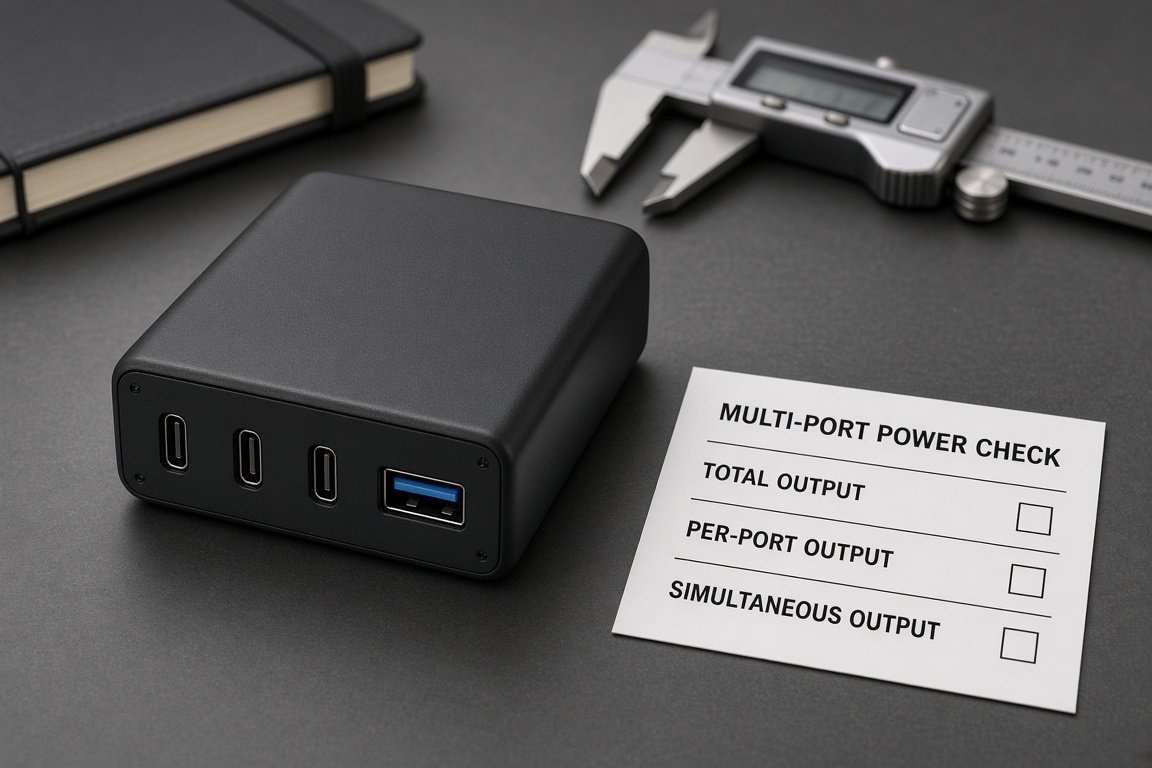
Port count determines how many devices a charger can serve, but the number of ports does not by itself establish the simultaneously available output. Single-port chargers suit dedicated devices and fixed installations where one output is sufficient. Multi-port chargers may provide two, three or four outputs, using fixed or dynamic power allocation depending on the model. Connecting additional devices may reduce the power available from one or more ports, but the result depends on the charger's total rating, active port combination and power-management logic. Confirm the maximum output of each port, the supported simultaneous-output combinations and whether connecting or disconnecting a device triggers power redistribution or renegotiation.
AC Input, Safety and Target Market
Confirm the rated AC input-voltage and frequency range, wall-plug type or detachable input cord, insulation construction, thermal performance and destination-market requirements for the selected charger. Do not assume that every model supports worldwide input or every regional plug configuration. Required protection functions, such as overcurrent, overvoltage, short-circuit and overtemperature protection, should be confirmed from the selected product specification and validation records. Safety, electromagnetic-compatibility and energy-efficiency requirements depend on the charger model and destination market.
Application
The intended application informs several secondary factors. Home and office use favors compact form factors and convenient mounting, while travel emphasizes smaller size and interchangeable blades where applicable. Fixed desktop or workstation setups may prioritize multi-port output and stable stand placement. Industrial, retail-display and OEM-bundled applications introduce requirements for enclosure mounting, cable management, duty cycle, cooling and specific output configurations. Because AC input standards and certification requirements differ by destination market, confirm that the selected charger and its power supply design comply with the applicable safety and energy regulations for each target market.
Part 3: Product Types
USB chargers can be described by several overlapping product dimensions. Wall and desktop chargers describe the physical form factor and AC-input arrangement. Single-port and multi-port chargers describe the output-port configuration. Silicon and GaN describe aspects of the internal power-conversion technology. A single product may therefore be a wall-mounted, multi-port GaN charger. These labels should be evaluated together with output power, protocol support, thermal performance and destination-market requirements.
Form Factor: Wall Charger
Wall chargers plug directly into an AC wall socket and are available in compact single-port and multi-port configurations. Their output capability varies widely, from low-power fixed-output USB-A designs to selected higher-power USB-C Power Delivery models. The supported output depends on the charger platform, port configuration, charging protocol and thermal design. Confirm the AC input rating, plug type, continuous output, charging protocol and destination-market requirements for the selected model.
Form Factor: Desktop Charger
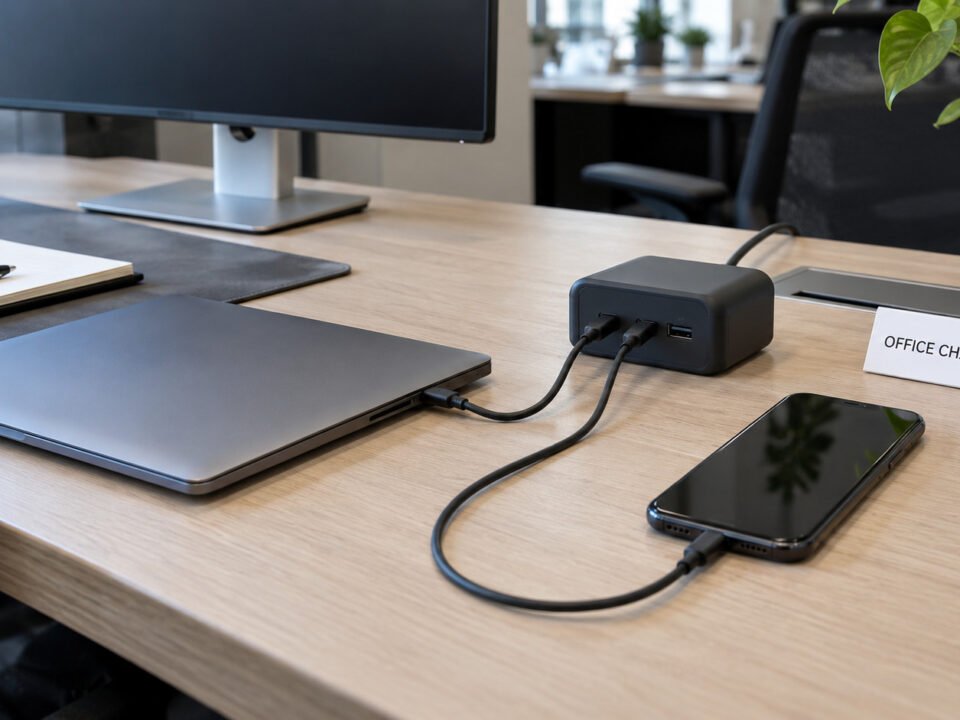
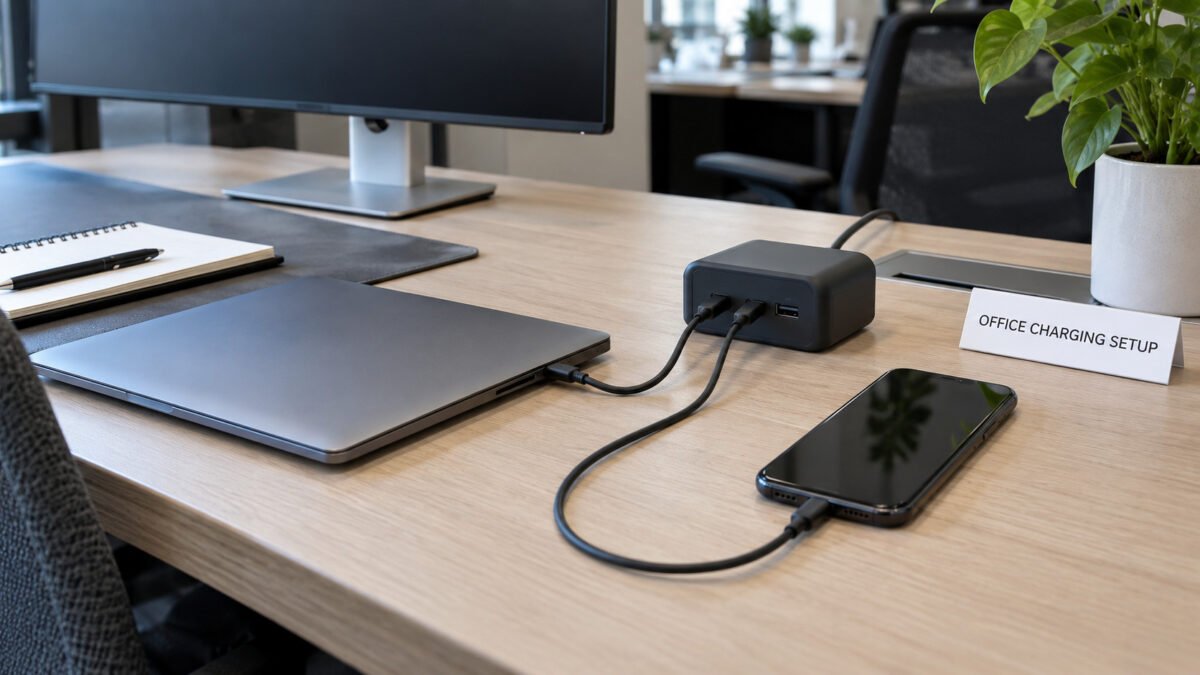
Desktop chargers sit on a desk, shelf or work surface and are powered through an AC input cord rather than plugging directly into a wall socket. This form factor is suited to workstations, meeting rooms and equipment benches where multiple devices are charged from a single source. Desktop models often provide higher total output and more ports than a typical wall charger, making them suitable for multiple simultaneous devices. Because desktop chargers often remain connected for extended periods, attention should be given to cooling, cord retention and the stability of the enclosure.
Port Configuration: Multi-Port Charger
Multi-port chargers may provide multiple USB-C ports, multiple USB-A ports or a combination of both, with the available output shared or allocated according to the product design. Depending on the model, the power-management logic may use fixed port limits, port priority or dynamic power redistribution when the connected-device combination changes. These chargers may be selected for home desks, offices, hotel rooms and field setups where several devices are charged from one AC source. The output of each port, total rated output and supported simultaneous-output combinations should be confirmed against the intended device set.
Power Technology: GaN-Based Charger
GaN-based chargers use gallium-nitride power transistors in one or more switching stages of the power-conversion circuit. Depending on the complete electrical and thermal design, GaN technology can support higher switching frequency and power density, which may allow a smaller enclosure for a given output. GaN is a semiconductor-technology description and does not by itself establish charger size, efficiency, temperature, output power, protocol support or certification status. The selected model must still be evaluated according to its complete specification, thermal validation and destination-market requirements.
Part 4: OEM and ODM Customization
USB charger customization may include output power, USB-C and USB-A port combinations, charging-protocol configuration, fixed or dynamic multi-port power allocation, enclosure design, color, AC plug type, detachable input cord, labeling and packaging. Available options depend on the selected charger platform, thermal design, certification scope, destination market, production feasibility and required validation. Custom specifications should be confirmed before sampling and production.
Request a USB Charger Selection Review
Provide the target device list, required charging protocols, maximum output power, number and type of output ports, simultaneous charging combination, AC input range, wall-plug or cord requirement, destination market, enclosure preference, estimated order quantity and required project schedule. These details support specification review, sample planning and OEM/ODM quotation.