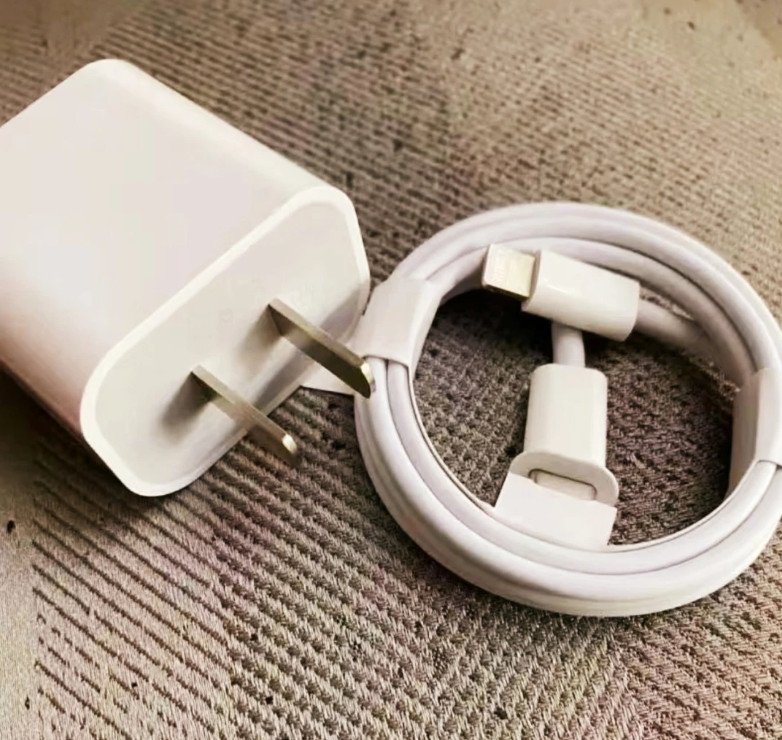


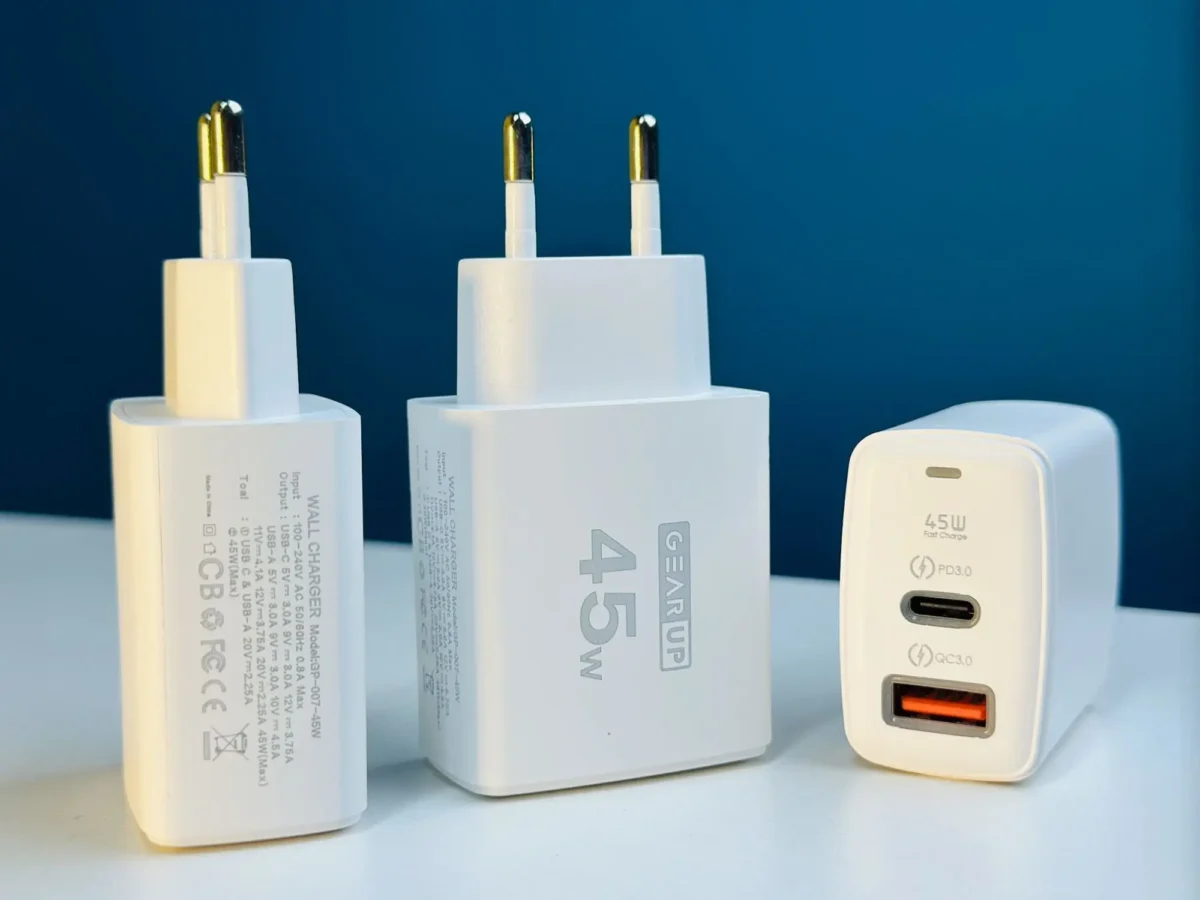
Chargeur 25 W vs chargeur 45 W : quelle est la différence ?
Chargeur 25 W vs chargeur 45 W : quelle est la différence ?
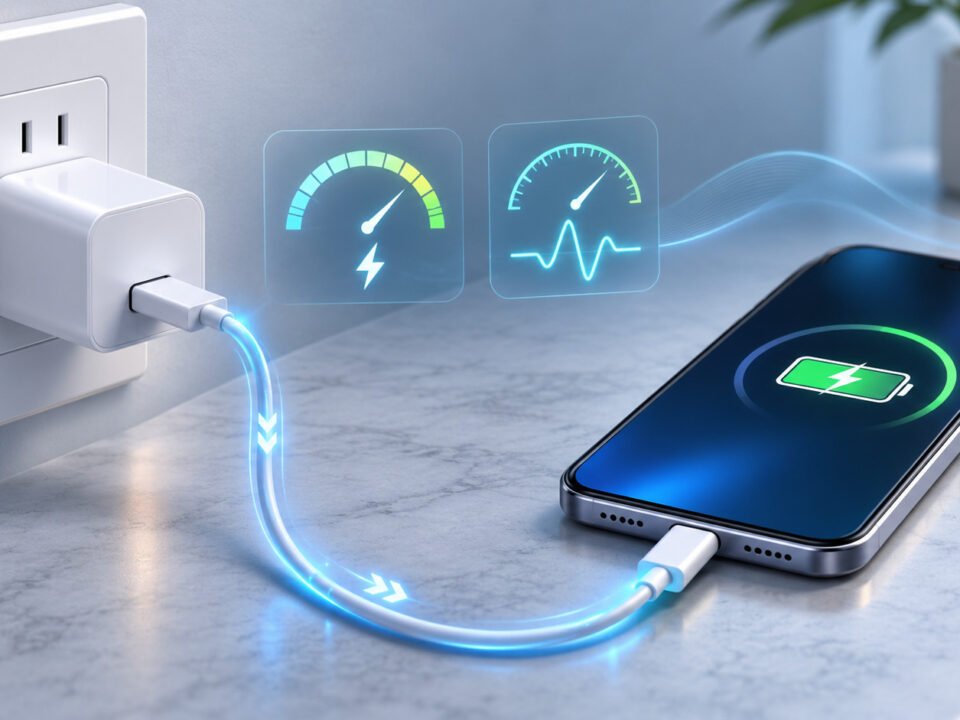
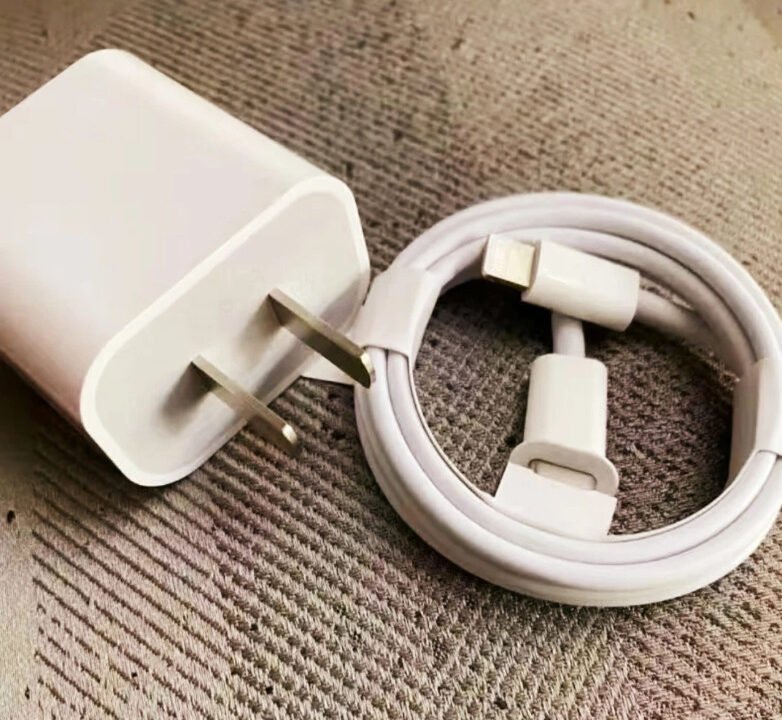
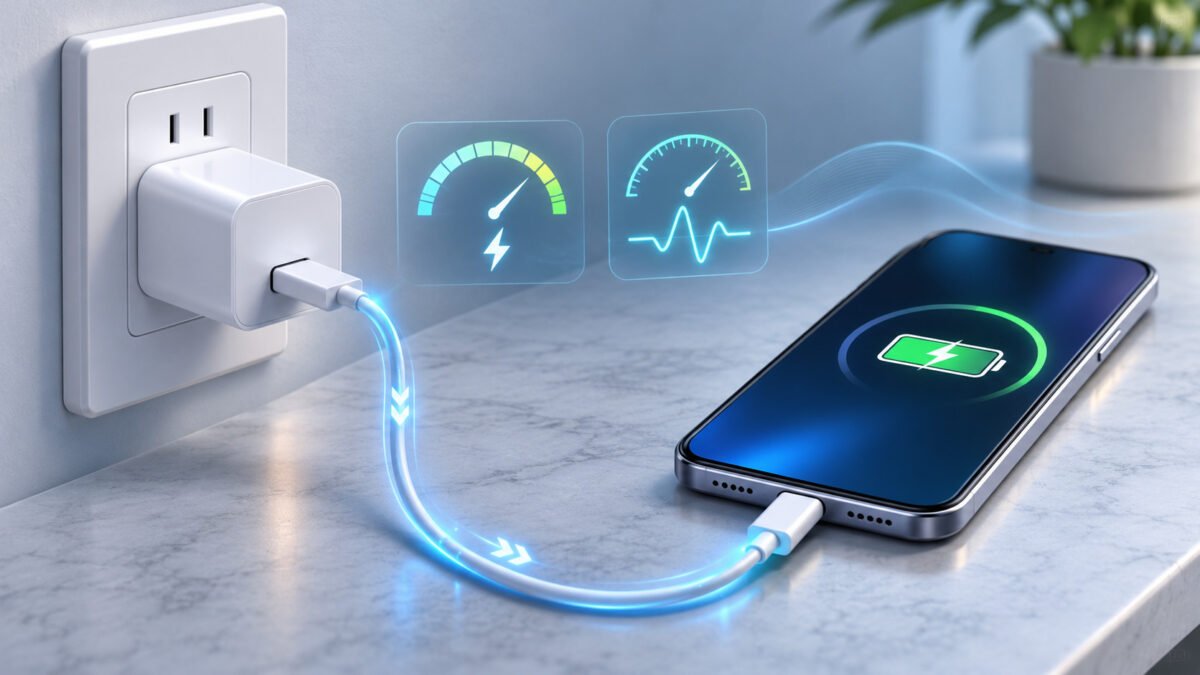
For a long time the assumption was that chargers were interchangeable — until two bricks, same phone, visibly different charging speed. The headline difference between a 25W and a 45W charger is power: a 45W USB-C charger can refill faster, but only if the device, the protocol and the cable are all able to accept it. Most of the confusion around these two numbers comes from treating the wattage as a promise instead of a ceiling.
- 1. What is the difference between 25w and 45w chargers?
- 2. Are both chargers compatible with fast charging?
- 3. Is a 45W charger safe for a 25W device?
- 4. The cable that quietly caps a 45W charger
- 5. How much difference does it make in daily use
- 6. Heat and battery life
- 7. How to choose between them
- 8. Conclusion

1. What is the difference between 25w and 45w chargers?
A 25W unit tops out around 12V/2.08A. A 45W unit adds higher voltage options, reaching 20V/2.25A, and a wider PPS range.
| Chargeur | Max output options | Typical devices |
|---|---|---|
| 25W | 5V/3A, 9V/2.77A, 12V/2.08A; PPS 3.3–5.9V at 3A and 5.9–11V at 2.25A | Phones, tablets |
| 45W | 5V/3A, 9V/3A, 15V/3A, 20V/2.25A; PPS 3.3–11V at 3A, up to 4.5A in the 5–11V range | Phones, tablets, thin laptops |
The wattage describes how much the charger can supply. A higher number means faster charging only when the device asks for it and the charger can deliver it in the right form.
2. Are both chargers compatible with fast charging?
Both chargers support Samsung's Super Fast Charging, the 25W mode most Galaxy phones use. Super Fast Charging 2.0 at 45W is a different step: it needs PPS with 4.5A available, and only some 45W units provide that.
A 45W charger without the 4.5A PPS range falls back to 25W on a phone that could take 45W. The same applies higher up the range: a 65W charger with no 4.5A PPS will not trigger Super Fast Charging 2.0 either. Wattage alone does not buy the mode.
| Chargeur | Super Fast Charging (25W) | Super Fast Charging 2.0 (45W) | 4.5A PPS |
|---|---|---|---|
| 25W | Oui | Non | Non |
| 45W | Oui | Some models | Some models |
Marketing caution: "45W" on the box says nothing about PPS. If the listing does not mention PPS or Super Fast Charging 2.0 explicitly, assume the 45W brick will behave like a 25W one on a Samsung phone.
3. Is a 45W charger safe for a 25W device?
Yes, for compliant hardware. The device and charger negotiate before power flows: the phone requests a voltage and current pair, the charger confirms it can supply that, and only then does the output move. A 45W charger connected to a 25W phone simply runs at 25W.
| Chargeur | Appareil | Power drawn | Safe |
|---|---|---|---|
| 45W | Phone capped at 25W | 25W or less | Oui |
| 45W | Earbuds | A few watts | Oui |
| 25W | Phone capped at 25W | 25W | Oui |
The exception is not the wattage but the build quality: a non-compliant charger that ignores the handshake, or a cable with damaged contacts, is where heat and damage actually come from.

4. The cable that quietly caps a 45W charger
This is the part most buyers never check, and it explains why two identical chargers perform differently in the field.
Super Fast Charging 2.0 draws 4.5A, which is above the 3A limit of an unmarked USB-C cable. A cable without a valid E-Marker is treated as 3A, so the system caps current there and the 45W mode never starts. The charger is fine, the phone is fine, the cable is the bottleneck.
Two practical consequences:
- A 45W charger bundled with a 3A cable delivers roughly 25–30W, not 45W.
- A 5A E-Marked cable is required to see the full 45W, and that requirement belongs on the spec sheet, not in the fine print.
5. How much difference does it make in daily use
The gap is front-loaded. Both chargers follow the same shape: full power while the battery is low, then a taper as it fills.
| Stage | What the charger does | Where 45W helps |
|---|---|---|
| First 30 minutes | Highest power, constant-current phase | Largest gap — this is where 45W earns its price |
| 30–60 minutes | Power tapers as the battery fills | Gap narrows quickly |
| Final 20% | Slow top-off, thermal limits dominate | Almost no difference |
A full charge typically differs by around 10–15 minutes, not by the 80% the wattage ratio suggests. For overnight charging, the two are interchangeable. For travel, back-to-back meetings or a shared car charger, the first half hour is the only window that matters — and that is exactly where 45W pays off.
6. Heat and battery life
Higher current means more heat, at the connector first and in the battery second. Both power levels rely on the same thermal management, so the difference is small in normal use, but sustained heat is what ages cells, not the wattage number itself.
A 45W charger running a 25W phone draws 25W from the wall, not 45W. The risk appears with cheap cables and blocked ventilation, not with a compliant higher-rated brick.
7. How to choose between them
| Your device | Better fit |
|---|---|
| Galaxy S20–S24 (base models) | 25W |
| Galaxy S22+ / S23+ / S24+ / S25+ and Ultra | 45W |
| Comprimés | 45W |
| Thin laptops | 45W or more |
For laptops, 45W is the entry point rather than a comfortable fit: many thin models need 65W to charge while in use, and will only hold their level on 45W.
Beyond the device list, three things decide the purchase:
- Look for PPS on the label, not just the wattage. Without it, the 45W brick is a 25W brick with a bigger housing.
- One 45W replaces two chargers if you carry a phone and a tablet, which matters more for travel than for a desk.
- Prefer brands that publish the full output table — voltage, current, PPS range, cable rating — over "fast charging" as a claim.
8. Conclusion
A 25W charger covers most phones, and covers them well. A 45W charger adds headroom for Plus and Ultra models, tablets and thin laptops, but the extra 20W only arrives when the protocol and the cable allow it.
The wattage on the label is a ceiling. The charging you actually get is set by the weakest link in the chain: device, protocol, cable, charger.