
Education Device Charging Solutions
2026-09-15
Embedded Electronics Power Solutions
2026-09-16
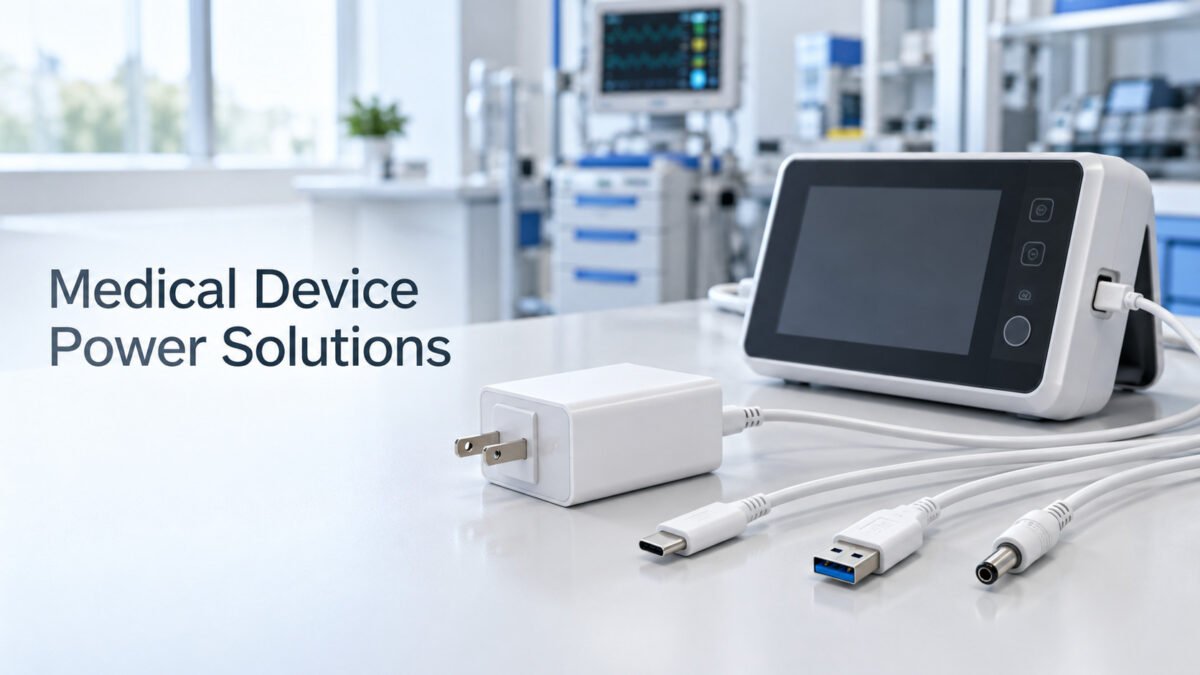
Medical Device Power Solutions
Medical Device Power Solutions
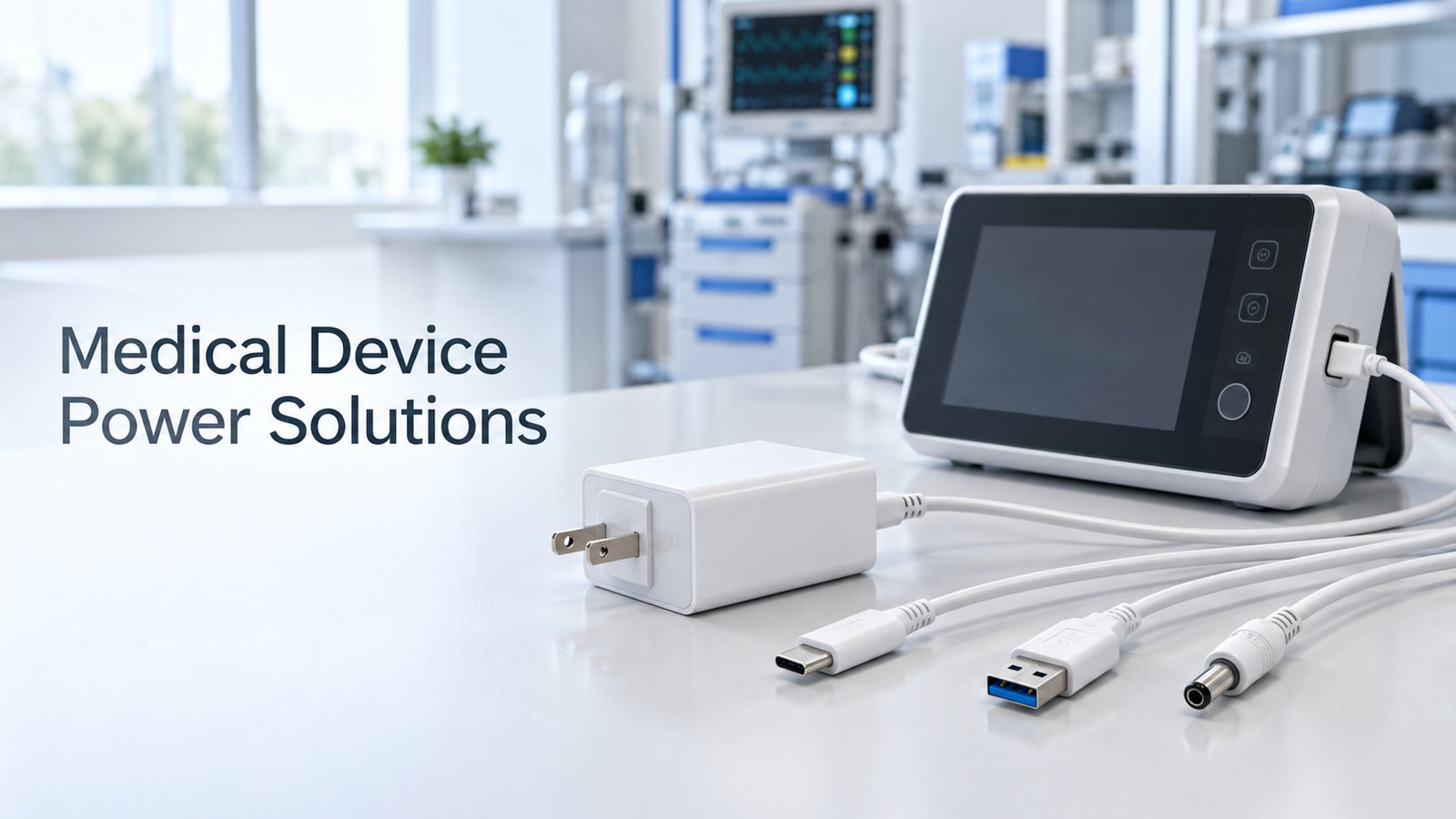
This page introduces power adapters and USB cable assemblies intended for selected medical and healthcare equipment applications. Solutions are configured according to the device input, connector, cable construction, operating environment, and target-market requirements. OEM and ODM support covers specification matching, prototyping, labeling, packaging, and production coordination.
1. Power Needs of Medical Devices
1.1 Reliability
Medical equipment is expected to operate when it is called on. In clinical rooms, at a patient bedside, or in a home environment, the power path from the outlet to the device needs to remain connected through normal working conditions. Reliability here means the connector stays seated, the cable maintains contact, and the adapter continues to deliver power over extended runtime.
A power solution is judged on how it behaves over time and under stress. Repeated plug and unplug cycles, movement of the device, and temperature changes place demands on the connection. A cable assembly that develops a loose contact can cause an intermittent problem that is difficult to diagnose at the point of use. For this reason, construction choices matter: molded connectors, strain relief at both ends, and conductor termination that holds up under flexing. The performance of a medical power connection is not assessed at the moment of first use, but across the months and years a device spends in service.
For the buyer, this reliability shows up in measurable ways. Lower field failure rates reduce the volume of returns and replacements under warranty. For equipment that supports patient care, a dependable connection also reduces unplanned service calls. Manufacturers select components that have proven performance in demanding environments rather than assuming a standard consumer cable will be adequate.
1.2 Sortie stable
Connected medical devices generally expect the input voltage and current to stay close to their rated values during normal operation. Adapters designed for medical use deliver regulated output, so the voltage received by the device remains within a tight band.
USB power capability depends on the source, device, connector, cable, and charging protocol. Traditional USB host ports provide limited 5 V power under the applicable USB specification, while dedicated charging ports and USB Type-C systems may support higher current. Where USB Power Delivery is used, the source and device negotiate an appropriate power level, and the cable must be rated for the required current and voltage. Each solution should therefore be selected according to the device's specified input requirements rather than by connector type alone.
The cable also affects the voltage delivered to the device. Longer cables, smaller power conductors, higher current, and increased contact resistance can produce a larger voltage drop. Selected cable assemblies use appropriate conductor sizes and low-resistance terminations to keep voltage drop within the agreed specification. Shielding, where required, is specified separately to support signal integrity and system-level EMC performance. Keeping voltage drop within the device manufacturer's specified limits helps the connected equipment operate within its intended electrical input range.
1.3 Durability and Service Life
Equipment in medical and healthcare environments frequently remains in service for several years. Among the components that are handled most often are the cables and adapters: they are moved between rooms, coiled for storage, and reconnected multiple times each day.
Long service life is a result of mechanical design decisions. Reinforced connector housings resist impact and wear. Strain relief at the point where the cable meets the connector absorbs bending so the internal conductors are not stretched. Depending on the selected material and validated specification, cable jackets can be configured for abrasion resistance, repeated flexing, and exposure to specified cleaning agents. The buyer should identify the actual chemicals and cleaning procedure so material compatibility can be evaluated.
A durable power solution can help reduce connection-related downtime and replacement requirements over the equipment's service life. For OEM buyers, a well-specified adapter and cable assembly may also reduce service issues associated with worn or damaged power connections.
2. Power Solution Offerings

2.1 Medical Power Adapters
A range of power adapters supports medical equipment with regulated DC output matched to the device input. An adapter is defined by its output voltage, current rating, connector type, enclosure design, and the safety and EMC requirements of the target market.
For USB-powered equipment, the adapter output must match the charging method supported by the device. Depending on the selected model, this may include fixed 5 V output, a dedicated USB charging configuration, USB Type-C current, or USB Power Delivery. Supported voltage, current, and power levels should be confirmed for each adapter, cable, and device combination.
For applications subject to medical electrical equipment requirements, the selected power adapter must be evaluated against the standards and regulatory requirements applicable to the final device and target market. Relevant considerations may include insulation, means of protection, leakage current, EMC performance, operating environment, and applicable collateral or particular standards. Compliance should be confirmed using the specifications and approval documents for the selected adapter model; the use of an adapter in a healthcare setting does not by itself make it a medical-grade product. Where documented compliance exists, specifications and approval documents for the selected part number are available on request.
Adapters are available across a wide range of common output configurations, so a buyer can match the adapter to the input rating of the device in a product line. Connector orientation, cable exit direction, and case color can be specified to suit the device design. Because the adapter forms part of the power path between the mains supply and the connected equipment, its electrical performance and mechanical construction must match the requirements of the intended application. Replacement adapters also matter for distributors and service providers who maintain equipment fleets, where a dependable source of matched adapters reduces the time a device stays out of service.
2.2 USB Connection Solutions
USB interfaces are present on many medical peripherals and accessories, including barcode scanners, label printers, imaging accessories, and input devices. The connection solutions include USB 2.0 and selected USB 3.x data configurations, with connector options such as USB-A, USB-C, and Micro-USB. Available lengths, connector orientations, and cable constructions depend on the required power, data performance, and equipment layout.
Where EMC performance is a concern, cable construction may include shielding and an appropriate grounding arrangement. Cable-level design can support EMC performance, but emissions and immunity must be evaluated in the complete equipment or system configuration.
USB Type-C is a reversible connector format, but its presence does not by itself define the supported data rate or power level. Depending on the product specification, a USB-C connection may support USB 2.0 data, higher USB data rates, charging only, or USB Power Delivery. The connection is specified to match the device's power and data requirement, the rated current capacity of the cable, and the mechanical reality of how the device is used, such as routing, reach across a cart, or connection by operators wearing gloves.
3. Applications
3.1 Diagnostic Equipment
Diagnostic instruments, including laboratory analyzers, imaging peripherals, and selected vital-sign devices, require power adapters and cable assemblies that match their specified electrical input. The power solution should maintain its output within the limits defined by the equipment manufacturer under the expected load and operating conditions. Measurement accuracy and clinical performance must be validated at the complete-device level.
Some compatible diagnostic peripherals carry both power and data over a single USB connection. In these cases the cable must support the data rate of the interface while also carrying the operating current at an acceptable voltage drop. The correct cable choice keeps the connection both functional and reliable over the instrument's working life.
3.2 Monitoring Equipment
Selected monitoring devices may operate for extended periods and therefore require a power solution rated for the expected load and duty cycle. The adapter and cable should be selected to maintain the specified electrical connection during normal handling and repositioning.
Monitoring equipment is often repositioned as patients move, which means the connected cables experience repeated relocation. Durable connectors and flexible cable constructions suit this kind of frequent handling, lowering the likelihood of wear-related failures at the bedside. Because a monitor may be moved between care settings, the connection is specified with both durability and easy handling in mind, so staff can reconnect quickly when needed.
3.3 Home Healthcare Devices
USB-powered home healthcare products, such as blood pressure monitors, digital thermometers, personal wellness devices, and portable instruments, increasingly rely on USB connections for power and charging. These devices are used in less controlled environments, where plugs may be handled casually and cables stowed roughly.
A widely used USB connector can simplify sourcing and end-user handling, but connector fit alone does not confirm compatibility. Replacement adapters and cables must match the device's required voltage, current, charging protocol, connector configuration, and, where applicable, data capability. Durable connector housings and appropriate strain relief can support everyday handling when specified and validated for the intended use.
4. How to Select a Medical Device Power Solution
A suitable power solution should be selected from the requirements of the complete device rather than from the connector appearance alone. Buyers should confirm the following information before sampling or quotation:
- Device input: required voltage, maximum operating current, peak load, and allowable voltage tolerance.
- Power source: AC input range, plug type, fixed-voltage output, USB charging method, or USB Power Delivery profile.
- Connecteur : USB-A, USB-C, Micro-USB, DC connector, or a custom interface, including orientation and pin configuration.
- Data requirements: charging only or power plus data, together with the required USB data rate where applicable.
- Cable construction: required length, conductor size, shielding, jacket material, flexibility, and strain-relief design.
- Operating environment: temperature range, cleaning exposure, movement, abrasion, and required ingress protection.
- Conformité: applicable safety, EMC, medical-device, and regional requirements for the final equipment and target market.
Providing these details allows the adapter and cable assembly to be evaluated as a complete power path. Final compatibility and compliance should be confirmed through samples, testing, and approval of the agreed specification.
5. OEM Support
5.1 Custom Development
OEM development supports buyers who need a power solution matched to a specific device rather than an off-the-shelf part. Custom options include output voltage and current, connector type and contact configuration, cable length, jacket color, and product marking. The goal is a power solution that integrates cleanly with the device design and meets the electrical and mechanical requirements of the application, within the limits defined by the relevant USB specifications. Customization options depend on technical feasibility, order requirements, and the approval scope of the selected product; changes to safety-critical components or electrical specifications may require additional testing or regulatory evaluation.
Development starts from the device's power requirement and the physical constraints of the end product. Prototypes are produced so the mechanical fit and electrical behavior can be validated before mass production. Samples and engineering drawings are available early in the process, letting the buyer confirm fit and appearance before committing to full production. Close alignment between the cable, the adapter, and the device input helps ensure the final product behaves consistently.
5.2 Production Support
Production support covers the activities that take a validated design into repeatable manufacturing. This includes quality control across incoming material, assembly, and finished goods, packaging options that match a buyer's channel and branding, and order planning aligned to the buyer's production schedule.
Consistent output across production batches matters for a product that will be sold under a brand or integrated into larger equipment. Manufacturing processes include checks on electrical continuity, contact quality, and assembly integrity so that delivered units perform within the agreed specification. Branded packaging and labeling support a buyer who sells the power accessory under their own product identity.
To evaluate a project, please provide the device input rating, power or charging method, connector type, cable length, data requirements, expected operating environment, target market, and estimated order quantity. A configuration can then be recommended from existing models, or an OEM solution assessed for sampling and validation.
Need a Medical Device Power Solution?
Whether you need standard medical power adapters, USB cable assemblies, or fully customized OEM/ODM solutions with specific output ratings, connector configurations, cable lengths, materials, labeling, and packaging, our team can help you review the requirements and recommend a standard model or develop a custom configuration for your medical or healthcare equipment. From fixed 5 V output to USB Power Delivery, and diagnostic to home healthcare applications, we support medical device power projects with competitive pricing and flexible MOQ.