
How to Select USB-C Charger Power
2026-09-14
How to Select a GaN Charger
2026-09-14
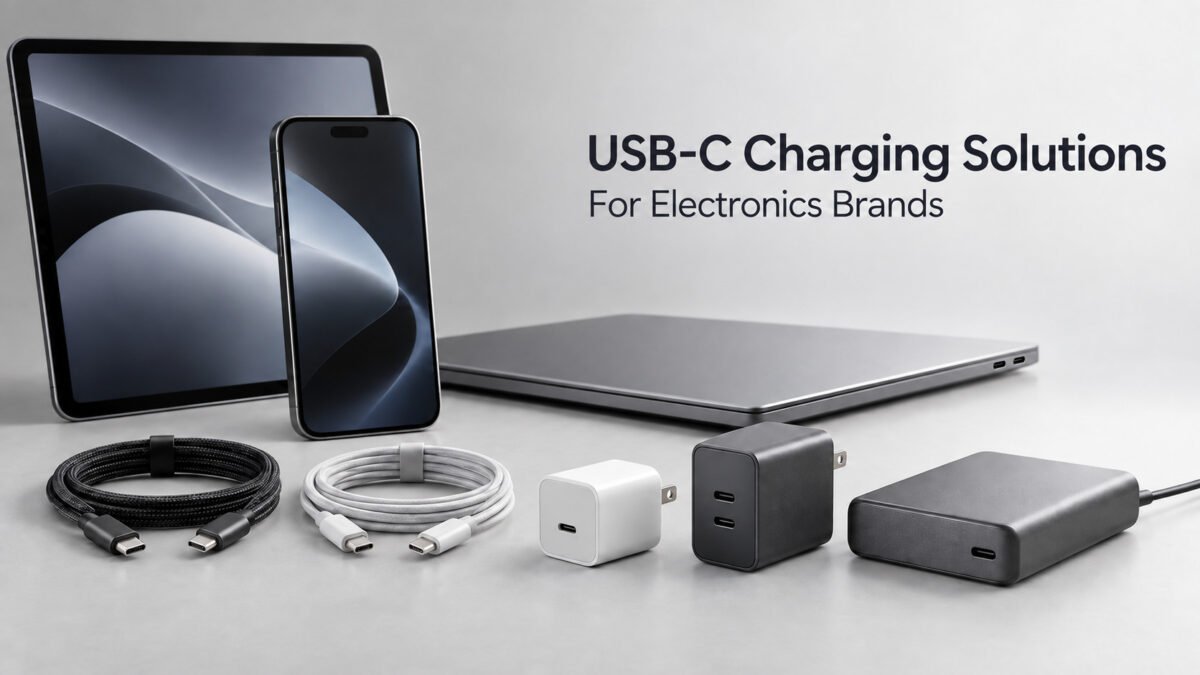
USB-C Charging Solutions for Electronics Brands
USB‑C Charging Solutions for Electronics Brands
Electronics brands launching or updating a device line need a charging setup that matches the device's power needs and the expectations of retail customers. A complete USB-C charging solution typically combines cables, chargers and power adapters that suit a wide range of consumer electronics, from smartphones and tablets to laptops and everyday accessories. This page serves as an entry point for procurement teams and brand managers: it outlines the USB-C product categories available from the manufacturer, the applications these components support, the factors that drive component selection, and the OEM services that can bring a branded charging line to market.
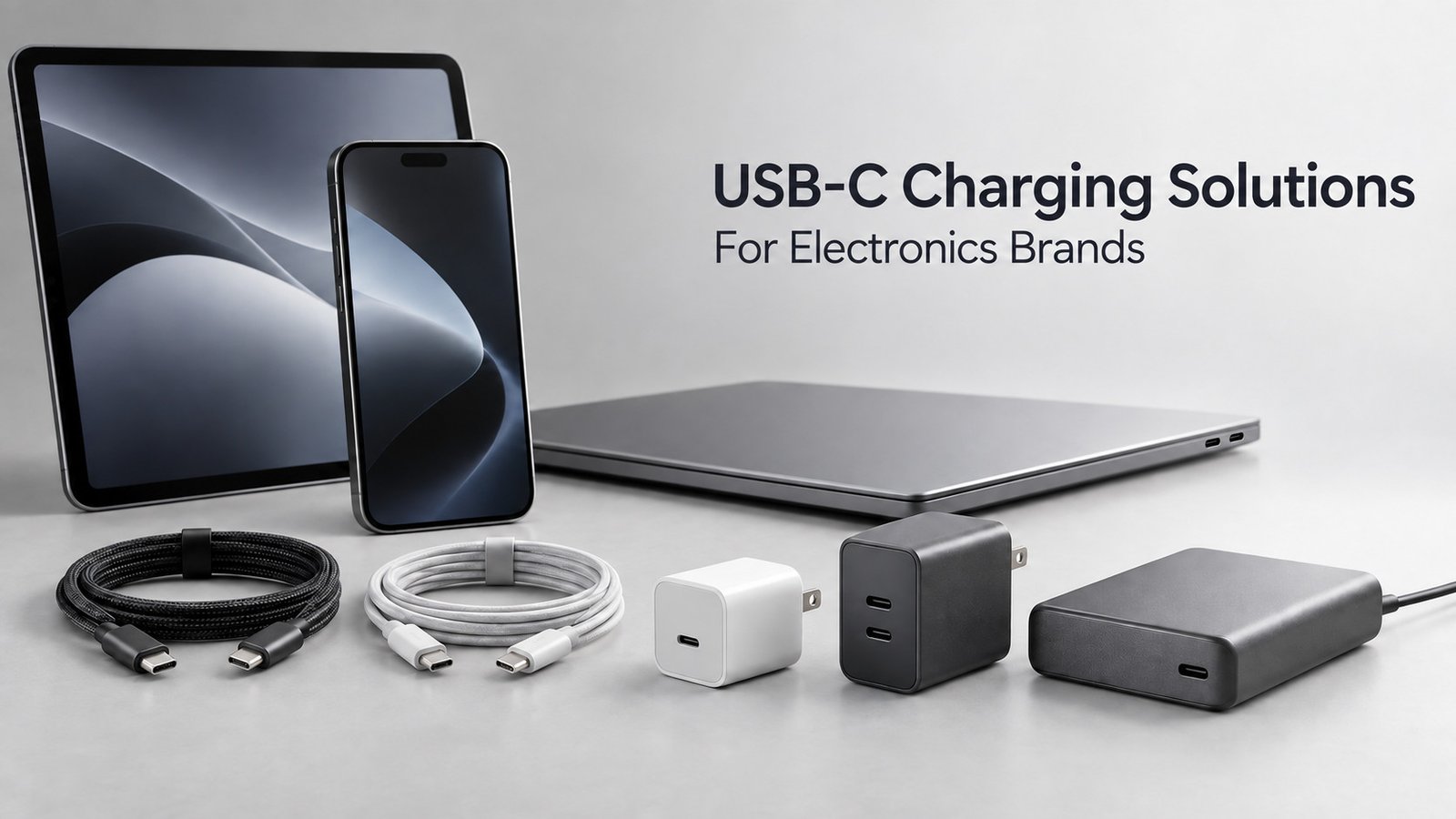
1. USB‑C Product Portfolio
USB-C has become the primary charging interface on a wide range of consumer electronics released in recent years. The portfolio covers three product categories — cables, chargers and power adapters — so a brand can source the charging components for an entire device line from one supplier and keep quality, compliance and packaging consistent across the range. As a USB-C accessories supplier, the manufacturer consolidates these categories under a documented internal quality system, with inspection points defined at production and pre-shipment stages according to the project quality plan.
1.1 USB‑C Cable
USB-C cables can support power delivery, data transfer or both, depending on their construction and specification. The manufacturer supplies cables in a wide range of specifications so that brands can match the cable to the application.
Specifications available:
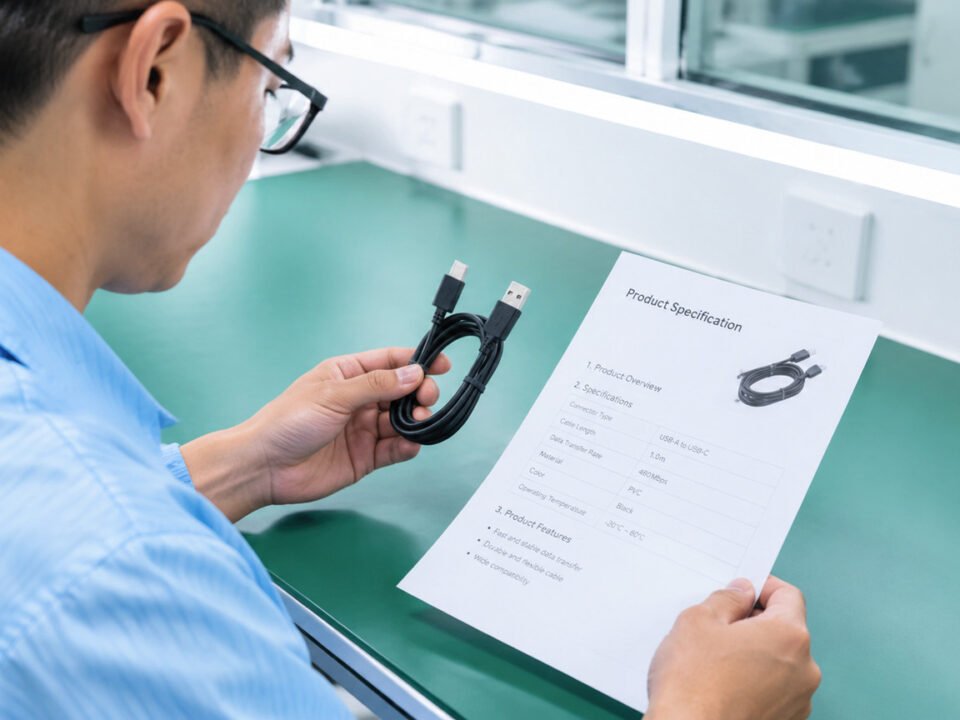
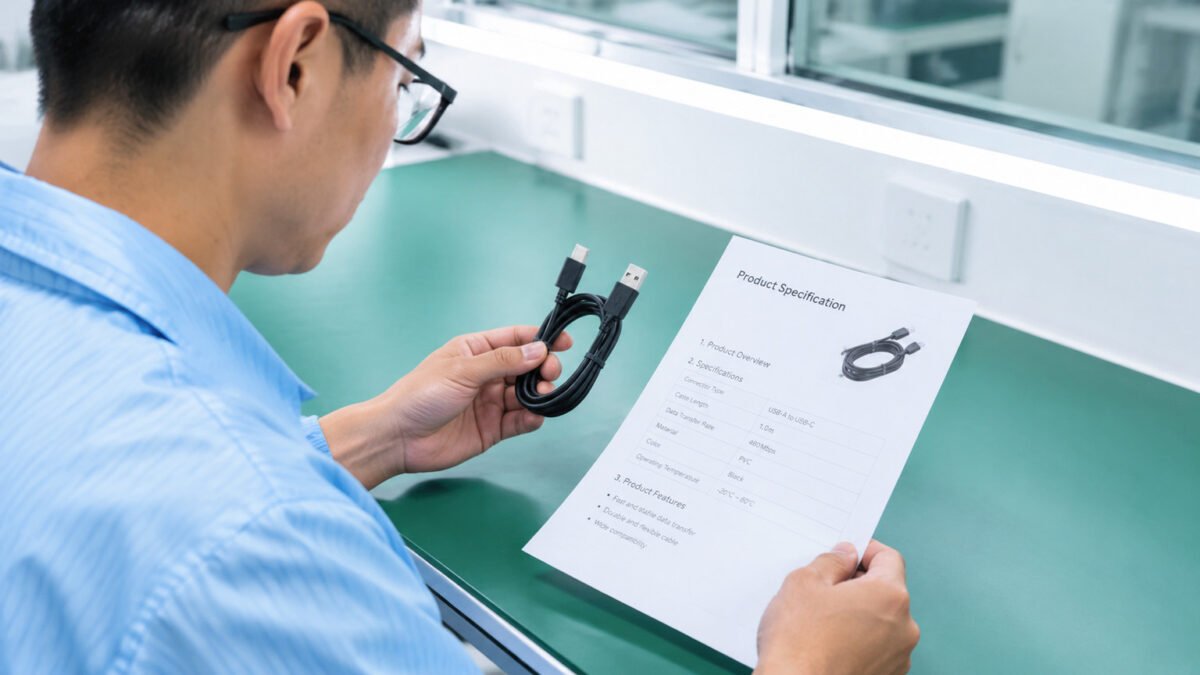
- Data transfer rates from 480 Mbps on USB 2.0 models up to 20 Gbit / s on selected high-speed models; available rates and maximum cable lengths depend on the selected model, and actual data performance is limited by the lowest capability of the cable, host and connected device.
- Current ratings of 3 A on standard cables; selected cables with an embedded e-marker support up to 5 A.
- Connector configurations including USB-C to USB-C and USB-C to USB-A, with other combinations available on request.
- Cable lengths from 0.15 m à 3 m, with custom lengths offered under OEM programs.
- Jacket materials including PVC, TPE and nylon braid; braided models provide additional abrasion resistance for daily use.
- Reinforced connector joints and strain relief options are available for applications requiring frequent handling; durability test data can be provided for selected models.
The reversible connector allows either orientation when plugging into the device, which simplifies use for end customers. Selected high-speed models use conductor layouts and shielding designed for their specified data rate and EMC requirements. Compliance documentation, material declarations and test reports are available for selected cable models according to the target market and customer requirements. Applicable documents may include RoHS declarations and relevant electrical or performance test reports. Certification status should be confirmed for the specific model before ordering.
1.2 USB‑C Chargers
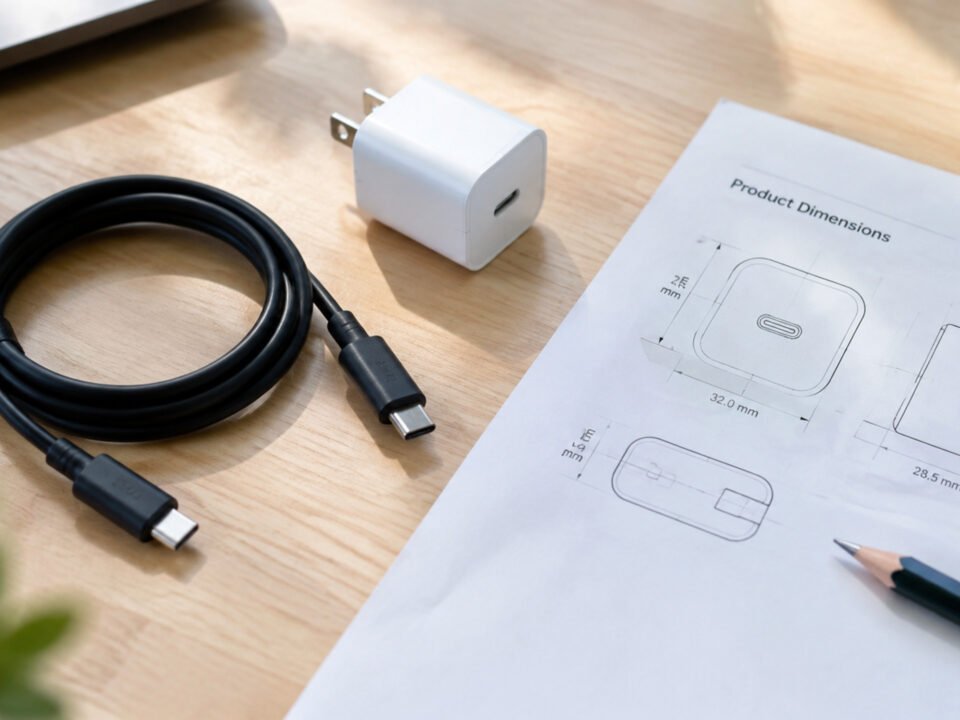
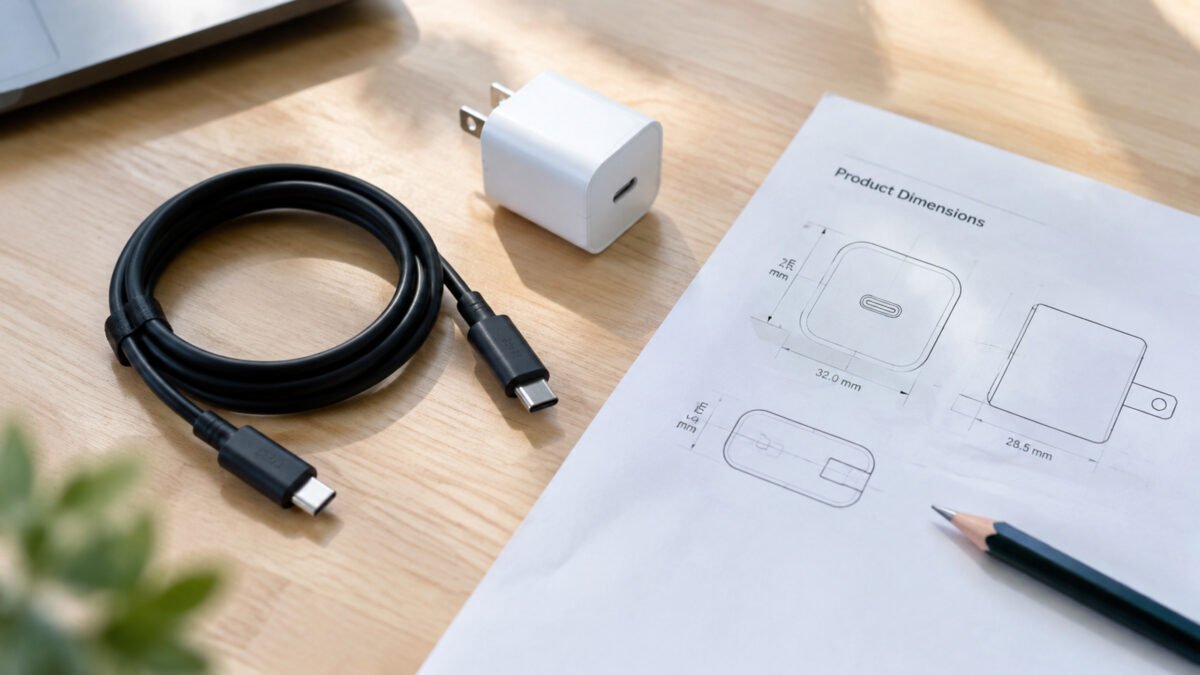
USB-C chargers are compact wall-mounted power supplies designed primarily for phones, tablets and portable electronics. Available models include single-port and multi-port configurations, with output ratings from 18 W à 100 W depending on the model and supported charging protocol.
Specifications available:
- Supported output profiles vary by model and charging protocol. Common USB Power Delivery profiles include 5 V, 9 V, 15 V et 20 V, with current up to 5 A on selected models. Additional voltage profiles may be available for specific designs or protocols.
- Fixed-pin and foldable-pin designs for US, EU, UK and AU markets; selected models use interchangeable plug heads for multi-region coverage.
- Single-port and multi-port configurations; multi-port models allow several devices to charge from one unit, and total output is rated for combined use.
- GaN-based designs are available on selected models and can support more compact product designs at higher output levels, depending on the thermal and electrical specification.
- Power indicators are available on selected models; indicator functions depend on the product design.
- Protection functions may include over-current, over-voltage, short-circuit and over-temperature protection, depending on the model. Safety certifications, EMC documentation and RoHS declarations are available for selected models and target markets. Exact certification status should be confirmed by model and destination country.
The charger, cable and connected device must support compatible charging profiles. Final charging power depends on the negotiated protocol, the charger's available output, the cable rating and the device's own input limit.
1.3 USB‑C Power Adapters
In this portfolio, USB-C power adapters refer to power supplies developed for laptops, docking stations and other devices that require sustained higher-power output. Depending on the product design, they may use a direct wall-plug construction, a detachable AC input cable or an integrated USB-C output cable. Available ratings range from 45 W à 100 W on selected models.
Specifications available:
- Output ratings up to 100 W on selected models (for example, 20 V / 5 A at 100 W).
- Wide input range of 100–240 V AC, 50/60 Hz on applicable models, supporting distribution across global markets.
- Interchangeable plug heads available on selected models for travel use.
- Compact housings with thermal management to maintain stable operation under sustained load.
- The required wattage and charging protocol vary by laptop model; the laptop manufacturer's specified input requirements should be confirmed before selection.
For hubs and docking stations with USB-C power pass-through, the adapter should provide enough power for both the dock and the connected laptop, because the power delivered to the laptop may be lower than the adapter's total rated output. Adapters in this range may also support high-capacity power banks, provided that the adapter and power bank use compatible USB-C charging profiles.
2. Applications
USB-C charging components appear across consumer electronics, and the same supply base can cover several product categories at once. The sections below describe common device categories served by the product range, along with typical component selections for each.
2.1 Mobile Devices
Smartphones and wireless earbud cases account for a large share of USB-C charging demand. For this category, the manufacturer typically recommends chargers in the 18–30 W range with 1 m cables, which keeps the setup compact for home and travel use. Shorter cables from 0.15 m à 0.3 m suit power banks and travel cases where space is limited, while 2 m cables are offered for bedside or desk use where a longer reach is convenient. Chargers at the lower end of the range are also adequate for smartwatches with a USB-C charging cradle and for small battery-powered gadgets.
2.2 Tablets
Tablets generally draw more power than phones and benefit from chargers in the 20–45 W range. A 1–2 m cable gives users the flexibility to keep the tablet in use while it charges, which matters for media consumption and video calls. Tablets that support data transfer over USB-C can pair with higher-speed cable models, so a single cable covers both charging and file sync. Where a tablet ships with a wall charger, the 20–45 W range provides enough margin for use while the display is on and the battery is low.
2.3 Laptops
Many USB-C laptops use adapters in the 45–100 W range, although the required wattage and charging protocol vary by model. The laptop manufacturer's specified input requirements should be confirmed before selecting the adapter. Ultraportable models commonly sit in the 45–65 W range, while larger notebooks may require higher output.
2.4 Accessories
Portable speakers, keyboards, mice, headsets, handheld game consoles and power banks increasingly use USB-C for charging. Their power requirements vary considerably by device. Many low-power accessories can be supplied with compact chargers, while game consoles and power banks may require higher-output USB PD models. Cable length and charger output should therefore be selected according to the device specification and packaging format. Bundled charger-and-cable sets can simplify sourcing and provide a consistent retail package for accessory product lines.
3. Product Selection Factors
Three factors are worth checking when building a charging solution for a new device line: the power requirement of the device, the type of cable, and the output of the charger or adapter. Working through these factors before sourcing helps keep the component list aligned with the device's actual needs.
3.1 Power Requirement
The charging system should be selected according to the device's required input power and supported charging protocol.
- Check the device manufacturer's recommended wattage, voltage profiles and supported charging protocols before selecting the charger.
- Confirm that the charger provides a compatible USB Power Delivery or other required charging profile. A higher maximum wattage alone does not mean faster charging.
- Select a cable with the current and power rating required by the application. For USB-C to USB-C charging above 60 W, use a compatible 5 A electronically marked cable.
- For multi-port chargers, check both the total rated output and the power available from each port when several devices are connected.
- A higher-rated compatible charger may support additional devices or future product generations, but the actual charging power remains dependent on the charger, cable and connected device.
3.2 Cable Type

The cable must carry the current required by the application and, where data transfer is part of the use case, the corresponding data rate.
- Standard cables rated at 3 A suit phone, tablet and accessory charging.
- For USB-C to USB-C charging at up to 60 W, a compliant 3 A cable is generally sufficient. Charging above 60 W requires a compatible 5 A electronically marked cable, together with a charger and device that support the required USB Power Delivery profile.
- For file transfer or high-speed sync, select cable models with the matching data rate so the cable does not limit the connection.
- Cable length should match the usage scenario — short for travel, longer for desks — while remaining practical to carry.
- Jacket material and connector construction affect durability; braided jackets and reinforced strain relief withstand daily handling better.
3.3 Charger Output
- Match the output voltage range and current to the device requirement so the charger operates within its specified range.
- For multi-port chargers, confirm that total output is sufficient when several ports are in use at the same time, and check how output is shared between ports.
- Select the plug type for the target market — US, EU, UK, AU or an interchangeable design for global distribution.
- Where the device line spans phones and laptops, a higher-output charger that supports the required charging profiles may cover both categories and help reduce the number of SKUs.
4. OEM Capabilities
Beyond standard products, the manufacturer provides OEM and ODM services that let brands adapt charging solutions to their own device lines and market positioning. Programs typically start from a sample evaluation and move through design, tooling, pilot production and volume shipment. Available documentation, validation samples and test reports are agreed according to the product specification, target market and project requirements.
4.1 Custom Design
- Custom housing materials, colors and finishes that follow the brand's device design language and retail presentation.
- Custom cable lengths, jacket materials, connector configurations and colorways defined by the target application.
- Custom output specifications and port layouts developed around the device's power requirement, reviewed with the customer before tooling.
- Mold development and tooling for structural designs that differ from the standard range, subject to order quantity and program timeline.
- Samples provided for validation before production begins; design adjustments are documented through an approved change process.
4.2 Branding
- Logo application through silk-screen printing, laser engraving or UV printing on chargers, adapters and cable connectors, depending on the surface material.
- Custom colorways, surface textures and finish treatments to match the brand identity across the full product set.
- Branded instruction sheets, safety labels and compliance documentation prepared for the target market.
- Artwork support for retail packaging, including logo placement, product imagery and regulatory text, coordinated with the factory's production schedule.
4.3 Packaging
- Retail-ready packaging options including paper boxes, blister packs and hang cards, sized to the product and the retail channel.
- Multi-language labeling for international markets, with artwork and text provided by the brand or prepared with factory support.
- Bulk and export packaging designed to protect products through long-distance shipping, including dividers, foam inserts and moisture protection where required.
- Custom carton printing can include brand identification, product specifications, handling information and applicable compliance markings. Display-ready carton structures can be developed for selected retail programs.
USB-C charging solutions can be configured for phones, tablets, laptops and connected accessories, with cables, chargers, power adapters and retail packaging developed around the device and target market. To request a recommendation or quotation, please provide the device input specification, required charging protocol, cable configuration, target country, estimated order quantity and packaging requirements. Samples and model-specific compliance documents are available for evaluation.
Need a USB‑C Charging Solution for Your Brand?
Whether you need standard USB-C cables, chargers, and power adapters, or fully customized OEM/ODM solutions with specific power ratings, connector configurations, housing designs, branding, and retail packaging, our team can help you review the requirements and recommend a standard model or develop a custom configuration for your device line. From 18W to 100W, USB 2.0 to 20Gbps, and compact chargers to GaN designs, we support electronics brands with competitive pricing and flexible MOQ.