

USB Charger and Power Adapter Performance Guide
USB Charger and Power Adapter Performance Guide
USB charger and power adapter performance specifications determine whether a power product can reliably supply the correct voltage and current to connected devices across expected operating conditions. For procurement professionals and brand managers, understanding the relationship between output performance, thermal characteristics and long-term reliability is essential for selecting power products that meet target device requirements and regulatory standards.
1. Output Performance
Output performance defines the electrical characteristics delivered by a charger or adapter. For USB PD chargers, voltage stability and current capability determine whether the product can deliver the negotiated power profile. For fixed-output adapters, the same parameters determine whether the adapter can maintain its rated DC output under the specified input, load and environmental conditions.
1.1 Voltage Stability
Voltage stability refers to a product's ability to maintain its output voltage within specified tolerances as input and load conditions change. For fixed-supply PDOs, USB Power Delivery defines 5V, 9V, 15V and 20V in Standard Power Range, with 28V, 36V and 48V available in Extended Power Range. The profiles offered depend on the charger design and advertised PDOs. Fixed-output adapters do not negotiate a PDO and instead maintain the rated DC output stated in the product specification.
Key Performance Parameters:
- Load regulation: output voltage variation as load current changes across the specified operating range. The allowable limit should be defined for each output mode and verified against the applicable product specification and USB PD requirements where relevant.
- Line regulation: output voltage variation when AC input voltage changes across the rated range
- Transient response: voltage deviation and recovery time when load current steps up or down rapidly; USB PD compliant chargers recover to within regulation tolerance within a defined time window
- Ripple and noise: AC component superimposed on the DC output, measured in millivolts peak-to-peak; lower ripple indicates cleaner power delivery to sensitive device electronics
- Voltage accuracy during PD negotiation: the charger must supply the negotiated PDO voltage within the tolerance specified by the USB PD specification
Voltage stability is important for safe and reliable charging operation. Excessive voltage deviation may trigger device-side protection circuits, causing charging interruption or reduced charging speed. In USB PD systems, the negotiated voltage must remain within specification to maintain compliant power delivery operation.
1.2 Current Capability
Current capability defines the maximum sustained output current a charger or adapter can deliver at each voltage level without exceeding thermal or safety limits. USB Power Delivery supports fixed supply voltages including 5V, 9V, 15V and 20V in Standard Power Range, with 28V, 36V and 48V available in Extended Power Range. The voltage and current combinations actually offered depend on the charger's advertised Power Data Objects and rated output. Possible examples include 20V at 5A for 100W, 28V at 5A for 140W, 36V at 5A for 180W and 48V at 5A for 240W.
Key Performance Parameters:
- Rated output current: maximum sustained current at each PDO voltage level, as specified in the product datasheet
- Current limiting: the charger should control or reduce output when the load exceeds the permitted current for the negotiated operating mode. The threshold and response method depend on the controller design, USB PD requirements and product safety specification
- Sustained output capability: published output ratings should represent the current that the product can supply under the specified input voltage, ambient temperature, port configuration and operating conditions. Short transient behavior should not be presented as a higher continuous power rating
- Current sharing: in multi-port chargers, total output current is distributed across connected ports based on the charger's configured power distribution strategy
- Cable dependency: USB-C operation above 3A requires an electronically marked 5A cable. USB PD Extended Power Range applications also require a cable designed and electronically marked for the applicable EPR power level. Actual charging power is limited by the charger, connected device, cable rating and negotiated USB PD profile
Current capability depends on factors such as transformer design, semiconductor ratings, PCB conductor capacity, connector ratings and thermal management. A charger rated for 20V at 5A should sustain 100W under the input voltage, ambient temperature, port configuration and test conditions specified for that model. Multi-port products may use different power-allocation profiles depending on the number and type of connected devices.
2. Thermal Performance
Thermal performance defines how a charger or adapter manages internally generated heat during operation. Power conversion efficiency, thermal design and operating condition limits determine whether a product can sustain rated output power without thermal throttling, derating or shutdown. Thermal performance directly affects product lifespan, user safety and regulatory compliance.
2.1 Heat Management
Heat management refers to the thermal design characteristics that dissipate conversion losses to the external environment. Switching power conversion generates heat in the transformer, MOSFETs, rectifiers and PCB conductors. The thermal design must transfer this heat to the external housing surface and surrounding air without exceeding internal component temperature limits.
Key Performance Parameters:
- Conversion efficiency: the ratio of output power to input power. Efficiency varies with input voltage, output voltage, load level, power-conversion topology and product design. Values should be taken from test data for the specific model rather than from a general charger category
- Temperature rise: difference between external housing surface temperature and ambient temperature at rated output power; regulatory standards specify maximum touchable surface temperatures for consumer safety
- Thermal protection: over-temperature protection (OTP) circuit that reduces output power or shuts down the charger when internal temperature exceeds a safe threshold, preventing component damage or safety hazards
- Thermal derating: automatic output power reduction at elevated ambient temperatures to maintain internal component temperatures within safe limits; selected models reduce output power above a specified ambient temperature threshold
- Cooling method: most consumer USB chargers use passive cooling (natural convection through housing surface); higher-power desktop chargers and charging stations may incorporate active cooling (forced air) on selected models
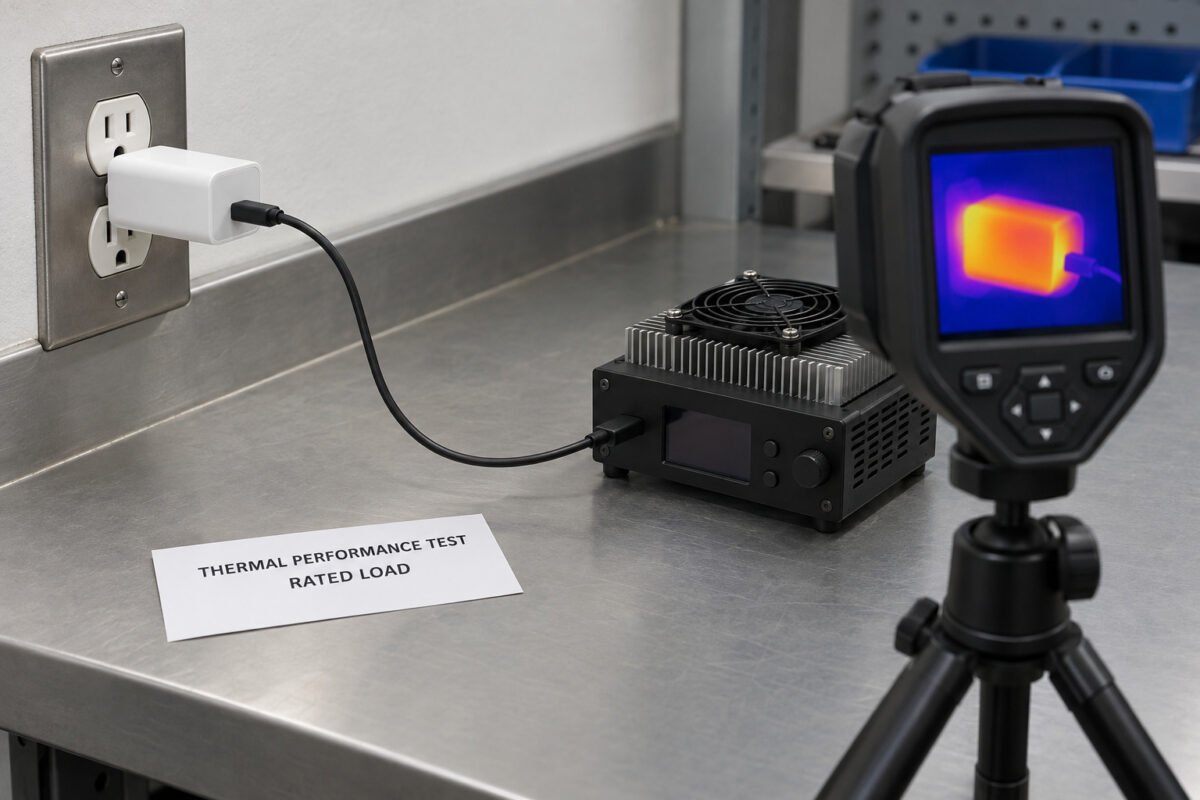
Heat management quality is evaluated through temperature rise testing at rated load in specified ambient conditions. Regulatory standards including IEC 62368-1 define maximum touchable surface temperature limits and require thermal testing under normal, abnormal and fault conditions. Thermal test data — including surface temperature rise, internal component temperatures and thermal protection activation thresholds — should be verified during product evaluation.
2.2 Operating Conditions
Operating conditions define the input and environmental ranges within which a charger or adapter maintains its specified performance. Input voltage range, ambient temperature range, humidity and altitude affect power conversion stability, thermal performance and long-term reliability. Products are rated for specific operating conditions that define the boundaries of safe and compliant operation.
Key Operating Condition Parameters:
- Input voltage range: many chargers intended for international use are designed for a nominal 100–240 V AC, 50/60 Hz input range. The actual rated input range must be confirmed from the product label, datasheet and applicable test report
- Ambient temperature range: operating temperature range within which the charger delivers rated output power. Typical values for selected models may include 0 °C to +40 °C for consumer-grade products; industrial-grade selected models may be rated for −20 °C to +60 °C
- Storage temperature range: non-operating temperature range. Typical values for selected models may include −20 °C to +70 °C for consumer models; wider ranges may be available for industrial-grade products depending on the product specification
- Humidity: operating humidity range. Typical values for selected models may include 5% to 90% RH (non-condensing) for consumer models; condensation-resistant designs may be available for selected industrial applications depending on the product specification
- Altitude: maximum operating altitude. Depending on the product specification, typical values for selected models may include 2,000 m; derating may apply above this altitude due to reduced air density affecting convection cooling
- Market compliance requirements: applicable product safety standards may include IEC 62368-1 and corresponding national or regional adoptions. EMC, market-access and energy-efficiency requirements depend on the product design and destination market and may include FCC equipment authorization requirements, applicable EU conformity requirements and U.S. DOE external power supply efficiency rules. Compliance documents should be verified for the specific model and market
Operating condition ratings define the product application boundaries. A charger rated for 0 °C to +40 °C ambient temperature may not sustain rated output power in a commercial charging station installed in a non-air-conditioned environment with ambient temperatures reaching +50 °C. Operating condition specifications should be matched to the intended deployment environment, and regulatory certifications should be verified for the destination market.
3. Reliability
Reliability defines the long-term performance consistency and durability of a charger or adapter under sustained operation. Two primary aspects — long-term operation and product stability — determine whether a power product maintains specified output performance across its designed service life under expected use conditions.
3.1 Long-term Operation
Long-term operation refers to the power product's ability to sustain rated output performance over extended operating periods. Component aging, thermal cycling, electrical stress and mechanical stress accumulate during operation and may degrade output performance, efficiency or safety protection functions over time.
Key Reliability Parameters:
- MTBF or reliability prediction: a calculated reliability metric based on a stated prediction model, component data and operating conditions. It can support design comparison but should not be presented as the guaranteed service life or warranty period of an individual charger
- Aging or burn-in testing: operation of selected units under defined load, input and ambient conditions to identify early failures and confirm output stability. Accelerated life and thermal-cycling tests are separate validation methods and should be described with their test duration, temperature, load profile and acceptance criteria
- Capacitor lifespan: electrolytic capacitor operating life is a primary factor in charger service life; capacitor manufacturers specify lifespan at rated temperature (e.g., 2,000–10,000+ hours at 105 °C), and actual service life depends on operating temperature and ripple current
- Thermal cycling: repeated temperature changes from power on/off cycles cause differential thermal expansion and contraction of components, solder joints and PCB traces; thermal cycling testing helps assess structural integrity under defined test conditions
- Surge and transient protection: the product's withstand capability depends on surge amplitude, waveform, event count, circuit design and protection component ratings. Some components, particularly MOVs exposed to repeated high-energy events, may age over time
Long-term operation reliability is evaluated through aging tests, thermal cycling tests and surge immunity tests. Reliability prediction data, aging test conditions and component derating analysis should be reviewed during supplier evaluation. Products designed with adequate component derating — operating components below their maximum rated stress — typically achieve longer service life than products operating components near rated limits.
3.2 Product Stability
Product stability refers to the consistency of output performance over defined validation periods and across production units. Evaluation should confirm that output voltage, current and efficiency remain within specified limits under the stated test conditions and acceptance criteria.
Key Stability Parameters:
- Output parameter drift: change in output voltage, ripple or efficiency over operating time; minimal drift indicates stable power conversion circuit design and adequate component selection
- Production consistency: variation in output performance parameters across production units, controlled through component tolerance selection, production testing and quality management processes
- Production test coverage: the supplier should define which electrical and safety checks are performed on every finished unit and which tests are conducted through batch sampling. Test items, limits, equipment and record-retention requirements should be agreed for the specific project
- Batch and periodic testing: selected units may undergo appearance, functional, aging, thermal, mechanical or immunity testing according to the agreed inspection plan. Sampling level, test frequency and acceptance criteria should be defined separately for each applicable test
- Safety protection verification: over-voltage protection (OVP), over-current protection (OCP), short-circuit protection (SCP) and over-temperature protection (OTP) should be validated according to the applicable test plan and acceptance criteria
- Quality management: supplier qualification should review the applicable quality management certification, certificate scope, incoming inspection, in-process control, final inspection and corrective-action procedures
Product stability is maintained through component quality control, production process control and comprehensive testing. Stable output performance over time reduces field failure rates and warranty claims, supporting brand reputation and customer satisfaction. Production consistency data — including test yield rates, sampling results and field failure rate statistics — provides objective evidence of product stability across production batches.
4. Applicable Products
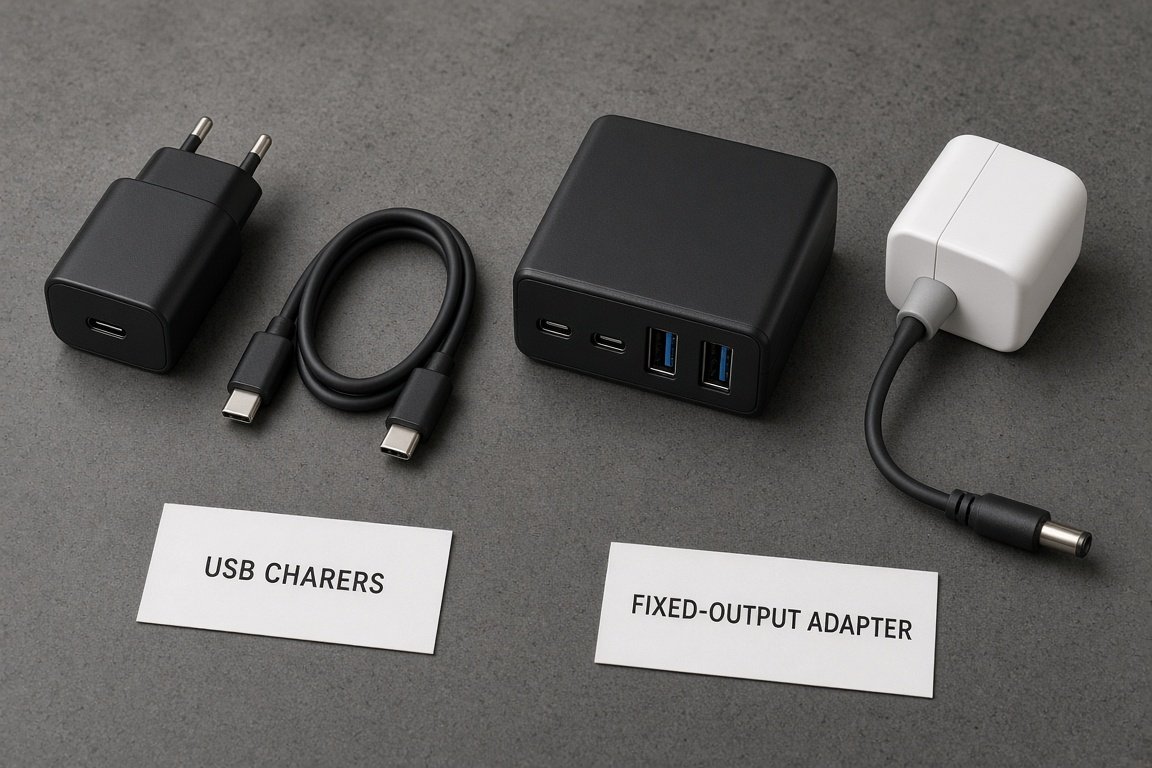
The performance specification framework outlined in this guide applies to two primary commercial product categories: USB chargers and fixed-output power adapters. While both product types convert AC input to regulated DC output, their application focus and performance requirements differ based on target device categories and deployment environments.
Cargador USB
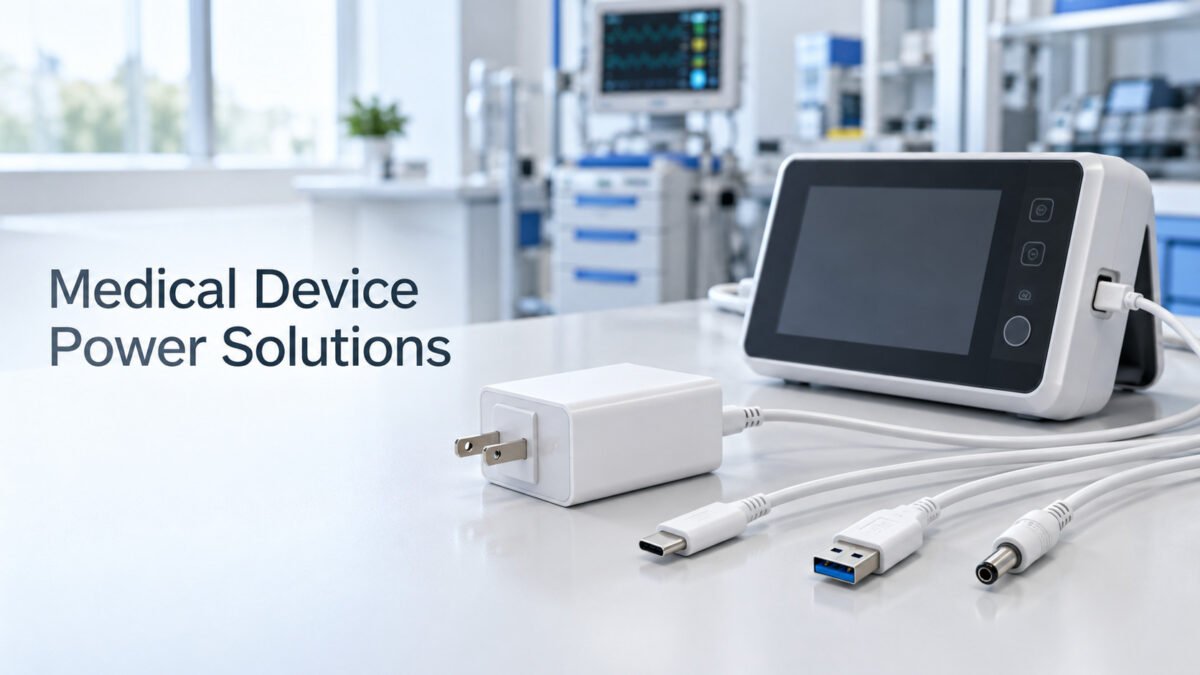
- Products designed to supply regulated DC power to USB-connected devices including smartphones, tablets, laptops and accessories
- Output interface: USB-C with USB Power Delivery on applicable models, USB-A with model-specific charging protocols, or multi-port configurations. Supported protocols, voltage profiles and power allocation should be confirmed for each model
- Power range: varies by model. USB PD Extended Power Range supports system power levels up to 240W, although the available charger portfolio may have a lower maximum rating
- Applicable specifications: USB Power Delivery and USB Type-C requirements appropriate to the product design. Supported voltage, current, power and protocol functions must be confirmed for each model
- Typical applications: consumer device charging, commercial charging stations, multi-device desktop charging and OEM brand projects
Adaptador de corriente
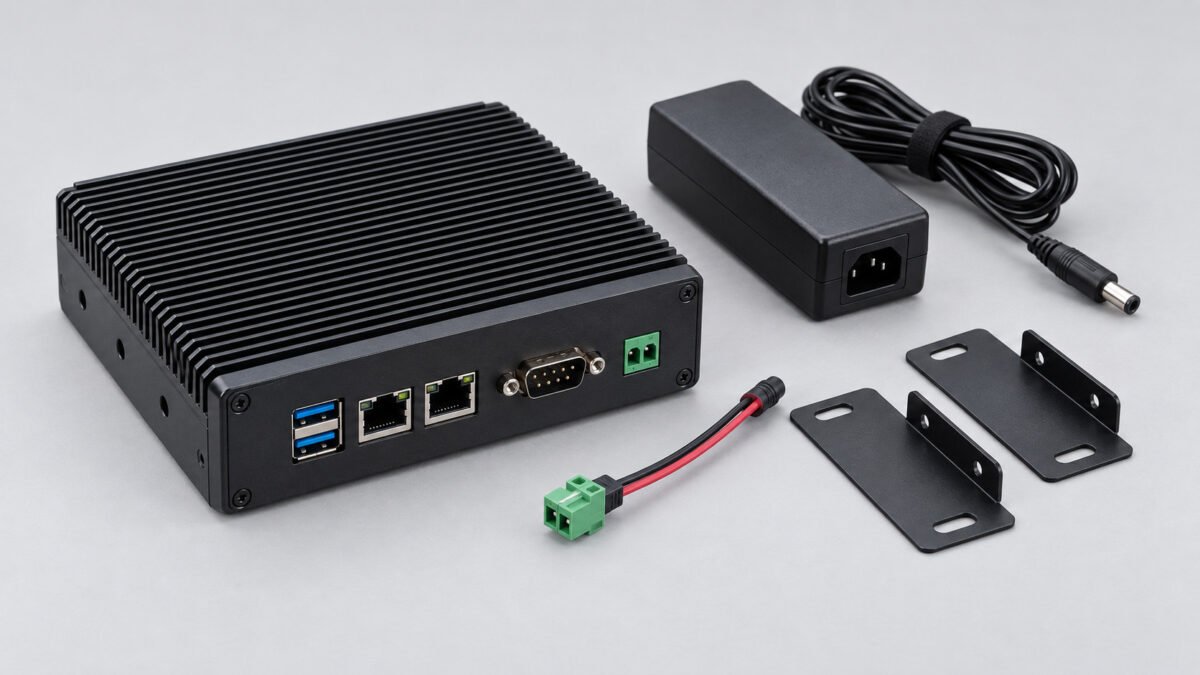
- Products designed to supply regulated DC power to non-USB devices through barrel connectors, terminal blocks or custom DC output connectors
- Output interface: fixed DC connector (5.5 × 2.1 mm, 5.5 × 2.5 mm, 3.5 × 1.35 mm and custom designs) or bare wire leads
- Power range: depends on the adapter model, output voltage, rated current, connector, thermal design and target-device requirements. Available power ratings should be confirmed from the current product portfolio
- Applicable specifications: IEC 62368-1 (audio/video, information and communication technology equipment safety), applicable efficiency standards and destination-market requirements
- Typical applications: consumer electronics power supply, industrial equipment power, networking device power and OEM brand projects
Both USB chargers and power adapters require evaluation against the output performance, thermal performance and reliability parameters described in this guide. The specific test methods, acceptance criteria and regulatory requirements vary based on product type, target market and application environment.
5. Request a Power Product Evaluation
USB charger and power adapter projects can be evaluated according to the required output profile, input range, port configuration, operating environment, destination market and validation requirements. Available customization, testing, documentation, minimum order quantity and pricing depend on the selected product platform and project scope.
Provide the target device, required voltage and current, USB PD profiles where applicable, operating conditions, destination market and estimated quantity when requesting a product recommendation or quotation.
Need Help Evaluating a Power Product?
Whether you need USB chargers, fixed-output power adapters, or fully customized power solutions with specific output profiles, thermal requirements, and regulatory certifications, our team can help you evaluate and specify the right product for your application. From consumer electronics to industrial equipment, we support OEM/ODM projects with competitive pricing and flexible MOQ.