

Guía de especificaciones del adaptador de corriente
Guía de especificaciones del adaptador de corriente
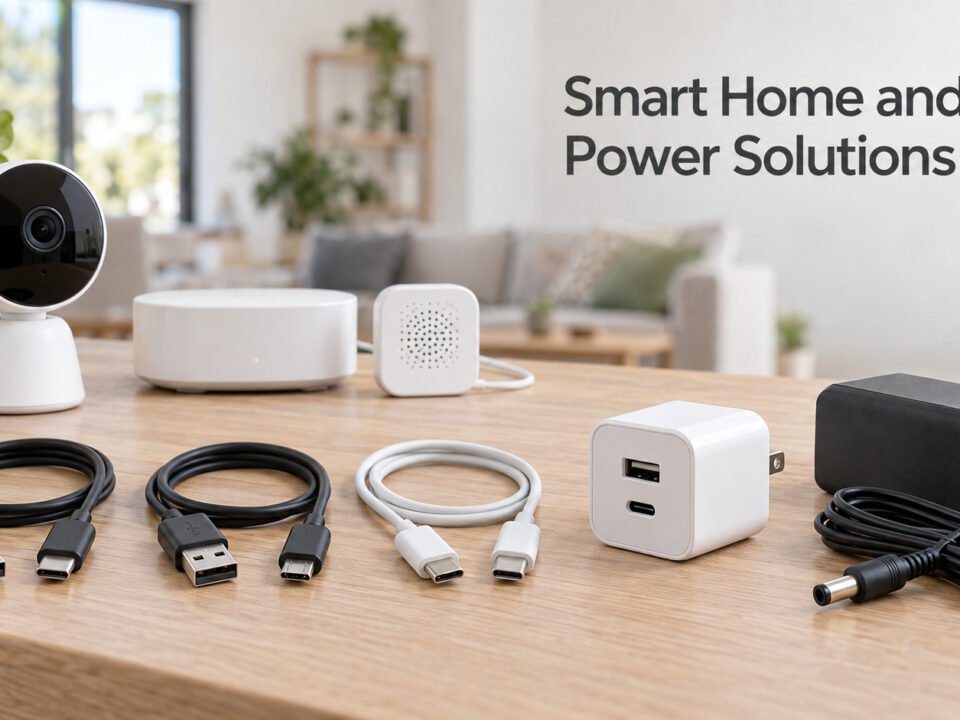
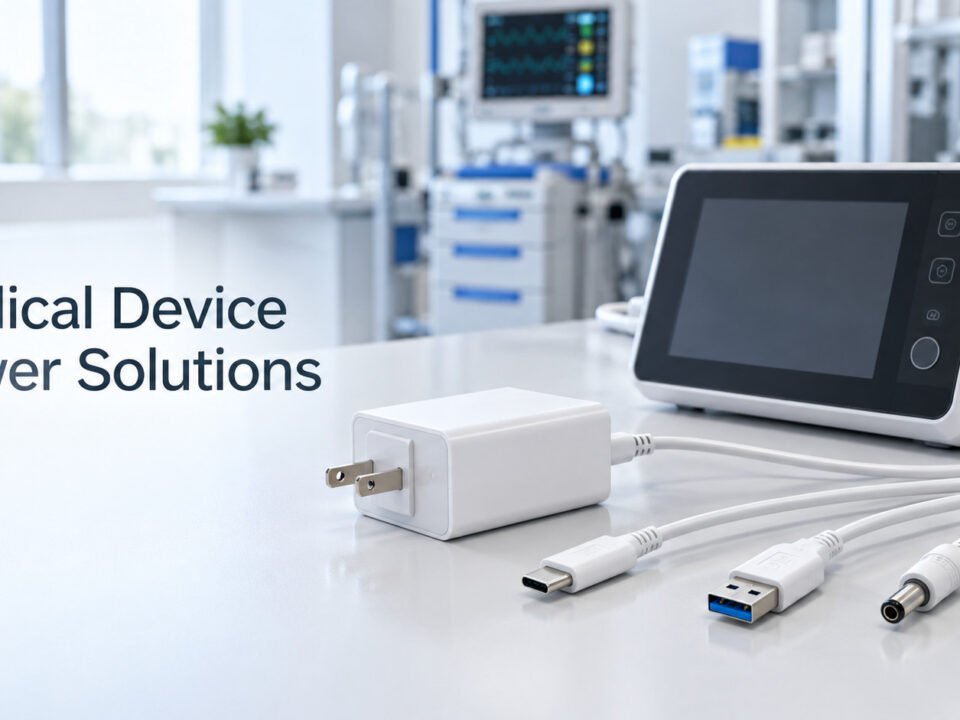
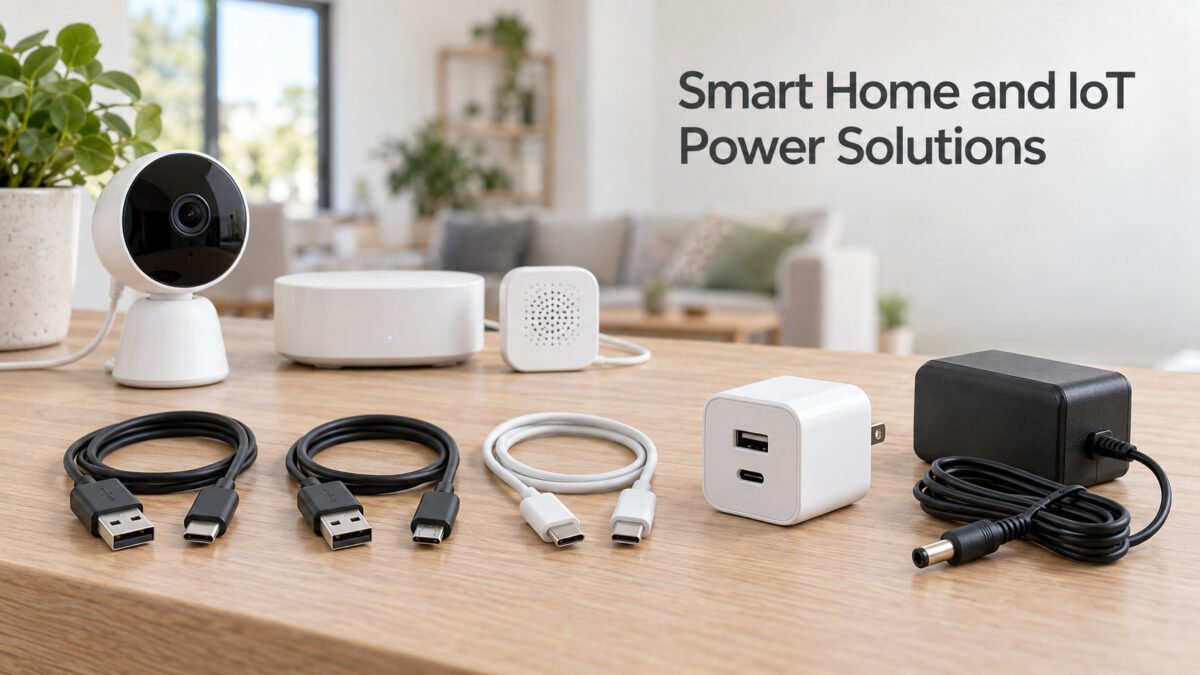
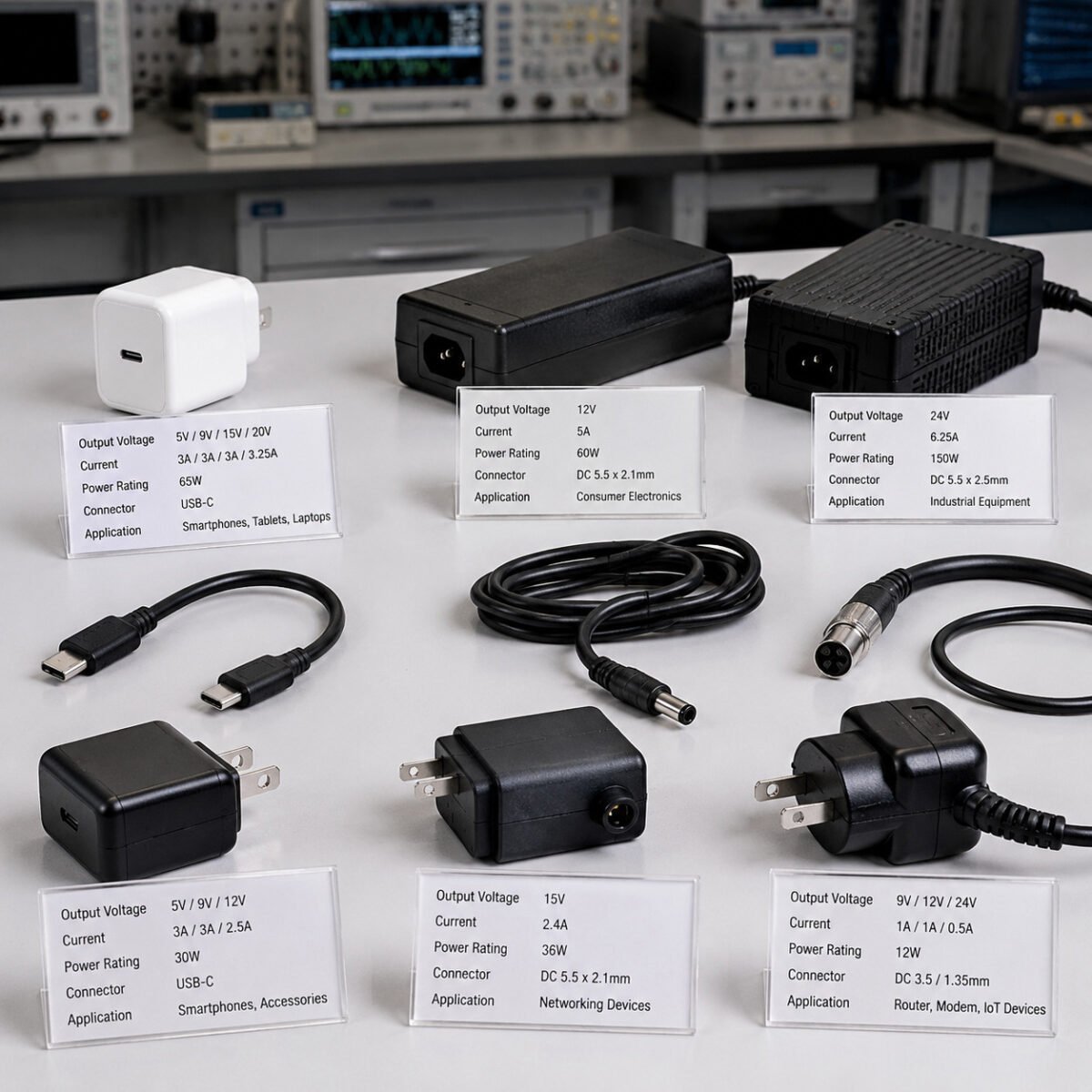
AC/DC power adapters are available in a wide range of output specifications, connector options, power ratings, and mechanical designs for consumer, industrial, and OEM applications. The product range includes AC/DC adapters, USB chargers, USB-C PD chargers, and customized power solutions. This guide explains the key specifications buyers should consider when selecting a suitable adapter solution.
| Power Range | Aplicaciones típicas |
|---|---|
| 5W–20W | Small consumer electronics |
| 30W–100W | USB-C PD chargers and laptops |
| 100W–240W | High-power USB-C PD devices |
| 50W–300W+ | Industrial and professional equipment |

1. Core Specifications
1.1 Output
Voltaje
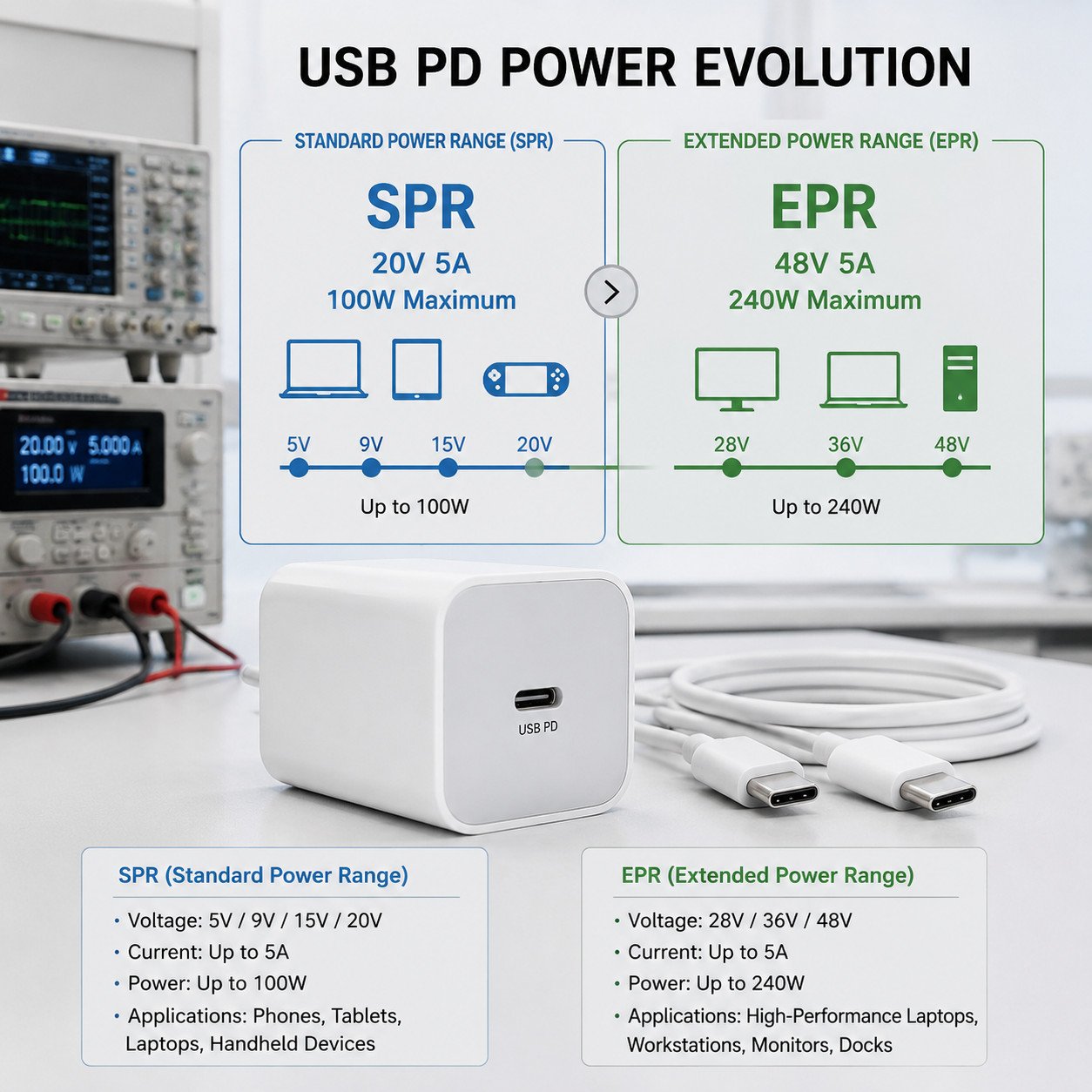
Output voltage defines the DC level delivered to the end device and must match the device's input specification within an acceptable tolerance band. Common fixed output voltages include 5V, 9V, 12V, 15V, 19V, 20V, 24V, y 48V. Voltage accuracy is generally maintained within ±5% of the nominal value under steady-state load. Adapters compliant with USB Power Delivery (USB PD) Revision 3.1 support fixed voltage levels of 5V, 9V, 15V, and 20V within the Standard Power Range (SPR), and extend to 28V, 36V, and 48V within the Extended Power Range (EPR). USB PD 3.1 EPR also introduces Adjustable Voltage Supply (AVS), allowing compatible devices to negotiate intermediate voltage levels within supported EPR ranges for optimized power delivery. Multi-voltage adapters that offer selectable output via a switch or auto-detection circuit accommodate devices with different voltage requirements, though fixed-voltage designs remain preferred for applications where the load specification is known and stable.
Actual
Rated output current determines the maximum load the AC adapter can sustain under continuous operation without triggering protection or exceeding thermal limits. Common ratings range from 0.5A a 5A depending on the application and power class. USB PD 3.1 specifies a maximum current of 5A for EPR operation, while USB PD SPR adapters commonly support up to 3A or 5A depending on cable capability, product design, and power requirements. The rated current must be matched to or exceed the connected device's draw to prevent thermal overload and voltage droop. Adapters incorporate current-limiting circuits that reduce or cut output when the load exceeds the rated threshold, protecting both the adapter and the connected device. Inrush current — the brief surge drawn when the adapter is first connected to AC mains — is also considered in design, as it affects fuse sizing and inrush-limiting component selection. Selecting sufficient output current ensures stable operation and prevents performance issues caused by insufficient power delivery.
Wattage
Wattage represents the total power delivery capacity, calculated as the product of rated output voltage and current. Within the USB PD framework, SPR supports up to 100W (20V at 5A) when used with compatible 5A-rated USB-C cables, while EPR extends the ceiling to 240 W (48V at 5A). Non-USB-PD power supply adapters span a wide range of wattage classes, from 5W for low-power consumer electronics to 300W for industrial equipment. Selecting the appropriate wattage class depends on the target device's peak power consumption and anticipated load headroom — a common guideline suggests 20–30% headroom above the device's maximum draw to account for inrush transients and component aging. Energy efficiency requirements are defined per the US Department of Energy (DOE) Level VI or EU ErP Tier 2 standards, requiring minimum average active-mode efficiency and limiting no-load power consumption, with specific requirements depending on adapter power class and regional standards. Active power factor correction (PFC) is commonly applied in higher-power adapters, especially designs above certain regulatory thresholds, depending on market requirements.
1.2 Input
Entrada de CA
AC input specifications define the voltage and frequency range the adapter accepts from the mains supply. A wide range of desktop and wall-plug adapters are designed for universal AC input at 100–240V, 50/60Hz, enabling single-SKU deployment across regions with differing grid standards. Adapters intended for region-specific markets may be configured for narrower input ranges (e.g., 200–240V, 50Hz) to optimize cost and component sizing. The input stage incorporates EMI filtering to suppress conducted emissions per FCC Part 15 Class B or CISPR 32, along with inrush current limiting and surge protection to handle transient voltage spikes from the mains. Certain designs are configured to meet surge withstand requirements per IEC 61000-4-5, depending on application and market requirements.
Tipo De Enchufe
The AC input plug must match the wall receptacle standard of the target market. Common configurations include:
- Type A — NEMA 1-15 (2-pin), commonly used in North America, Japan, and selected countries with regional voltage differences
- Tipo C — CEE 7/16 Europlug (2-pin, 2.5A, 250V), used across continental Europe
- Type G — BS 1363 (3-pin with fuse, 13A, 250V), used in the United Kingdom and several Commonwealth markets
- Type I — AS/NZS 3112 (Australia/New Zealand), also used in several other markets including China with different national standards
Desktop adapters frequently use a detachable IEC C13 or C5 mains cord, allowing the same adapter body to ship with different region-specific cables. Wall-plug adapters integrate the AC plug directly into the housing and require per-region SKU management. Interchangeable plug systems — where a single adapter accepts snap-on plug heads for different regions — reduce SKU count but add mechanical complexity and require additional safety certification.
1.3 Connector
Enchufe de CC
The DC output connector interfaces the adapter cable to the device. Common barrel connector sizes include 5.5 × 2.1mm, 5.5 × 2.5mm, 4.0 × 1.7mm, y 3.5 × 1.35mm, with outer diameter and inner pin dimensions defined by the device manufacturer's specification. The contact interface must maintain low contact resistance under the rated current; barrel connector current ratings vary by connector size, contact design, and application requirements. USB Type-C connectors are widely used for USB PD chargers, supporting reversible connection and power negotiation. Up to 5A operation requires compatible USB-C cables with appropriate current ratings and E-Marker identification. Locking DC connectors (twist-lock or bayonet-type) are available for industrial and medical applications where accidental disconnection poses operational risk. Pin polarity (center-positive or center-negative) must be confirmed at the design stage, as reverse polarity can permanently damage connected equipment.
1.4 Cable
The DC output cable carries the specified current with minimal voltage drop between the adapter output and the device input. Cable gauge is selected based on rated current and length — thinner conductors increase resistance and voltage loss, particularly over extended cable runs. DC output cables are selected according to output current, cable length, voltage drop requirements, and application conditions; common conductor sizes vary widely depending on product specifications. For USB PD EPR applications at 5A, cables must be rated and marked for EPR operation per the USB Type-C Cable and Connector Specification. Cable jacket materials (PVC, TPE, or braided nylon) are chosen based on the operating environment, with optional versions offering reinforced strain relief for high-cycle insertion durability.
1.5 Mechanical
Tamaño
Adapter dimensions affect packaging, thermal management, and end-user ergonomics. Wall-plug form factors aim for a compact footprint that avoids obstructing adjacent AC outlets, with volume targets below 60cm³ for USB chargers up to 65W in certain designs. Desktop adapters trade larger enclosures for improved heat dissipation and higher power density. PCB layout, transformer sizing, and enclosure design collectively determine the final dimensions for a given wattage class. Power density — expressed in W/in³ — serves as a comparative metric; some advanced GaN-based designs can achieve power densities above 20W/in³, depending on power level, thermal design, and component selection, while conventional silicon-based designs generally operate at lower density ranges.
La vivienda
Housing materials and construction influence thermal performance, mechanical robustness, and regulatory compliance. Common materials include UL 94V-0 rated flame-retardant plastics (such as polycarbonate or ABS blends) for the enclosure. Housing design must accommodate adequate ventilation or convection paths while maintaining ingress protection where applicable. Industrial-grade housings may incorporate potting or conformal coating for resistance to moisture, dust, and vibration, and may carry IP ratings (e.g., IP54, IP67) for environmental sealing. Consumer-grade housings prioritize aesthetic finish and lightweight construction. Operating and storage temperature ranges are defined by the housing and internal component ratings, with consumer-grade adapters generally rated for 0 to 40°C ambient operation. Industrial-grade units may support wider temperature ranges, such as −20 to 70°C or beyond, depending on design and application requirements.
2. Application Differences
2.1 Electrónica de consumo
Compacto
Consumer electronics — smartphones, tablets, laptops, and smart-home peripherals — demand adapters with minimal physical footprint. USB PD wall chargers in the 20–100W range are engineered for high power density, using GaN-based switching topologies to reduce transformer and heatsink volume. GaN FETs offer lower switching losses and higher operating frequencies than silicon MOSFETs, enabling smaller magnetic components. Compact form factors also require careful thermal design to keep enclosure surface temperatures within applicable safety requirements under IEC 62368-1 evaluation. Foldable AC pins are available in certain designs to reduce pocket footprint when the adapter is not in use. The trade-off between compact size and thermal performance remains a central design consideration, as higher power density concentrates heat generation in a smaller volume.
Coste
Consumer electronics adapters focus on compact size, cost efficiency, energy performance, and compatibility with common electronic devices. High-volume production of available configurations allows economies of scale in manufacturing. Cost optimization generally targets the 5–65W power range, where USB PD compliance and compact size must be balanced against material and assembly cost. Standardized interchangeable plug configurations and optimized component counts help reduce per-unit cost while maintaining compliance with applicable safety and efficiency standards.
2.2 Industrial Applications
Fiabilidad
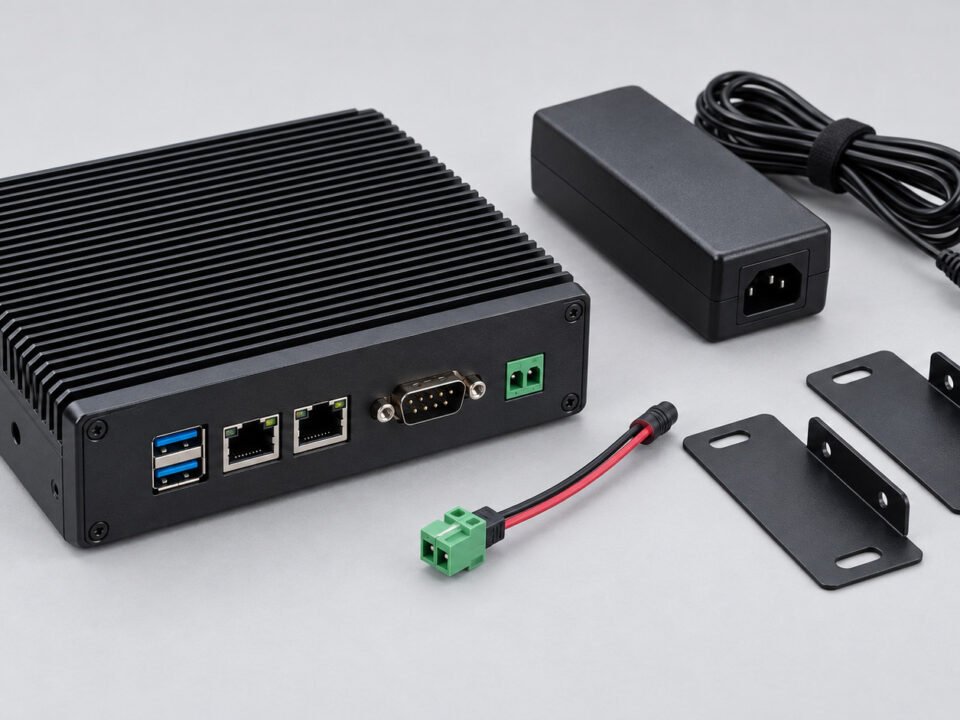
Industrial equipment — including factory automation controllers, networking infrastructure, and test instrumentation — requires adapters engineered for sustained operation under demanding conditions. Reliability is achieved through derated component selection (operating transformers, capacitors, and switching MOSFETs below their maximum ratings), over-voltage and over-current protection circuits, and extended burn-in testing. Industrial-grade adapters may specify MTBF values based on reliability prediction models such as Telcordia SR-332 or MIL-HDBK-217, depending on customer requirements. Certain designs may be configured to meet applicable safety and EMC standards, depending on market requirements and application conditions. Protection features include output over-voltage protection (OVP), over-current protection (OCP), over-temperature protection (OTP) with auto-recovery, and short-circuit protection (SCP). Operating life is influenced by electrolytic capacitor selection, with industrial designs incorporating 105°C rated capacitors with extended life ratings to maintain performance over the adapter's service life.
Stability
Output voltage regulation under varying load and input conditions is critical for industrial applications. Load regulation is generally maintained within ±2% a ±5% depending on the class, with line regulation held within ±1%. Ripple and noise specifications are tightened for sensitive applications — adapters powering communication or measurement equipment may require ripple below 100mV peak-to-peak. Hold-up time (the period the output remains within regulation after AC input loss) is designed to allow graceful device shutdown, with values of 10–20ms available for industrial-grade units. Transient response — the time required for the output to settle within regulation after a step change in load — is also considered for applications with rapidly varying loads. Remote sense capability is available on certain designs, compensating for voltage drop across the output cable by sensing voltage at the load terminals rather than at the adapter output.
Need Help Selecting the Right Power Adapter?
Whether you need standard AC/DC adapters, USB-C PD chargers, or fully customized industrial power solutions, our team can help you specify the right solution for your application. From output voltage and connector type to housing design and compliance certification, we support OEM/ODM projects with competitive pricing and flexible MOQ.