

GaN Chargers Explained: Technology, Benefits & Buying Guide
GaN Chargers Explained: Technology, Benefits & Buying Guide
GaN chargers have become increasingly popular as smartphones, tablets, and laptops require faster and more flexible charging solutions. Compared with traditional silicon-based chargers, GaN technology allows manufacturers to develop compact power adapters with higher power density and improved power conversion performance.
From compact 30W phone chargers to 100W and 140W laptop adapters, GaN technology is now widely used in modern USB charging products.
However, there are several questions worth understanding:
• What does GaN mean in charging?
• How does a GaN charger work?
• Is a GaN charger better than a traditional silicon charger?
• What are the differences between GaN 1, GaN 2, GaN 3, GaN 4, and GaN 5?
• Are GaN chargers safe for smartphones and laptops?
• What power rating should you choose for different devices?
This guide explains GaN technology, its advantages, generational differences, common applications, and important considerations when choosing a GaN charger.
1. What Does GaN Mean in Charging?
GaN stands for Gallium Nitride, a semiconductor material used in power electronics.
Traditional chargers commonly use silicon-based power transistors to control electrical energy conversion. GaN power transistors offer different electrical characteristics, including faster switching capabilities and the potential for lower switching losses in appropriately designed circuits.
These properties allow charger engineers to develop more compact power conversion systems without sacrificing the required output power.
1.1 Why Is GaN Important for Chargers?
GaN technology offers several advantages in charger design.
Higher Switching Frequency
GaN transistors can switch at higher frequencies than many conventional silicon power devices. This allows engineers to reduce the size of certain magnetic components, such as transformers and inductors, in suitable circuit designs.
Improved Power Conversion Efficiency
GaN devices can reduce switching losses, helping improve overall power conversion efficiency when the charger is properly designed.
Higher Power Density
With smaller internal components and more efficient power conversion, manufacturers can develop chargers that deliver relatively high output power in compact housings.
Thermal Design Flexibility
Reduced switching losses can help lower internal heat generation. However, actual operating temperature still depends on power density, component selection, circuit layout, and heat dissipation.
In short, GaN gives charger manufacturers more flexibility when developing smaller, higher-power charging products.
2. GaN Charger Generations: GaN 1, GaN 2, GaN 3, GaN 4 and GaN 5
GaN charger technology has continued to evolve, with manufacturers introducing different generations of semiconductor devices and power conversion designs.
You may encounter terms such as GaN 1, GaN 2, GaN 3, GaN 4, and GaN 5 when comparing modern fast chargers.
These generation labels are used in some product descriptions and market discussions to indicate technological development. However, they are not universal industry standards, and their definitions can vary between manufacturers.
2.1 GaN Generations and Typical Charger Power Ratings
The following table compares commonly discussed GaN charger generations and their associated power ranges. These categories are used to describe technological developments in the market, although they are not defined by a universal industry standard.
| GaN Generation | Typical Charger Power Range | Main Development Focus |
|---|---|---|
| GaN 1 | 45W–65W | Early GaN transistors and basic power integration |
| GaN 2 | 65W–100W | Improved switching performance and thermal design |
| GaN 3 | 100W–140W | Higher switching frequencies and more compact circuit layouts |
| GaN 4 | Around 140W | Higher power density and greater semiconductor integration |
| GaN 5 | 30W, 45W, 65W and 140W+ | More compact designs and advanced power integration |
These wattage ranges are market-oriented examples rather than fixed technical limits. A charger's maximum output power depends on its complete circuit architecture, semiconductor components, cooling design, and supported charging protocols.
2.2 GaN 1: Early GaN Charger Designs (45W–65W)
The first generation of GaN chargers introduced gallium nitride power transistors into consumer charging products.
Typical characteristics included:
- Basic GaN transistor implementation.
- Limited design integration.
- Relatively conventional power conversion designs.
- Applications in early 45W–65W chargers.
These products demonstrated how GaN technology could help reduce charger size while maintaining practical output power.
2.3 GaN 2: Improved Efficiency and Integration (65W–100W)
The next stage of GaN charger development focused on improving switching performance, component integration, and thermal management.
Typical improvements included:
- More compact semiconductor packaging.
- Reduced switching losses in suitable designs.
- Improved circuit integration.
- Better thermal management.
- Applications in 65W–100W chargers.
These developments helped manufacturers expand GaN technology into higher-power laptop charging products.
2.4 GaN 3: Higher-Power Charging Designs (100W–140W)
GaN 3 is often associated with more mature high-power charger designs in market classifications.
Common development priorities include:
- Higher switching frequencies.
- More compact PCB layouts.
- Improved EMI management.
- Better power density.
- Applications in 100W–140W charging products.
These designs are particularly relevant to laptop chargers and multi-port USB-C charging adapters.
2.5 GaN 4: Higher Power Density Around 140W
Some manufacturers use GaN 4 to describe newer high-integration power conversion designs.
Potential improvements include:
- Integration of GaN power devices and driver functions.
- Reduced external component requirements.
- More compact circuit layouts.
- Higher power density.
These technologies can support compact 140W charger designs, depending on the overall power architecture.
2.6 GaN 5: Compact and High-Power Charging Designs
GaN 5 is another generation label appearing in some market descriptions.
The applications associated with this category include:
- 30W and 45W compact phone chargers.
- 65W ultra-compact laptop chargers.
- Foldable-plug travel chargers.
- 140W and higher-power laptop charging products.
The emphasis is on combining compact physical dimensions with suitable power conversion performance.
However, GaN 5 is not a universally standardized semiconductor generation. Buyers should evaluate actual electrical specifications, power density, efficiency, and thermal performance rather than relying on the generation name alone.
2.7 Does a Higher GaN Generation Always Mean More Power?
Not necessarily.
The comparison above shows that some newer GaN technologies are used in both low-power compact chargers and high-power laptop adapters.
For example, a GaN 5 charger may be designed for 30W output rather than 140W. Its newer technology classification does not mean it must deliver more power than a GaN 3 charger.
The actual output depends on the product's circuit design, components, and intended application.
When comparing GaN chargers, always consider the rated wattage, USB PD or PPS support, port configuration, conversion efficiency, and thermal performance together.
3. Are GaN Chargers Really Better Than Silicon Chargers?
GaN chargers offer several advantages over traditional silicon-based designs, particularly when manufacturers need to deliver higher power in a smaller enclosure.
However, whether a GaN charger is better depends on its intended application and overall engineering quality.
3.1 Smaller and More Compact Designs
One of the most noticeable advantages of GaN technology is its potential to reduce charger size.
Higher switching frequencies can allow smaller transformers and other magnetic components to be used in suitable power conversion architectures.
This makes GaN particularly attractive for compact travel chargers and high-power USB-C adapters.
3.2 Improved Energy Efficiency
GaN power devices can reduce switching losses compared with conventional silicon solutions.
This helps engineers improve the efficiency of the overall power conversion system.
However, total charger efficiency also depends on circuit topology, control components, transformer design, and operating conditions.
3.3 Higher Power Density
GaN technology allows designers to develop chargers that deliver more output power relative to their physical size.
For example, compact 65W and 100W USB-C chargers can provide sufficient power for many laptops while remaining portable enough for everyday travel.
3.4 Thermal Performance
Reduced switching losses can help lower internal heat generation.
Nevertheless, a high-power GaN charger can still become warm during operation, particularly when operating near its maximum output.
Thermal performance depends on enclosure design, component layout, power loading, heat dissipation, and temperature protection.
3.5 Flexible Multi-Port Designs
GaN technology is useful in multi-port charger designs.
A single adapter can combine several USB-C and USB-A outputs to charge compatible smartphones, tablets, and laptops.
The charger must also have an appropriate power distribution design to manage the available output across multiple connected devices.
Overall, GaN provides important engineering advantages, but the material alone does not guarantee that every GaN charger is smaller, cooler, faster, or more efficient than every silicon charger.

4. Do GaN Chargers Damage Your Battery?
No. A properly designed GaN charger does not damage a smartphone or laptop battery simply because it uses gallium nitride technology.
The main purpose of GaN is to improve the power conversion stage inside the charger. It does not directly control the battery charging process inside the connected device.
4.1 How Does Battery Charging Protection Work?
Modern smartphones and laptops contain battery management and power management systems that regulate charging.
These systems help manage:
- Charging voltage.
- Charging current.
- Battery temperature.
- Charging speed.
- Battery protection and charging cycles.
When a compatible USB-C Power Delivery charger is connected, the charger and device negotiate an appropriate power configuration.
The device then manages the power it accepts according to its charging design.
4.2 What Actually Determines Charger Safety?
Charger safety depends on more than whether the product uses GaN or silicon.
Electrical Protection: The charger should incorporate suitable overvoltage, overcurrent, short-circuit, and overtemperature protection.
Gestión térmica: Internal components and enclosure design must be able to manage heat under the intended operating conditions.
Charging Protocol Compatibility: The charger should support the appropriate charging protocols and output profiles required by connected devices.
Product Quality: Component selection, manufacturing quality, electrical testing, and regulatory compliance all affect product reliability.
The important distinction is that GaN is a semiconductor technology, not a guarantee of charger safety by itself.
5. Common Questions About GaN Chargers
5.1 Why Do Some GaN Chargers Feel Warm?
GaN chargers can still generate heat during operation.
Although GaN power devices can reduce certain switching losses, the charger still contains transformers, capacitors, rectification components, and other electronic parts that generate heat.
A compact enclosure can also concentrate heat in a smaller physical area.
A warm charger during normal operation is not automatically a sign of a problem. However, excessive temperature, unusual smells, or unstable operation should not be ignored.
5.2 Why Are Some 65W GaN Chargers Smaller Than Others?
Two chargers with the same rated output can have noticeably different dimensions.
This is because overall size depends on several engineering factors:
- GaN semiconductor technology.
- Circuit topology.
- Transformer and inductor design.
- PCB layout.
- Component integration.
- Thermal management.
- Housing and insulation requirements.
Therefore, the GaN label alone does not determine how compact a charger will be.
5.3 Why Does My Laptop Charge Slowly with Some GaN Chargers?
A GaN charger may provide less charging power than expected for several reasons:
- The charger does not support the laptop's required USB PD profiles.
- The charger does not provide sufficient maximum output power.
- The USB-C cable does not support the required current.
- Multiple connected devices share the charger's total output.
- The laptop limits charging power under certain operating conditions.
For higher-power USB-C charging, the charger, device, and cable must all support the required power configuration.
5.4 Can a GaN Charger Charge a Gaming Handheld?
Yes, compatible GaN chargers can charge gaming handheld devices that support USB Power Delivery.
However, the recommended power output varies by model. Check the device manufacturer's charging requirements before selecting a charger.
5.5 Are Multi-Port GaN Chargers Safe?
Multi-port GaN chargers can safely charge several compatible devices when properly designed and manufactured.
Important features include:
- Appropriate output power management.
- Suitable power distribution between ports.
- Overcurrent and overvoltage protection.
- Short-circuit protection.
- Thermal protection.
When multiple devices are connected, the charger may redistribute its available power according to its predefined output configuration.

6. What to Look for When Buying a GaN Charger
Choosing a GaN charger involves more than checking its maximum wattage.
Buyers should consider charging protocols, port configurations, cable compatibility, safety features, and the power requirements of their devices.
6.1 Important Features to Consider
| Especificación | What to Check |
|---|---|
| GaN Power Technology | Semiconductor and circuit implementation |
| USB PD Support | PD 3.0 or PD 3.1, depending on requirements |
| PPS Support | Important for compatible smartphones |
| Quick Charge | QC support when required by target devices |
| Potencia de salida | 30W, 45W, 65W, 100W, 140W or other configurations |
| Configuración Del Puerto | USB-C, USB-A, or multi-port combinations |
| Safety Protection | Overvoltage, overcurrent, short-circuit, and temperature protection |
| Certificaciones | Applicable market-specific safety and regulatory requirements |
| Cable Compatibility | Appropriate cable current and power rating |
6.2 Common GaN Charger Power Ratings
Different output ratings serve different applications.
| Charger Power | Common Applications |
|---|---|
| 30W | Smartphones, tablets, and compact travel charging |
| 45W | Smartphones, tablets, and selected lightweight laptops |
| 65W | Many laptops, smartphones, and multi-device charging |
| 100W | Compatible laptops and higher-power USB-C applications |
| 140 W | Compatible high-power laptops and USB PD 3.1 EPR applications |
These are typical application examples, not universal device requirements.
For example, a 140W USB-C charger requires the appropriate USB PD 3.1 EPR configuration to deliver 140W. The connected device and cable must also support the required power level.
USB PD 3.1 supports power delivery up to 240W with compatible equipment and suitable USB-C cables.
6.3 Check Cable Compatibility
The cable is an important part of any high-power USB-C charging setup.
For example:
- A standard 3A USB-C cable supports up to 60W at 20V.
- A suitable 5A E-Marked USB-C cable can support up to 100W at 20V.
- A compatible 5A USB-C EPR cable is required for power levels above 100W, including 140W and 240W configurations.
Choosing the correct cable helps ensure that the charger and connected device can operate within their supported power specifications.
7. Common GaN Charger Types and Applications
GaN technology is used across different charger categories, from compact smartphone adapters to high-power laptop chargers.
7.1 65W GaN USB-C Charger
A 65W GaN charger is suitable for many smartphones, tablets, and compatible laptops.
It is a practical option for consumers who want one compact adapter for several everyday devices.
7.2 100W GaN Multi-Port Charger
A 100W multi-port GaN charger can support compatible laptops, tablets, and smartphones.
Its actual output distribution depends on the number of connected devices and the charger's port allocation design.
7.3 120W Multi-Port GaN Charger
Higher-output multi-port chargers are designed for users who need to power several devices from one adapter.
The individual port output and total available power should be checked before choosing a model.
7.4 140W GaN Laptop Charger
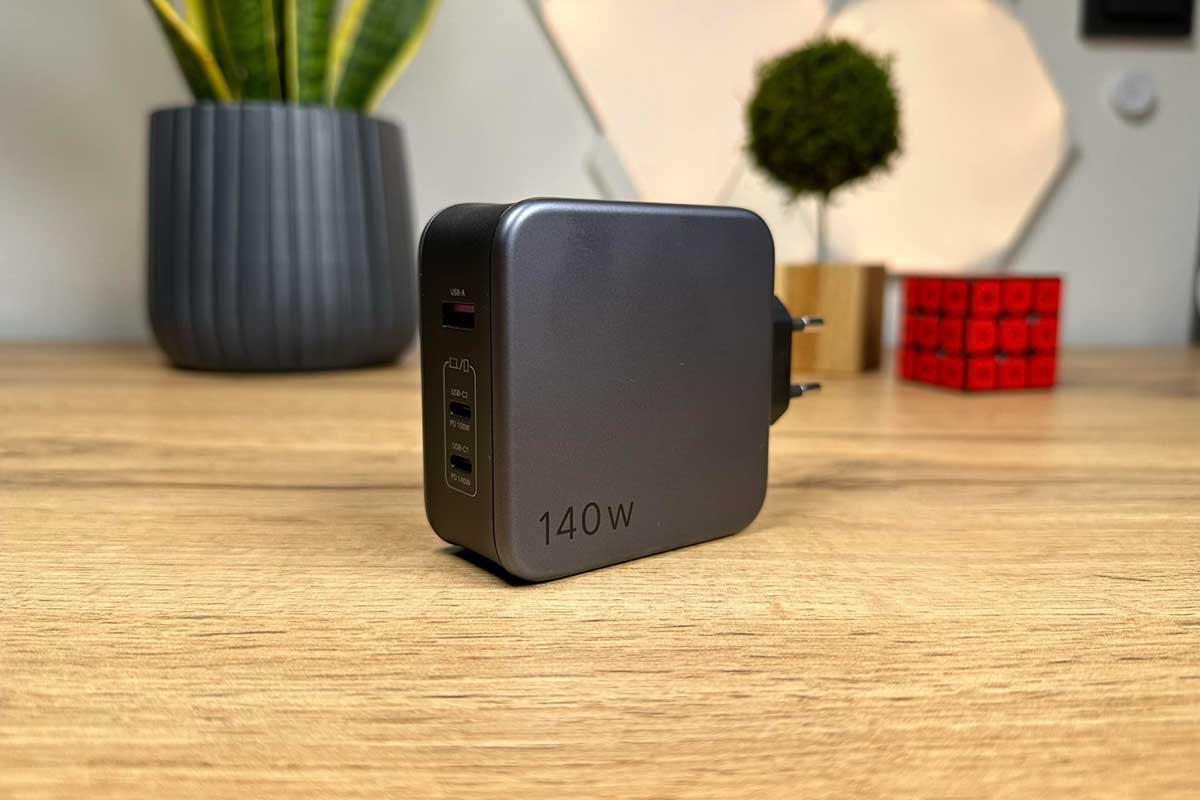
A 140W GaN charger can support compatible high-power laptops using the appropriate USB PD 3.1 EPR configuration.
It is particularly relevant for devices designed to accept higher USB-C charging power.
7.5 Compact Travel GaN Chargers
Compact GaN chargers are available in lower and medium power ratings, including 30W and 45W models.
Their smaller size and foldable-plug options can make them convenient for travel and everyday use.
8. Frequently Asked Questions About GaN Chargers
Q1: What does GaN mean in charging?
GaN stands for Gallium Nitride. It is a semiconductor material used in power electronics to enable faster switching, reduced switching losses, and higher power density in appropriately designed charging circuits.
Q2: Are GaN chargers better than traditional chargers?
GaN chargers can offer smaller dimensions, improved power density, and better conversion efficiency in suitable designs. However, overall performance depends on the complete charger architecture and component quality.
Q3: Do GaN chargers damage phone batteries?
No. A properly designed and compatible GaN charger does not damage a phone battery simply because it uses GaN technology. Battery charging is managed by the device's internal power and battery management systems.
Q4: Is GaN 3 better than GaN 1 or GaN 2?
GaN 1, 2, and 3 are generation labels used in some product descriptions, not universal industry classifications. Buyers should compare actual technical specifications, efficiency, thermal performance, and product testing rather than relying only on the generation number.
Q5: Can GaN chargers charge laptops?
Yes. Compatible GaN chargers with sufficient output power and the required USB Power Delivery profiles can charge many USB-C laptops.
Q6: Are GaN chargers suitable for multi-device charging?
Yes. GaN technology is commonly used in multi-port chargers. However, buyers should check the charger's total output, individual port ratings, and power distribution when multiple devices are connected.
Q7: What power rating should I choose for a GaN charger?
The appropriate rating depends on the connected devices. A 30W or 45W charger may be sufficient for many smartphones and tablets, while 65W, 100W, or 140W models are suitable for compatible laptops and higher-power applications.
Q8: What should I check before buying a GaN charger?
Check the charger's rated output, supported USB charging protocols, port configuration, cable compatibility, safety protection, and applicable certifications.
9. Conclusion: GaN Is Advancing Modern Charging Technology
GaN technology has helped transform modern charger design by enabling higher switching frequencies, improved power density, and more compact power conversion systems.
From smartphone adapters to high-power laptop chargers, GaN offers manufacturers greater flexibility when developing products for different charging requirements.
For consumers, the main advantages include compact designs and convenient multi-device charging.
However, a good GaN charger is not defined by its generation label or maximum wattage alone. Its overall performance depends on semiconductor selection, circuit architecture, thermal design, electrical protection, and manufacturing quality.