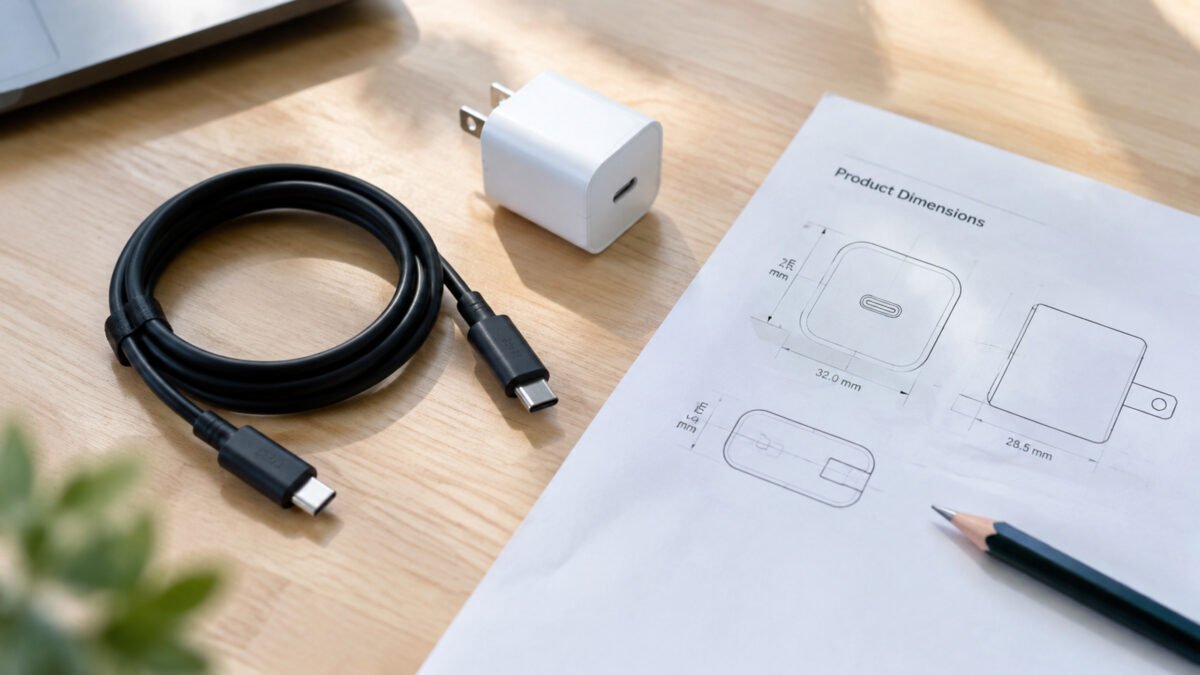


OEM/ODM Manufacturing Partnership for Cables, Chargers & Power Adapters
2026-09-19

Electronics Manufacturing Capability Overview
Electronics Manufacturing Capability Overview
Overview of electronics manufacturing capability for overseas buyers, brand owners, and industrial customers — covering product development, production, assembly, testing, and quality control for USB cables, USB chargers, and power adapters.

1. Manufacturing Capability
The manufacturing capability presented on this page is structured to support overseas buyers, brand owners, and industrial customers who need electronics built to defined specifications. It spans the main stages of electronics fabrication, from an agreed development input to finished units ready for shipment. The following sections address product development, production, assembly, testing, and quality control. Each item is presented at a capability level; the applicable manufacturing, inspection, testing, and quality-control scope is confirmed for each product and project according to the agreed specification.
1.1 Product Development
Development work converts a customer’s electrical, mechanical, and performance requirements into a buildable design. Engineering translates an agreed specification into schematics, layout files, and component selections, and documents the design choices for review. The applicable electrical and safety parameters are reviewed for each project before prototype production, according to the agreed development scope. The deliverable of this stage is normally a bill of materials, design documentation, and an initial set of test criteria agreed with the customer. The purpose is to reach design maturity before volume production, so that late-stage changes are limited to what the product actually requires.
1.2 Production
Production covers the fabrication processes that turn components and subassemblies into functional electronics. The applicable process scope depends on the product category and project; it can include printed circuit board assembly, cable manufacture, and power-unit manufacturing, arranged according to the agreed specification. Production is organized around repeatable process steps, with equipment settings and operator instructions defined in advance. Process controls are applied to keep output consistent across batches. Line capacity is arranged to suit orders of different sizes, from pilot runs to higher-volume schedules, with the practical volume range depending on the product and the agreed order plan. For projects where dedicated tooling is required, the tooling is released and qualified according to the manufacturing plan.
1.3 Assembly
Assembly brings together the fabricated components and finished subassemblies to create the complete product. For cable products, assembly can include termination of conductors, connector attachment, and overmolding. For chargers and power adapters, assembly can involve transformer mounting, housing closure, and final wiring connections. The specific assembly steps are arranged according to the product and process requirements. Assembly follows the applicable work instructions, with operator qualification and working conditions defined according to the product and process requirements. The assembly stage determines much of the finished product’s structural integrity and is reviewed at defined points to confirm that the required checks are carried out.
1.4 Testing
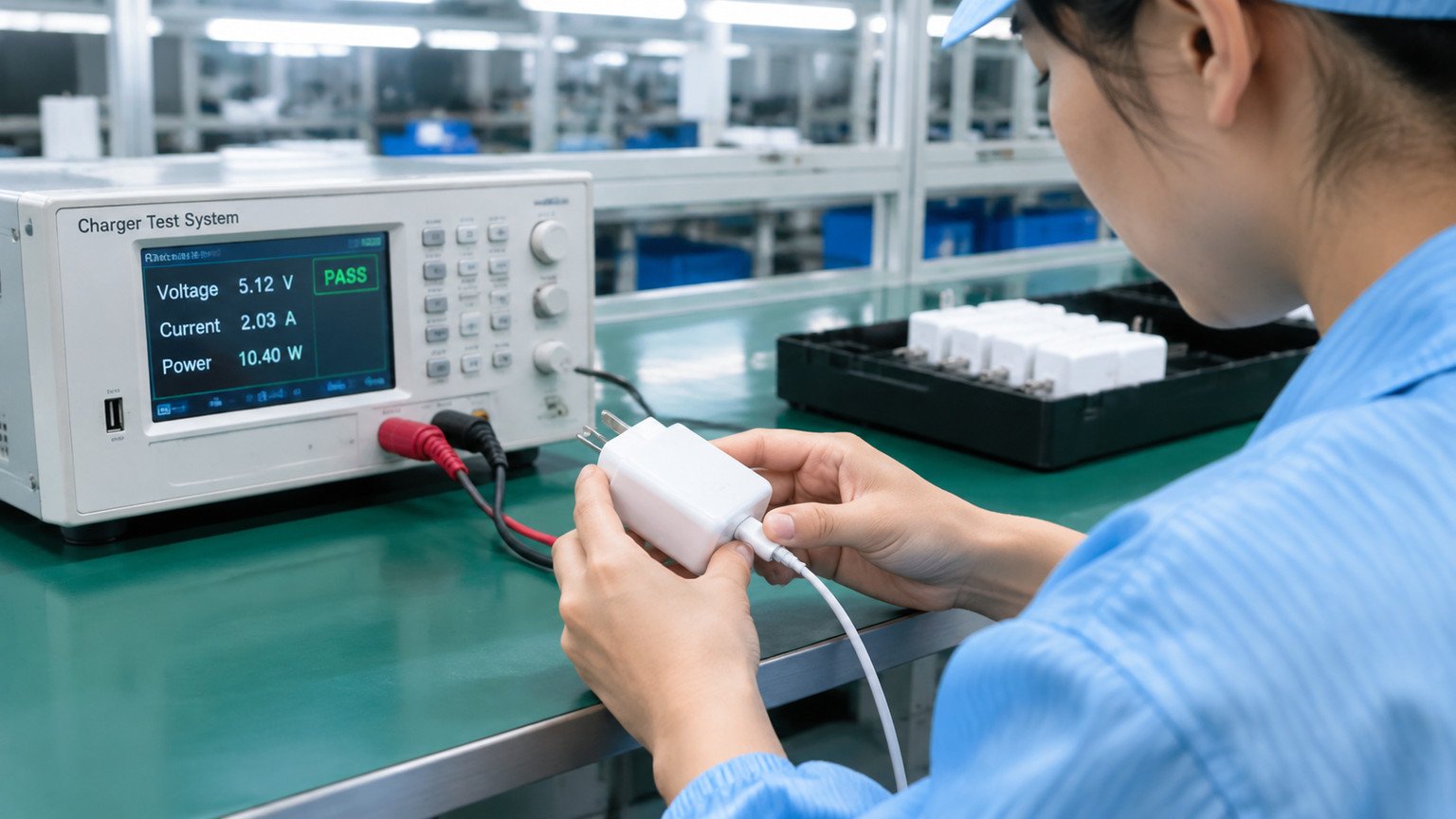
Testing is performed according to the product test plan to verify that applicable units meet their agreed specifications before shipment. Electrical testing can cover continuity, insulation, voltage, and current parameters relevant to each product type. Where applicable, functional checks confirm that the product’s specified signal or power performance meets the agreed requirements under defined operating conditions. Testing is carried out at defined stages and at completion, using measuring equipment that is maintained and calibrated according to the applicable internal or customer requirements. Test and traceability records are maintained at the traceability level agreed for the product and project, subject to the applicable documentation and quality requirements.
1.5 Quality Control
Quality control provides the framework for detecting and correcting defects during production. Incoming materials are inspected against specified requirements before they enter production. In-process inspection verifies that procedures are followed and that intermediate products meet defined criteria. Finished products undergo inspection covering appearance, dimensions, and performance where these are specified, before packing. The applicable inspection steps are confirmed for each product and project. Control measures are reviewed regularly, and corrective action is taken when inspection shows a process has moved outside acceptable limits. Where a nonconforming condition is found, the affected units are identified and handled according to the applicable quality procedure, and the process is reviewed to prevent recurrence. The objective is consistent output that meets the customer’s agreed requirements for the selected scope.
2. Supported Products
The manufacturing capability covers a focused range of power and connectivity products. Production and test arrangements are selected according to the product category, design, and agreed project requirements. The supported product families are USB cables, USB chargers, and power adapters.

2.1 USB Cable
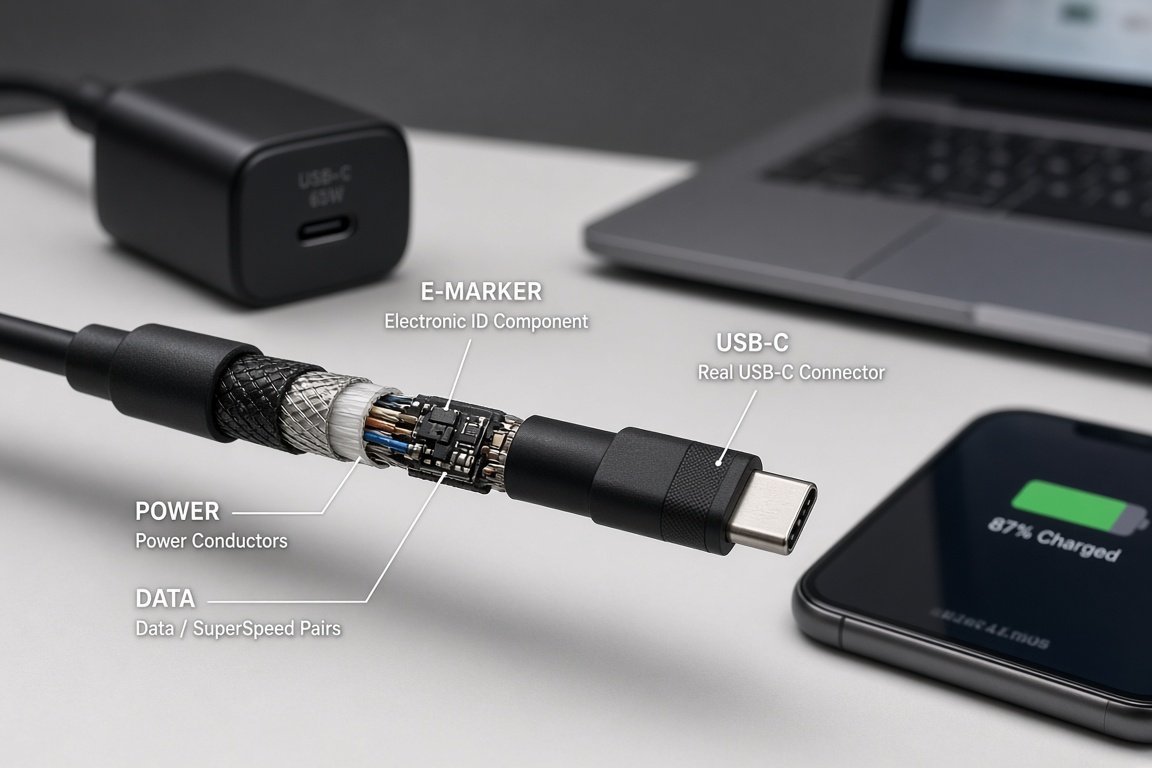
USB cable manufacturing supports selected connector types, lengths, and constructions according to the product specification. Applicable models may be tested for continuity, wiring configuration, and connector retention under the agreed test plan. Conductor sizing, shielding, overmolding, and environmental suitability depend on the selected design and application requirements. Common configurations include selected USB-A and USB-C connector combinations, subject to the required wiring, data, and power specifications. Cable length and jacket material are chosen to suit the installation, and the finished assembly can be produced with the labeling, color, and packaging agreed for the order.
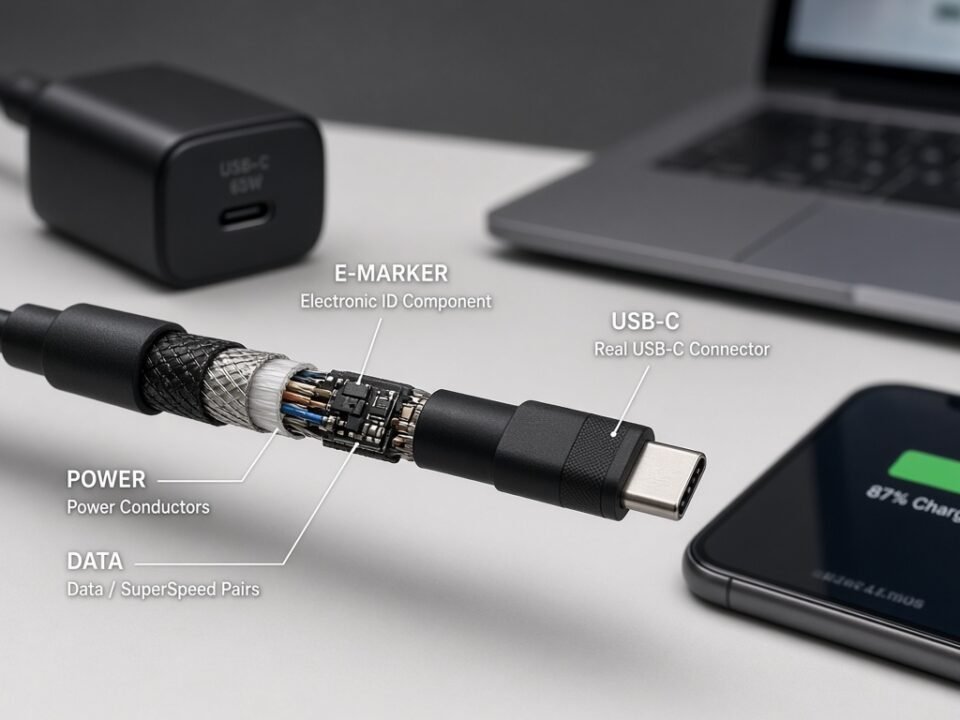
For selection, the main decisions are the connector type at each end, the wiring configuration, the usable length, and the rated data or power performance. Either a specific configuration or a made-to-order design can be arranged during product review. Data, power, and video capability depend on the selected cable design and the supported host and device specifications. Connector shape alone does not define these functions. Marking on the cable or packaging can be arranged to identify the agreed configuration. The specific connector options, gauges, shielding levels, and materials applicable to a project are confirmed during product review rather than assumed as standard across the range.
2.2 USB Charger
USB chargers are designed to supply power through USB output ports for compatible devices. Charger models are available in selected output ratings and enclosure styles according to the product range, and can be arranged as single-port or multi-port configurations depending on the model. Applicable safety design features and checks, such as insulation, creepage, or enclosure-related requirements, are defined and verified according to the model, rating, and target-market compliance plan. Applicable models are tested to confirm that output voltage and current remain within the specified limits under defined load conditions. For a project, the required input supply, output rating, port configuration, plug format, and target-market requirements are documented before production is confirmed.
2.3 Power Adapter
Power adapters provide a specified DC output to the target equipment, typically through a dedicated connector. Depending on the model specification, power adapters may be considered for equipment requiring a compatible regulated DC input. Voltage, current, connector, polarity, protection features, and target-market requirements must be confirmed for the intended application. The category shares the production and quality approach used for charger-type products while accommodating the output specifications and connector options required by the project.
USB chargers and power adapters differ mainly in output interface and intended load. A USB charger delivers power through a USB port to compatible devices, while a power adapter supplies a specified DC output through a dedicated connector to particular equipment. Charger and adapter models are tested against their agreed electrical and safety requirements. Applicable checks may include output voltage and current under defined load conditions, insulation-related tests, and mechanical or enclosure inspections, depending on the design, product rating, and target-market requirements.
3. Manufacturing Process
The manufacturing process follows five main project stages: engineering, prototype, production, testing, and delivery. Assembly and quality control are applied within the relevant production and testing activities. Each stage has an entry criterion and an exit criterion, so work proceeds only when the required conditions are met. The description here covers the general sequence; the applied detail is confirmed for each project in the product review.
3.1 Engineering
The process begins with engineering, where the product is designed and specified in detail. Schematic design, layout, component selection, and mechanical design are completed, and the design is checked against the customer’s requirements. Engineering also defines the materials list, the process instructions, and the test plan that will be applied later. A complete engineering package forms the input to the prototype stage. Key parameters such as input and output ratings, connector and plug choices, polarity, and enclosure dimensions are recorded so they can be reviewed with the customer before tooling or sampling begins.
3.2 Prototype
Prototype manufacturing produces a limited number of units to validate the design and the process. Prototypes are used to confirm form, fit, and function, and to verify that the product performs to specification. Findings from the evaluation are reviewed with the customer, and the design or process is adjusted where necessary. The customer is typically asked to confirm the prototype against the intended application before volume production proceeds. Prototype approval provides the basis for releasing the agreed tooling and process resources, where required, for volume production.
3.3 Production
On approval of the prototype, production builds the product to the agreed schedule. Materials are ordered to cover the run, and process lines are set up according to the engineering instructions. Production stages such as assembly and final build are carried out with the process controls described earlier. In-process checks monitor output quality, and adjustments are made to keep the process within specification. Quantity planning is coordinated with the customer so that the agreed delivery schedule can be supported. Lot identification is applied where traceability is required by the product and project, so that produced units can be associated with the relevant production and test records.
3.4 Pruebas
Testing is applied during and after production to confirm that applicable units meet their agreed specifications. In-line testing helps identify issues at an early stage, where it is part of the agreed process, while final testing provides a last check before packing. Test data is recorded for the agreed traceability scope. Units that do not pass the applicable testing are identified and handled according to the nonconforming-product procedure. Investigation and corrective action are applied where required by the product or quality plan, so that the cause is addressed before subsequent runs where the quality plan calls for it.
3.5 Delivery
Delivery completes the manufacturing cycle by packaging and shipping finished products according to the customer’s order requirements. Packing protects the product during transport and is arranged according to the specific requirements of each shipment. Packaging can include the labeling, carton layout, and documentation agreed for the order, such as packing lists and applicable compliance records within the agreed scope. Production scheduling is coordinated across the earlier process stages to support the agreed delivery schedule.
4. Suitable Customers
The manufacturing capability is structured to serve purchasers who require electronics built to defined specifications and quality requirements for resale or integration. It is suitable for electronics brands, industrial companies, and OEM customers, each of which brings a distinct set of requirements.
4.1 Electronics Brands
Electronics brands seeking a production partner benefit from a manufacturing setup that can build to defined specifications and apply production and inspection controls to repeated orders according to the agreed specification. Brands typically supply detailed design inputs and require disciplined production and testing in return. Support includes adherence to the agreed specification, controlled manufacturing in line with brand requirements, and records that support the agreed traceability. Custom options can include labeling, color, packaging, and selected mechanical or electrical requirements, subject to product review.
4.2 Industrial Companies
Industrial companies integrate manufactured electronics into equipment and systems for professional use. This customer group often requires specific electrical parameters, mechanical configurations, and reliability considerations suited to the intended operating conditions. Manufacturing support accounts for these requirements through defined testing and quality controls, with the applicable controls depending on the product specification and operating conditions. Environmental or endurance claims are confirmed against the actual product and test basis before they are included in the agreed specification.
4.3 OEM Customers
OEM customers may outsource part or the full manufacturing scope and typically look for engineering, production, and quality resources that match their project requirements. Cooperation can cover review of the design, prototype validation, and production, including options to adapt products to the customer’s branding and packaging requirements. For product evaluation and quotation, the customer is asked to share the target application, connector and output requirements, key dimensions, forecast quantity, and required compliance documents. Inputs such as critical dimensions, materials, operating environment, and relevant technical or compliance files allow the product and process to be reviewed, so that a quotation can be prepared against the agreed scope. The compliance documents and test reports available for a product are confirmed according to its specification, target market, and agreed project scope.

Descripción general
This overview outlines the electronics manufacturing capability available to buyers, covering the development, production, assembly, testing, and quality-control functions, the supported product families, the five-stage manufacturing process, and the customer groups this capability is structured to serve.