Fast vs Normal Charging Cables: Key Differences
Fast vs Normal Charging Cables: Key Differences
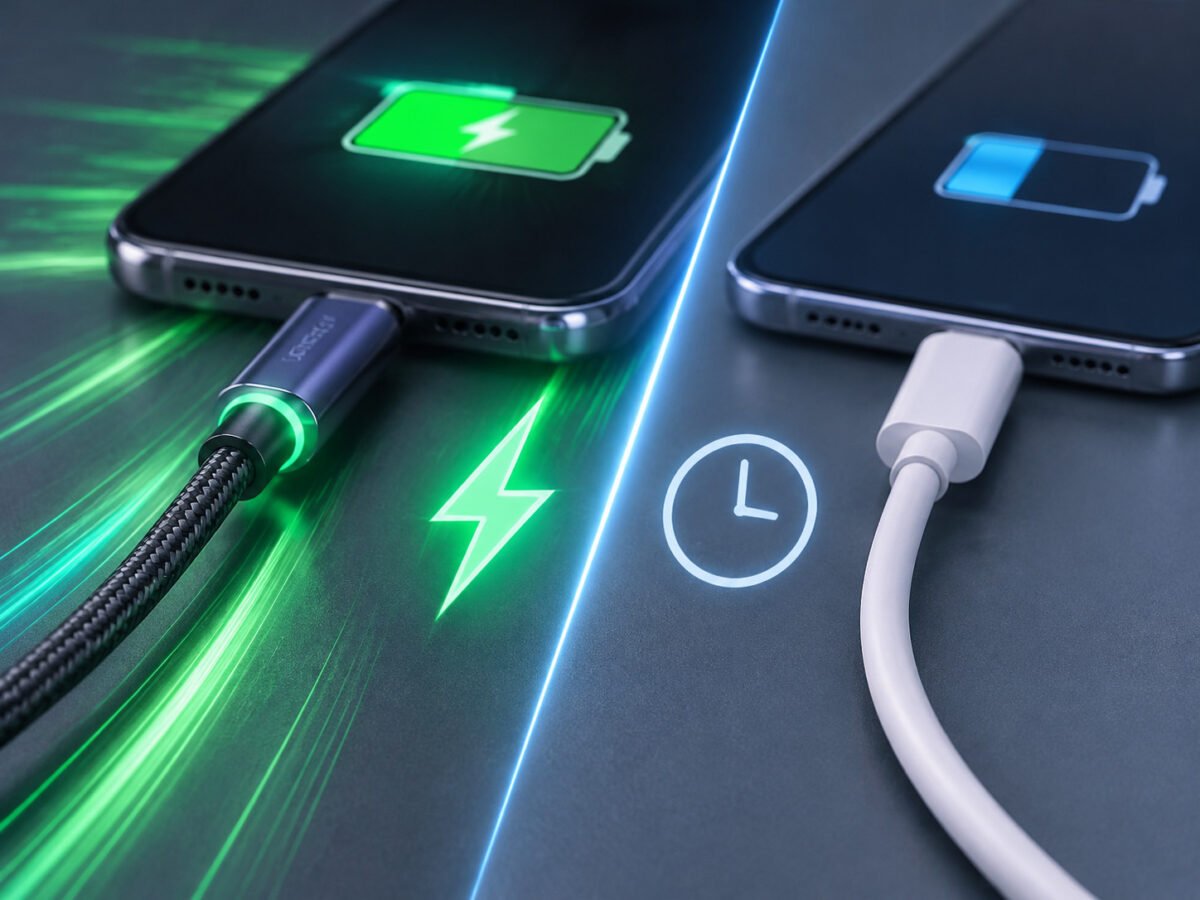
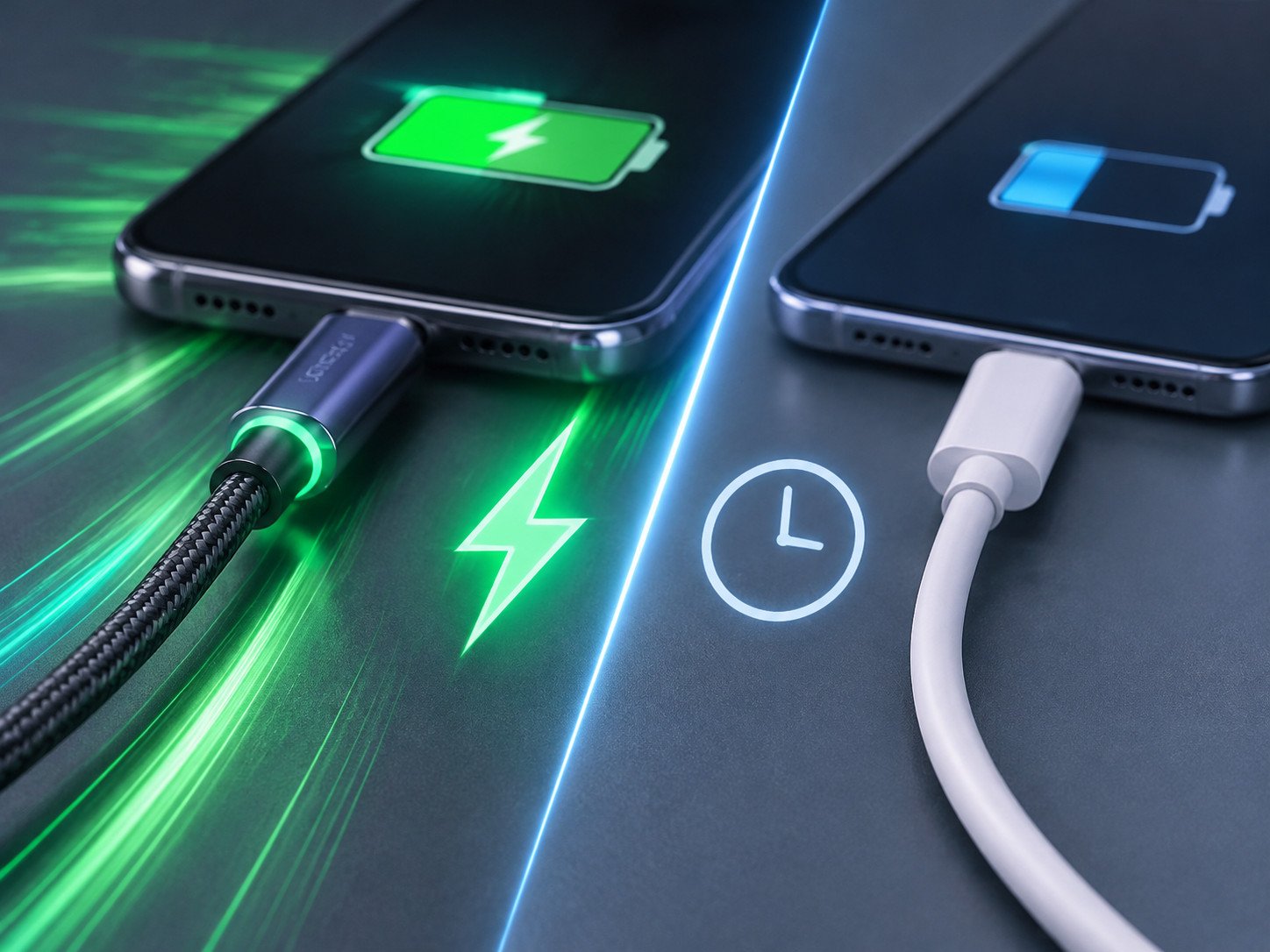
Two cables look the same from the outside and can behave very differently on the same charger. That is not marketing shorthand — but the reason is narrower than the packaging suggests, and it is not "one cable is fast and the other is slow."
A charging cable is a set of copper conductors with connectors on the ends. What separates a fast-charging cable from a basic one is how much current those conductors can carry without overheating, and whether the cable can tell the charger what it is rated for. Everything else follows from those two facts.
1. What Is Actually Different Inside the Cable
Normal charging cables
- Thinner copper. Conductors in the 28–30 AWG range, which is adequate for 1–2A and inexpensive to make.
- Power and basic data only. No SuperSpeed pairs, and often no more than the four legacy conductors.
- No E-Marker. Without the chip there is no way to declare a rating above 3A, so the link is capped there.
- Minimal shielding. Shielding protects signal integrity; a charge-only cable has little signal to protect.
The 15W figure often attached to "normal" cables comes from the USB-A case, not from the cable. An A-to-C cable has a resistor on the CC pin instead of a PD channel, so the phone sees a default 5V source and stops at 5V/3A.
Fast charging cables
- Thicker copper. 20–26 AWG on the power pair, which lowers resistance and therefore heat at the same current.
- An E-Marker above 3A. The chip declares the cable's current rating and, for EPR cables, its voltage rating.
- Full wiring. The CC wire that PD negotiation runs on, plus SuperSpeed pairs if the cable is also rated for data. The two functions are separate: a 5A charging cable can still be a 480 Mbps cable.
- Better strain relief and jackets. Relevant to how long the cable lasts, not to how much power it carries.
Current capacity is set by the cross-section of the VBUS and ground conductors. Adding data pairs does not add ampacity, and a thicker outer jacket does not either — a common point of confusion when buyers judge a cable by feel.
2. How Much Faster "Fast" Actually Is
Speed depends on three things in series: the charger's maximum output, the cable's current rating, and what the phone's charging circuit will accept. The weakest of the three sets the result.
The table below converts a 4,500mAh battery — about 17.3Wh — at roughly 85% end-to-end efficiency, with a taper near full. These are arithmetic from the battery capacity, not marketing claims.
| Setup | Effective power | 0–50% | 0–100% |
|---|---|---|---|
| 5W charger, basic cable | ~4W | About 2 hours | About 4.5 hours |
| 10W charger, basic cable | ~8W | About 1 hour | About 2.5 hours |
| 30W charger, 3A cable | ~24W | About 30 minutes | About 1 hour |
| 65W charger, 5A E-Marked cable | Phone-limited, often ~25W | About 25 minutes | About 1 hour |
Two readings matter here. The first is that the jump from 5W to 10W halves the time; the jump from 10W to 30W cuts it again by more than half. The second is that the last row is barely faster than the third, because the phone stops accepting power long before the cable does. A 65W cable on a phone that caps at 25W changes almost nothing.
3. Compatibility
Fast charging is a negotiation, and the cable is one of three parties.
- Charger. It has to offer the voltage and current the phone wants. A 30W PD charger publishes 9V/3A or 15V/2A; a 45W Samsung charger relies on PPS at 4.5A, which a 3A cable cannot carry.
- Cable. 3A rating caps the contract at 60W (20V × 3A); 5A with an E-Marker reaches 100W, and 5A with an EPR E-Marker reaches 240W at 48V.
- Device. The phone sets the ceiling. iPhone 8 and later fast-charge over USB PD; iPhone 14 and earlier need a C-to-Lightning cable, iPhone 15 and later a C-to-C one.
The incompatibility that catches buyers is not "fast cable with old phone" but "5A phone with a 3A cable": a Galaxy that wants 45W PPS at 4.5A will quietly settle at 25W, with no error message.
4. Heat, Durability and Safety
Heat in a charging cable comes from resistance, and resistance falls as copper gets thicker. That is the whole mechanism. A thin cable pushed to 3A warms up; a thick one at the same current stays cool.
Three common claims deserve correcting:
- Shielding does not improve power delivery. It reduces interference on data lines. A charge-only cable without shielding charges just as fast.
- A braided jacket does not dissipate heat. Nylon braid resists abrasion and flex fatigue. Heat leaves through the copper and the connector, not the braid.
- A metal connector shell is cosmetic and structural. It does not raise the current rating.
What does matter for safety: the cable's declared rating, the connector's solder joints, and whether the assembly was tested. Unbranded cables that advertise 5A with no E-Marker either cannot deliver it or are misreporting.

5. When a Fast Cable Is Worth Paying For
Buy the higher-rated cable when any of these is true:
- You charge a laptop through the same cable: 60W versus 100W is a real difference in time.
- You own a 45W PPS phone: the 4.5A profile needs a 5A E-Marked cable, and a 3A cable drops it to 25W.
- The cable is plugged and unplugged daily, where strain relief and jacket quality decide lifespan.
- You are specifying above 100W, where EPR and a 5A E-Marker are mandatory.
A basic cable is fine when the device is a watch, earbuds, a keyboard, a bedside phone charged overnight, or anything that tops out near 10W. Paying for 5A there buys nothing.
6. Quick Checklist
- Device ceiling. Look up the phone's maximum wired charging power, not the charger's.
- Charger output. It must publish the profile the phone actually requests — PPS for recent Galaxy models, PD for iPhone and most others.
- Cable rating. 3A for up to 60W, 5A with an E-Marker above that. If the listing says 5A but never mentions E-Marker, treat the rating as unproven.
- Length. Longer and thinner means more voltage drop. Keep high-current runs short.
- Documentation. A test report or certificate number is worth more than a logo on the jacket.
7. Final Verdict
"Fast" and "normal" are not two product categories; they are two points on a current-rating scale. A cable is fast when its conductors and E-Marker let the charger and the phone agree on a high-power contract, and it is normal when any of those three parties declines.
That also means the upgrade is usually just the cable: if the phone and charger are already capable, the cable is the only missing part. If they are not, no cable fixes it.