

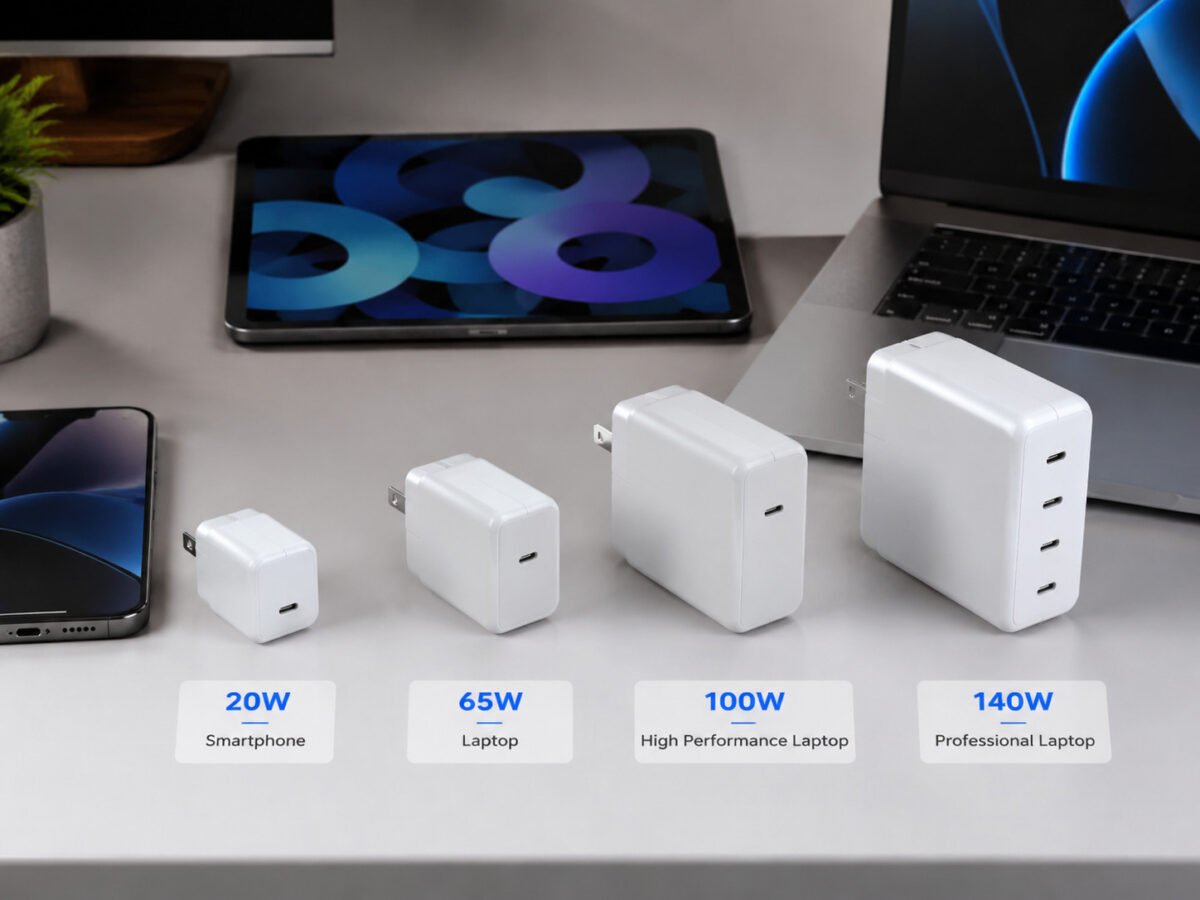
USB-C PD Charger Specification Guide
USB‑C PD Charger Solutions
USB-C PD chargers provide regulated power delivery solutions for smartphones, tablets, laptops, and professional computing devices. Available in multiple power ratings, port configurations, plug types, and OEM customization options, these chargers serve global B2B applications including brand integration, distribution, retail programs, and commercial projects.

1. Power Output Specification
USB-C PD (Power Delivery) chargers are categorized by power output ratings, each serving specific device categories based on their power consumption requirements. The configurations below represent commonly manufactured USB Power Delivery power tiers based on USB PD specifications. USB PD defines fixed supply voltage levels — 5V, 9V, 15V, and 20V under the standard power range (SPR), with 28V, 36V, and 48V added under the extended power range (EPR) in revision 3.1. USB PD supports current levels up to 5A depending on the selected voltage profile, cable capability, and product specification. Actual wattage is determined by the voltage and current combination between source and connected device. Available power ratings include 20W, 30W, 45W, 65W, 100W, 140W, and additional customized PD profiles depending on application requirements. For detailed electrical parameters of individual product models, refer to the corresponding PD charger datasheet.
| Power Rating | Typical Application |
|---|---|
| 20W | Smartphones |
| 30W–45W | Tablets, compact laptops |
| 65W | Thin-and-light laptops |
| 100W | High-performance laptops |
| 140W | Professional laptops, mobile workstations |
Selecting the appropriate USB-C PD charger specification depends on the connected device's rated input power, charging profile, and intended usage scenario.
1.1 20W Charger
The 20W configuration operates within the USB PD standard power range, delivering output at 9V/2.22A. This specification is suitable for smartphone charging, providing adequate power for standard mobile device battery replenishment at rates that reduce charging time compared to baseline 5V charging. Selected models may support additional fast-charging protocols depending on market requirements and device compatibility. The 20W tier represents an entry point in the PD charger product line, balancing compact enclosure dimensions with sufficient output for daily mobile device charging needs.
1.2 65W Charger
The 65W configuration operates at 20V/3.25A, supporting a broader range of device types. 65W chargers are commonly used for thin-and-light laptops, tablets, and portable computing devices. Actual compatibility depends on the device manufacturer's power requirements. Chargers at this power level incorporate thermal management structures sized for sustained operation, with components rated for continuous duty at the specified output.
1.3 100W Charger
The 100W specification represents the maximum power level of the USB PD 3.x Standard Power Range (SPR), operating at 20V/5A. This configuration is designed for high-power laptops and performance-oriented portable workstations that require sustained power delivery during intensive computing tasks. Devices with dedicated graphics processors, higher-performance CPUs, or demanding workloads typically benefit from this power tier. Higher-power chargers may incorporate power factor correction (PFC) and advanced switching technologies depending on power rating, efficiency requirements, and regional regulations. Cable assemblies used for 100W charging must support 5A current capability and typically require an electronically marked (E-Marker) USB-C cable. EPR capability is not required for standard 100W PD operation.
1.4 140W Charger
The 140W specification operates under USB PD 3.1 Extended Power Range (EPR), delivering output at 28V/5A. This tier is commonly used for advanced laptops and mobile workstations requiring charging power beyond the traditional 100W PD limit. The 28V rail was introduced in USB PD revision 3.1 to address the power requirements of advanced portable computing systems that exceed the 100W ceiling of the standard power range. Chargers in this category incorporate enhanced thermal management structures and current-carrying components rated for EPR operation at 28V. 140W USB PD operation requires an EPR-capable USB-C cable with an E-Marker chip, supporting up to 5A current and the higher voltage requirements defined by USB PD 3.1 EPR specifications.
2. Product Configuration Factors
Beyond power output rating, several configuration factors determine charger suitability for specific applications and deployment scenarios.
2.1 Port Number
Charger configurations range from single-port to multi-port designs. Common configurations include 1C (single USB-C), 2C (dual USB-C), 1C1A (USB-C + USB-A), and multi-port layouts. Single-port chargers dedicate the full rated power to one connected device. Multi-port chargers enable simultaneous charging of multiple devices from a single power adapter. The port count and combination directly influence the internal power management architecture and total wattage distribution. Dual-port and multi-port designs incorporate an internal power management controller that monitors connected device power profiles and allocates available output accordingly. Multi-port configurations should also consider total power budget and power-sharing behavior between ports. Port count selection should consider the expected number of simultaneously connected devices and the power profile of each connected device.
2.2 Output Distribution
Multi-port chargers implement output distribution strategies that allocate total power across connected ports. Selected models feature dynamic power allocation, adjusting output per port based on connected device requirements in real time. This approach allows a single high-power port to receive the majority of available output when one device is connected, then redistribute power when additional devices are connected. Fixed-distribution designs assign predetermined power levels to each port, with individual port ratings that remain constant regardless of the number of connected devices. The distribution method affects charging efficiency when multiple devices draw power simultaneously. Dynamic allocation generally optimizes power utilization across connected devices, while fixed distribution provides predictable per-port output that simplifies device compatibility assessment.

2.3 Product Size
Physical dimensions represent a critical factor in product selection. Compact form factors suit portable and travel-oriented applications, where adapter volume and weight directly impact portability. Larger enclosures accommodate higher-wattage components and enhanced thermal dissipation structures. Higher-power chargers generally require more space for thermal management. Product designs are available across a range of form factors to meet various spatial requirements. GaN (gallium nitride) switching technology has enabled reductions in enclosure volume compared to traditional silicon-based designs at equivalent power levels, as GaN components support higher switching frequencies with reduced switching losses. GaN technology is commonly applied in compact high-power chargers where size and efficiency are key design considerations. Common housing materials include flame-retardant PC, PC+ABS blends, and selected metal materials for specialized designs.
3. Applications
USB-C PD chargers are commonly used for:
- Smartphones and tablets
- Laptops and portable computers
- Retail charging products
- Travel charging solutions
- Corporate device programs
- OEM private label projects
4. OEM Configuration
Manufacturing partnerships support customized charger configurations tailored to specific brand and application requirements. The following OEM options enable clients to specify product parameters aligned with market positioning objectives, target device compatibility, and regional regulatory requirements.
4.1 Custom Power
OEM configurations accommodate customized power output specifications. OEM customization may include output power, PD profiles, PPS support, charging protocols, connector configurations, and regional plug options. Clients may define voltage and current combinations within USB PD standard parameters, or request specified power profiles for specialized devices. Custom power development can be designed according to USB Power Delivery specifications, with optional USB-IF certification and required safety and EMC testing depending on target market requirements. Additional charging features can be configured according to device requirements and target market specifications.
4.2 Custom Housing
Housing customization encompasses enclosure design, material selection, and surface treatment. Options include various plastic and metal materials, with finishes such as matte, gloss, or textured surfaces. Custom enclosure designs can incorporate brand-specific form factors, color schemes, and mechanical features including folding pins, interchangeable plug types, and integrated cable management structures. Plug configurations can be specified for regional compatibility, with options including US plug (Type A), EU plug (Type C), UK plug (Type G), and additional regional variants. Foldable pin mechanisms reduce the adapter footprint during transport, while interchangeable plug systems enable a single charger platform to serve multiple regional markets through plug accessory kits.
4.3 Custom Branding
Branding customization supports client-specific visual identity implementation. Options include logo application via silk-screen printing, laser engraving, or in-mold decoration. Custom packaging design, color-matched enclosures, and model-specific labeling are available. Silk-screen printing provides a cost-effective method for applying single or multi-color logos on flat or mildly curved surfaces. Laser engraving produces a permanent mark on compatible surface materials. Packaging customization options include retail box design, multilingual labeling, included accessories specification, and compliant material options for carton and insert components. Model-specific labeling can include product names, regulatory marks, serial number formats, and QR codes linking to product support resources.
Need a Custom USB‑C PD Charger Solution?
Whether you need standard USB-C PD chargers or fully customized configurations with specific power profiles, port layouts, housing designs, and branding, our team can help you specify the right solution for your application. From compact 20W travel chargers to high-power 140W EPR units, we support OEM/ODM projects with competitive pricing and flexible MOQ.