

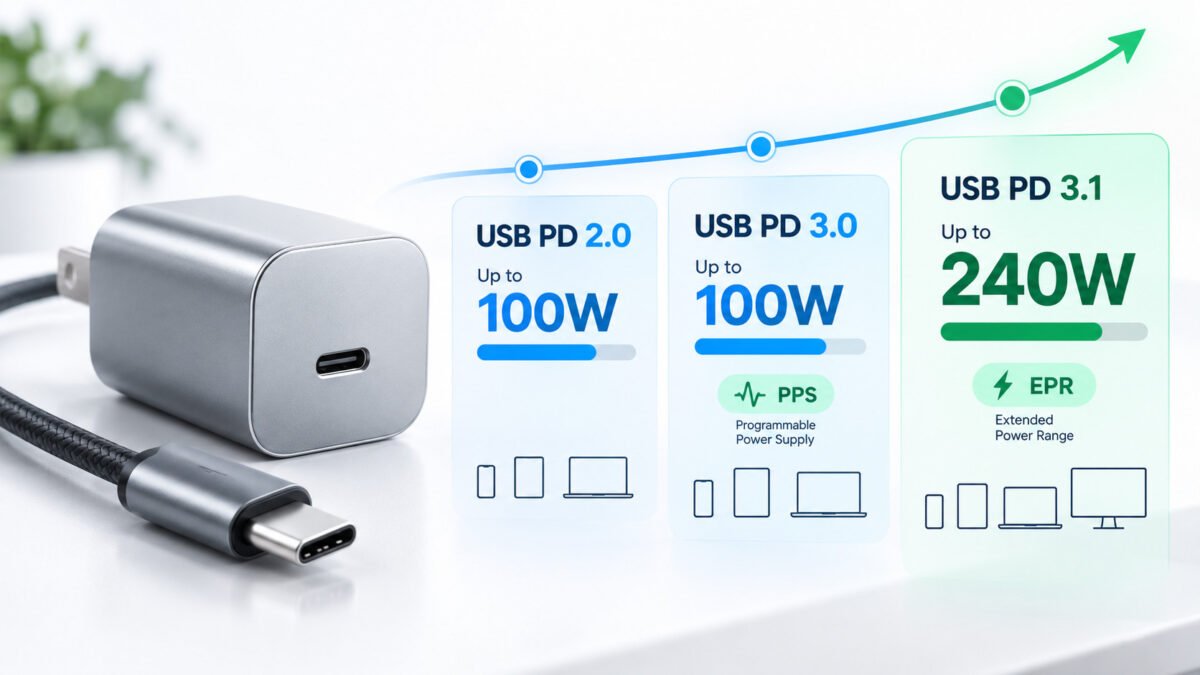
USB PD 2.0 vs PD 3.0 vs PD 3.1: Quais são as diferenças?
USB PD 2.0 vs PD 3.0 vs PD 3.1: Quais são as diferenças?
USB Power Delivery (PD) has become the universal fast-charging language behind nearly every USB-C device on the market. With each revision, the standard has pushed the wattage ceiling higher, the voltage ranges wider, and the negotiation between charger and device smarter. If you have ever compared a charger spec sheet and seen "PD 3.0", "PD 3.1" or "PPS" and wondered what actually changes, this guide breaks it down.
1. What Is USB Power Delivery (PD)?
USB PD is a charging protocol that runs over a USB-C cable and connector. Instead of a fixed 5 V output like older USB ports, PD lets the charger and the device talk to each other over the CC (Configuration Channel) pin and agree on a voltage — 5 V, 9 V, 15 V, 20 V, and on PD 3.1 also 28 V, 36 V and 48 V — and a current level up to 5 A.
The plug and cable are the physical side; PD is the negotiation language running inside them. Every USB-C cable carries at least one CC wire, but a USB-C cable without an E-Marker chip is limited to 3 A — about 60 W at 20 V. A cable that carries an E-Marker chip advertises its rated current (up to 5 A, 100 W), and EPR-rated cables also advertise 48 V capability. That is what unlocks fast charging for phones, tablets, laptops and even larger devices.

2. USB PD 2.0: The First 100 W Standard (2014)
Released in 2014, USB PD 2.0 was the version that turned USB-C into a real charging platform. It raised the ceiling from the old USB Battery Charging 1.2 limit of 7.5 W to 100 W (20 V at up to 5 A), which was enough to start charging thin laptops as well as phones.
PD 2.0 defined a fixed set of Power Delivery Objects (PDOs):
- 5 V / 3 A
- 9 V / 3 A
- 15 V / 3 A
- 20 V / 3 A
- 20 V / 5 A (requires an E-Marker cable)
Within those fixed steps, a phone could ask for 9 V, a laptop could ask for 20 V, and the charger would deliver whichever PDO both sides supported. PD 2.0 is still the baseline that every later version is backward-compatible with.
3. USB PD 3.0: Finer Control, PPS, Smarter Negotiation (2015)
USB PD 3.0 arrived in 2015 and kept the same voltage and wattage ceiling as PD 2.0 — still 100 W. The big changes were under the hood:
- More robust power negotiation. The message protocol was improved so chargers and devices agree on a power contract more reliably, especially when multiple devices are plugged into one charger.
- Better cable identification. PD 3.0 tightened how the CC pin reads an E-Marker chip, so a 60 W cable and a 100 W cable are no longer confused.
- PPS (Programmable Power Supply). Introduced in 2017 as an update to the PD 3.0 specification, PPS lets the device request a continuously adjustable voltage — from 3.3 V up to 21 V, in 20 mV steps — rather than snapping to a fixed 5/9/15/20 V step. This is what lets modern phones charge at higher peak speeds and stay cooler during the charge cycle, because the charger follows the battery curve instead of forcing fixed steps.
PPS is not a separate version of PD. It is a feature of PD 3.0, and it is the reason most modern fast-charging phones from Samsung, Google and Xiaomi list "PPS" on the spec sheet.
4. USB PD 3.1: Breaking Past 100 W to 240 W (2021)
USB PD 3.1, released in 2021, kept all of PD 3.0 (including PPS) and added a new high-wattage range called Extended Power Range (EPR):
- 28 V / 5 A = 140 W
- 36 V / 5 A = 180 W
- 48 V / 5 A = 240 W
PD 3.1 also added AVS (Adjustable Voltage Supply) options — 15–28 V, 15–36 V and 15–48 V at up to 5 A — so a charger can tune the voltage more precisely for laptops, monitors and small appliances.
Two practical notes:
- Most PD 3.1 chargers are still 100 W-class. The Fixed Power Range (FR) — 5 V to 20 V — is unchanged from PD 3.0. Only chargers explicitly marketed as "EPR" or "240 W" can deliver the new voltages.
- You need an EPR-rated cable. A normal 5 A / 100 W USB-C cable will not safely carry 48 V. EPR cables are required to carry an E-Marker chip that advertises EPR support and a higher voltage rating.
5. Side-by-Side Comparison
| Recurso | PD 2.0 | PD 3.0 | PD 3.1 |
|---|---|---|---|
| Released | 2014 | 2015 (PPS added 2017) | 2021 |
| Conector | USB-C | USB-C | USB-C |
| Voltage range | 5, 9, 15, 20 V | 5, 9, 15, 20 V | 5–20 V (FR) + 28, 36, 48 V (EPR) |
| Max current | 5 A | 5 A | 5 A |
| Max power | 100 W | 100 W | 240 W (EPR) |
| PPS (adjustable voltage) | Não | Sim | Sim |
| E-Marker cable required above 3 A | Sim | Sim | Yes (plus EPR rating for >100 W) |
| Typical use today | Baseline compatibility | Phones, thin laptops | Phones, thin laptops, gaming laptops, 240 W accessories |
6. Which One Do You Actually Need?
- For a smartphone or tablet: PD 3.0 with PPS is the sweet spot. Anything between 18 W and 65 W will charge quickly, and PPS keeps the phone cooler than fixed-step charging.
- For a thin-and-light laptop: PD 3.0 at 60 W–100 W is enough. Most ultrabooks ship with a 65 W or 90 W PD 3.0 charger.
- For a gaming laptop, a 16-inch workstation, or a 240 W monitor: You need PD 3.1 EPR. Make sure both the charger and the cable are explicitly rated for EPR — a normal 100 W cable will not unlock 240 W, even if it physically fits.
- For future-proofing: PD 3.1 chargers are backward-compatible, so buying a PD 3.1 charger today means you can use it with older PD 2.0 / 3.0 devices and still have headroom for future high-wattage gear.
7. A Quick Note on Cables
The cable is half of the equation. A 240 W charger plugged into a cheap 3 A USB-C cable will negotiate down to 60 W or 100 W, and a 100 W charger plugged into an EPR-rated cable will simply use the Fixed Range it supports. When buying a PD charger, check two things on the cable:
- E-Marker chip — required for anything above 60 W (3 A).
- EPR rating — required only if you actually intend to pull more than 100 W.
8. Summary
PD 2.0 gave us 100 W over USB-C. PD 3.0 kept 100 W but added PPS, which is why modern phones charge so smoothly. PD 3.1 kept all of that and added the EPR range that pushes the ceiling to 240 W for power-hungry laptops and accessories. For most people buying a charger today, a PD 3.0 / PPS charger between 20 W and 100 W is the practical choice; PD 3.1 EPR only matters if you are feeding a gaming laptop or a >100 W device.