
Embedded Electronics Power Solutions
2026-09-16
Custom USB Cable Manufacturing Process
2026-09-17
Smart Home and IoT Power Solutions
Smart Home and IoT Power Solutions
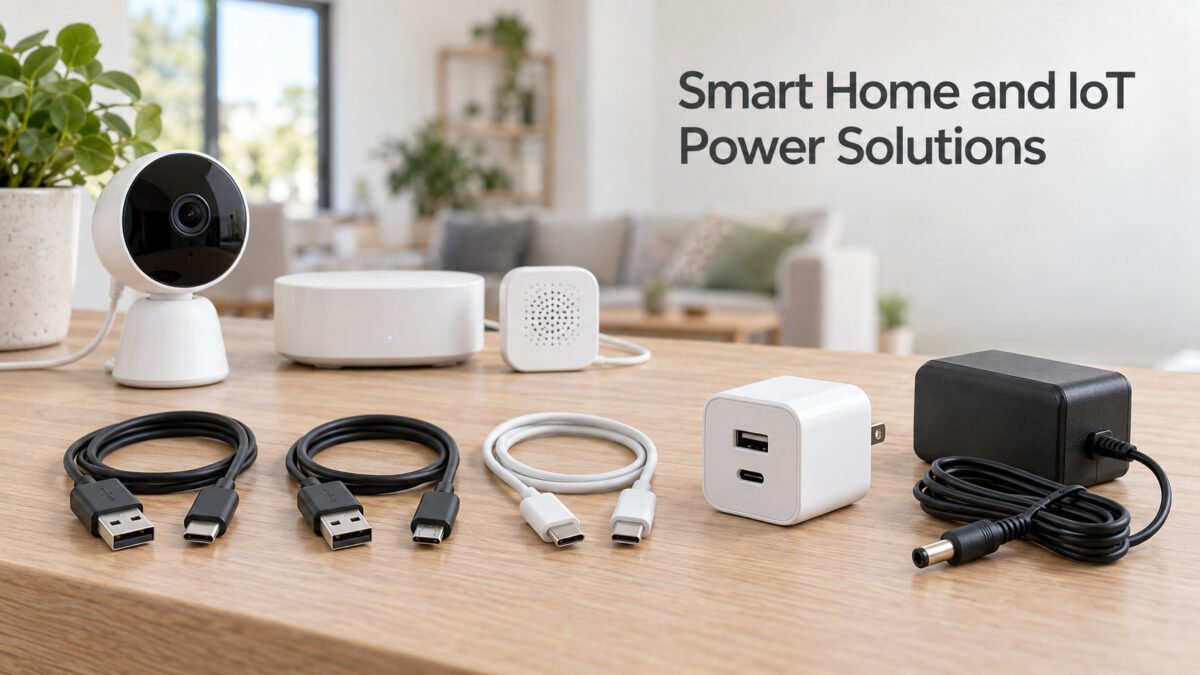
Smart home and IoT devices introduce power supply considerations that differ from conventional consumer electronics. Compact housings, continuous operating schedules, and distributed installation points call for power components that fit tight spaces, hold stable output, and remain functional over long service periods. This page outlines these requirements and introduces a corresponding range of USB cables, chargers, and power adapters for OEM customers, brand owners, distributors, and project buyers planning smart home and IoT device programs.
1. IoT Product Requirements
IoT devices share several power-related requirements that influence component selection at the design stage.
1.1 Compact Design
IoT products typically combine processing, sensing, and communication modules inside small enclosures. Space reserved for the power input is limited, and this affects both the connector on the device and the cable attached to it.
Connectors need a low profile and a small footprint. Micro-B and USB-C connectors are common choices because their housings fit compact device enclosures without requiring excessive connector depth. For installations where the cable exits at an angle, right-angle connector variants reduce the clearance required behind wall-mounted or recessed devices.
Cable routing is equally important. Short cable lengths—commonly 0.3 m, 0.5 m, e 1 m—reduce slack inside enclosures and behind devices. Flexible PVC and TPE jacket options can simplify routing through confined spaces and help reduce mechanical stress near the connector, subject to the cable's specified minimum bend radius. A smaller outer diameter can further ease routing through grommets and cable clips.
Where the cable is a permanent part of the device assembly, a strain-relief boot at the connector protects the joint from repeated bending at the exit point. A compact power path also simplifies packaging and logistics. Devices with a detachable cable can ship with the cable bundled separately, while integrated designs can use a molded connector that eliminates loose parts. Both approaches help manufacturers control overall product dimensions and keep the device housing small.
1.2 Stable Power
IoT devices often run without supervision and are expected to maintain operation between maintenance visits. Fluctuating or interrupted power can cause device resets, missed sensor readings, and lost event records. Stable power delivery is therefore a central requirement.
A wide range of IoT peripherals accept a standard 5 V supply, the common output level of USB power sources. For this voltage to reach the device in usable form, the cable must deliver consistent current along its length. Power-conductor size should be selected according to cable length, device current, allowable voltage drop, connector resistance, and operating temperature. For example, selected low-current products may use 28 AWG power conductors, while longer or higher-current assemblies may require 24 AWG or another suitable conductor size. Final performance should be verified against the electrical requirements of the target device.
Connection integrity also affects stability. A loose or intermittent connection can interrupt power during vibration or handling. Properly specified connectors provide controlled mating and retention forces that help reduce accidental disconnection during normal use. Where vibration or cable movement is a concern, consider locking connectors, screw-lock USB-C options, panel-mount designs, or additional cable retention appropriate to the installation. For cables that also carry data, shielding and controlled construction can help manage electromagnetic interference and support signal integrity. DC voltage stability, however, depends primarily on the source output, connector resistance, conductor resistance, cable length, and device current.
1.3 Long-Term Reliability
IoT equipment is frequently installed once and expected to operate for years with minimal intervention. Power components must support this expectation through both mechanical and electrical durability.
Mechanical durability is expressed by mating cycles. USB-compliant Micro-B and USB-C connector designs have a specified durability rating of 10,000 mating cycles under the applicable test conditions. The durability of a finished cable assembly still depends on connector quality, overmolding, strain relief, workmanship, and the supplier's validation plan. For a device that is plugged in once and rarely unplugged, such ratings leave a wide margin; for devices where the cable is disconnected during maintenance, the ratings support repeated handling over the product lifetime.
Cable construction contributes to long service life as well. Selected braided nylon constructions can provide improved surface abrasion resistance compared with basic PVC-jacketed cables in installations where cables rub against walls, frames, or floor edges. Reinforced strain relief at both connector ends distributes bending stress away from the conductor termination and connector interface, a common failure point in cables subjected to pulling and flexing.
Electrical stability over time matters equally. Connector contact materials and plating systems should be selected to meet the required contact-resistance, corrosion, and durability performance. Where specified, gold-plated contact areas over a suitable underplate can support reliable long-term electrical contact. Depending on the agreed quality plan, finished cable assemblies can be inspected for continuity and subjected to specified mechanical tests before shipment. Test methods, acceptance criteria, and sampling levels should be confirmed for each OEM program.
2. Product Solutions
An IoT power configuration normally combines a suitable cable with one of two AC/DC power-source options: a USB charger with a detachable USB cable, or a power adapter with an attached output cable or application-specific connector. The appropriate configuration depends on the device input, required voltage and current, installation method, target market, and whether users need to disconnect or replace the cable.

2.1 USB Cable
USB cables form the connection between the power source and the IoT device. A wide range of configurations is available to match device interfaces and installation conditions.
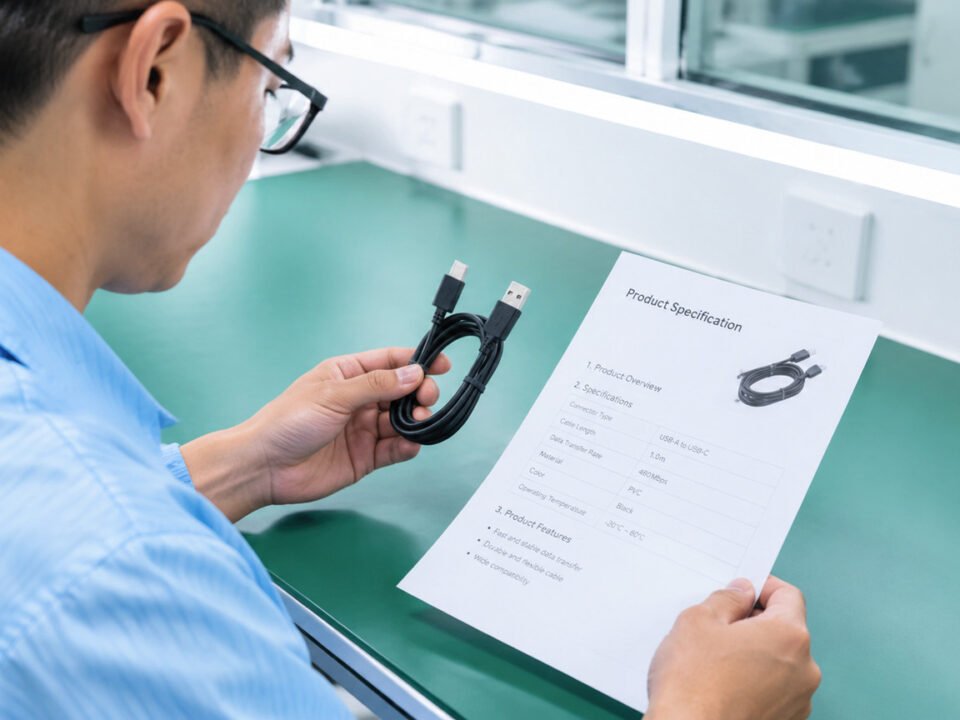
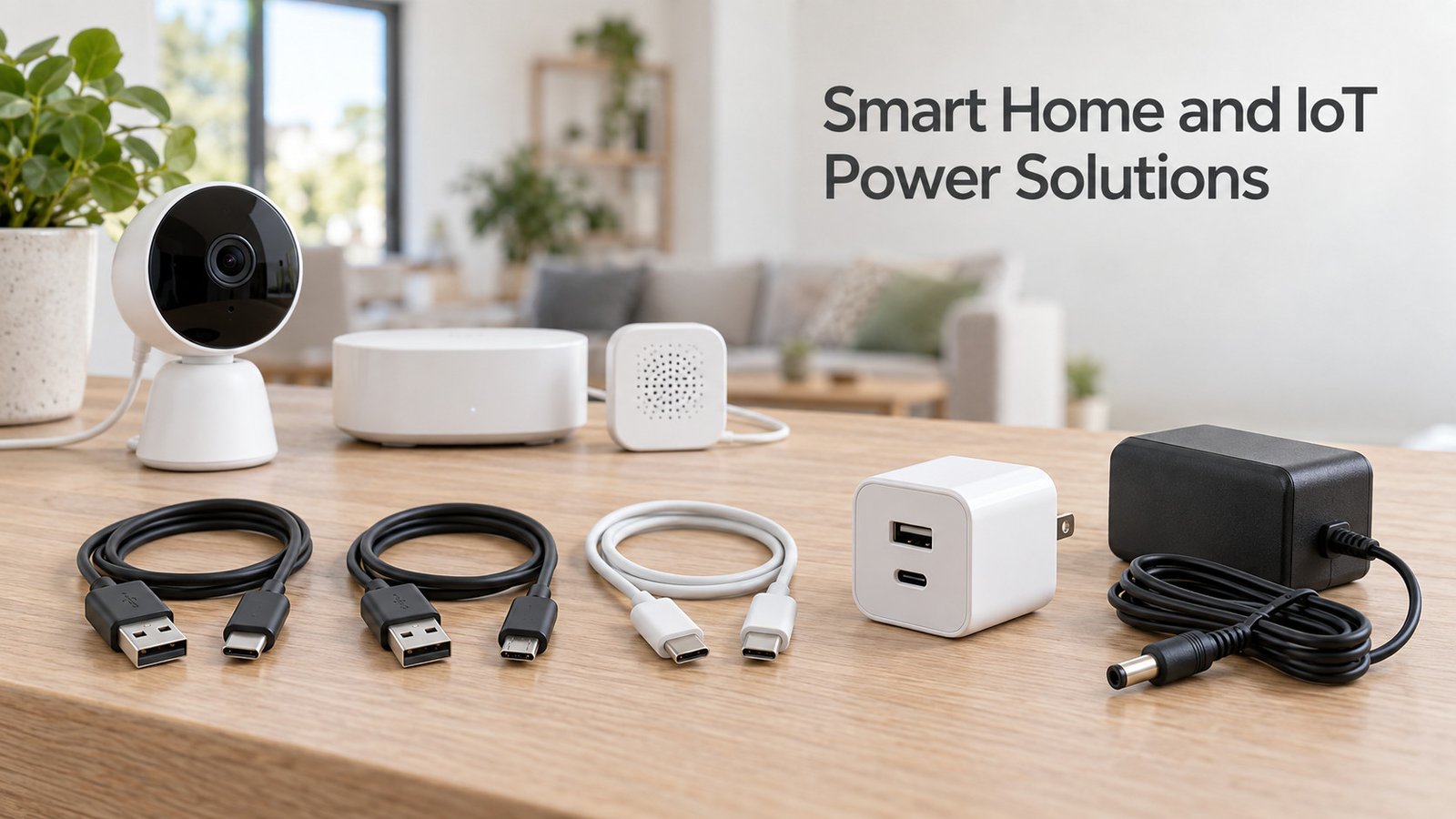
Connector combinations include USB-A to Micro-B, USB-A to USB-C, and USB-C to USB-C, covering common IoT device input configurations in current and existing product lines. Devices with earlier interfaces can be served by USB-A to Mini-B cables, which remain available for existing product lines.
Internal construction varies according to the required power and data functions. Depending on the specification, a cable may include power conductors, USB 2.0 signal conductors, additional high-speed pairs, shielding, and other components required by the selected USB configuration. Available conductor sizes may include 28 AWG, 26 AWG, e 24 AWG, depending on the model. The appropriate construction should be selected and validated according to current, length, voltage-drop limit, and device requirements. Jacket options include PVC for general indoor use, TPE for flexibility, and braided nylon for abrasion resistance in routed installations.
Lengths range from 0.3 m for in-enclosure connections to 3 m for wall-mounted devices positioned away from outlets. Connector durability, cable flexibility, and color can be customized within OEM programs, with customer branding applied to the connector housings.
2.2 USB Charger
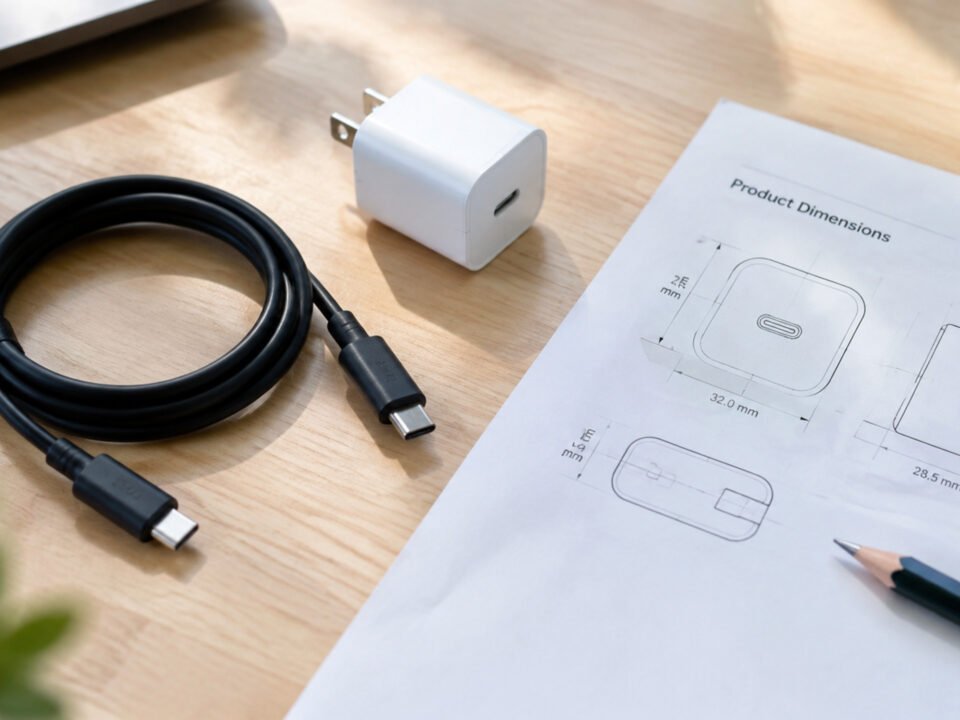
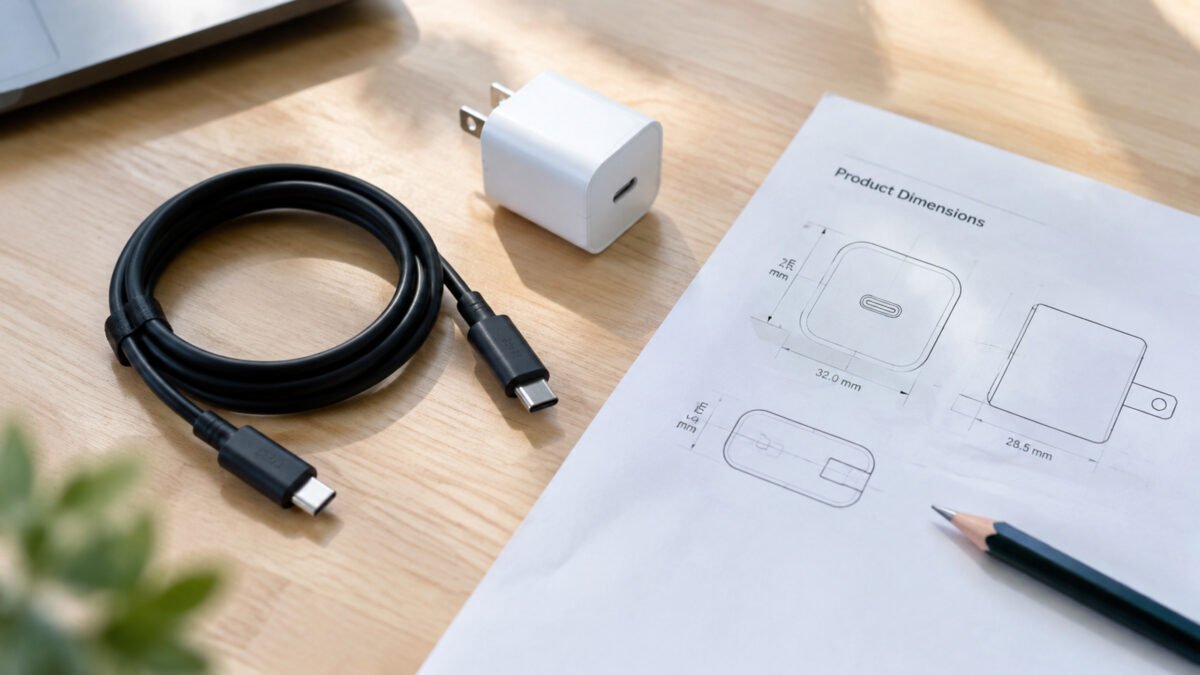
USB chargers convert mains power into a stable 5 V USB output and provide standard USB-A or USB-C output ports, which are paired with a detachable USB cable selected for the device.
Single-port chargers are available with output ratings of 5 V/1 A, 5 V/2 A, e 5 V/2.4 A, matching low-current sensors as well as devices with higher draw. Multi-port models provide two, four, or more USB-A or USB-C ports, allowing several devices at one location to share a single wall outlet—useful for hub-style installations where multiple sensors and controllers are grouped together. For multi-port models, buyers should confirm the total rated output, per-port limits, and power-allocation behavior when several devices operate simultaneously.
Compact wall chargers reduce occupied space around the outlet, while foldable-prong designs can simplify packing, shipping, and portable use where available. Desktop models with longer cords allow placement away from the outlet, which helps in installations where the outlet sits behind furniture or in an awkward position. US, EU, UK, and AU plug configurations may be available for selected models. Each regional version must be reviewed against the applicable safety, labeling, plug, and documentation requirements of its target market.
Depending on the model, available protection functions may include over-current, over-voltage, over-temperature, and short-circuit protection. The protection functions and applicable test documentation should be confirmed for the exact model. Compliance options depend on the product model and target market. Selected models may be available with applicable safety approvals, regulatory test reports, and supporting documents, such as UL or ETL certification where specified, FCC compliance documentation where applicable, and EU Declaration of Conformity and RoHS documentation for relevant EU-market models. Buyers should confirm the required standards and document set for the exact model before ordering. Charger casings can be produced in custom colors and with customer branding for retail packaging.
2.3 Fixed-Cable Power Adapter
Fixed-cable power adapters combine AC/DC conversion with an attached output cable. Unlike USB chargers with user-accessible USB output ports, these adapters are supplied as a dedicated power source for a specific device. Depending on the model, the cable may terminate in USB-C, Micro-B, a DC barrel plug, or a customer-specified connector.
Fixed-cable adapters suit devices installed in fixed locations where the power path is expected to remain undisturbed. The permanently attached cable removes the need for a separate cable purchase and reduces the risk of using an unsuitable cable, while the output length and termination are specified for the target device.
Output specifications focus on the standard 5 V level at current ratings selected for the connected device, with fixed-output models removing the need for user configuration. Selected adapters accept a wide input range, typically 100–240 V AC. Regional use also depends on the plug configuration, safety approvals, labeling, and compliance requirements applicable to the target market. Available protection functions, safety approvals, and compliance documents vary by model and target market. The required output specification and regulatory scope should be confirmed during product selection. Selected models may be supplied with more robust housings for protected indoor installations. Use in garages, covered outdoor areas, or other variable environments requires confirmation of the model's temperature, humidity, ingress-protection, and regulatory ratings.
2.4 How to Select an IoT Power Solution
The following checklist summarizes the parameters to define when specifying a cable and power-supply configuration:
- Device input: USB-C, Micro-B, Mini-B, DC plug, or a custom connector
- Power requirement: Rated voltage, continuous current, peak current, and supported charging protocol
- Data requirement: Power only or power plus data, including the required USB data rate
- Cable length: Select according to installation distance and allowable voltage drop
- Mechanical design: Straight, right-angle, panel-mount, locking, or molded connector
- Jacket and environment: PVC, TPE, or braided construction, with required temperature, UV, flame, chemical, or ingress ratings as applicable
- Target market: Plug type, safety standards, labeling, and compliance documentation
- OEM requirements: Color, logo, packaging, cable marking, and validation criteria
A USB-C connector does not by itself define the supported power, data rate, or video capability. These functions depend on the cable construction, connected devices, and supported USB or USB Power Delivery specification. Power-only, USB 2.0 data, higher-speed data, and USB PD cable options should therefore be specified separately.
3. Applications
The following sections outline how these power components apply to common IoT device categories.
3.1 Smart Camera
Smart cameras operate continuously and require a stable supply to avoid interruptions in recording and event detection. Their installation locations—corners, ceilings, doorways—often sit at some distance from the nearest outlet, so cable length and voltage stability are primary considerations.
Cables of 1.5 m to 3 m with appropriately sized power conductors help reduce voltage drop over longer runs. For cameras mounted at height, reinforced strain relief helps reduce bending stress during installation. The cable run should also be properly supported so that its weight is not carried by the device connector. For cameras installed under eaves or in other partially exposed locations, use only cable and connector assemblies with documented UV, temperature, moisture, and ingress-protection characteristics appropriate to the installation. A thicker jacket alone should not be treated as proof of outdoor suitability.
Power requirements vary substantially among camera designs. Some compact USB-powered models operate from 5 V, while other cameras use 9 V or 12 V adapters, USB Power Delivery, or Power over Ethernet. Infrared LEDs, motors, heaters, wireless transmission, and other peak-load functions must be included when determining the required output. A 5 V/2 A supply should be specified only after confirming the camera's rated voltage, continuous current, peak current, connector, and voltage tolerance. Connector choice follows the camera's input port, with USB-C increasingly common on current models and Micro-B still present on devices in the installed base. Multi-port chargers allow several cameras to be powered from one outlet when cameras are grouped at the same location.
3.2 Smart Sensor
Smart sensors—temperature, humidity, motion, contact, and air-quality types—are installed at windows, doors, duct openings, and other positions where space is tight and cable access is limited. Many small USB-powered sensors draw less than 1 A, but the required voltage, operating current, and peak current should be confirmed for the specific sensor design.
Small-footprint connectors such as Micro-B and USB-C fit the compact input ports of sensor housings. Short cables of 0.3 m to 1 m keep the power path tidy in confined spaces. For concealed, in-wall, ceiling, or conduit installations, cable selection must follow the applicable local electrical and building-code requirements. Standard consumer USB cables should not be specified for these locations unless the cable has the required installation rating and supporting documentation.
Because sensors may operate unattended for long periods, connector and cable durability becomes a practical factor. Connector options designed and validated for the required mating-cycle target, combined with cable strain relief, support long-term sensor deployments with limited routine handling.
3.3 Smart Hubs, Control Panels, and Displays
Smart hubs, control panels, and displays coordinate connected devices and often consume more power than individual sensors. Power demand varies by processor, display size, wireless functions, connected peripherals, and operating mode. Some 5 V devices can use conventional USB power supplies, while higher-power products may require USB-C Power Delivery or a dedicated adapter. Selection should be based on the device's rated voltage, continuous and peak current, connector, and supported power protocol.
Devices with a fixed installation, such as wall-mounted panels, can be paired with a wall-mount power source that stays out of sight behind the device. Devices that may be relocated—tabletop displays, portable hubs—work with a cable and charger combination that can be unplugged and moved together.
For installations where several smart home devices are powered from a single point, multi-port chargers reduce outlet requirements and keep cable runs organized; per-port output limits and total rated output should be confirmed for simultaneous operation. Matching cable lengths and connector types to each device avoids clutter and simplifies maintenance, and cable ties, clips, and sleeving can be provided as part of OEM packaging programs.
OEM customers can specify the connector, cable length, conductor construction, jacket material, power rating, regional plug, branding, and packaging for their device program. Contact the sales team with your device input, power requirement, target market, installation environment, and estimated order volume for a recommended cable and power-supply configuration.
Need a Smart Home or IoT Power Solution?
Whether you need standard USB cables, USB chargers, and fixed-cable power adapters, or fully customized OEM/ODM solutions with specific connector configurations, cable lengths, conductor sizes, jacket materials, power ratings, and branding, our team can help you review the requirements and recommend a standard model or develop a custom configuration for your smart home or IoT device program. From 0.3 m to 3 m, 5 V/1 A to 5 V/2.4 A, and compact wall chargers to fixed-cable adapters, we support IoT power projects with competitive pricing and flexible MOQ.