

Custom Power Adapter Manufacturing Process
2026-09-18
Prototype to Mass Production Process
2026-09-18
Product Selection Tool: Requirements to Recommended Product
USB Cable Product Selection Tool
A centralized online entry point for overseas buyers, brand integrators, and industrial clients — matching USB cable configurations to defined application parameters across connector, power, data, video, length, construction, and environment.
1. Page Positioning: USB Cable Selection
The USB Cable Product Selection Tool helps overseas buyers, sourcing teams, product managers, and engineering teams identify suitable cable configurations based on application requirements.
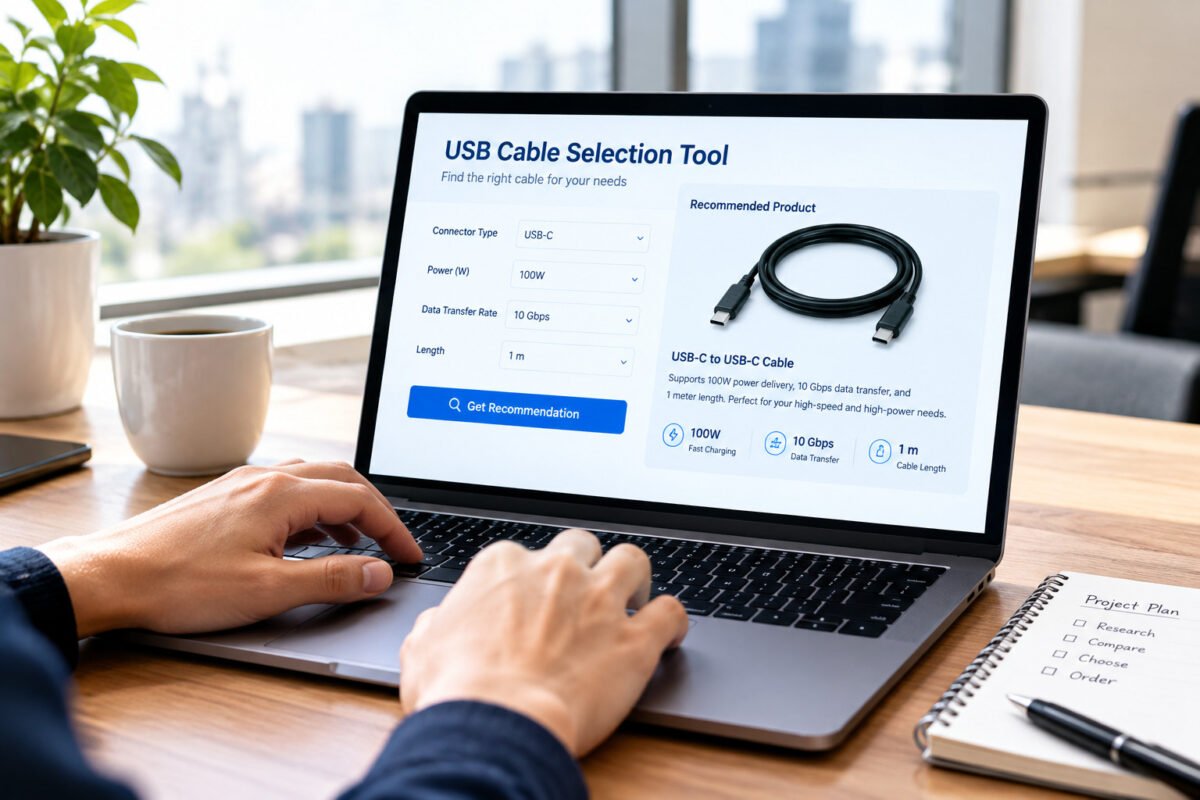
Instead of browsing an unfiltered cable catalog, users can specify key requirements such as connector combination, power capability, data performance, video capability, cable length, construction, and operating environment. The selection process then narrows the available cable configurations and identifies suitable standard or customized solutions.
For projects requiring specific connector combinations, cable constructions, branding, packaging, or application-specific performance, the selection process can lead directly to an RFQ for OEM/ODM development.
2. Target Keywords
This page is optimized for search queries including product selection tool e product selector. These terms reflect the search intent of procurement professionals and technical buyers who require a structured, parameter-driven approach to identifying USB cable products from a manufacturing source. The tool is designed to serve this intent by translating technical specifications into matched product recommendations, rather than presenting an unfiltered catalog browse experience.
3. Content Direction: User Input
The product selection tool accepts structured user input across key selection factors. Each factor defines a specific dimension of the cable requirement. Understanding the distinction between these factors is essential for accurate product matching.
| Selection Factor | What It Defines |
|---|---|
| Connector | Physical interface type (e.g., USB Type-C, Type-A, Micro-B) |
| Poder | Maximum supported power capability |
| Data | Maximum supported data performance |
| Video | Display and Alt Mode support |
| Comprimento | Maximum cable run distance and passive/active construction type |
| Construção | Conductor, shielding, jacket, and mechanical design |
| Environment | Operating conditions and application-specific requirements |
3.1 USB Cable
Connector
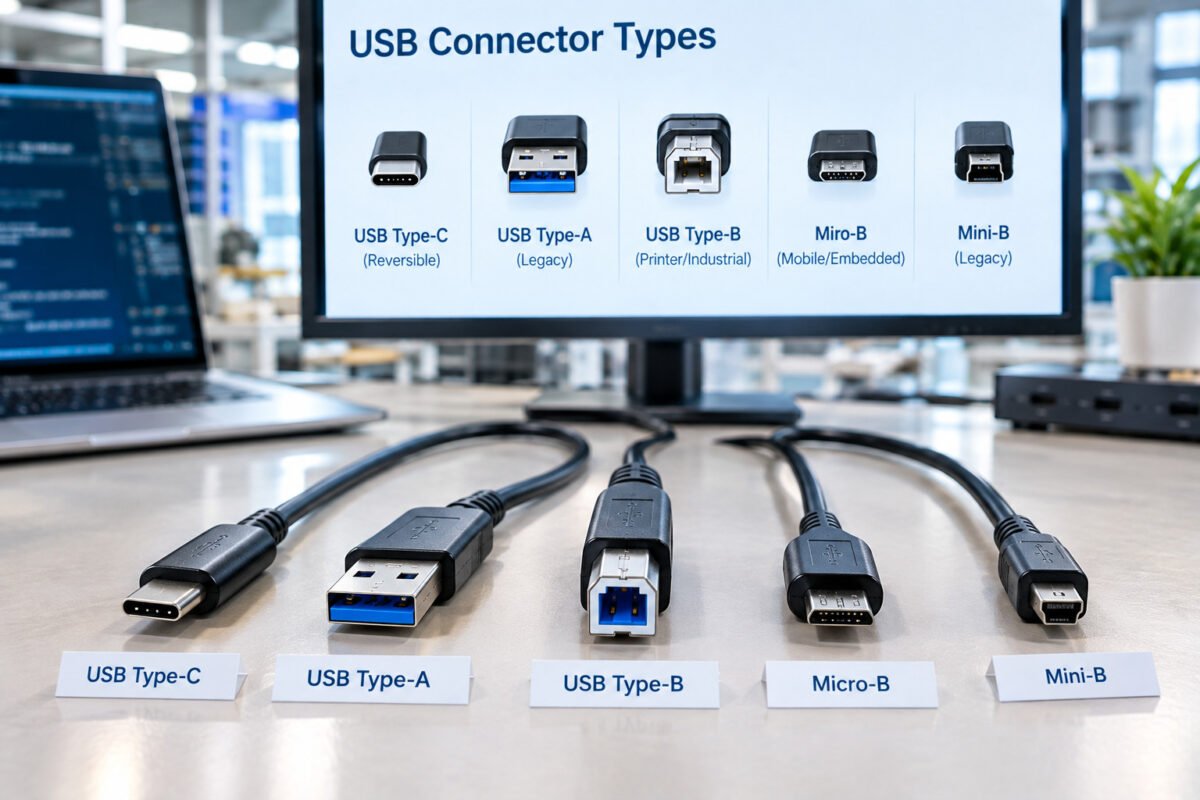
USB cable connectors are specified according to USB Type-C and legacy connector standards. Available connector options include USB Type-C, USB Type-A, USB Type-B, Micro-B, and Mini-B for selected legacy equipment. USB Type-C supports reversible plug orientation and is used for USB4 and USB Power Delivery applications. USB Type-C specifications define the connector architecture, signaling, power-related requirements, and cable characteristics applicable to Type-C cable assemblies.
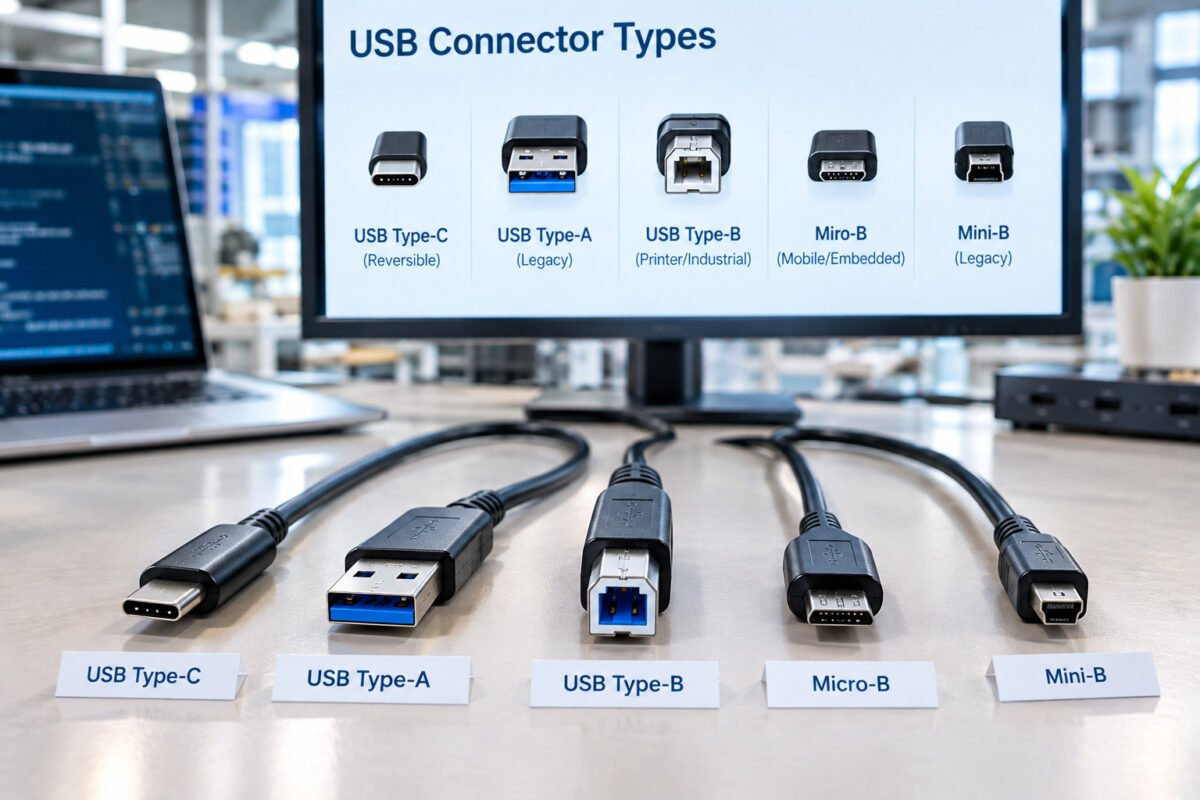
Legacy connectors remain relevant for selected models targeting backward-compatible installations, industrial equipment with older USB ports, and applications where USB Type-C adoption has not yet been implemented. Cable assemblies bridging connector types — such as USB Type-C to Type-A or USB Type-C to Micro-B — are available for mixed-interface deployment scenarios.
| Connector | Common Applications |
|---|---|
| USB Type-C | Smartphones, laptops, docks, displays, modern equipment |
| USB Type-A | PCs, legacy peripherals, charging equipment |
| USB Type-B | Printers, industrial equipment, instruments |
| Micro-B | Legacy mobile, embedded and industrial devices |
| Mini-B | Selected legacy equipment |
Poder
USB Type-C cable power capabilities include standard USB power, USB Power Delivery up to 100W for Standard Power Range (SPR) configurations, and up to 240W for Extended Power Range (EPR) configurations on compatible USB Type-C cable assemblies.
For 5A and EPR applications, the cable must meet the relevant current, identification, and compliance requirements. Actual power capability depends on the cable specification and the connected source and device. Power selection should therefore be based on the required wattage, voltage/current profile, and cable rating rather than the USB-C connector type alone.
For USB Type-C to USB Type-C cables undergoing the USB-IF Compliance Program, applicable power capability markings include 60W ou 240W. Specific cable ratings and required markings depend on the cable category and applicable compliance specifications.
Actual power capability depends on the cable rating, power source, connected device, and applicable USB Power Delivery configuration.
Marcador eletrônico
E-Marker identification is used on applicable USB Type-C cable configurations to communicate cable capabilities to the connected system. For 5A and other applicable high-power USB Type-C cable configurations, E-Marker implementation and identification requirements depend on the cable design and applicable USB specifications.
Where required, E-Marker information can be included as part of the cable specification and compliance documentation.
Data Performance
USB cable data performance depends on the cable design, signaling capability, and supported USB specification. Typical performance categories include:
- USB 2.0: up to 480 Mbps
- USB 3.2 Gen 1: up to 5 Gbps
- USB 3.2 Gen 2: up to 10 Gbps
- USB 3.2 Gen 2×2: up to 20 Gbps (requires compatible USB Type-C implementation)
- USB4: up to 40 Gbps for compatible cable configurations
- USB4 versão 2.0: up to 80 Gbps for compatible systems and cable configurations
Actual performance depends on the cable construction, connected devices, and supported USB implementation. Data rate should therefore be specified together with connector type and cable configuration.
USB-IF explicitly states that USB 3.2 defines transfer rate only — it is not a connector type, not USB Type-C, and not USB Power Delivery. This separation means that a USB Type-C cable may carry varying data rate capabilities depending on its internal construction. Understanding this distinction — connector does not equal data speed, and data speed does not equal power rating — is essential for accurate cable selection.
Video
For USB Type-C cables used with monitors, docking stations, and other display applications, video capability should be specified separately from the connector type and USB data rate.
Depending on the cable and connected devices, supported video functions may include DisplayPort Alt Mode or DisplayPort tunneling through USB4. Maximum resolution and refresh rate depend on the cable capability, host device, display, and supported display protocol. Video specifications should therefore be confirmed for the complete system rather than inferred from the USB-C connector alone.
- No video requirement
- Modo alternativo DisplayPort
- USB4 display applications
- Custom video requirements
Comprimento
For high-speed passive USB Type-C cable assemblies, practical length limits generally decrease as signaling speed increases. Typical reference configurations may include approximately 2 m for USB 3.2 Gen 1 and 1 m for USB 3.2 Gen 2, while higher-speed USB4 configurations generally require shorter passive cable lengths or active cable architectures. Typical USB 2.0 passive cable configurations can support lengths up to 5 m. Actual supported length depends on the cable design, signaling requirements, and applicable USB specification.
- Short passive — compact device connections
- Standard passive — typical desktop and equipment runs
- Long / active — extended reach with retimer or redriver technology
- Optical isolated active cable (OIAC) — specialized long-distance solution for industrial imaging, medical equipment, and remote storage applications
OIAC configurations are specialized solutions with specific power and protocol limitations. Higher-speed applications may require shorter passive cable lengths or active cable designs.
Construção
Cable construction defines the physical and electrical build of the cable assembly. For OEM/ODM and industrial applications, construction parameters directly affect signal integrity, durability, and environmental performance. Available construction parameters include:
- Conductor material and construction
- Wire gauge
- Shielding structure (foil, braid, or combination)
- Jacket material (PVC, TPE, TPU, or other materials)
- Outer diameter
- Bend radius
- Connector housing and strain relief
- Overmolding
Construction selection should match the application’s mechanical, electrical, and environmental requirements. Specific construction details are confirmed during the specification and quotation process.
Environment
Operating environment defines the conditions under which the cable will be deployed. For B2B and industrial applications, environmental requirements may affect cable material selection, shielding design, and connector construction. Available environment categories include:
- Standard indoor use
- High-flex applications (frequent bending, moving equipment)
- Industrial environments
- High-temperature environments
- Low-temperature environments
- Moisture / water-resistant requirements
- Dust / chemical exposure
- Vibration / mechanical stress
- Medical / machine vision / automation applications
Environmental ratings such as IP classification, temperature range, and flex-life data are provided only for cable configurations with corresponding test data.
4. Output: Recommendation
Upon processing the user input parameters across the selection factors, the product selection tool generates structured recommendations organized into three output components: product solution, specification guide, and contact/RFQ. These components work together to support technical evaluation, engineering review, and procurement decision-making.
4.1 Product Solution
The product solution output presents matching cable configurations filtered by the user-specified parameters. The solution includes cable models matching connector type, data rate tier, power delivery rating, video capability, length requirement, construction type, and environmental specifications — distinguishing between passive and active cable constructions where distance exceeds passive limits.
Each product solution entry includes the model identifier, relevant certification status where applicable, and key technical specifications matched to the input parameters. Where multiple models satisfy the input criteria, the solution presents a range of options suitable for the specified requirements, allowing the buyer to compare specifications such as cable jacket material, connector housing, or form factor within the filtered result set. Solutions that fall outside standard catalog configurations are flagged, indicating where customization or OEM/ODM development may be required to meet the specified parameters.
4.2 Specification Guide
The specification guide provides detailed technical documentation for each recommended product solution, supporting engineering evaluation and verification prior to procurement. For USB cables, the guide details electrical specifications including supported data rates, impedance characteristics, and power delivery ratings; mechanical specifications including connector dimensions, cable diameter, jacket materials, and bend radius; and relevant certifications and safety standards. The guide distinguishes between passive and active cable characteristics, documenting active cable architecture and signal integrity characteristics, and maximum supported lengths under the relevant USB specification tier.
Application notes within the guide address installation considerations, environmental ratings such as operating temperature range, and compatibility notes for specific device categories. This documentation package enables technical teams to verify that recommended products meet application requirements and regulatory standards before committing to volume procurement. Where USB-IF certification applies, the certification status and relevant product information can be provided for verification.
4.3 Contact / RFQ
The contact and RFQ output facilitates direct engagement with the sales and engineering team for pricing, customization, and order placement. Upon selecting a recommended product solution, users can submit a Request for Quotation specifying quantity requirements, customization parameters, target lead times, and compliance documentation needs.
RFQ parameters include:
- Connector A / B type
- Power rating
- Data rate
- Video requirement
- Comprimento
- Conductor material and wire gauge
- Shielding structure
- Jacket material
- Environmental requirements
- Quantidade
- Branding (logo, color coding, custom labeling)
- Embalagem
- Compliance requirements
The RFQ channel connects procurement teams with technical sales representatives who provide detailed pricing structured by volume tiers, minimum order quantities, sample availability, and production scheduling information. For OEM and ODM projects, the contact channel also supports discussions on custom connector configurations, specialized cable constructions tailored to application-specific environmental requirements, and designs that extend beyond the standard product catalog. Customization capabilities include cable overmolding, color coding, custom labeling, custom wire gauge, shielding structure, jacket material, custom length, connector housing, strain relief, and custom pinout. The contact/RFQ output helps buyers move from product identification to quotation request within the same tool workflow, streamlining the transition from technical specification to commercial engagement.
Need a Custom USB Cable Solution?
Whether you need standard bulk USB cables or fully customized cable assemblies — Type-C, Type-A, Micro-B, or mixed-interface — our engineering team can help you specify the right configuration. From connector combinations and E-Marker implementation to jacket materials, shielding, and overmolding, we support OEM/ODM projects with competitive pricing and flexible MOQ.