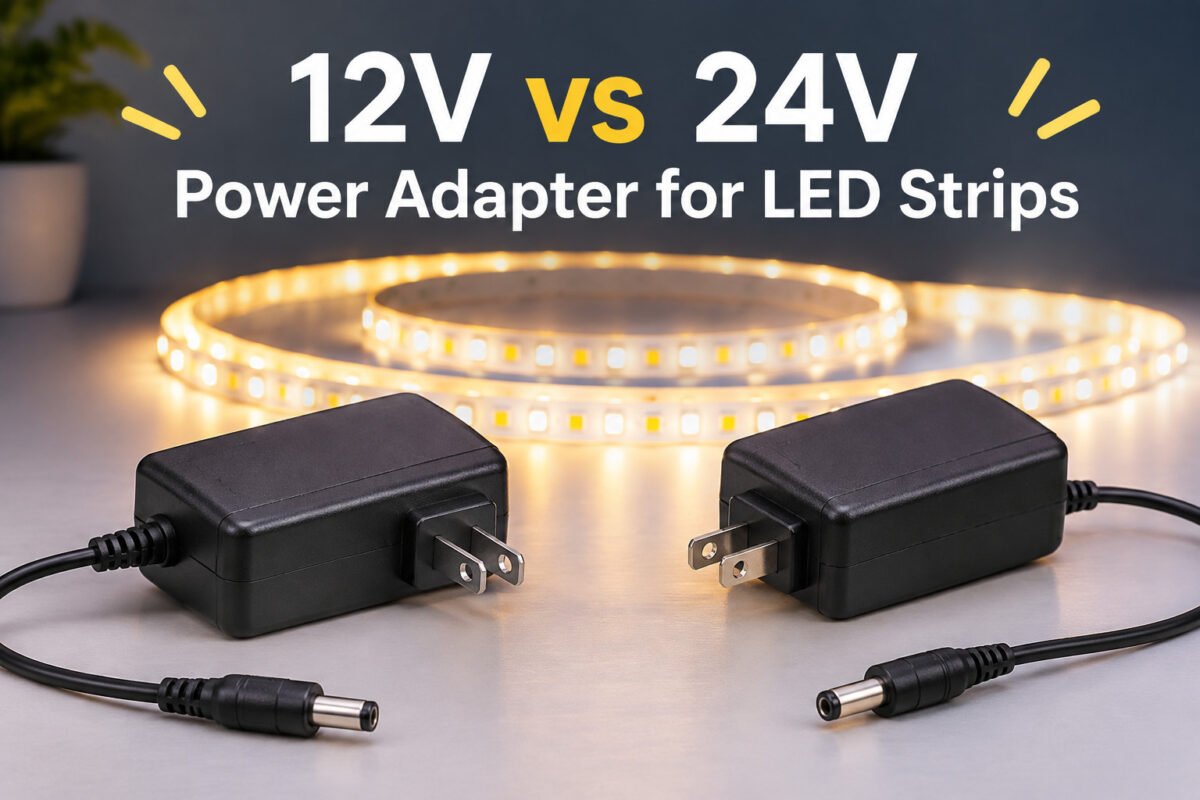
12V vs 24V Power Adapter for LED Strips
GUIDE · LED STRIP POWER
12V vs 24V Power Adapter for LED Strips
Two strips, same LEDs, same brightness per meter, and one is sold as 12V while the other is 24V. The choice changes the adapter, the cable, and how far a single run can reach before the far end goes dim.
The short version: at the same wattage, 24V halves the current, and half the current means a quarter of the losses in the same copper. That single fact decides most installations.
This guide covers what each voltage means on a strip, how the adapter is sized, where voltage drop shows up, and which one to pick for a given run.
1. What the Two Voltages Mean on a Strip
An LED strip is a constant-voltage load. Each short section of the strip carries the LEDs plus a series resistor sized so the LEDs see their rated current at the strip's nominal voltage. Feed it 12V and the sections draw their design current; feed it less and they dim.
The two versions are not different LEDs. A 12V strip groups three LEDs per resistor, a 24V strip groups six, and the copper runs are arranged so the same power per meter results. That is why a 24V strip of the same power is not brighter, only differently wired.
Because the strip expects a fixed voltage, the adapter has to be a regulated constant-voltage supply. A battery charger, an unregulated transformer, or a supply with a wide no-load offset will produce uneven brightness and excess heat in the strip.
2. The Same Power at Half the Current
Take a strip rated 14.4W per meter and a five-meter length, which is 72W in total.
At 12V, 72W draws 6A. At 24V, the same 72W draws 3A. The LEDs receive the same power in both cases; the difference is entirely in the wiring between the adapter and the strip.
Loss in a cable is the current squared times resistance. Halving the current divides those losses by four. The practical consequence is that a 24V installation can use thinner cable, run longer, or both, and still deliver close to nominal voltage at the far end.
3. Voltage Drop and How Far a Run Goes
Voltage drop is the reason 12V installations are usually kept short. The current travels out along one conductor and back along another, so the resistance that matters is twice the run length.
With 20AWG cable, about 33 milliohms per meter, a three-meter run gives roughly 0.2 ohms in the loop. At 6A that is a 1.2V drop, or 10% of 12V. At 3A it is 0.6V, or 2.5% of 24V.
| Configuração | Atual | Loop resistance | Drop | Share of supply |
|---|---|---|---|---|
| 12V, 72W, 3m of 20AWG | 6A | 0.2Ω | 1.2V | 10% |
| 24V, 72W, 3m of 20AWG | 3A | 0.2Ω | 0.6V | 2.5% |
A 10% drop is visible. The far end of the strip runs dimmer and slightly warmer in color, and the effect grows with length. As a rule of thumb, a single 12V feed is kept to about five meters, while a 24V feed can reach roughly twice that with the same cable. Copper gauge and load decide the real limit, not the rule.
4. Brightness and Color Consistency
Both voltages lose brightness along a long run, but the 12V version loses it sooner. Because the drop is a larger share of a smaller supply voltage, the same absolute loss costs more.
Color shift follows brightness. As the LEDs at the far end see less current, their output falls, and the balance between the phosphor and the die shifts enough to be visible on white strips. Two strips fed from opposite ends look even; one strip fed from one end does not.
Cut marks matter here as well. A 12V strip is commonly cuttable every three LEDs and a 24V strip every six, because the cut point has to fall between resistor groups. Cutting outside those marks leaves a section that will not light.
5. How to Size the Adapter
Start from the total wattage, not the length. Multiply the strip's watts per meter by the meters used, then add headroom.
For the 72W example, a 100W adapter leaves 28W of headroom. That margin covers two things: strips often draw close to their rating rather than below it, and a supply run near its maximum for hours runs hot.
Current ratings follow from the same arithmetic. The 72W load needs at least 6A at 12V or 3A at 24V, and the adapter should exceed that. A 12V 8A unit or a 24V 4A unit covers the example with room to spare.
Do not mix the two voltages on one supply, and do not assume a 24V adapter will run a 12V strip at half brightness. It will run it at double voltage, which destroys the strip.

6. Practical Rules for Each Voltage
- Short runs and vehicles. 12V suits installations close to the supply and anything drawing from a 12V system, such as a car or a boat.
- Long runs and large areas. 24V suits ceilings, coves, and commercial installations where a single feed has to cover distance.
- Feed both ends. On any run over a few meters, connecting the strip at both ends halves the effective resistance and evens out brightness.
- Match the dimmer. PWM dimmers are rated for a voltage and a current. A 12V dimmer on a 24V strip fails, and an undersized dimmer overheats.
- Check the connector rating. Barrel jacks and push connectors carry limited current. The 6A of a 12V installation is harder on them than the 3A of a 24V one.
7. Which One to Choose
For a desk, a shelf, or a vehicle, 12V is simpler: 12V adapters are widely available, and the run is short enough that drop does not matter.
For a ceiling, a long cove, or a retail installation, 24V is the better engineering choice. It halves the current, allows thinner cable, extends the usable run, and reduces heat at every connector in the path.
If the installation already exists, stay with its voltage. Rewiring a strip to a different supply voltage is not an upgrade; it is a failure waiting for the first power-up.
8. Conclusão
The two voltages do the same job with different wiring economics. At equal power, 24V carries half the current, loses a quarter as much in the same copper, and reaches farther before the far end dims.
Choose 12V for short runs and 12V systems, 24V for distance and larger loads, and size the adapter from total wattage with headroom rather than from the strip's length.
A regulated constant-voltage supply with the right voltage, enough current, and a connector rated for the load is what makes either choice work in practice.
That is also where installations fail: a correct strip on an undersized adapter, or a long run on cable chosen for appearance rather than for current.