

65W GaN Charger: Why Is It Ideal for Modern USB-C Charging?
65W GaN Charger: Why Is It Ideal for Modern USB-C Charging?
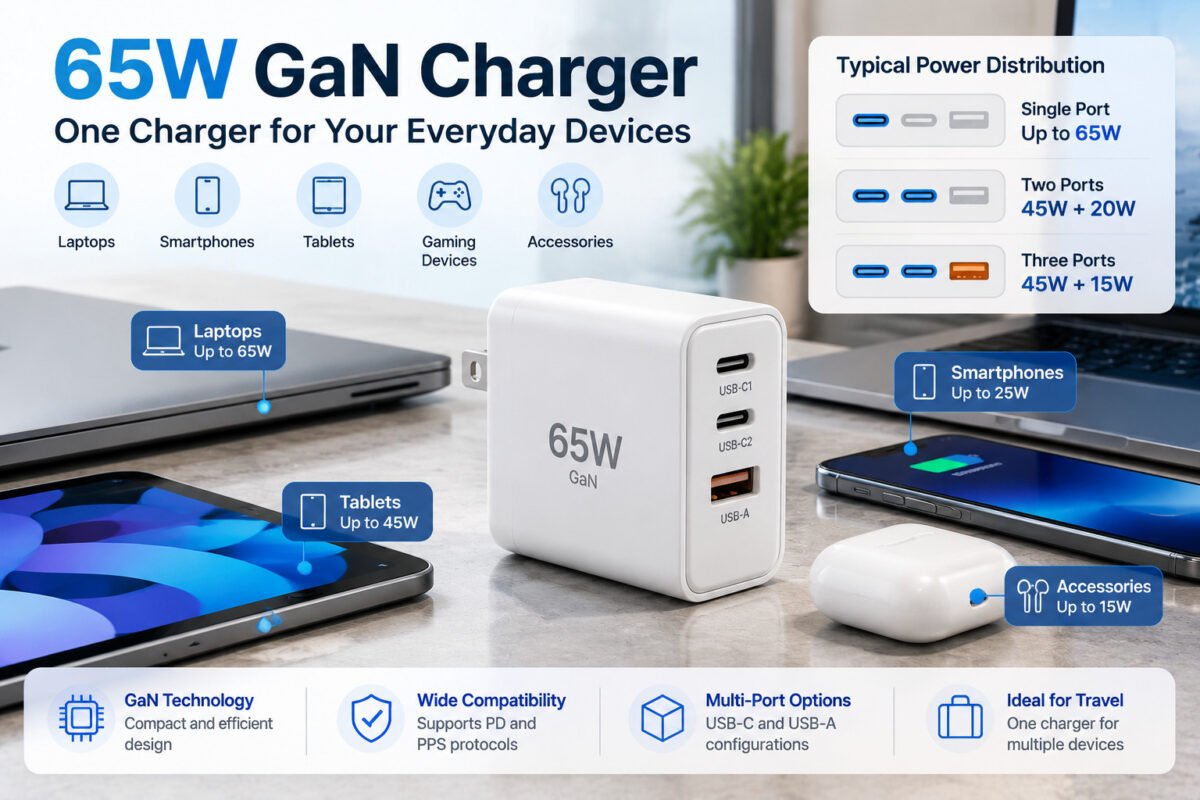
A 65W GaN charger has become a popular choice for charging smartphones, tablets, and laptops through a compact USB-C power adapter. It offers a practical balance between charging power, portability, and compatibility with modern electronic devices. Compared with traditional silicon-based chargers, GaN technology allows manufacturers to develop compact power adapters with high power density. Combined with USB Power Delivery (PD), a 65W GaN charger can support a wide range of charging applications. But why has 65W become such a popular power rating? What devices can it charge, how do multiple ports distribute power, and what cable specifications are required? This guide explains the main features, configurations, compatibility, and applications of 65W GaN chargers.
- 1. Why Is 65W GaN Charger a Popular Choice?
- 2. Common Port Configurations for 65W GaN Chargers
- 3. Which Devices Can a 65W GaN Charger Support?
- 4. Power Distribution and USB-C Cable Requirements
- 5. Thermal Performance of 65W GaN Chargers
- 6. 65W vs 100W GaN Chargers: Product Positioning
- 7. Where Are 65W GaN Chargers Commonly Used?
- 8. Conclusion
1. Why Is 65W GaN Charger a Popular Choice?
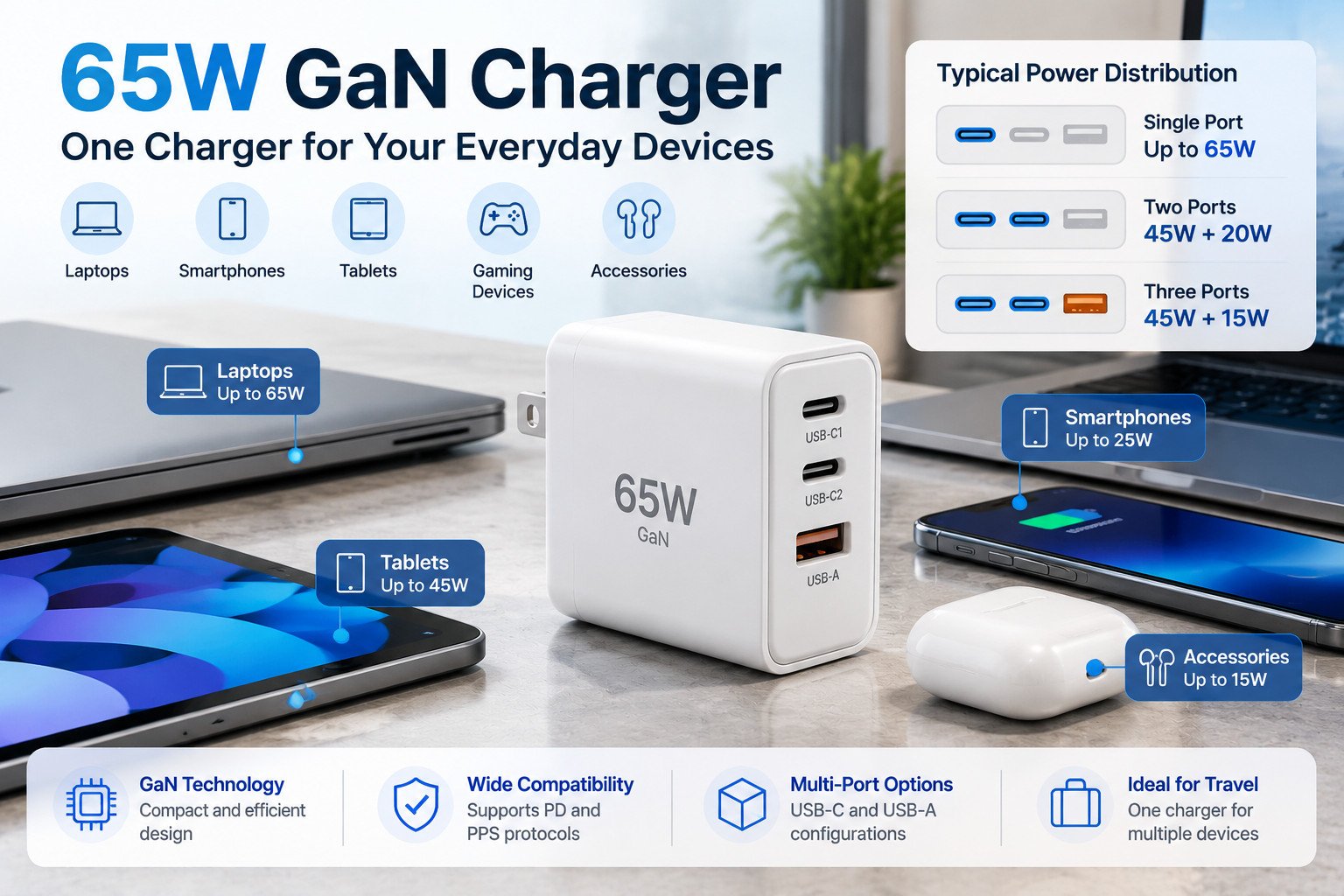
65W has become an important power rating in the USB-C charger market because it can support many smartphones, tablets, and lightweight laptops.
A smartphone generally requires less charging power than a laptop. However, a compatible 65W charger can provide additional power when connected to devices designed to accept higher wattage.
This makes 65W a versatile option for users who want one charger for several types of electronic equipment.
Why Use GaN Technology?
GaN stands for Gallium Nitride, a semiconductor material used in modern power electronics.
Compared with conventional silicon-based power components, GaN technology can operate at higher switching frequencies and support more compact power-conversion designs.
For charger manufacturers, this creates opportunities to develop:
- Smaller charger housings.
- Higher power density.
- More compact internal circuit layouts.
- Efficient power conversion.
- Multi-port charging products.
However, the actual size, efficiency, and thermal performance depend on the complete charger design, including the power architecture, components, circuit layout, and heat-management system.
Why Choose 65W Instead of 20W or 100W?
Different power ratings are designed for different charging requirements.
| Charger Power | Common Applications |
|---|---|
| 20W | Smartphones and smaller USB-C devices |
| 30W | Smartphones, tablets, and selected lightweight laptops |
| 45W | Smartphones, tablets, and compatible laptops |
| 65W | Smartphones, tablets, and many lightweight laptops |
| 100W | Compatible laptops and higher-power USB-C devices |
A 65W charger provides more available power than a typical smartphone charger without necessarily requiring the larger power capacity of a 100W adapter.
For users who regularly charge both a laptop and a smartphone, 65W can be a practical middle-ground option.

2. Common Port Configurations for 65W GaN Chargers
The port configuration determines which devices can connect to a charger and how available power is distributed.
Most 65W GaN chargers use one of the following configurations.
Single-Port USB-C Charger
A single-port 65W GaN charger typically provides one USB-C output.
Its main advantage is that the available output power can be directed to one connected device, subject to the charger's supported output profiles and the device's requirements.
Typical applications include:
- USB-C laptops.
- Tablets.
- Smartphones.
- Compatible portable electronic devices.
A single-port configuration is suitable for users who primarily charge one device at a time.
Dual-Port USB-C Charger
A dual-port 65W GaN charger provides two USB-C outputs.
This configuration allows users to connect two devices simultaneously, such as a laptop and a smartphone.
However, the maximum output of each port may change when both ports are used.
For example, a charger may provide up to 65W through its primary USB-C port when used alone, but distribute power between the two ports when both devices are connected.
The exact output combination depends on the charger's internal power-management design.
USB-C and USB-A Combination
Some 65W GaN chargers combine USB-C and USB-A outputs.
This configuration supports newer USB-C devices while maintaining compatibility with accessories and equipment that use USB-A cables.
It can be useful for travel chargers and multi-device charging products.
Common 65W GaN Port Configurations
| Configuração | Typical Application | Main Advantage |
|---|---|---|
| 1 × USB-C | Laptop or single-device charging | Simple power delivery |
| 2 × USB-C | Laptop and smartphone | Supports two modern devices |
| 1 × USB-C + 1 × USB-A | Modern and legacy devices | Wider connector compatibility |
| 2 × USB-C + 1 × USB-A | Multiple electronic devices | More flexible connectivity |
The port count alone does not determine the charger's performance. Buyers should check the maximum output of each port and the available power combinations when multiple devices are connected.
3. Which Devices Can a 65W GaN Charger Support?
A 65W GaN charger can support many electronic devices, provided that the charger and device use compatible charging specifications.
Smartphones
Most modern smartphones require less than 65W of charging power.
A compatible 65W USB-C charger can therefore supply power to many smartphones, while the phone controls how much power it draws.
The actual charging speed depends on the phone's maximum supported input power and charging protocol.
Some smartphones support USB Power Delivery, while others use proprietary fast-charging technologies or additional protocol requirements.
Comprimidos
Many USB-C tablets can be charged using a 65W GaN charger.
The charger provides the power supported by the tablet, rather than automatically delivering its full rated output.
For tablets used for work, entertainment, or drawing, a 65W charger can provide a convenient charging solution when the device supports the required USB-C charging standard.
Laptops
A 65W GaN charger can also charge many lightweight laptops and compatible notebook computers.
Examples include selected models from:
- Apple MacBook Air.
- Dell XPS.
- Microsoft Surface.
- Lenovo ThinkPad.
- HP laptops.
Compatibility must be checked against the specific model because different laptop configurations may have different power requirements.
Some laptops support USB-C Power Delivery, while others require a higher-power adapter or a proprietary charging connection.
A 65W charger may also charge a compatible laptop more slowly than its original higher-wattage adapter.
Other USB-C Devices
A 65W GaN charger can also support compatible devices such as:
- Portable monitors.
- USB-C docking accessories.
- Handheld gaming devices.
- Wireless headphone charging cases.
- Other USB-C powered electronics.
The connected device must support the charger's available output voltage and charging method.
4. Power Distribution and USB-C Cable Requirements
When selecting a 65W GaN charger, it is important to understand both power distribution and cable specifications.
These two factors directly influence the charging performance of the complete system.
How Does Multi-Port Power Distribution Work?
A multi-port charger does not necessarily deliver its maximum rated power to every port simultaneously.
The total available power is shared according to the charger's internal power-management design.
For example, consider a 65W dual-port charger:
| Connection Status | Example Power Distribution |
|---|---|
| USB-C1 only | Up to 65W |
| USB-C2 only | Up to 65W, if supported |
| USB-C1 + USB-C2 | 45W + 20W |
| USB-C1 + USB-A | Model-specific allocation |
| Three devices connected | Model-specific allocation |
The 45W + 20W configuration is an example, not a universal 65W charger specification.
Some chargers may also change their output when a device is connected or disconnected.
Before selecting a multi-port GaN charger, check its individual output profiles and simultaneous charging combinations.
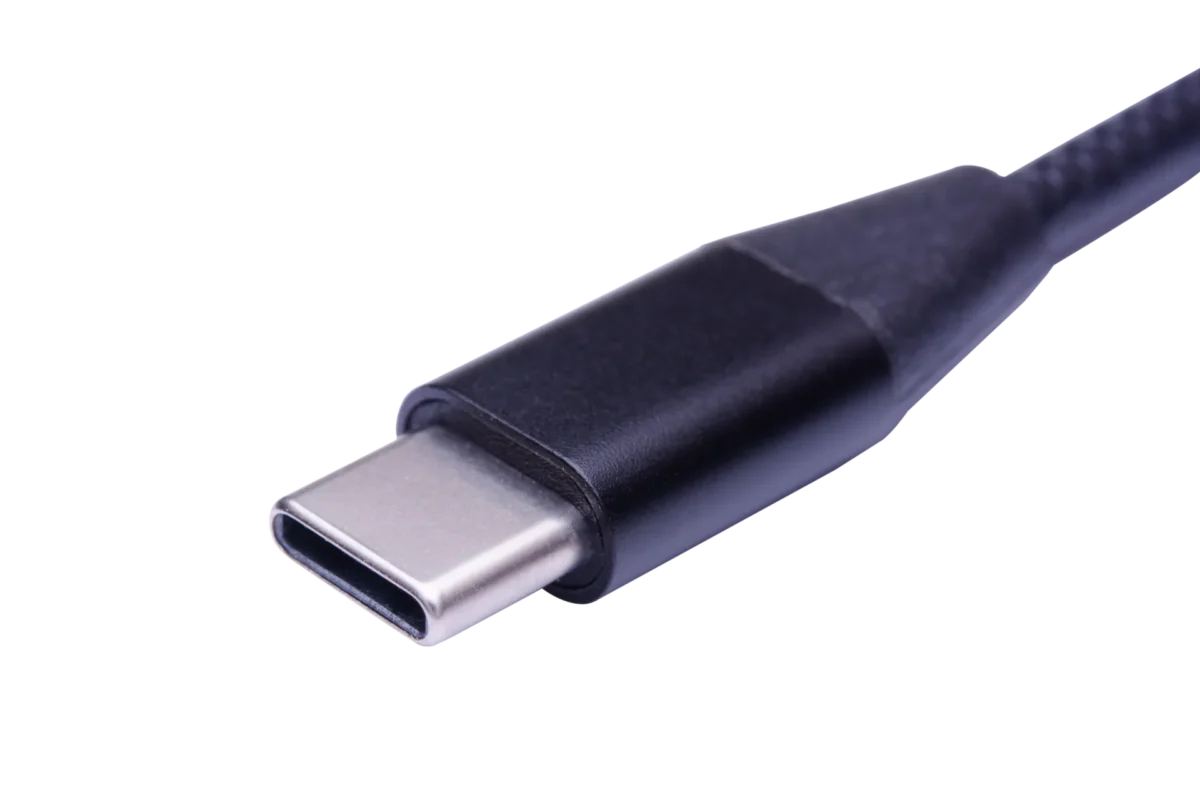
Why Does the USB-C Cable Matter?
The cable must support the power and current required by the charging configuration.
For a 65W USB-C Power Delivery connection using 20V at 3.25A, the cable must support more than 3A.
A suitable 5A USB-C cable with the required electronic marking is therefore needed for this configuration.
A standard 3A USB-C cable should not be assumed to support the full 65W at 20V.
For high-power charging applications, buyers should confirm:
- Cable current rating.
- Supported charging power.
- USB Power Delivery compatibility.
- E-Marker requirements where applicable.
- Connector quality and electrical performance.
A higher-wattage charger cannot compensate for an unsuitable cable.
5. Thermal Performance of 65W GaN Chargers
Heat management is an important consideration in high-power charger design.
A compact 65W charger must convert electrical power while managing heat generated by its internal components.
GaN technology can help manufacturers develop high-frequency power-conversion circuits and improve power density.
However, GaN does not automatically mean that every charger operates at a lower temperature than a silicon-based charger.
Actual thermal performance depends on several factors:
- Power-conversion efficiency.
- Internal circuit architecture.
- Component selection.
- PCB layout.
- Housing material and dimensions.
- Ventilation and heat dissipation.
- Ambient temperature and operating load.
For example, a 65W charger operating near its maximum output may experience different thermal conditions from the same charger supplying only 20W.
For charger manufacturers, thermal testing should be performed under defined operating conditions to evaluate temperature rise and long-term reliability.
A well-designed 65W GaN charger should balance power density, electrical efficiency, safety, and thermal performance rather than focusing only on reducing physical size.
6. 65W vs 100W GaN Chargers: Product Positioning
65W and 100W GaN chargers serve different charging requirements.
Both can be used in USB-C charging products, but the appropriate power rating depends on the connected devices and the intended product positioning.
| Recurso | 65W GaN Charger | 100W GaN Charger |
|---|---|---|
| Maximum rated power | 65W | 100W |
| Common applications | Smartphones, tablets, lightweight laptops | Higher-power laptops and multiple compatible devices |
| Port configurations | Single-port and multi-port options | Single-port and multi-port options |
| Cable requirements | Depends on output; 5A cable for 20V/3.25A operation | 5A cable required for 20V/5A USB PD operation |
| Product positioning | Compact everyday charging | Higher-power charging applications |
| Target users | General consumers and mobile professionals | Laptop users and users with higher power requirements |
A 65W charger is suitable for many everyday USB-C charging applications.
A 100W charger may be more appropriate for compatible laptops requiring higher input power or users who need additional power capacity.
However, a 100W charger does not automatically charge every device faster than a 65W charger.
The receiving device must support the additional power.
For product developers and purchasing teams, the decision should be based on device compatibility, output profiles, port combinations, and target market requirements.
7. Where Are 65W GaN Chargers Commonly Used?
65W GaN chargers are suitable for a variety of consumer electronics and commercial charging applications.
Eletrônicos de consumo
They are commonly used for charging compatible smartphones, tablets, and laptops.
A single charger can replace several lower-power adapters when the connected devices support compatible USB-C charging.
Carregadores de viagem
Their compact design makes 65W GaN chargers suitable for travel applications.
Depending on the model, they may support different regional plug configurations and universal AC input.
For international products, plug standards, electrical safety requirements, and regional compliance should be confirmed.
Retail and E-Commerce
65W GaN chargers are also suitable for retail products and online marketplaces targeting users who need a charger for multiple devices.
Different port combinations, colors, packaging options, and regional plug configurations can help brands develop product variations for different markets.
OEM and ODM Projects
For brands, wholesalers, and distributors, 65W GaN chargers can be developed with different product specifications.
Depending on the project, these may include:
- Single-port or multi-port configurations.
- USB-C PD and PPS support.
- USB-A and USB-C combinations.
- Different plug types.
- Custom housing designs.
- Branding and packaging.
- Region-specific product configurations.
The final specification should be confirmed before prototype approval and mass production.
8. Conclusion
A 65W GaN charger offers a practical balance between charging power, compact design, and device compatibility.
It can support many smartphones, tablets, and lightweight laptops when the connected devices use compatible charging standards.
Its performance depends on more than the 65W rating alone. Port configuration, simultaneous power distribution, USB Power Delivery profiles, cable current rating, and thermal design all influence the final charging solution.
For brands and businesses sourcing USB-C chargers, these specifications should be reviewed together to ensure that the selected product meets its intended application.
Related WJW Products