

Cos'è Quick Charge 3.0? QC 3.0 spiegato
Cos'è Quick Charge 3.0? QC 3.0 spiegato
Quick Charge 3.0 is one of the most widely deployed fast-charging standards ever shipped. Qualcomm announced it in 2015, and it went into hundreds of millions of phones, tablets and USB accessories — at 18W, 24W and 36W output levels that are still the backbone of mid-range charger lines. It is also frequently misdescribed. "QC 3.0" gets attached to phones that never supported it, and its 20V ceiling gets quoted as if 60W were a normal operating point. This article covers what the standard actually specifies, how it differs from QC 2.0, and where it still makes sense in a product line.
1. What Quick Charge 3.0 actually specifies
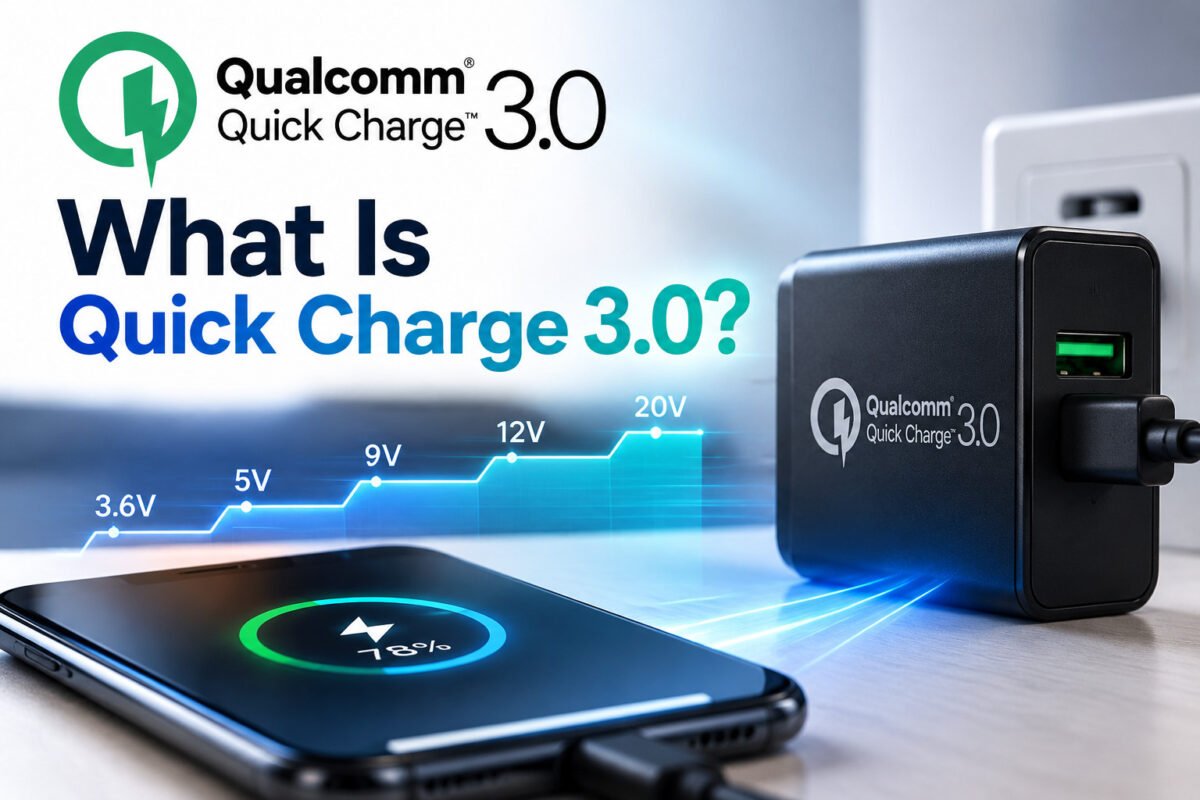
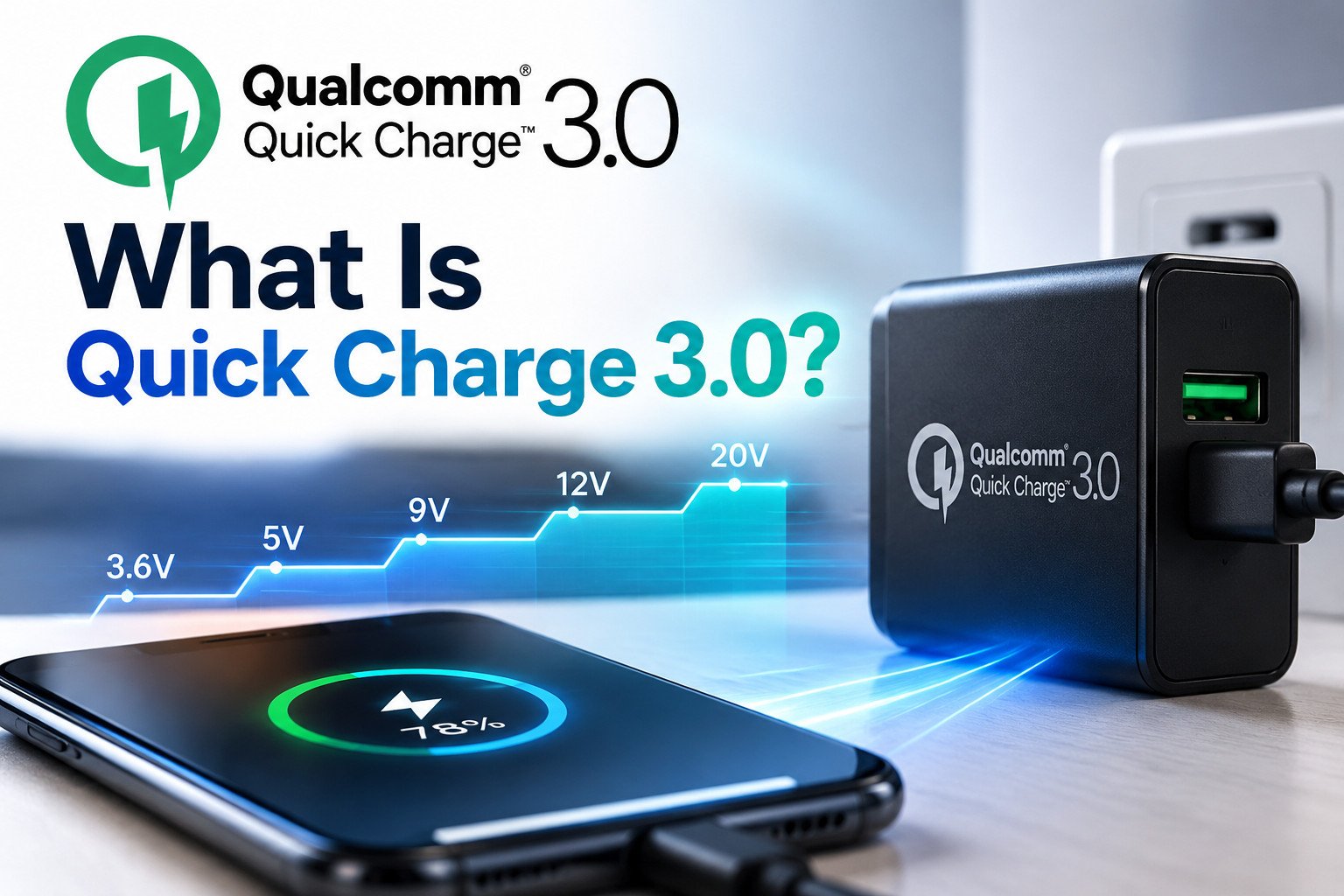
QC 3.0 is a Qualcomm fast-charging technology built around fine voltage control rather than a fixed set of levels. Its four defining features are:
- INOV — Intelligent Negotiation for Optimum Voltage. The device asks for the voltage it wants, step by step, instead of picking from a short menu.
- 200mV increments across a 3.6V–20V range.
- Higher efficiency than QC 2.0 — Qualcomm's figure is up to 38% less loss in the charging path.
- Backward compatibility with QC 2.0 and QC 1.0, so one charger can serve several device generations.
The numbers that matter for a spec sheet:
| Parametro | Valore |
|---|---|
| Gamma di tensione | 3.6V – 20V |
| Step size | 200mV |
| Maximum current | 3A |
| Typical maximum output | 36W (12V/3A) |
| Common retail outputs | 18W, 24W, 36W |
| Connector generations | USB-A (native), USB-C (Qualcomm's Type-C implementation) |
One clarification worth making explicit, because it is the most common error in QC 3.0 articles: the 20V figure is the top of the negotiable range, not a typical operating point. At 3A, 20V would be 60W, which no mainstream QC 3.0 product delivers. Treat the top of the range as a specification boundary, not an operating point — the volume sellers are 18W e 24W.
2. QC 3.0 vs QC 2.0: what changed
QC 2.0 introduced fast charging on fixed levels — 5V, 9V and 12V — with 18W as the ceiling. QC 3.0 kept the 3A current limit and replaced the fixed levels with a negotiable 3.6–20V range.

| Funzione | Quick Charge 2.0 | Quick Charge 3.0 |
|---|---|---|
| potenza massima | 18W | up to 36W |
| Voltage steps | Fixed 5V / 9V / 12V | 3.6–20V in 200mV steps |
| Negoziazione | Level selection | INOV, request-by-request |
| Efficienza | Moderate | up to 38% better |
| Heat control | Average | Improved by smaller steps |
| Device coverage | Narrower | Broader, plus QC 2.0/1.0 fallback |
The practical difference is where the waste heat lands. A QC 2.0 phone that wants 4.4V must take 5V and drop the extra 0.6V internally; at 2A that is about 1.2W dissipated inside the handset. With 200mV steps, the adapter can sit at 4.4V and the device converts almost nothing.
That is also why QC 3.0 is usually described as "cooler" rather than "faster": most units in the field are 18W, the same as QC 2.0. The gain shows up as longer sustained current before thermal throttling, and as lower battery stress over a full charge — not as a higher peak wattage on the average charger.
3. Which devices support QC 3.0
This is the section where most published lists go wrong, so it is worth being precise. QC 3.0 is a Qualcomm certification; a phone that ships a proprietary charging scheme does not become a QC 3.0 device just because it charges at 15W or faster.
Devices that genuinely support QC 3.0 include the LG G5, G6, V20 and V30; the HTC 10 and U Ultra; Sony's Xperia XZ family; Xiaomi's Mi 5, Mi 6 and Mi 8 (the Mi 8 also carries QC 4+); and a long tail of mid-range models built on Snapdragon 6xx and 4xx platforms.
Two widely repeated misattributions:
- Samsung's Galaxy S7, S8 and S9 are AFC devices, not QC 3.0. Samsung implemented its own Adaptive Fast Charging, which looks similar at 9V/1.67A but is not a Qualcomm certification. Pairing them with a QC 3.0 charger works, because the two schemes overlap at 5V/9V, but the phone will not run at QC 3.0 rates.
- OnePlus 3/3T/5/6 use Dash Charge, a proprietary 5V/4A scheme. They are not QC 3.0 devices either.
For a B2B spec sheet, the honest line is "Qualcomm Quick Charge 3.0 certified" plus a note on which fallback levels are supported. Vague "supports fast charging" claims are what generate returns.
4. Why QC 3.0 still matters for charger makers
Even with USB PD 3.1 and Quick Charge 5 on flagship devices, QC 3.0 chargers keep shipping in volume, for four reasons:
- Cost structure. A QC 3.0 controller and an 18W transformer are cheap, mature and available from multiple suppliers — the right bill of materials for mid-market SKUs.
- Device coverage. Years of Snapdragon handsets mean a QC 3.0 charger is useful to a very large installed base, including devices that will never see PD.
- Buyer recognition. Consumers recognise the logo, which shortens the sales conversation on marketplaces.
- Bundle economics. It pairs well with USB-A to USB-C cables in travel kits, wall bundles and multi-port accessories.
Typical QC 3.0 designs ship at 18W, with 24W e 36W (12V/3A) as the marketed upper variants. 36W is the common ceiling, not a hard limit of the standard — the negotiable range reaches 20V. A-port units ship with a Cavo da USB-A a USB-C, since a C-to-C cable cannot attach to an A port, and in multi-port GaN chargers QC 3.0 usually sits on the A port beside USB-C PD outputs.
5. Where QC 3.0 stops
Being clear about the ceiling is part of selling it honestly:
- 3A current limit. QC 3.0 cannot deliver the 5A that 100W PD needs, which is why it stayed a phone-side technology rather than a laptop charging path.
- No PPS. QC 3.0's 200mV steps are coarser than PPS's 20mV, and it is not part of the USB PD protocol stack, so a device expecting a PPS profile will fall back to a fixed voltage.
- USB-A legacy. QC 3.0 is native to USB-A. Over USB-C it works, but it does not bring the C-port's 5A, E-Marker or alt-mode capabilities with it.
- No 100W+ path. EPR belongs to USB PD; QC 3.0 has no equivalent, so high-wattage laptop work stays out of scope.
6. Where QC 3.0 chargers fit
| Use case | Recommended output |
|---|---|
| Smartphone fast charging | 18W or 24W QC 3.0 |
| Dual-port travel charger | 36W total, split across ports |
| Budget multi-device adapter | 30W with QC 3.0 on the A port |
| Retail bundle with cable | 18W with a USB-A port, bundled with an A-to-C cable |
7. Is QC 3.0 still worth it?
Yes, with the right framing. It is not a flagship technology and it will not win a spec-sheet comparison against PD 3.1, PPS or Quick Charge 5. What it does is cover a huge installed base at a low build cost, with a recognised logo and broad fallback compatibility.
For a brand, wholesaler or marketplace seller, a QC 3.0 SKU still earns its place: wide demand, low heat, mature supply chain, and a price point that PD-only products cannot reach at the same margin.