

What Are 3A, 5A and 6A Charging Cables?
What Are 3A, 5A and 6A Charging Cables? Current Ratings Explained
"What does 5A mean again?" is a question that comes up every time a new cable line is quoted. The number on the jacket, the number on the charger, and the number the phone actually draws are three different things. For retailers, brands, e-commerce sellers and charger wholesalers, the amp rating decides what a product can honestly claim on its listing. This guide covers 3A, 5A and 6A — what each is for, what it cannot do, and where the numbers stop being part of the USB-C standard.
- 1. What the 3A, 5A and 6A numbers actually mean
- 2. 3A vs 5A vs 6A at a glance
- 3. 3A vs 5A: what actually differs
- 4. The 3A cable: the default rating
- 5. The 5A cable: the 100W class
- 6. The 6A cable: outside the USB-C standard
- 7. Can a 3A cable deliver 100W?
- 8. E-Marker: the chip that sets the ceiling
- 9. Why resistance matters more than the printed number
- 10. Does length change high-power charging?
- 11. The short version
1. What the 3A, 5A and 6A numbers actually mean
The rating is the current the cable is designed to carry continuously: conductor cross-section, connector contacts, insulation and thermal behaviour, all sized for that number.
It is not a charging speed. Power is what charges a battery, and power is voltage multiplied by current:
Power (W) = Voltage (V) × Current (A)
| Attuale | At 5V | At 9V | At 15V | At 20V |
|---|---|---|---|---|
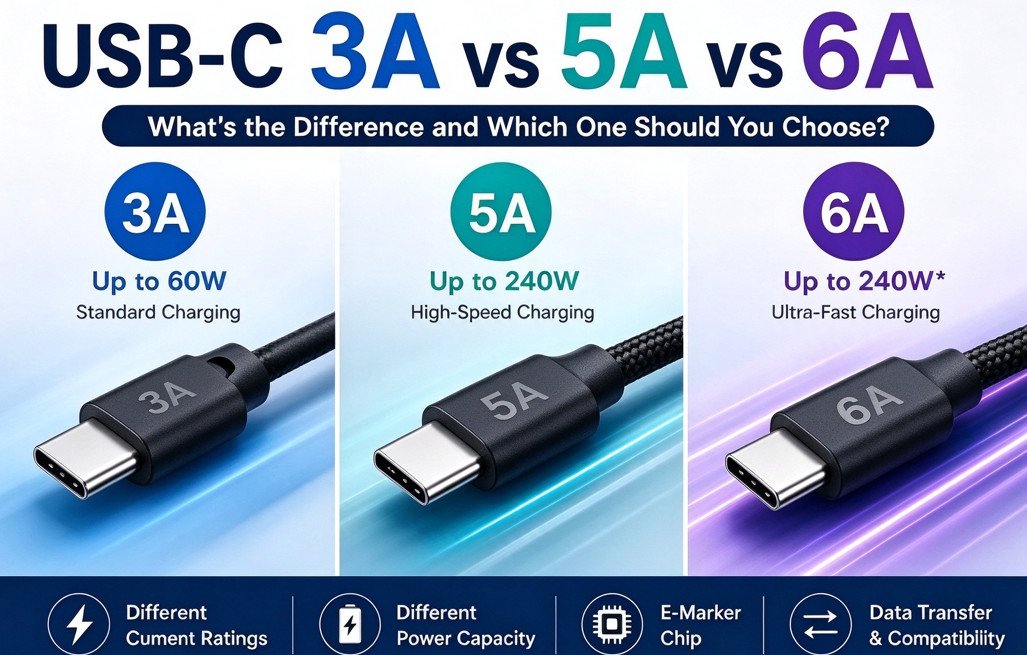
| 3A | 15W | 27W | 45W | 60W |
| 5A | 25W | 45W | 75W | 100W |
| 6A | 30W | 54W | 90W | 120W |
The 6A row is arithmetic only. There is no 6A rating in the USB-C or USB Power Delivery specification, a point worth coming back to — see the 6A section below.
The rule that prevents most support tickets
A higher-current cable adds electrical headroom. It does not make every device charge faster. Plug a 100W charger into a phone that accepts 25W and the phone takes 25W; the cable in between changes nothing.
2. 3A vs 5A vs 6A at a glance
| Cable rating | Example at 20V | Typical position | What to check |
|---|---|---|---|
| 3A | Fino a 60 W | Ricarica quotidiana | Device power requirement |
| 5A | Fino a 100 W | High-power USB-C applications | Charger, device and cable capability |
| 6A | 120W by calculation | Vendor-specific high-current systems | Charging protocol and cable specification |
Choosing the largest number is the wrong instinct. The correct cable is the one that matches the charging system it will live in.
3. 3A vs 5A: what actually differs
Two cables with the same USB-C plug can look identical from the outside and behave very differently under load. The difference is copper and contacts, not appearance.
At a 20V operating point:
- 3A × 20V = 60W
- 5A × 20V = 100W
That is the whole reason 5A cables are associated with the 100W class, and why 60W laptop chargers ship with 3A cables without any problem.
A 3A cable fits when:
- the device tops out below 60W
- the charger and protocol never ask for more than 3A
- the product is a phone, tablet or accessory
- the cable specification matches the rest of the system
A 5A cable matters when:
- the application is 100W-class USB-C charging
- a laptop, dock or monitor needs the full 20V/5A option
- the charger and device can both negotiate that mode
A 5A USB-C cable is not "better" for a 25W phone. It is simply over-specified, and sometimes thicker and stiffer for no benefit.
4. The 3A cable: the default rating
3A is the baseline of the USB-C world. It needs no electronics inside, which is why it is the cheapest and most common build.
At 20V it corresponds to 60W, but 3A does not mean "60W everywhere". The voltage the charger and device agree on, the protocol in use, the device's input limit and the charger's output all decide the real figure.
Typical fits: phones, tablets, earbuds, low-power USB-C accessories, and thin laptops that draw 45–60W.
5. The 5A cable: the 100W class
At 20V, 5A gives 100W, the top of the standard PD range below EPR — which is why a 100W charging cable is almost always a 5A build.
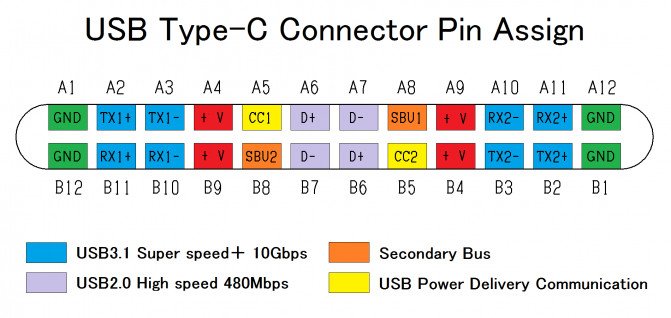
The difference is not only heavier conductors. A cable rated above 3A must carry an E-Marker — a small chip in the plug that tells the system what the cable can handle. Without a valid marker, the system treats the cable as 3A and never enables the 5A option, so a "5A" cable with a failed or missing marker behaves like a 3A cable in the field.
The other half of the bargain is at the ends: the charger must offer a 5A option and the device must request it. A 65W charger will never use a 5A cable's headroom, and a phone that caps at 30W will not either.
6. The 6A cable: outside the USB-C standard
This is where marketing language most often outruns the specification.
USB-IF defines ratings at 3A and 5A. PD tops out at 5A — 100W at 20V, and 240W at 48V under PD 3.1 EPR, still 5A. There is no 6A class in the standard.
6A cables belong to vendor fast-charge schemes: 11V/6A at 66W, 20V/6A at 120W, usually a USB-A to USB-C cable paired with that vendor's own charger and protocol. Inside that ecosystem the rating is real. Outside it, a 6A cable connected to a PD charger behaves as a 5A or 3A cable, because the protocol will never ask for 6A.
Practical consequences for a product listing:
- A 6A label alone guarantees nothing; the charger, the protocol and the device must all support the same scheme.
- A 6A cable sold as a general-purpose USB-C cable will not make a 100W PD laptop charge faster than a 5A cable.
- Proprietary high-current systems have their own connector and current-control requirements, which is why the cable often cannot be swapped with a standard one.
7. Can a 3A cable deliver 100W?
At 20V, no. 100W ÷ 20V = 5A, and the USB-C specification only permits current above 3A when the cable carries an E-Marker. A 3A cable cannot complete a 100W PD link at 20V regardless of what the charger can output.
| Target power | Voltaggio | Required current |
|---|---|---|
| 60W | 20V | 3A |
| 100W | 20V | 5A |
The rest of the system still has to agree: charger capable of the voltage and power, device willing to accept it, cable rated for the current.
8. E-Marker: the chip that sets the ceiling
Two USB-C cables that look the same can have completely different power limits because one has electronics in the plug and the other does not.
An E-Marker reports the cable's current capability, its data capability, construction details and vendor information to the system when the cable is attached.
Why it matters in practice:
- Above 3A it is mandatory. The system will not enable 5A without it.
- It caps the negotiation. A 100W charger, a 100W laptop and a 3A cable settle at 60W, not 100W.
- It can be counterfeited. Mislabelled markers are the usual cause of a cable claiming 5A while the connector runs hot.
The useful question is not "is this a USB-C cable?" but "what current and voltage does this cable actually declare?"
9. Why resistance matters more than the printed number
Current rating is one variable; resistance is the other, and it is the one that shows up as heat.
Resistive loss follows:
Power loss = I² × R
Current is squared, so doubling the current quadruples the loss for the same resistance. That is why a 5A build needs heavier conductors and better contacts rather than a new label on the same construction.
Resistance comes from conductor size and material, cable length, connector contact quality and operating temperature. Two cables with the same nominal rating can differ measurably in voltage drop and connector temperature.
10. Does length change high-power charging?
Yes. A longer conductor has more resistance than a shorter one of the same material and cross-section, so voltage drop grows with length.
A short 5A cable and a long 5A cable carry the same rating on paper but behave differently at full load. For a product design, length belongs in the specification next to current, conductor size, connector design and thermal performance — not added at the end as a packaging decision.
11. The short version
- 3A covers everything up to 60W and most phones, tablets and accessories.
- 5A is the 100W class, and only works when the cable is E-Marked and both ends negotiate 5A.
- 6A is a vendor-specific rating, not a USB-C one; it only delivers its headline number inside that vendor's ecosystem.
The takeaway: a cable's current rating describes charging capability, not guaranteed charging speed. What a device actually receives depends on the whole charging system — cable, charger, protocol and device — and the weakest part of that chain sets the ceiling.