

Multi-Port USB Charger Solutions
Multi‑Port USB Charger Solutions
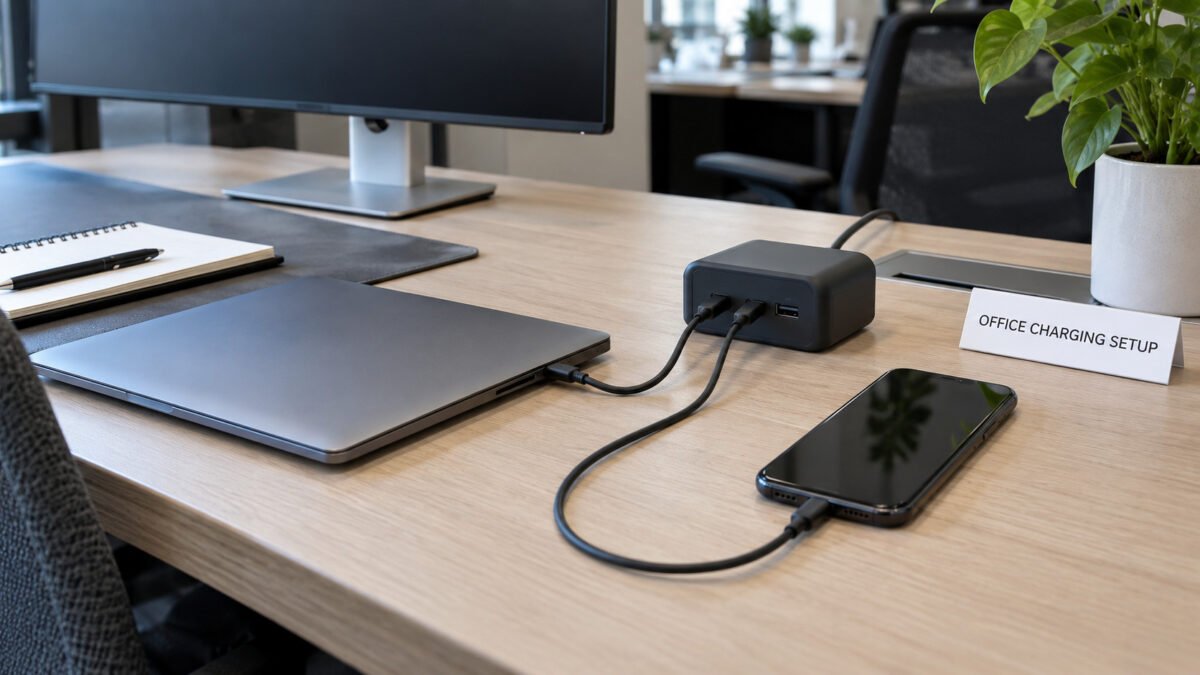
Multi-port USB chargers address the growing need to charge several devices simultaneously from a single power outlet. As the number of USB‑C PD compatible devices — smartphones, tablets, laptops and accessories — increases in professional and consumer environments, multi‑port chargers provide a consolidated charging solution that reduces outlet clutter and simplifies power management across multiple devices.
1. Multi‑Port Charger Types
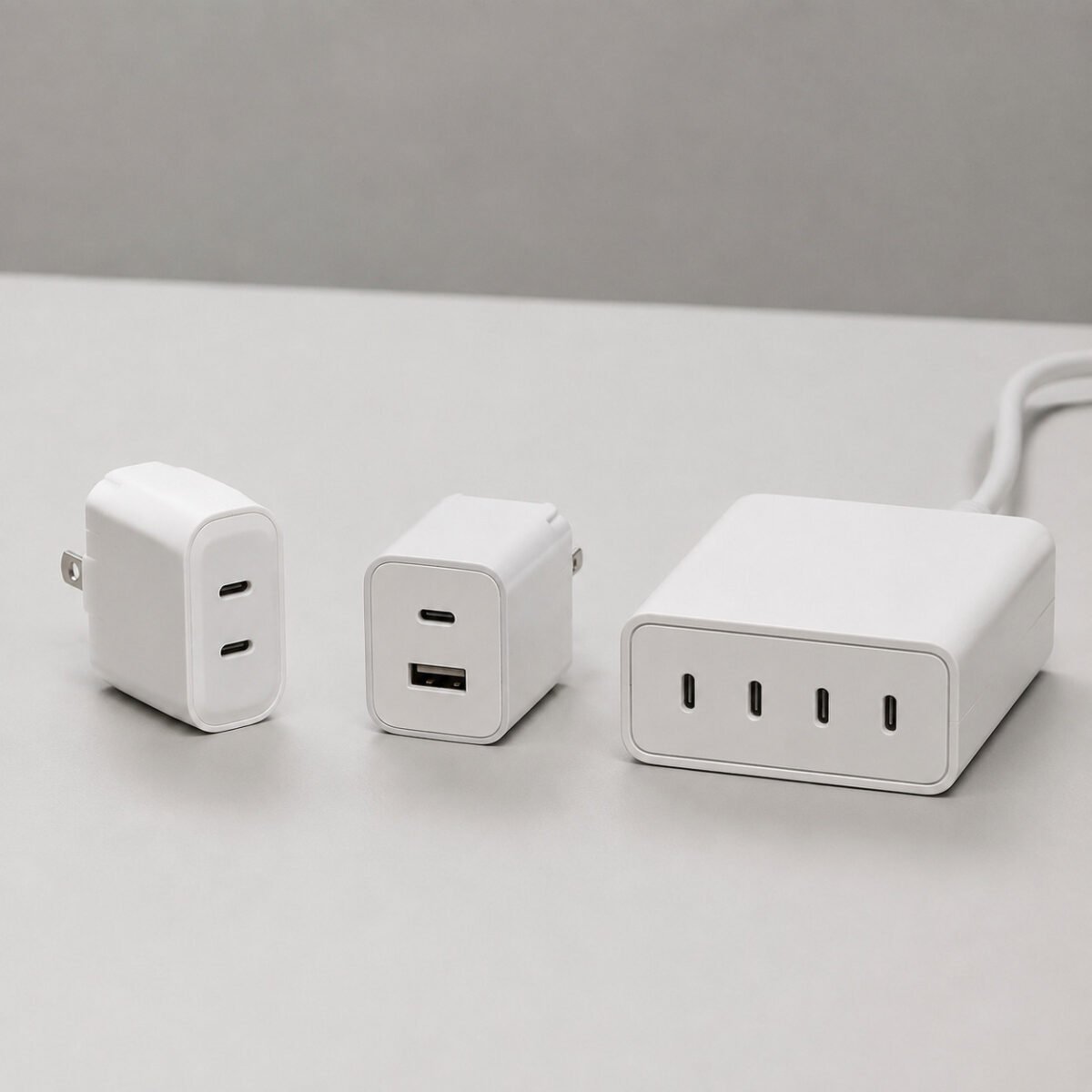
Multi-port chargers are categorized by port count, port type combination and total power output. Three primary configurations address a wide range of multi-device charging requirements in consumer, professional and commercial environments.
1.1 Dual Port Charger
Dual port chargers combine two USB output ports in a single housing, allowing two devices to charge simultaneously from one power outlet. This configuration is the entry point for multi-port charging and is available in compact wall-plug and small desktop form factors. Total output power typically ranges from 30W to 65W, with intelligent power distribution allocating current based on each connected device's negotiated power level.
Product Specifications:
- Port configuration: 2 ports (USB-C + USB-C, or USB-C + USB-A)
- Total output power: 30W to 65W combined
- Intelligent power distribution: e.g., 45W + 20W, or 65W to one port when the other is idle
- Form factors: compact wall-plug and small desktop designs
- USB PD 3.0 SPR support on USB-C ports (up to 100W per port on selected models with higher total output)
Suitable Applications:
- Home — simultaneous charging of smartphone and tablet
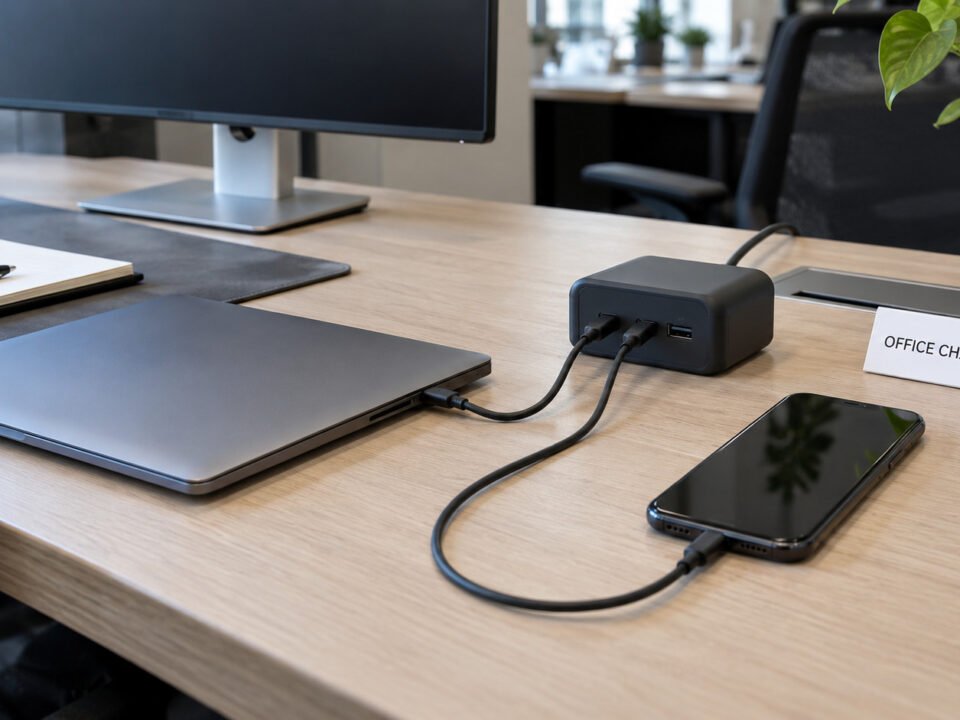
- Office — charging a laptop and a smartphone from a single outlet
Dual port chargers are suitable for environments where two devices require concurrent charging and outlet availability is limited. The compact form factor of wall-plug dual-port models makes them practical for residential and small office use, while desktop dual-port models provide a stable base for workstation charging setups.
1.2 USB‑C + USB‑A Charger
USB-C + USB-A chargers combine both port types in a single housing, addressing scenarios where devices with different connector types require simultaneous charging. This configuration is available in dual-port, triple-port and multi-port arrangements. USB-C ports support USB Power Delivery for laptops, tablets and modern smartphones, while USB-A ports support legacy devices and accessories that use USB-A to USB-C or USB-A to Lightning cables.
Product Specifications:
- Port configuration: mixed USB-C and USB-A ports (2 to 6 ports)
- Total output power: 45W to 140W combined, depending on model
- USB-C ports: USB PD 3.0 SPR support (up to 100W per port on selected models)
- USB-A ports: USB-A charging with support for Quick Charge, AFC and SCP protocols on selected models
- Intelligent power distribution across mixed port types
Suitable Applications:
- Mixed Devices — environments where USB-C PD devices and USB-A legacy devices coexist
- Home and office setups with a combination of modern and older devices
- Retail and commercial charging stations serving diverse device types
The USB-C + USB-A configuration is particularly relevant for transitional markets where device fleets include both USB-C and USB-A connected equipment. Rather than maintaining separate chargers for each connector type, a single mixed-port charger consolidates charging infrastructure while maintaining backward compatibility with legacy USB-A devices.
1.3 Multi USB‑C Charger
Multi USB-C chargers feature three or more USB-C ports in a single housing, designed for professional and high-demand charging environments where multiple USB-C PD devices require simultaneous charging. These chargers are available in desktop and charging station form factors, with total output power ranging from 65W to 200W combined. Intelligent power controllers manage distribution across ports based on each connected device's USB PD negotiation.
Product Specifications:
- Port configuration: 3 to 6 USB-C ports
- Total output power: 65W to 200W combined
- Per-port USB PD 3.0 SPR support (up to 100W on selected ports, depending on model)
- Intelligent power distribution with dynamic allocation based on connected device demand
- Form factors: desktop charging stations with cable management features
- Selected models with USB PD 3.1 EPR support (up to 140W per port)
Suitable Applications:
- Professional Charging — IT departments, design studios and development teams with multiple laptops
- Conference rooms and meeting spaces requiring multi-device charging
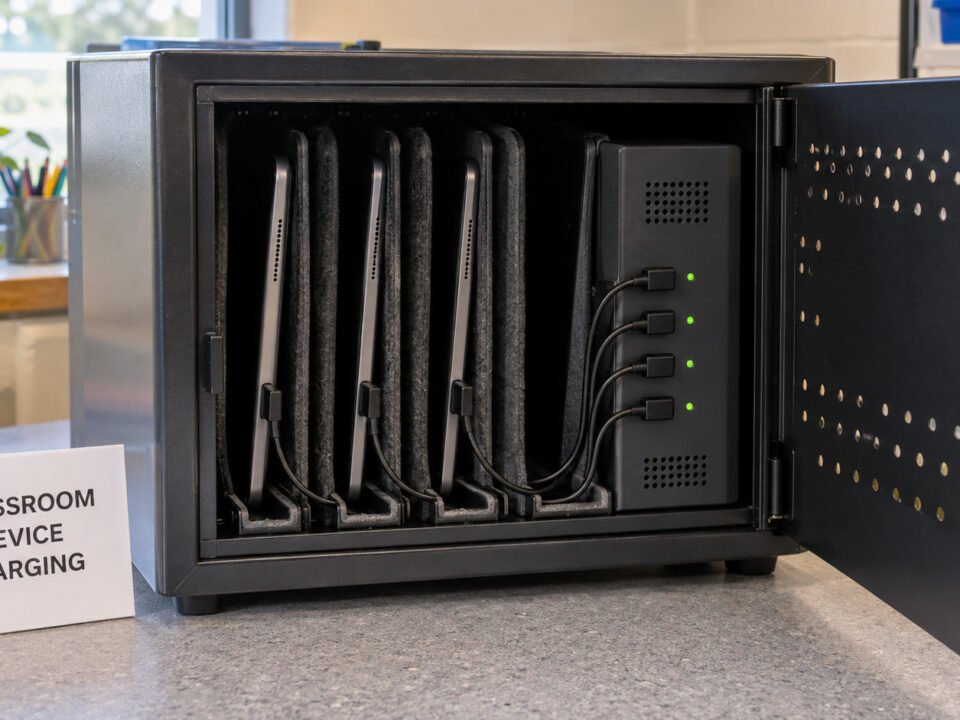
- Educational institutions with shared device charging needs
- Commercial charging stations in airports, cafes and co-working spaces
Multi USB-C chargers represent the upper tier of multi-port charging solutions. The high total output power and multiple USB-C PD ports make them suitable for professional environments where several high-power devices — such as laptops, tablets and smartphones — require concurrent charging. Actual per-port output depends on the total number of connected devices and the charger's configured power distribution strategy.
2. Selection Factors
Selecting the appropriate multi-port charger requires evaluating four primary factors. These factors determine whether a specific charger configuration can meet the power, connectivity and usage requirements of the target environment.
2.1 Total Power Output
Total power output, measured in watts (W), determines the combined charging capacity of the multi-port charger. This value represents the maximum power the charger can deliver across connected ports simultaneously. When multiple devices are connected, the intelligent power controller distributes the total available power based on each device's negotiated requirement.
Key Considerations:
- 30W–45W total: suitable for two smartphones or a smartphone and a tablet
- 65W total: suitable for a laptop and a smartphone charging simultaneously
- 100W total: suitable for a laptop and two mobile devices, or two laptops at reduced power
- 140W–200W total: suitable for multiple laptops or a combination of laptops and several mobile devices
- Actual per-port output depends on connected device count and negotiated power levels
A charger rated at 100W total does not deliver 100W to each port. For example, in a dual-port 100W charger, connecting a 65W laptop and a 20W smartphone typically results in 65W to one port and 20W to the other, totaling 85W — within the 100W total capacity. The remaining 15W headroom supports power negotiation adjustments when additional devices are connected.
2.2 Port Combination
Port combination refers to the number and type of USB ports on the charger. The selection depends on the device types in the target environment and whether backward compatibility with USB-A devices is required.
Available Combinations:
- USB-C only: for environments with modern USB-C PD devices exclusively
- USB-C + USB-A: for mixed environments with both USB-C and USB-A connected devices
- Variable port counts: 2, 3, 4, 5 and 6 port configurations available across the product range
- Per-port protocol support: USB PD 3.0 SPR on USB-C ports; Quick Charge, AFC, SCP on USB-A ports (selected models)
Port combination selection should account for the current device fleet and anticipated device transitions. Environments transitioning from USB-A to USB-C may benefit from mixed-port chargers to maintain compatibility during the transition period, while environments with fully USB-C device fleets can select USB-C only configurations.
2.3 Device Number
The number of devices requiring simultaneous charging directly determines the minimum port count needed. Selecting a charger with insufficient ports forces sequential charging, while selecting a charger with excess ports may result in unnecessary cost and physical size.
Selection Guidance:
- 2 devices: dual-port charger (30W–65W total)
- 3 devices: triple-port charger (65W–100W total)
- 4–6 devices: multi-port charger (100W–200W total)
- Additional ports beyond current device count provide capacity for future expansion
- Consider charging frequency — frequent simultaneous charging favors higher port counts
2.4 Application
The intended application environment influences the charger form factor, power level and feature requirements. Different environments prioritize different characteristics — portability for travel, stability for office use, or durability for commercial deployment.
Application-Specific Considerations:
- Home: compact wall-plug or small desktop form factor, 30W–65W total
- Office: desktop form factor with cable management, 65W–100W total
- Travel: foldable-pin wall-plug form factor, 30W–65W total, universal input voltage
- Commercial: durable desktop or mounted charging station, 100W–200W total, with tamper-resistant features on selected models
- Retail: display-friendly design with multiple port types, 65W–140W total
3. Application Scenarios
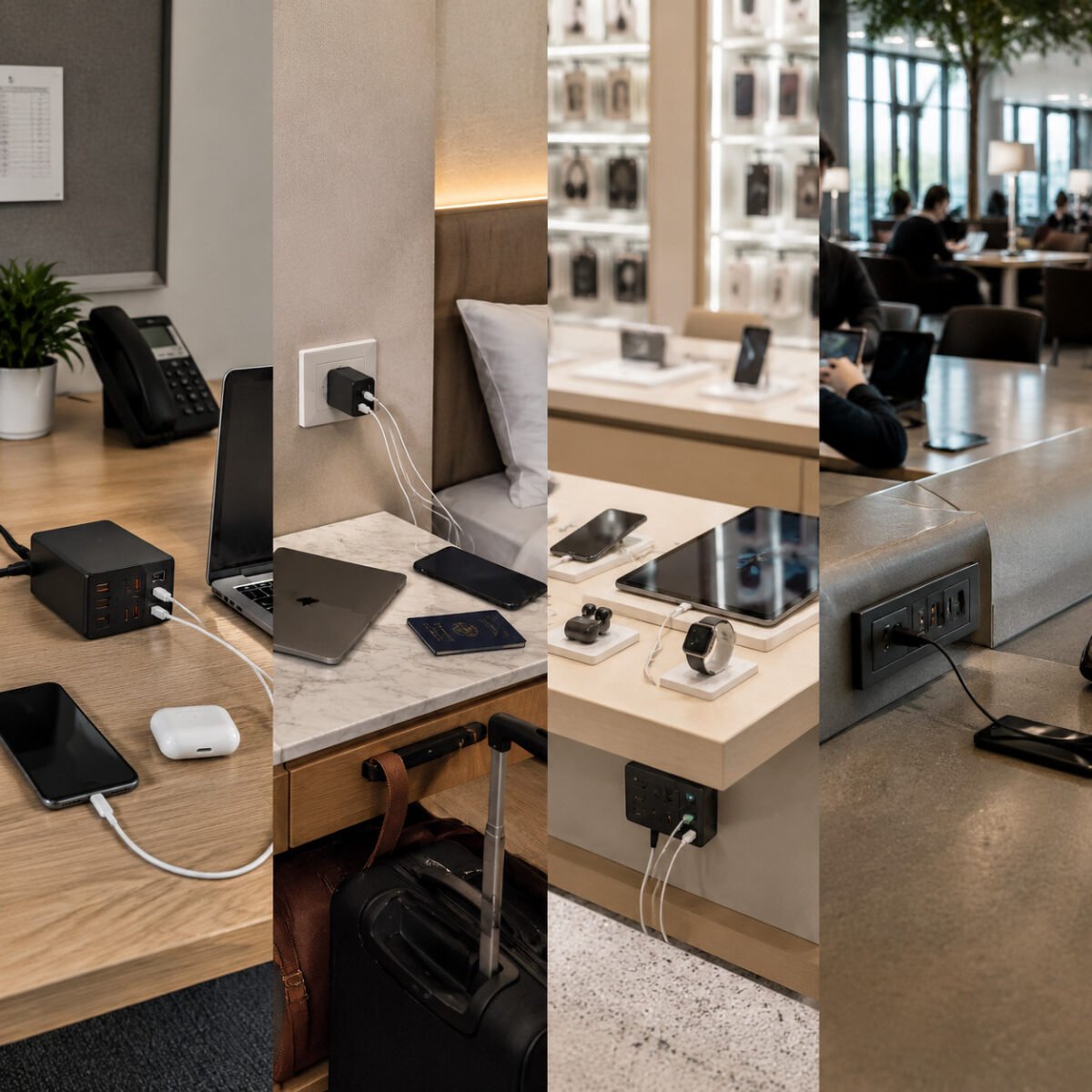
Multi-port chargers serve four primary application environments, each with distinct requirements for power output, form factor, port combination and operational characteristics.
3.1 Office
Office environments typically require multi-device charging for laptops, smartphones, tablets and wireless earbuds. Desktop multi-port chargers provide a centralized charging point that reduces the number of individual power adapters at each workstation. A 65W to 100W desktop charger with 3 to 4 ports can serve a typical office desk setup, supporting simultaneous laptop charging and mobile device charging from a single outlet.
Office-Specific Requirements:
- Desktop form factor with stable base and cable management
- 65W–100W total output for laptop and mobile device combinations
- Mixed USB-C and USB-A ports for device fleet compatibility
- Low operating noise and minimal heat emission for shared workspace environments
- Professional aesthetics suitable for modern office interiors
3.2 Travel
Travel applications prioritize compact size, multi-region compatibility and sufficient power output to charge a smartphone and a laptop or tablet simultaneously. Travel multi-port chargers with foldable plug pins and universal input voltage (100–240V) address the needs of mobile professionals who require multi-device charging across different regional power standards.
Travel-Specific Requirements:
- Compact wall-plug form factor with foldable pins
- Dual-port configuration (30W–65W total) for smartphone and laptop/tablet charging
- Universal input voltage (100–240V) for international compatibility
- Interchangeable plug heads for US, EU, UK and AU socket types (selected models)
- Reduced weight and minimal physical footprint for portability
3.3 Retail
Retail environments utilize multi-port chargers for product display charging, customer try-before-buy device charging and accessory demonstration. Retail charging solutions prioritize visual presentation, multi-device support and compatibility with diverse consumer device types. Mixed USB-C and USB-A port configurations serve a wide range of consumer devices in retail settings.
Retail-Specific Requirements:
- Display-friendly design with clean aesthetics
- Mixed USB-C and USB-A ports for consumer device compatibility
- 65W–140W total output for multiple display devices
- Durable housing for handling in retail environments
- Selected models with security features for open-display deployment
3.4 Commercial Charging
Commercial charging applications include public charging stations in airports, cafes, co-working spaces, hotels and educational institutions. These deployments require higher total output power, multiple ports, durable construction and compatibility with a wide range of consumer devices. Charging stations with 4 to 6 ports and 100W to 200W total output serve high-traffic environments where multiple users charge devices simultaneously.
Commercial-Specific Requirements:
- 4–6 port configurations with 100W–200W total output
- Durable housing with impact-resistant materials for public deployment
- Mixed USB-C and USB-A ports to serve diverse consumer devices
- Thermal management for sustained high-power operation in continuous-use environments
- Mounting options for desk, wall or kiosk installation (selected models)
- Tamper-resistant construction for unattended public use on selected models
4. OEM Solutions
Full OEM and ODM development services are available for brand partners seeking custom multi-port charger solutions. The development process supports customization across port layout, housing design and private label branding. The following sections outline the primary customization directions for multi-port charger OEM projects.
4.1 Custom Port Layout
Port count, type, arrangement and physical placement on the housing are customizable to match specific product requirements. Custom port layouts accommodate unique form factors, specific device charging scenarios and brand-differentiated designs.
Available Customization:
- Custom port count: 2 to 6 ports in various combinations of USB-C and USB-A
- Port arrangement: side-by-side, stacked, circular or custom geometric layouts
- Port orientation: front-facing, top-facing or angled configurations
- Custom power distribution logic: fixed allocation ratios or dynamic intelligent distribution
- Per-port protocol support configuration: USB PD 3.0 SPR, PD 3.1 EPR, Quick Charge, AFC, SCP
- Port labeling and identification markings per brand specifications
Port layout customization also incorporates power distribution design. The total output capacity is divided across ports according to the configured distribution strategy. For example, a custom 4-port 100W charger can be configured with one 100W primary port and three 20W auxiliary ports, or with four equal 25W ports. The distribution strategy is defined during the development phase based on the target use scenario.
4.2 Custom Housing
Housing form factor, material, color, finish and industrial design are tailored to brand identity and target market positioning. Custom housing development is available for qualified projects with sufficient volume to support dedicated tooling investment.
Available Customization:
- Form factors: wall-plug, desktop, charging station and custom geometries
- Housing materials: PC (polycarbonate), ABS and flame-retardant compounds (V-0 rated options)
- Custom color matching to specified Pantone references
- Surface finishes: matte, glossy, textured, soft-touch and metallic options
- Integrated cable management features: cable channels, cable wraps and cable storage compartments
- Mounting features: desk stand, wall mount, kiosk mount or display bracket integration
- Custom industrial design and tooling for exclusive product lines
Housing design for multi-port chargers requires additional thermal management consideration compared to single-port models. Higher total output power generates more heat, and the larger housing surface area must accommodate adequate ventilation. Custom housing designs undergo thermal testing to verify compliance with safety standards under sustained multi-port load conditions.
4.3 Private Label
Private label services enable brand partners to market multi-port chargers under their own brand identity. Branding is applied to the charger housing, retail packaging and documentation through multiple methods selected based on material, durability and visual requirements.
Available Branding Methods:
- Silk-screen printing for flat housing surfaces with single or multi-color logos
- Laser engraving for durable, permanent branding on metal or plastic housings
- Embossed or debossed molding for integrated brand identity in the housing tool
- Custom logo size, position and color per brand specifications
- Custom retail packaging with brand logo, product information and certification marks
- Custom user manual and quick start guide with brand identity and destination market language
- Co-branded designs for partnership and promotional channels
Private label projects include custom packaging development with brand-specific design, product information printing and certification marks for destination markets. Sample units with applied branding and packaging are provided for approval before mass production. For qualified projects with sufficient volume, full custom housing tooling with brand-exclusive industrial design is available. Brand artwork files are accepted in AI, EPS or PDF vector formats. Contact the technical sales team with port layout requirements, housing design specifications, estimated quantity and target markets to receive product recommendations, sample options and a competitive quotation.
Need a Custom Multi‑Port Charger Solution?
Whether you need standard multi-port USB chargers or fully customized configurations with specific port layouts, housing designs, power distribution and private label branding, our team can help you specify the right solution for your application. From compact dual-port travel chargers to high-power 200W commercial charging stations, we support OEM/ODM projects with competitive pricing and flexible MOQ.