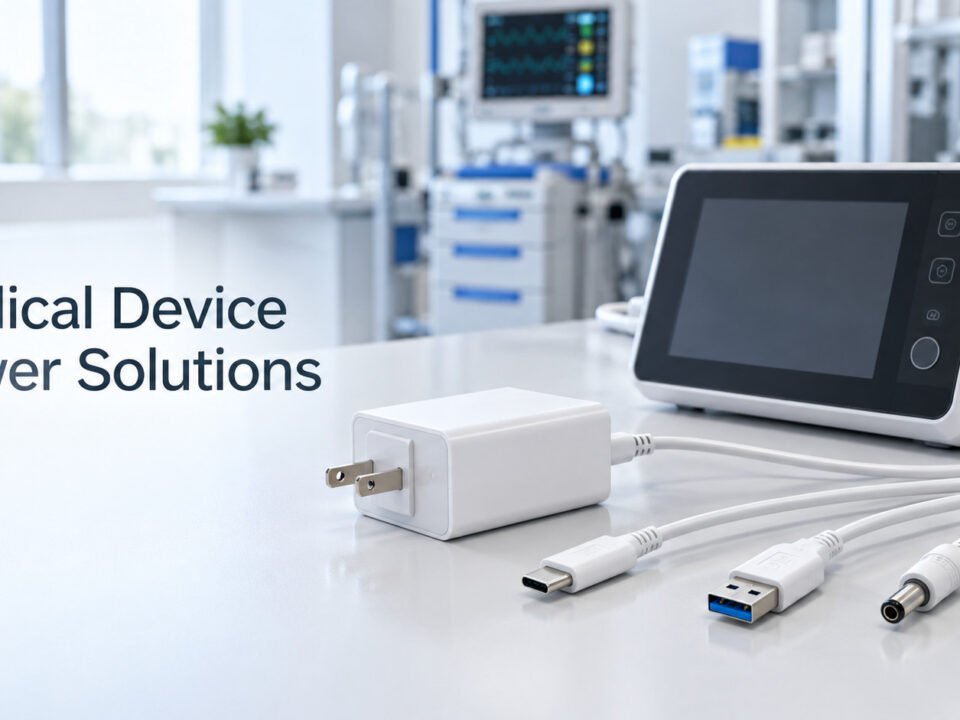


Medical Power Adapter Solutions
Medical Power Adapter Solutions
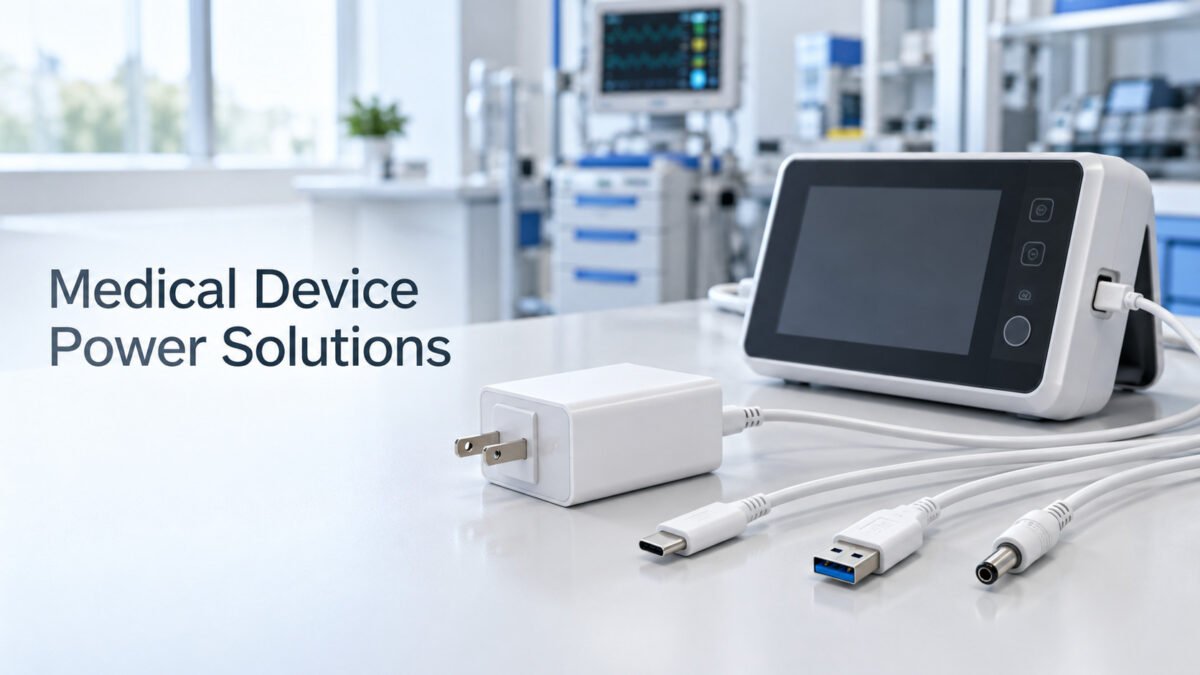
Power delivery solutions designed for diagnostic, monitoring, and home healthcare applications — engineered for reliability, stable output, and long service life.

1. Medical Power Adapter Product Requirements
Medical devices depend on consistent and dependable power delivery to support accurate operation, safe performance, and long service life. Power adapters for medical applications must address application-specific requirements that may differ from those of general-purpose consumer power supplies.
1.1 Reliability
Medical equipment often operates for extended periods, making stable operation and protection against common electrical and thermal stresses important considerations. Power adapters for these applications incorporate protection functions, appropriate component selection, and thermal design strategies according to the application requirements. Selected models include overcurrent protection, overvoltage clamping, and thermal shutdown circuits that activate when operating parameters deviate from defined thresholds. Surge-rated input components are available on selected models for environments where line transients are a concern.
1.2 Stable Power
Fluctuations in output voltage and current ripple can introduce noise into sensitive measurement circuits. Power adapters for medical applications are designed to provide stable output regulation, controlled ripple and noise, and reliable operation according to the requirements of the target device. Design characteristics and applicable requirements vary by model and application.
Output regulation and transient response are considered according to the electrical requirements of the target device. Selected models are available with low-ripple output performance according to the application requirements and specified test conditions.
1.3 Long Life
Medical devices may operate on extended duty cycles, making continuous-operation capability and long-term reliability important considerations. Component selection prioritizes long-life components and thermal management designs that keep internal temperatures within derated ranges. Component selection and thermal design are evaluated to support reliable operation over the intended service period.
1.4 Product Consistency
In controlled production environments, batch-to-batch consistency is a measurable requirement. Manufacturing processes follow controlled documentation, with incoming material inspection, in-process testing, and final electrical testing on production lines. Statistical process control tracks critical parameters to maintain output characteristics within defined tolerance bands across production lots.
Final electrical testing measures output voltage, current limit, ripple, regulation, and protection activation points against pass-fail thresholds. Applicable production records can provide traceability to component lots and production dates. Periodic reliability audits sample finished goods for extended stress testing to detect process drift.
2. Medical Application Solutions
Medical power adapters serve three primary application categories, each with distinct power, form factor, and safety considerations.
2.1 Diagnostic Equipment
Applications : Laboratory Testing, Point-of-Care Testing
Diagnostic instruments — including laboratory analyzers, selected imaging-related equipment, and point-of-care testing devices — require power adapters that support stable operating conditions. Stable, low-noise DC output can help support consistent operation in equipment with sensitive measurement circuits.
Adapters suited for diagnostic equipment provide regulated DC output with controlled ripple and noise, helping support stable operation of sensitive measurement circuits. Selected models range from 15W to 120W, supporting a range of diagnostic equipment such as compact analyzers, point-of-care testing devices, and selected benchtop systems. Output voltage options span 5V to 48V DC, with connector configurations matched to common diagnostic equipment input interfaces.
Benchtop analyzers may draw peak current above the nominal rating during measurement cycles. Selected models can be specified with appropriate power and transient-load capability for equipment with short-duration peak current demands. Selected higher-power models incorporate active power factor correction (PFC) to improve input power factor and reduce input-current harmonics. Locking DC connectors are offered on selected models to prevent accidental disconnection during active measurement sequences.
Plage de puissance : 15W – 120W | Tags: Laboratory Analyzers, Imaging-Related Equipment, Point-of-Care Testing
2.2 Monitoring Equipment
Applications : Surveillance des patients
Patient monitoring devices — such as multi-parameter vital signs monitors, ECG systems, and pulse oximeters — operate in proximity to patients, making appropriate electrical protection and insulation considerations important in the power solution.
Power adapters for patient monitoring applications can be configured with appropriate insulation, protection, and leakage-current characteristics according to the requirements of the target device and application. Selected models are available with single or dual-rail DC output configurations to match common monitoring device architectures. Selected models support continuous-duty operation for equipment used over extended monitoring periods.
Tags: Vital Signs Monitors, ECG Systems, Pulse Oximeters, Patient Monitoring
2.3 Home Healthcare Devices
Applications : Portable and Home-Use Healthcare
The shift toward home-based healthcare has increased demand for power adapters suitable for portable and consumer-facing medical devices. Applications include blood pressure monitors, glucose meters, portable respiratory aids, and home-use diagnostic devices.
These products require adapters that balance compact form factors with the reliability expectations of power supplies for medical applications. Interchangeable plug options support multi-region deployment, allowing a single device platform to ship with region-appropriate AC input configurations. Energy-efficiency requirements can be considered during product selection and development according to the target market and application.
Home healthcare environments can involve shared outlets and varying electrical loads. Selected models can be configured with appropriate input protection and housing characteristics according to the application requirements.
Tags: Blood Pressure Monitors, Glucose Meters, Portable Respiratory Aids
3. Product Solutions
Three product categories address different installation, power, and customization requirements across a range of medical applications.

3.1 Wall Mount Medical Adapter
Wall mount adapters provide a compact, direct-plug power solution suitable for medical devices with moderate power requirements. The integrated plug design eliminates cable management between the adapter and the wall outlet, reducing clutter in clinical and home environments. AC plug heads are available in configurations for different regional socket standards.
The housing incorporates thermal management features while maintaining a compact form factor. Selected models are available with potting or conformal coating options where required by the application. Selected models incorporate fuse and surge-suppression components appropriate for the target input-voltage range.
- Available Power Range: 5W – 60W, depending on model
- Tension de sortie : 5V, 9V, 12V, 15V, 24V, 48V DC (selected models)
- Plug Configurations: US, EU, UK, AU, CN — available by model
- Suitable For: Patient monitors, diagnostic instruments, home healthcare devices
3.2 Desktop Medical Adapter
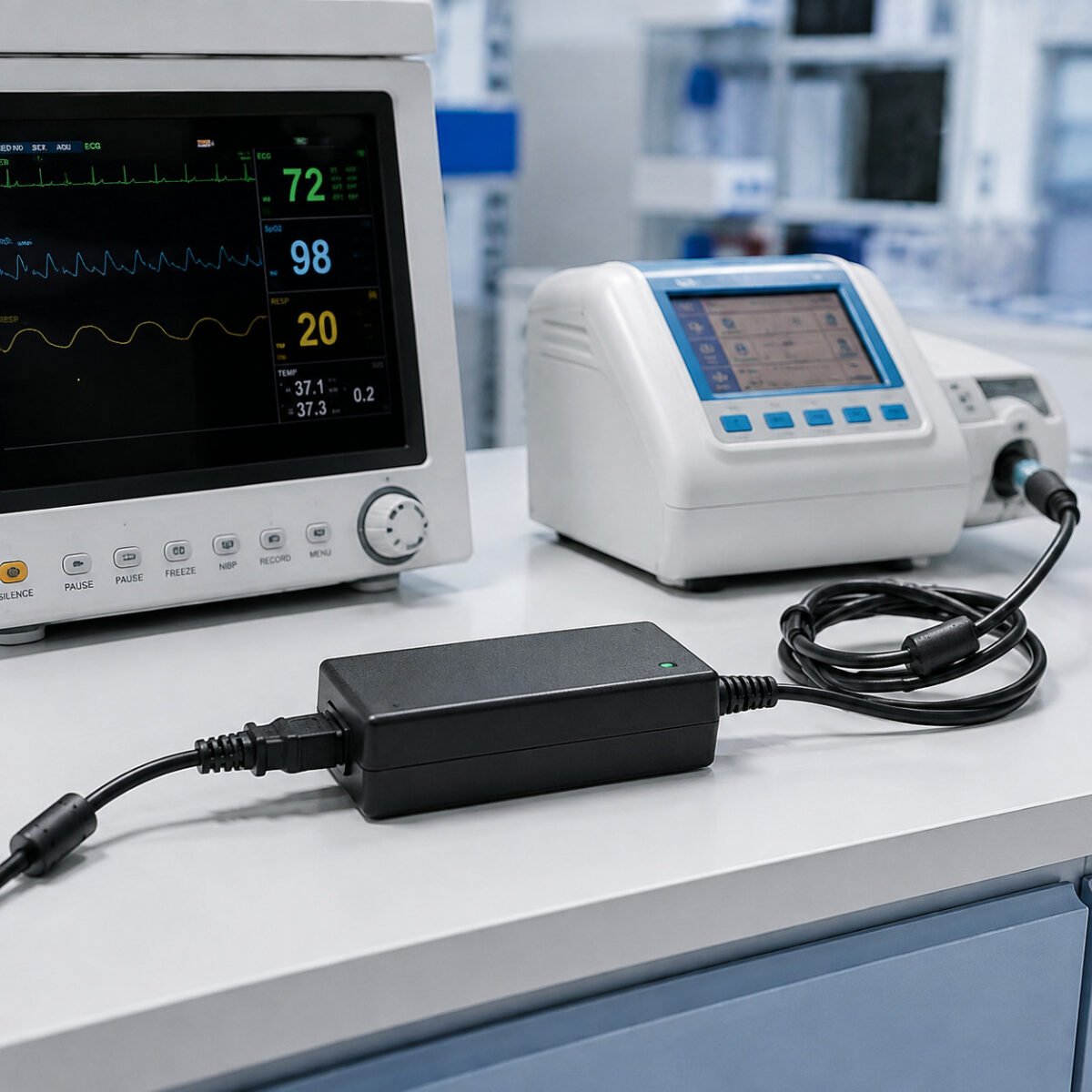
Desktop adapters accommodate higher power requirements and can support multi-output configurations on selected models. The separated brick-and-cable design supports devices that require the adapter to be positioned away from the wall outlet, common in laboratory and imaging equipment installations. Selected models use ventilation and internal thermal management features to support continuous operation at higher power levels while maintaining component temperatures within specified limits.
The brick housing provides space for additional circuitry. Selected models can incorporate active power factor correction (PFC), multiple isolated output rails, and enhanced EMI filtering according to the application requirements. Thermal management combines conduction through the housing surface with convection via ventilation slots. The DC output cable is available in selected lengths and connector types, with locking connectors offered on selected models for applications where connection stability is a concern.
- Available Power Range: 60W – 200W, depending on model
- Output Configurations: Single, dual, or triple DC outputs (selected models)
- Connector Options: Barrel, locking, and custom pin configurations
- Suitable For: Diagnostic analyzers, imaging systems, multi-parameter monitors
3.3 Custom Medical Power Solution
When standard catalog models do not match the application specification, custom development provides a tailored path. Custom solutions encompass modified output voltages, specialized connector interfaces, custom cable assemblies, and housing designs adapted to specific device enclosures. Development follows a structured process from specification review through functional verification, with prototype units provided for customer evaluation prior to production release.
Custom projects are initiated when a target device requires output voltage or current combinations outside the standard catalog range, specific connector interfaces, or a housing integrating with the device enclosure. The development process produces defined deliverables at each stage — specification, schematic, prototype, test report — establishing review checkpoints.
- Customization Scope: Output parameters, connector types, cable length, housing design
- Development Support: Schematic review, prototyping, verification testing coordination
- Production: Pilot runs, volume scaling, end-of-life management
- Suitable For: OEM projects requiring application-specific power specifications
4. OEM Support
OEM engagements follow a structured workflow covering specification review, product development, and production support — providing a path from initial requirements through volume manufacturing.
4.1 Requirement Review
The OEM engagement begins with a structured review of the application requirements. Technical specifications — including input and output parameters, environmental conditions, regulatory targets, and mechanical constraints — are documented and evaluated against manufacturing capabilities. This review identifies suitable standard models from the existing catalog or determines whether custom development is required. The review also addresses the intended deployment context, including ambient temperature range, humidity, altitude, and vibration conditions. Where the application requires compatibility with an existing device platform, interface parameters — connector pinout, cable length, output voltage tolerance — are captured.
4.2 Product Development
For custom specifications, the development phase covers circuit design, component selection, mechanical design, and prototyping. Design verification testing validates electrical performance, thermal characteristics, and mechanical integrity against the agreed specification. Prototypes are provided for customer evaluation, with iterative refinement based on test results and application feedback. The development phase concludes with a design freeze and production documentation package. Verification test protocols cover electrical performance across the specified line voltage and load range, thermal performance at maximum ambient temperature, and mechanical integrity under defined test conditions.
4.3 Production Support
Once a design is approved for manufacturing, production support encompasses tooling preparation, process documentation, test fixture development, and supply chain setup. Quality control protocols include incoming inspection, in-line testing, and final electrical testing on production units. Production volume planning supports both moderate pilot quantities and high-volume orders, with logistics arrangements tailored to the customer delivery schedule. For high-volume programs, dedicated production lines and kanban inventory models can support delivery schedules aligned to the customer build plan. End-of-life planning is addressed through component roadmap reviews with advance notification when a component approaches discontinuation.
4.4 Key Selection Factors
When evaluating power adapters for medical applications, the following factors help determine the appropriate solution:
- Input Voltage and Frequency
- Output Voltage and Power
- DC Connector and Pinout
- Cable Length and Configuration
- Plug Type and Target Market
- Operating Temperature and Environment
- Application and Duty Cycle
- Protection and Insulation Requirements
- Customization Requirements
Need a Medical Power Adapter for Your Device?
Share your input and output requirements, connector specifications, application environment, and target market. The team can recommend a suitable standard model or discuss a custom power solution for your project.
Medical Power Adapter Solutions
Power delivery solutions designed for diagnostic, monitoring, and home healthcare applications — engineered for reliability, stable output, and long service life.
1. Medical Power Adapter Product Requirements
Medical devices depend on consistent and dependable power delivery to support accurate operation, safe performance, and long service life. Power adapters for medical applications must address application-specific requirements that may differ from those of general-purpose consumer power supplies.
1.1 Reliability
Medical equipment often operates for extended periods, making stable operation and protection against common electrical and thermal stresses important considerations. Power adapters for these applications incorporate protection functions, appropriate component selection, and thermal design strategies according to the application requirements. Selected models include overcurrent protection, overvoltage clamping, and thermal shutdown circuits that activate when operating parameters deviate from defined thresholds. Surge-rated input components are available on selected models for environments where line transients are a concern.
1.2 Stable Power
Fluctuations in output voltage and current ripple can introduce noise into sensitive measurement circuits. Power adapters for medical applications are designed to provide stable output regulation, controlled ripple and noise, and reliable operation according to the requirements of the target device. Design characteristics and applicable requirements vary by model and application.
Output regulation and transient response are considered according to the electrical requirements of the target device. Selected models are available with low-ripple output performance according to the application requirements and specified test conditions.
1.3 Long Life
Medical devices may operate on extended duty cycles, making continuous-operation capability and long-term reliability important considerations. Component selection prioritizes long-life components and thermal management designs that keep internal temperatures within derated ranges. Component selection and thermal design are evaluated to support reliable operation over the intended service period.
1.4 Product Consistency
In controlled production environments, batch-to-batch consistency is a measurable requirement. Manufacturing processes follow controlled documentation, with incoming material inspection, in-process testing, and final electrical testing on production lines. Statistical process control tracks critical parameters to maintain output characteristics within defined tolerance bands across production lots.
Final electrical testing measures output voltage, current limit, ripple, regulation, and protection activation points against pass-fail thresholds. Applicable production records can provide traceability to component lots and production dates. Periodic reliability audits sample finished goods for extended stress testing to detect process drift.
2. Medical Application Solutions
Medical power adapters serve three primary application categories, each with distinct power, form factor, and safety considerations.
2.1 Diagnostic Equipment
Applications : Laboratory Testing, Point-of-Care Testing
Diagnostic instruments — including laboratory analyzers, selected imaging-related equipment, and point-of-care testing devices — require power adapters that support stable operating conditions. Stable, low-noise DC output can help support consistent operation in equipment with sensitive measurement circuits.
Adapters suited for diagnostic equipment provide regulated DC output with controlled ripple and noise, helping support stable operation of sensitive measurement circuits. Selected models range from 15W to 120W, supporting a range of diagnostic equipment such as compact analyzers, point-of-care testing devices, and selected benchtop systems. Output voltage options span 5V to 48V DC, with connector configurations matched to common diagnostic equipment input interfaces.
Benchtop analyzers may draw peak current above the nominal rating during measurement cycles. Selected models can be specified with appropriate power and transient-load capability for equipment with short-duration peak current demands. Selected higher-power models incorporate active power factor correction (PFC) to improve input power factor and reduce input-current harmonics. Locking DC connectors are offered on selected models to prevent accidental disconnection during active measurement sequences.
Plage de puissance : 15W – 120W | Tags: Laboratory Analyzers, Imaging-Related Equipment, Point-of-Care Testing
2.2 Monitoring Equipment
Applications : Surveillance des patients
Patient monitoring devices — such as multi-parameter vital signs monitors, ECG systems, and pulse oximeters — operate in proximity to patients, making appropriate electrical protection and insulation considerations important in the power solution.
Power adapters for patient monitoring applications can be configured with appropriate insulation, protection, and leakage-current characteristics according to the requirements of the target device and application. Selected models are available with single or dual-rail DC output configurations to match common monitoring device architectures. Selected models support continuous-duty operation for equipment used over extended monitoring periods.
Tags: Vital Signs Monitors, ECG Systems, Pulse Oximeters, Patient Monitoring
2.3 Home Healthcare Devices
Applications : Portable and Home-Use Healthcare
The shift toward home-based healthcare has increased demand for power adapters suitable for portable and consumer-facing medical devices. Applications include blood pressure monitors, glucose meters, portable respiratory aids, and home-use diagnostic devices.
These products require adapters that balance compact form factors with the reliability expectations of power supplies for medical applications. Interchangeable plug options support multi-region deployment, allowing a single device platform to ship with region-appropriate AC input configurations. Energy-efficiency requirements can be considered during product selection and development according to the target market and application.
Home healthcare environments can involve shared outlets and varying electrical loads. Selected models can be configured with appropriate input protection and housing characteristics according to the application requirements.
Tags: Blood Pressure Monitors, Glucose Meters, Portable Respiratory Aids
3. Product Solutions
Three product categories address different installation, power, and customization requirements across a range of medical applications.
3.1 Wall Mount Medical Adapter
Wall mount adapters provide a compact, direct-plug power solution suitable for medical devices with moderate power requirements. The integrated plug design eliminates cable management between the adapter and the wall outlet, reducing clutter in clinical and home environments. AC plug heads are available in configurations for different regional socket standards.
The housing incorporates thermal management features while maintaining a compact form factor. Selected models are available with potting or conformal coating options where required by the application. Selected models incorporate fuse and surge-suppression components appropriate for the target input-voltage range.
- Available Power Range: 5W – 60W, depending on model
- Tension de sortie : 5V, 9V, 12V, 15V, 24V, 48V DC (selected models)
- Plug Configurations: US, EU, UK, AU, CN — available by model
- Suitable For: Patient monitors, diagnostic instruments, home healthcare devices
3.2 Desktop Medical Adapter
Desktop adapters accommodate higher power requirements and can support multi-output configurations on selected models. The separated brick-and-cable design supports devices that require the adapter to be positioned away from the wall outlet, common in laboratory and imaging equipment installations. Selected models use ventilation and internal thermal management features to support continuous operation at higher power levels while maintaining component temperatures within specified limits.
The brick housing provides space for additional circuitry. Selected models can incorporate active power factor correction (PFC), multiple isolated output rails, and enhanced EMI filtering according to the application requirements. Thermal management combines conduction through the housing surface with convection via ventilation slots. The DC output cable is available in selected lengths and connector types, with locking connectors offered on selected models for applications where connection stability is a concern.
- Available Power Range: 60W – 200W, depending on model
- Output Configurations: Single, dual, or triple DC outputs (selected models)
- Connector Options: Barrel, locking, and custom pin configurations
- Suitable For: Diagnostic analyzers, imaging systems, multi-parameter monitors
3.3 Custom Medical Power Solution
When standard catalog models do not match the application specification, custom development provides a tailored path. Custom solutions encompass modified output voltages, specialized connector interfaces, custom cable assemblies, and housing designs adapted to specific device enclosures. Development follows a structured process from specification review through functional verification, with prototype units provided for customer evaluation prior to production release.
Custom projects are initiated when a target device requires output voltage or current combinations outside the standard catalog range, specific connector interfaces, or a housing integrating with the device enclosure. The development process produces defined deliverables at each stage — specification, schematic, prototype, test report — establishing review checkpoints.
- Customization Scope: Output parameters, connector types, cable length, housing design
- Development Support: Schematic review, prototyping, verification testing coordination
- Production: Pilot runs, volume scaling, end-of-life management
- Suitable For: OEM projects requiring application-specific power specifications
4. OEM Support
OEM engagements follow a structured workflow covering specification review, product development, and production support — providing a path from initial requirements through volume manufacturing.
4.1 Requirement Review
The OEM engagement begins with a structured review of the application requirements. Technical specifications — including input and output parameters, environmental conditions, regulatory targets, and mechanical constraints — are documented and evaluated against manufacturing capabilities. This review identifies suitable standard models from the existing catalog or determines whether custom development is required. The review also addresses the intended deployment context, including ambient temperature range, humidity, altitude, and vibration conditions. Where the application requires compatibility with an existing device platform, interface parameters — connector pinout, cable length, output voltage tolerance — are captured.
4.2 Product Development
For custom specifications, the development phase covers circuit design, component selection, mechanical design, and prototyping. Design verification testing validates electrical performance, thermal characteristics, and mechanical integrity against the agreed specification. Prototypes are provided for customer evaluation, with iterative refinement based on test results and application feedback. The development phase concludes with a design freeze and production documentation package. Verification test protocols cover electrical performance across the specified line voltage and load range, thermal performance at maximum ambient temperature, and mechanical integrity under defined test conditions.
4.3 Production Support
Once a design is approved for manufacturing, production support encompasses tooling preparation, process documentation, test fixture development, and supply chain setup. Quality control protocols include incoming inspection, in-line testing, and final electrical testing on production units. Production volume planning supports both moderate pilot quantities and high-volume orders, with logistics arrangements tailored to the customer delivery schedule. For high-volume programs, dedicated production lines and kanban inventory models can support delivery schedules aligned to the customer build plan. End-of-life planning is addressed through component roadmap reviews with advance notification when a component approaches discontinuation.
4.4 Key Selection Factors
When evaluating power adapters for medical applications, the following factors help determine the appropriate solution:
- Input Voltage and Frequency
- Output Voltage and Power
- DC Connector and Pinout
- Cable Length and Configuration
- Plug Type and Target Market
- Operating Temperature and Environment
- Application and Duty Cycle
- Protection and Insulation Requirements
- Customization Requirements
Need a Medical Power Adapter for Your Device?
Share your input and output requirements, connector specifications, application environment, and target market. The team can recommend a suitable standard model or discuss a custom power solution for your project.