12V vs 19V Power Adapter: Can You Use Either?
GUIDE · POWER ADAPTER VOLTAGE
12V vs 19V Power Adapter: Can You Use Either?
A drawer of adapters, one device with a missing supply, and two candidates that look the same: same barrel plug, same black brick, one label reading 12V and the other 19V.
The instinct is to try one, and the device will usually answer quickly. It either runs, or it does not, or it runs for a minute and then does not. The third outcome is the expensive one.
The two voltages are not interchangeable in either direction. This guide covers what each rating is for, what happens when they are crossed, the narrow cases that look like exceptions, and how to check before anything is plugged in.

1. What the Two Ratings Actually Mean
Both figures are nominal DC output voltages, and both carry a tolerance. A 12V adapter typically sits a little above 12V at no load; a 19V unit behaves the same way.
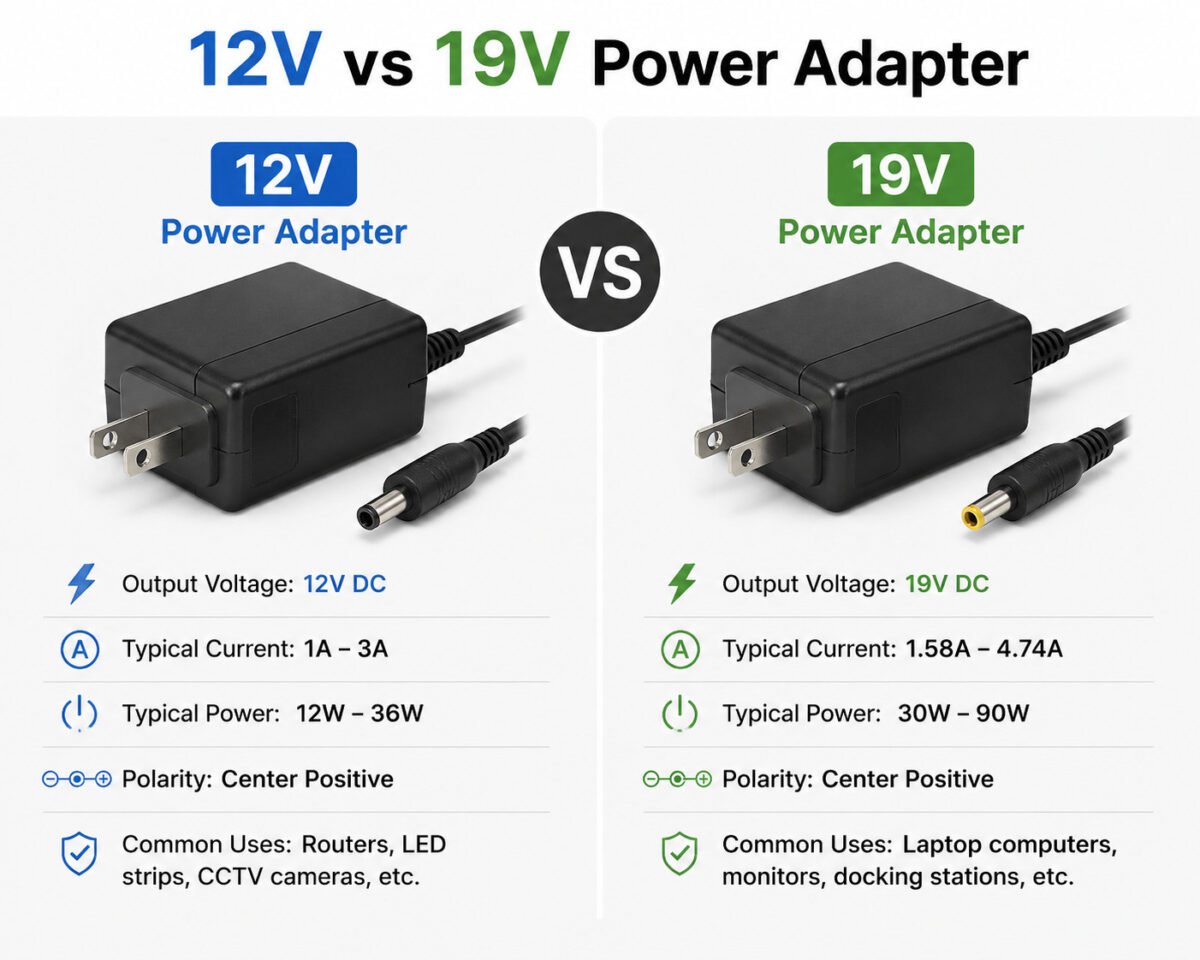
12 V is the working voltage of a large group of devices: routers, switches, CCTV cameras, LED controllers, external drive enclosures, audio gear, and many small hubs. Inside, these devices step 12V down to 5V, 3.3V, and lower rails.
19V belongs to a different group: laptops with barrel jacks, mini PCs, some monitors, and docking stations. These devices expect a higher input because their internal converters need headroom above the rails they produce.
The number is not a suggestion or a preference. It is the input the internal circuitry was designed around, and the rest of the design follows from it.
2. The Short Answer
| Direction | What happens | Verdict |
|---|---|---|
| 19V adapter into a 12V device | Input sits about 58% above design, internal parts see the excess | Do not use |
| 12V adapter into a 19V device | Input sits about 37% below design, the device cannot start | Do not use |
Neither direction is a "probably fine" case. The first can damage the device; the second usually just fails to power it.
3. Why 19V Cannot Feed a 12V Device
A 12V device is built around a 12V input. Its first stage is a converter that steps down to the rails the electronics use, and its input capacitors, protection devices, and regulator ratings are chosen for a narrow window around 12V.
Supply 19V and every one of those parts is over its design point at once. Input capacitors are often rated for 16V and see 19V continuously. The switching device and the converter's control loop sit outside the window they were chosen for, and the extra energy has to go somewhere, which is heat.
Some devices survive briefly because a clamp or protection diode absorbs the excess, which is the worst outcome: the device appears to work for a few minutes, then fails after the protection device gives up.
The failure is not always instant and rarely reversible. A router that dies this way is not repairable at the board level for what the router costs.
4. Why 12V Cannot Feed a 19V Device
The opposite direction fails for a different reason. A 19V device's internal converter needs an input above its own output plus some margin; at 19V input it has that margin, at 12V it does not.
Most devices handle this gracefully: an undervoltage lockout keeps them off, and nothing is damaged. A laptop may show a charge light and refuse to boot, or boot and immediately drop out when the processor draws current and the input sags further.
The risk here is smaller than in the other direction, but repeated brownout restarts are not harmless for drives and flash storage. The device is not being damaged by overvoltage; it is being stressed by a supply that cannot hold its input up.
5. The Cases That Look Like Exceptions
Three situations get cited as proof that the swap works, and each has a condition attached.
Devices marked with a range. Some routers, switches, and PoE gear are labeled 12–24V or 12–48V, because the internal design accepts a window rather than a point. If the label states a range and the adapter falls inside it, that is a designed input, not an exception. If the label states 12V alone, it is a point.
USB-C Power Delivery devices. A USB-C device negotiates its voltage over the configuration channel and can accept 5V, 9V, 12V, 15V, or 20V depending on what both ends support. That flexibility belongs to the protocol, not to the barrel. A device with a barrel jack has no channel to negotiate on, so it takes whatever the adapter gives it.
Laptops documented for 19V and 20V. Some laptops accept both, which is why a 20V USB-C supply can run them through a proper PD path. The accepted window is in the documentation. It is not a license to try 24V, and it does not apply to a 12V-only router.
The pattern is consistent: flexibility exists only where the device's own documentation says it does.
6. How to Check Before You Swap
Five checks settle it, and all five are faster than a repair:
- Voltage on the label. Match the figure exactly, including any stated range. Do not average two adapters or "round" 19V to 20V.
- Current rating. The adapter must meet or exceed the device's draw at that voltage. A higher current rating is safe; a lower one causes voltage sag.
- Polarity. Most equipment is center-positive, but center-negative devices exist, and reverse polarity damages electronics.
- Plug size. A 5.5 × 2.5 plug on a 5.5 × 2.1 pin makes poor contact even when the voltage is right.
- No-load output. A multimeter on an unconnected adapter should read close to its rating. A 19V adapter reading 24V is failing, not "close enough".
If any one of these does not match, the adapter is the wrong adapter, regardless of how well the plug fits.
7. What to Do If You Only Have the Wrong One
The reliable option is to buy the correct rating. Adapters at 12V and at 19V are both standard products, and matching the label removes every question above.
A DC-DC converter can raise 12V to 19V in principle, and such modules exist. They also add a failure point, need a current rating above the load, and are easy to buy undersized. For a device that matters, a correct adapter is cheaper than a converter plus the risk.
A USB-C PD supply with a trigger module is a reasonable path only when the device documents a PD-compatible input window. A 20V trigger is not a 19V supply, and a barrel-jack device has no way to ask for either.
8. Conclusion
The two voltages serve two device families, and neither tolerates the other's supply. 19V into a 12V device is an overvoltage event that can destroy it, sometimes within minutes; 12V into a 19V device is an undervoltage event that usually just refuses to start.
The exceptions are documented ranges and protocol-negotiated USB-C inputs, and both are conditions written into the device rather than tricks that work around the label.
For a replacement, the label is the specification: voltage exact, current at or above the draw, polarity confirmed, plug measured. That is a two-minute check against a repair that is rarely possible.
A supplier that prints the voltage, current, polarity, and plug dimensions on every model makes that check trivial, which is the practical difference between a first-time fit and a device that never powers on.