

Soluciones personalizadas de cargadores USB
Custom USB Charger Solutions | OEM & Private Label Charger Manufacturing
OEM and private label charger manufacturing solutions for brand, retail, and enterprise customers. Configurable power, port, and appearance options developed through a structured OEM process with applicable USB specifications and destination-market requirements taken into account. Charger platforms are designed to support a range of USB Power Delivery profiles, connector types, and housing configurations, with customization scope defined according to each project's target application, certification scope, and market positioning.

1. Custom Charger Applications
Charger OEM projects commonly serve three commercial customer segments: brand and private-label programs, retail distribution, and enterprise or institutional deployments. Each segment carries distinct requirements for branding, certification, volume, and packaging, addressed through tailored OEM configurations.
1.1 Brand & Private Label Products
Chargers developed under a customer's brand identity. This segment typically requires custom housing colors matching Pantone references, applied logos via silk-screen or laser engraving, and retail-ready packaging design. Brand owners launching proprietary accessory lines or expanding existing product ecosystems benefit from tailored electrical specifications, distinctive appearance treatment, and packaging that aligns with established brand guidelines. Selected platforms may be suitable for product line launches and market testing, depending on the product configuration and order requirements. Brand-specific requirements may extend to custom label content, localized language versions, and co-branded packaging inserts that support channel partner identification.
1.2 Retail Products
Charger platforms configured for retail distribution channels, with options for power ratings, port combinations, branding, packaging, labeling, and barcode requirements. Selected models support blister-pack or gift-box packaging and multilingual labeling. A wide range of power ratings accommodates retail shelf segmentation from entry-level to premium fast-charging tiers. Retail configurations take into account shelf-ready packaging formats, compliance with destination-market retail regulations, and consumer-facing labeling requirements including safety markings and specification disclosure. Retail charger projects may additionally address category-specific requirements such as hook-compatible packaging and window-box designs for product visibility.
1.3 Enterprise Products
Bulk charger deployments for enterprise and institutional environments, including hospitality, education, and corporate IT procurement. These configurations emphasize cost efficiency at scale, standardized port configurations, and compliance with destination-market electrical safety regulations. Enterprise projects often involve multi-region deployment, requiring plug configurations and certification scopes tailored to each destination market. Pricing is typically structured according to order quantity, product configuration, and customization requirements. Enterprise configurations may also include asset tagging and custom labeling for internal inventory management.
2. Customization Scope
Key configuration dimensions include power rating, port layout, physical appearance, plug type, and packaging. These dimensions are specified independently or in combination to match the target application and certification requirements.
2.1 Power Configuration
Selected OEM platforms can be configured for power levels such as the following. Actual voltage/current combinations and charging profiles depend on the selected PD implementation and target-device requirements.
| Potencia nominal | PD Platform | Aplicaciones típicas |
|---|---|---|
| 20W | PD SPR | Smartphones and mobile accessories |
| 30–45W | PD SPR | Smartphones, tablets and compact devices |
| 65W | PD SPR | Tablets, ultrabooks and laptops |
| 100W | PD SPR | Laptops and high-power mobile devices |
| 140 W | PD 3.1 EPR | High-performance laptops and workstations |
| Hasta 240 W | PD 3.1 EPR | Selected high-performance laptops and computing devices |

USB Power Delivery supports Standard Power Range (SPR) configurations up to 100W, while USB PD 3.1 adds Extended Power Range (EPR) configurations up to 240W at 48V/5A. EPR includes power levels such as 140W, 180W, and 240W. Available power profiles depend on the selected charger platform and product specification.
PPS (Programmable Power Supply), available in compatible USB PD implementations, enables finer-grained voltage and current adjustment within defined operating ranges for compatible fast-charging devices. PPS support is platform-dependent and may be selected for charger models targeting compatible smartphone fast-charging applications.
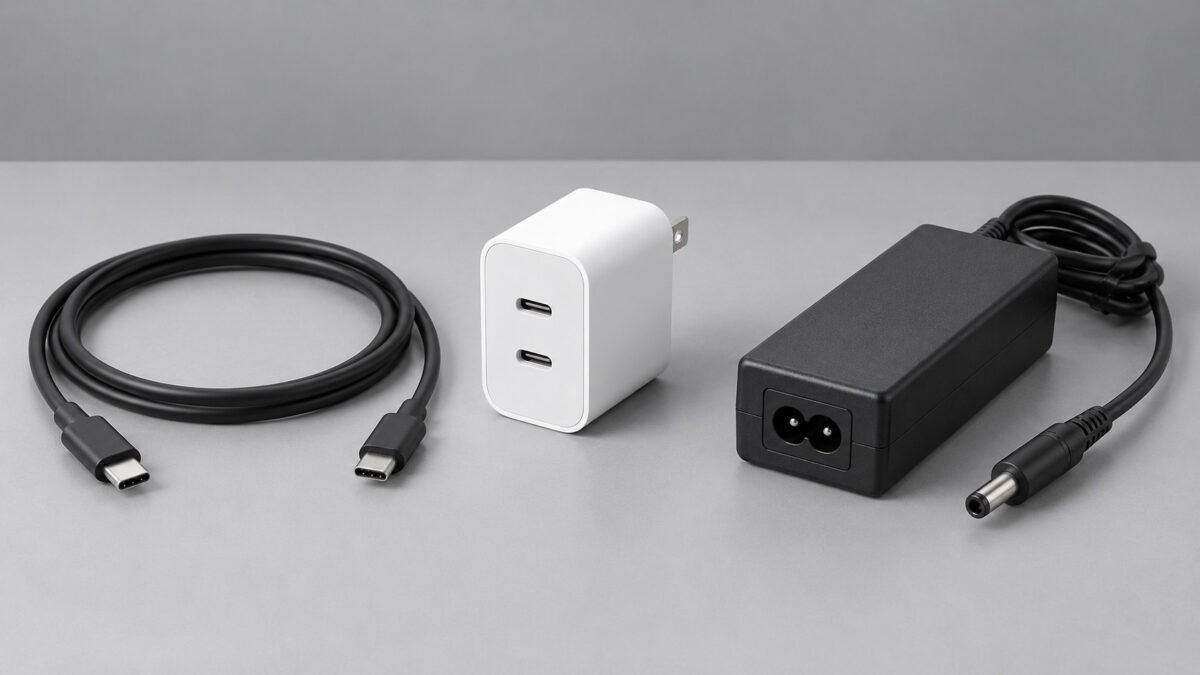
For power levels above 100W, system-level compatibility depends on the charger, device, and appropriate USB-C cable implementation. For EPR power levels above 100W, the USB-C cable must be appropriately rated for the required current and power level. Depending on the cable specification, an E-Marker may be required to identify the cable's supported power capability. Cable selection should therefore be considered as part of the overall charging system configuration.
2.2 Port Configuration
Port layouts are configured based on target device compatibility, region-specific connector adoption, and power distribution requirements for multi-output designs.
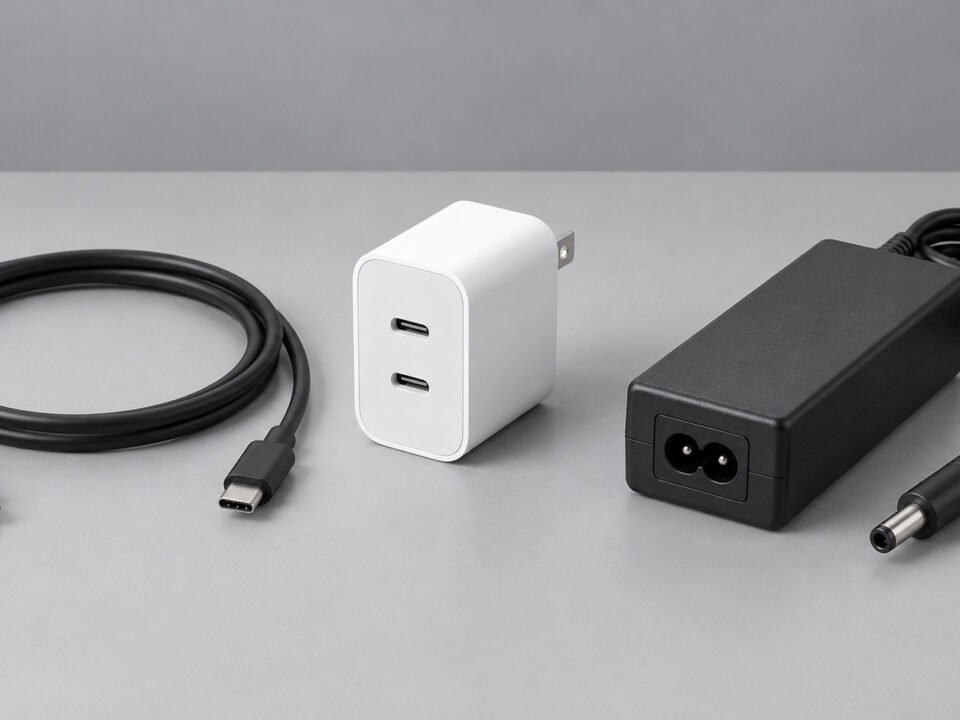
- USB-C: Reversible USB Type-C connectors support USB Power Delivery charging on compatible charger platforms. Selected models support USB PD 3.1 EPR power levels up to 240W, depending on the charger, device, and cable configuration. Suitable for smartphones, tablets, laptops, and other USB-C powered equipment.
- USB-A: USB Type-A connectors provide compatibility with legacy devices and accessories. Charging capability depends on the charger design and supported charging protocols, with selected models supporting USB Battery Charging (BC) 1.2 and other device-specific charging requirements. Suitable for markets and applications where Type-A remains widely used. USB-A configurations may be selected where compatibility with existing device fleets or legacy accessories remains a procurement priority.
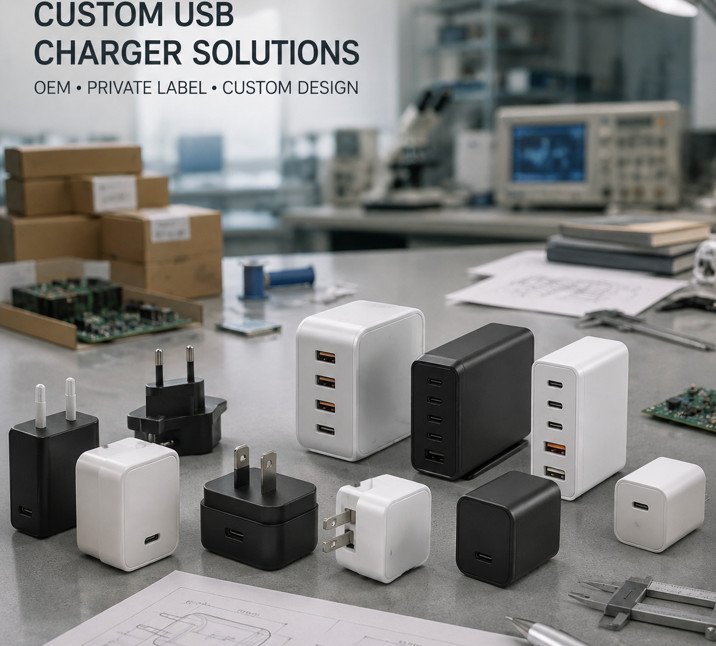
- Multi-Port: Multi-port configurations combine USB-C and USB-A outputs on a single charger body. Power distribution across ports is managed via internal power-sharing controllers. Total output is allocated dynamically based on the number and type of connected devices, with per-port maximums defined in the product specification. Multi-port designs are suitable for shared charging environments such as office desks, hotel rooms, and education settings where multiple device types are charged simultaneously.
2.3 Apariencia
Customization options cover four key areas: housing, color, branding, and packaging.
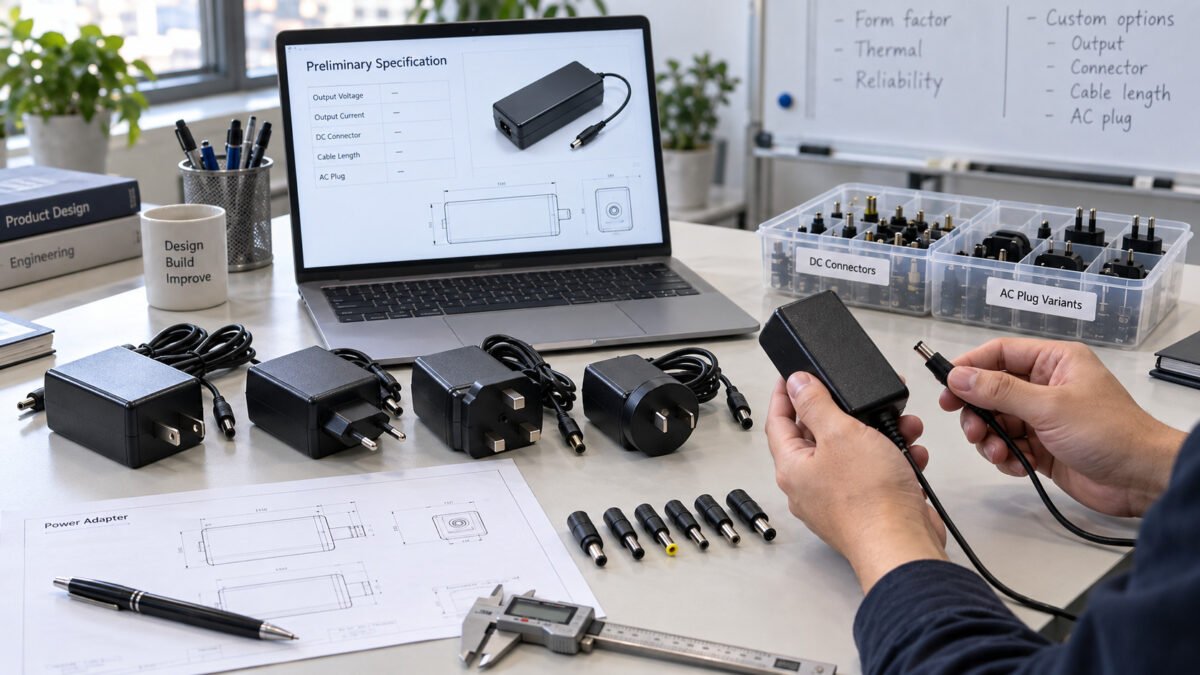
- Housing: Charger housings are typically molded from flame-retardant thermoplastic materials such as PC (polycarbonate) or PC/ABS blends. Material grades and flame-retardancy ratings are selected according to the product design and applicable safety requirements. Housing form factors include compact wall-plug, desktop brick, and foldable-pin designs. Pin configurations are selected by destination market plug standard (US, EU, UK, AU).
- Color: Housing colors are matched to Pantone or RAL references provided by the customer. Standard stock colors include white and black. Custom color matching may require minimum order quantities depending on the housing material and production volume.
- Logo: Customer logos can be applied through suitable printing or engraving processes based on housing material and design requirements.
- Embalaje: Packaging options include retail gift boxes, blister packs, and bulk cartons. Gift box designs support custom printing, insert configurations, and multilingual instruction sheets. Bulk carton packing is suited for enterprise and wholesale distribution channels. Packaging can be configured to meet destination-market labeling requirements, including language versions, regulatory marks, and recycling symbols where applicable.
3. Proceso de desarrollo OEM
The OEM development cycle follows five sequential stages, from initial specification review through mass production. Each stage includes defined deliverables and review points before progressing to the next stage.
3.1 Requirement Review
Target specifications are documented, including power rating, port configuration, plug type, certification scope, and destination markets. Applicable USB specifications, electrical safety requirements, EMC requirements, and destination-market regulatory requirements are identified according to the target market and product configuration. Depending on the product and destination market, the applicable compliance pathway may involve requirements or schemes such as UL, CB, PSE, or EU conformity assessment and CE marking, together with other market-specific requirements. A bill of materials and project timeline are drafted for customer confirmation.
3.2 Product Design
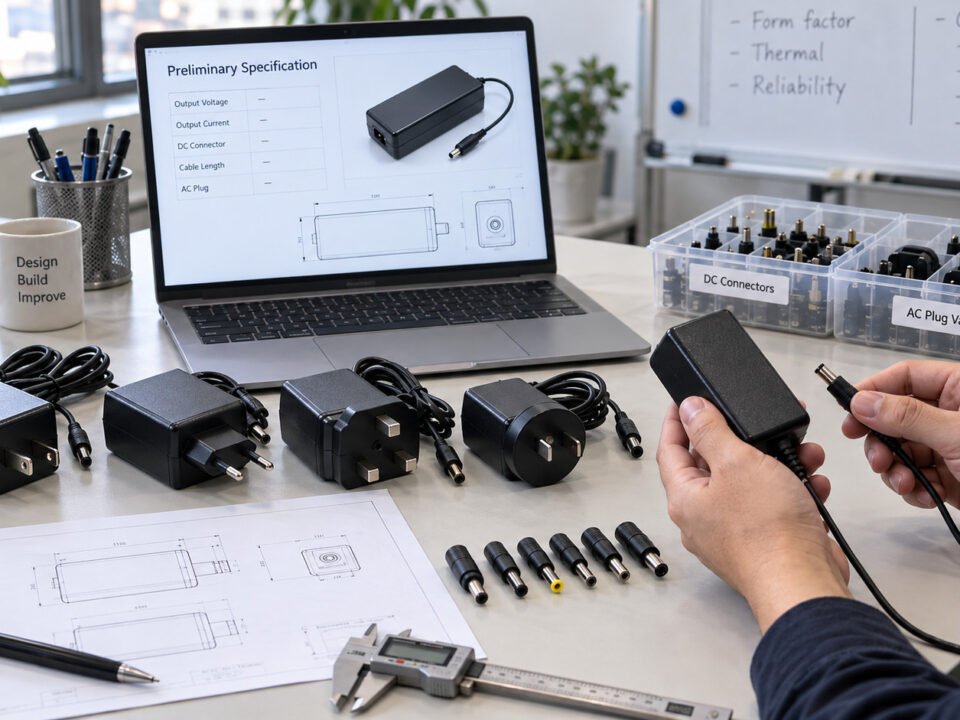
Electrical schematic and PCB layout are designed around the selected power conversion topology. Mechanical CAD models define housing dimensions, thermal management structures, and connector placement. Design files undergo internal review before tooling or production preparations begin.
3.3 Prototipo
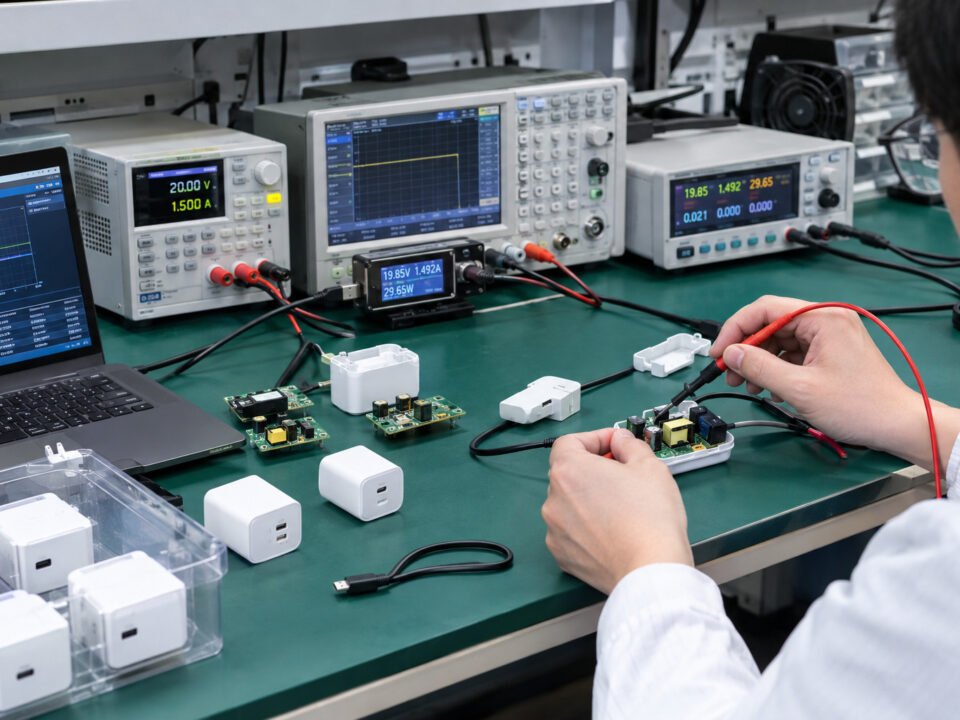
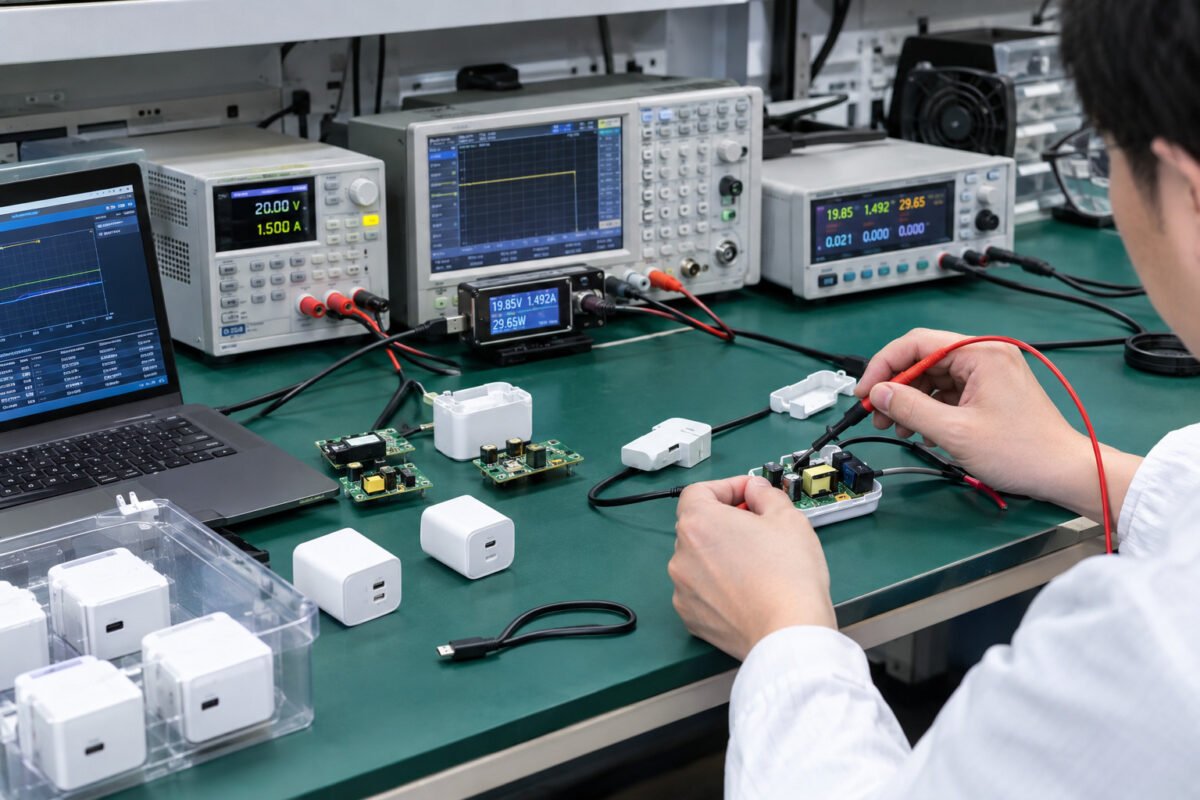
Prototype units are produced for functional verification, mechanical fit checks, and preliminary electrical performance evaluation. Key electrical, thermal, and mechanical issues are identified and addressed through design revisions before validation. Customer feedback is collected at this stage.
3.4 Validation
Validation testing covers electrical safety, EMC performance, thermal performance, and applicable USB PD functionality. Test reports and compliance documentation are prepared according to the requirements of the target market and certification program. Any required certification or regulatory approval is completed before commercial production, where applicable. Additional environmental and reliability testing may be performed depending on the product application and customer requirements.
3.5 Producción en masa
Production runs follow established SMT and final assembly procedures. Quality control may include automated optical inspection, hi-pot testing, output load verification, and other production-line inspections according to product requirements. Outgoing inspection is conducted according to agreed quality requirements and applicable AQL criteria. Production lead times depend on order volume and component availability. Production scheduling can be coordinated with customer delivery requirements for phased rollouts or replenishment programs.
3.6 OEM Manufacturing Capabilities
- Power platform customization
- Multi-port charger development
- Private label production
- Custom housing and branding
- Market-specific plug configurations
- Compliance support
- Packaging customization
- Production and quality control
4. Related Resources
The following guides provide additional technical and procurement reference material for charger selection and OEM project planning.
- USB Charger Specification Guide
- USB-C PD Charger Selection Guide
- USB Charger Certification Guide
- Private Label Charger Packaging Guide
Start Your OEM Charger Project
Share your target power, port configuration, plug type, destination market, branding requirements, and estimated order quantity. The appropriate charger platform and customization options can be evaluated based on your project requirements.