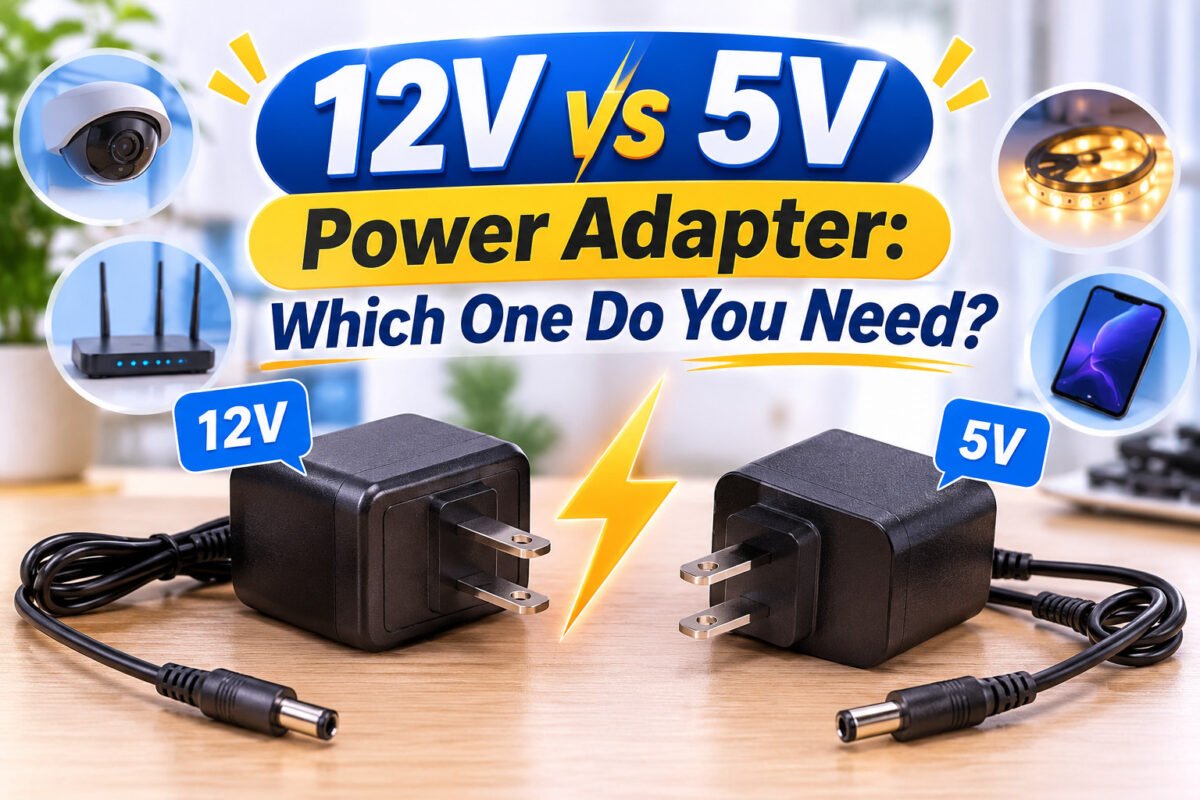
12V vs 5V Power Adapter: Which One Do You Need?
GUIDE · POWER ADAPTER SELECTION
12V vs 5V Power Adapter: Which One Do You Need?
A power adapter turns the high-voltage alternating current from a wall socket into the low-voltage direct current a device can use. Inside, a rectifier, a switching stage, a transformer, and a filter produce a steady output from an input that swings with the grid.
Mains voltage differs by country, but the adapter's job does not. Whether the socket supplies 120V or 230V, the device on the other end sees a single regulated DC level chosen at design time.
Two values on the label decide everything: output voltage in volts and output current in amps. Across consumer and commercial electronics, 12V and 5V are the two most common levels, and mixing them up is the fastest way to destroy a device.
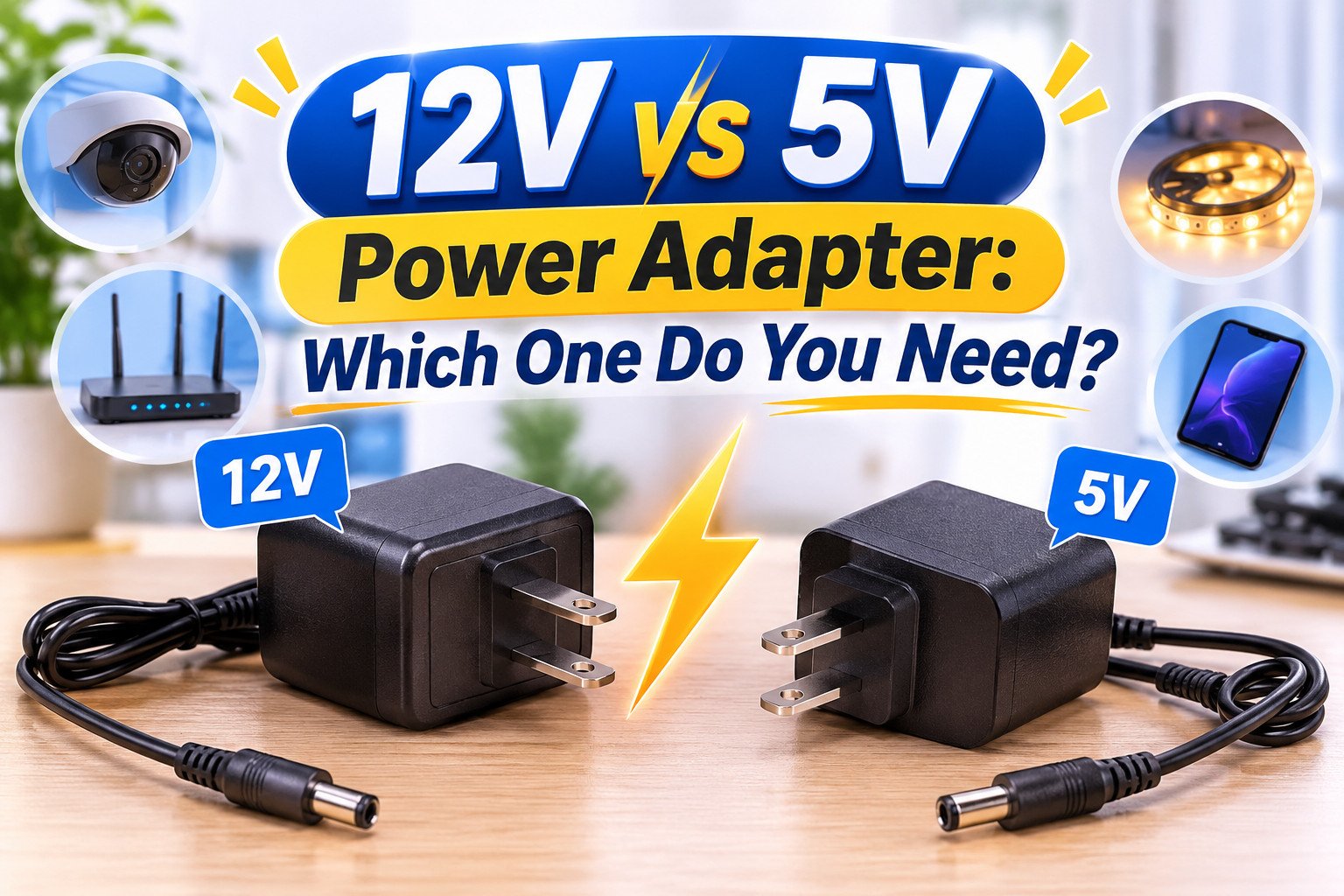
1. 12V vs 5V Power Adapter: Key Differences at a Glance
| Funktion | 12V power adapter | 5V power adapter |
|---|---|---|
| Ausgangsspannung | 12V DC | 5V DC |
| Common current ratings | 1A, 2A, 3A, 5A | 1A, 2A, 3A |
| Typical power range | 12W to 60W | 5W to 15W |
| Typical devices | Cameras, routers, LED strips | IoT boards, hubs, small accessories |
| Steckertyp | DC barrel jack, often 5.5 × 2.1 mm | DC barrel jack, often 5.5 × 2.1 mm or 3.5 × 1.35 mm |
| Typical use | Surveillance, networking, lighting | Microelectronics, automation, accessories |
2. What Is a 12V Power Adapter?
A 12V power adapter delivers a regulated 12V DC output. It is the workhorse of residential, commercial, and industrial low-voltage systems, because a great deal of equipment is built around a barrel jack rather than a USB port, and 12V sits well below the safety threshold for accessible wiring.
2.1 Common Applications of a 12V Power Adapter
- Security cameras. Most analog and many IP cameras run on 12V DC.
- Routers and network switches. Home and small-office networking gear commonly uses 12V.
- LED light strips. 12V strips dominate decoration and shelf lighting.
- Cable TV amplifiers. Distribution equipment typically runs on 12V.
- Access control. Door locks, card readers, and intercoms use 12V.
- DVR and NVR units. Recording equipment for CCTV systems is usually 12V.
- Water purifiers. Many reverse-osmosis systems use a dedicated 12V unit for the pump motor.
2.2 Typical Specifications of a 12V Adapter
A regulated 12V adapter built for this class of equipment usually carries the following label data:
| Spezifikation | Typical value |
|---|---|
| Ausgangsspannung | 12V DC, ±5% |
| Output current | 1A, 2A, or 3A variants |
| Input voltage | 100–240V AC |
| Häufigkeit | 50/60 Hz |
| Stecker | 5.5 × 2.1 mm DC barrel jack |
| Schutz | Over-voltage, over-current, short circuit, thermal |
| Effizienz | Around 85% at full load |
Protection circuits are what separate a usable adapter from a risky one. Over-voltage and over-current limits, short-circuit cutoff, and thermal shutdown all act before the connected device absorbs the fault.
3. What Is a 5V Power Adapter?
A 5V power adapter outputs 5V DC, the same level the USB standard uses for power. It suits low-power electronics, microcontroller projects, and small accessories that draw a few watts.
3.1 Common Applications of a 5V Power Adapter
- Single-board computers and microcontroller boards. These typically run on 5V.
- USB hubs and USB-powered accessories. Anything designed around the USB power rail expects 5V.
- Smart home sensors and IoT modules. Automation devices commonly use 5V.
- Small LED displays and indicators. Low-power panels and segment displays.
- Mini fans and cooling modules. Small DC fans inside equipment enclosures.
- Power bank input and output. 5V is the baseline level of the USB power standard.
3.2 Typical Specifications of a 5V Adapter
| Spezifikation | Typical value |
|---|---|
| Ausgangsspannung | 5V DC, ±5% |
| Output current | 1A, 2A, or 3A variants |
| Input voltage | 100–240V AC |
| Häufigkeit | 50/60 Hz |
| Stecker | 5.5 × 2.1 mm or 3.5 × 1.35 mm barrel jack |
| Schutz | Over-voltage, over-current, short circuit, thermal |
| Effizienz | Around 85% at full load |
4. 12V vs 5V Power Adapter: Detailed Comparison
1. Voltage Level
This is the difference that matters most. A 12V adapter puts 12V across the load, a 5V adapter puts 5V across it, and a device designed for one level will not accept the other. Twelve volts on a 5V device is more than twice its rating and can destroy the input stage within seconds; 5V on a 12V device leaves it below its start-up threshold, so it does not turn on.
Rule: match the output voltage to the voltage printed on the device label.
2. Current Rating
The current rating is the maximum the adapter can supply, not the amount it pushes. A device that needs 12V 1A runs fine on a 12V 2A adapter, because it draws only the 1A it needs. A 12V 0.5A adapter on the same device is a different story: the load pulls more than the adapter is rated for, the output voltage sags, and a cheap unit overheats while a well-built one shuts down or hiccups.
3. Power Output
Power is voltage times current, so the same current rating yields very different wattages at the two levels:
- A 12V 2A adapter delivers 24W.
- A 5V 2A adapter delivers 10W.
This gap in wattage is why 12V serves the larger loads. A camera array, a router, or a strip of LEDs needs more than 5V can deliver at a reasonable current, while a sensor board may need a single watt.
4. Connector Type
Both voltages often appear on the same 5.5 × 2.1 mm barrel jack, which is a frequent source of confusion: two adapters that plug into the same socket can still differ in output. Size is the only visual hint, since a 12V unit usually carries the larger case and the heavier cable while a 5V unit is smaller and lighter. Even that is not reliable, so the label decides.
5. Heat Generation
Heat follows the load, not the nominal voltage. A 12V adapter delivering 24W dissipates more than a 5V adapter delivering 5W, simply because it is converting more power; a lightly loaded 12V unit can run cooler than a hard-worked 5V one. Efficiency and enclosure design decide the rest.
5. How to Read Your Device Label and Choose the Right Adapter
Every device carries a label, usually on the bottom or the back, listing what it needs.
Example label: INPUT: 12V DC — 2A
This means the device expects exactly 12V DC and draws up to 2A. A 12V adapter rated at 2A or higher fits; a 12 V, 3 A unit also works, and the device still takes only what it needs.
Steps to Choose the Right Adapter
- Find the power label on the device.
- Note the required voltage and match it exactly.
- Note the required current and choose an adapter rated at or above it.
- Match the connector size and the polarity, which is center-positive on most equipment.
- Choose a unit with over-voltage, over-current, and short-circuit protection.

6. Common Mistakes When Choosing a 12V vs 5V Power Adapter
1. Using the wrong voltage. The most damaging error. A 12V adapter on a 5V device can destroy it, and the risk rises with the current the adapter can supply.
2. Choosing a lower current rating. A 1A adapter on a 2A load will overheat, age faster, and may make the device behave erratically.
3. Ignoring protection features. An adapter without over-voltage or short-circuit protection passes mains disturbances straight to the device.
4. Buying a narrow-input adapter for an unstable grid. A 100–240V input range keeps the output steady when the mains sags or spikes, which matters in areas with weak supply.
5. Trusting the connector alone. Two adapters can share a plug size and output different voltages, so the barrel jack tells you nothing until the label confirms it.
7. Schlussfolgerung
12V and 5V adapters do the same job at different levels. The voltage has to match the device exactly, the current rating has to meet or exceed what the device draws, and the connector and polarity have to line up with the socket on the device.
The choice is rarely a preference. The label on the device decides which one is correct, and the adapter's protection circuits decide whether a mistake stays contained.
Read the label first, size the current with a little headroom, and verify the connector before plugging anything in.
That order prevents the two failures that account for most replacements: a wrong-voltage adapter that kills a device, and an undersized one that dies on its own.
8. FAQs
Can I use a 12V adapter for a 5V device?
No. Twelve volts is more than twice the device's rating, and the input stage can fail within seconds. Match the voltage printed on the label.
Can I use a 5V adapter for a 12V device?
No. The device will not start, or it will behave erratically as the supply collapses under load.
Is it safe to use a higher-amperage adapter than required?
Yes. A device draws only the current it needs, so a 5V 3A adapter on a 5V 1A device supplies 1A. The rating is a ceiling, not a push.
What happens if I use a cheap adapter without protection?
Over-voltage and short-circuit events pass straight through to the device. A surge that a protected unit would absorb can permanently damage the equipment on the other end.
How do I know whether my router needs 12V or 5V?
Check the label on the bottom of the router. Most home routers use 12V DC, but the printed figure is the one to follow.
Where can I buy a reliable 12V or 5V power adapter?
From a supplier that publishes the output voltage, current rating, connector size, and protection features for each model, and can supply the same unit in volume with consistent specifications.
What is the difference between a power adapter and a charger?
A charger includes charge-control circuitry and follows a battery's charging profile. A power adapter delivers a fixed regulated voltage to a device that manages its own power. Both convert AC to DC, but only one is built to charge a battery.