
Complete Power and Connectivity Solutions
2026-09-17
Product Design & Engineering Support
2026-09-18
Custom USB Charger Manufacturing Process
Custom USB Charger Manufacturing Process
A custom USB charger starts with a product requirement rather than a catalog item. For consumer brands, retail ranges and enterprise equipment, a charger is developed when the required output, port configuration, appearance or compliance provisions do not match a standard product. The path from that requirement to a mass-produced charger follows a defined sequence: requirement review, engineering design, prototyping and validation, and production with quality control. The sequence is designed to confirm that the finished product meets the electrical, mechanical and regulatory requirements agreed at the start, and it gives both the sourcing team and the manufacturer a common reference for the project.
1. Custom Charger Applications
Custom chargers are developed for different customer groups, and the application drives the specification. The product may be a branded charger sold through retail, a charger added to a consumer product line, or a power unit built for enterprise equipment. Each application sets a different balance between output, appearance, packaging, reliability and compliance, and the development process is adjusted to that requirement rather than applied as a fixed template.
1.1 Consumer Brands
A consumer brand develops a custom charger to match its product line and its visual identity. The specification is fixed by the devices the charger supports, so the power output and supported protocols are confirmed for the intended phones, tablets, earbuds or other accessories before design begins. A USB-C connector alone does not confirm USB PD support or a particular wattage, so the charger and the target devices must support compatible power profiles. Enclosure color, surface finish, branding and packaging become part of the custom build, and the selected options are validated for appearance and function together.
For a consumer brand, the custom work is usually based on an existing platform with a modified or custom configuration. The supported protocols, power profiles and any negotiated power are confirmed against the target devices, and where a charger is expected to power or charge a laptop, the rated output under load and the intended operating conditions are reviewed. The finished product is evaluated for electrical performance, mechanical integrity and applicable regulatory requirements before production, so the branded charger behaves in the field as it does in the sample.
1.2 Retail Products
Retail products are stocked and sold as a unit with specific performance, compatibility and compliance expectations. For a retail charger, the measured output, port configuration and safety behavior are confirmed and documented, because the product is used by a wide range of buyers without engineering support. Port types and labeling are set for clear shelf presentation, and any stated capability is confirmed for the produced configuration rather than assumed from the connector or the enclosure.
A retail program places emphasis on consistency across a production run. The specification, acceptance criteria and compliance documentation are defined before production, and quality control is applied at incoming materials, during production and on the finished product so that the units delivered match the validated sample within the agreed tolerances. Because a retail product is compared with many alternatives, the documented performance and packaging form part of the commercial specification.
1.3 Enterprise Products
Enterprise products include power units for offices, meeting rooms, education and professional equipment, where the charger is specified for a managed fleet rather than a single user. The development is driven by the devices served, how many are charged at the same time and where the unit is installed, so power output, port configuration and installation method are confirmed together. On multi-port models, the maximum rating shown for each port does not necessarily mean that every port can deliver that output simultaneously, so the simultaneous-output behavior and total rated output are reviewed against the expected load.
For enterprise products, the custom process may include fixed-output adapters as well as USB chargers. Because the devices, load patterns and installation vary, the suitable architecture is confirmed for the application: a centralized USB output, a fixed DC source matched to a device input, or a combination. The selected model is validated for the expected duty, thermal conditions and operating environment, and the compliance scope for the destination market is confirmed for the produced configuration.
2. Development Process
The custom charger development process moves a requirement through requirement review, engineering design, prototyping and production. Each stage produces a defined output that the next stage builds on, so that the final product can be traced back to the agreed specification. The depth of each stage depends on whether the project uses a standard platform, a modified product or a fully custom build, and the process is sized to the risk and scope of the program.
2.1 Requirement Review
Requirement review establishes what the charger must do before any design begins. The target is defined in three areas: the power output, the port configuration and the application. Power output covers the total rated power, the supported USB PD power profiles and, for a multi-port unit, the per-port and simultaneous output that can be delivered with the ports loaded together. Where USB PD is required, the charger, intended device and cable must support compatible power profiles. For current above 3 A, a compliant 5 A electronically marked cable is required. For USB PD Extended Power Range above 100 W, the source and sink must support the applicable EPR power level, and a compliant EPR-rated 5 A electronically marked USB-C cable is required.
Port configuration covers the number and type of ports, how they are arranged and how they are labeled, together with any per-port ratings and the fixed-or-negotiated output behavior for the model. The application is reviewed to set the operating conditions, the devices served, the installation and the destination-market compliance, including the AC input for the region. A documented requirement covering wattage, protocol, ports, environment and regulatory scope is the reference for the stages that follow, so that later decisions can be checked against it and ambiguities are resolved before they propagate into design.
2.2 Engineering Design
Engineering design turns the approved requirement into a manufacturable design, working across the electrical and the mechanical sides. Electrical design covers the power conversion, the supported AC input range, output regulation and stability under load, the charging protocol implementation and the protection functions such as overvoltage, overcurrent, short-circuit and overtemperature protection where provided on the selected model. These functions are confirmed within the platform’s rated conditions rather than assumed from the connector, because a USB-C port alone does not establish USB PD support or a particular output.
The electrical design is matched to the AC input and the intended device mix, and the rated input and output are documented for the produced configuration. Housing design covers the enclosure, its size, finish and construction, thermal management and the mounting or placement for the intended use. For higher-power units, enclosure construction and internal thermal design are evaluated under sustained rated load because excessive internal temperature can reduce reliability or activate power derating or thermal protection. Ingress protection, drop resistance and cable management are reviewed where relevant to the application.
The mechanical design must allow the electrical design to operate within its thermal limits and meet the intended appearance, ergonomic and installation requirements. The two design streams are reviewed together so the complete unit is coherent, and the mechanical and electrical outputs are recorded against the specification before sampling.
2.3 Prototype
Prototyping produces physical units against the design so the charger can be tested rather than assumed correct. Sampling covers both a sample build and validation. The sample confirms that the unit can be assembled as designed and that the mechanical and electrical elements fit together, including the enclosure, the PCB and the ports. The sample build also reveals any issue in manufacturability that must be corrected before a repeatable process can be established.
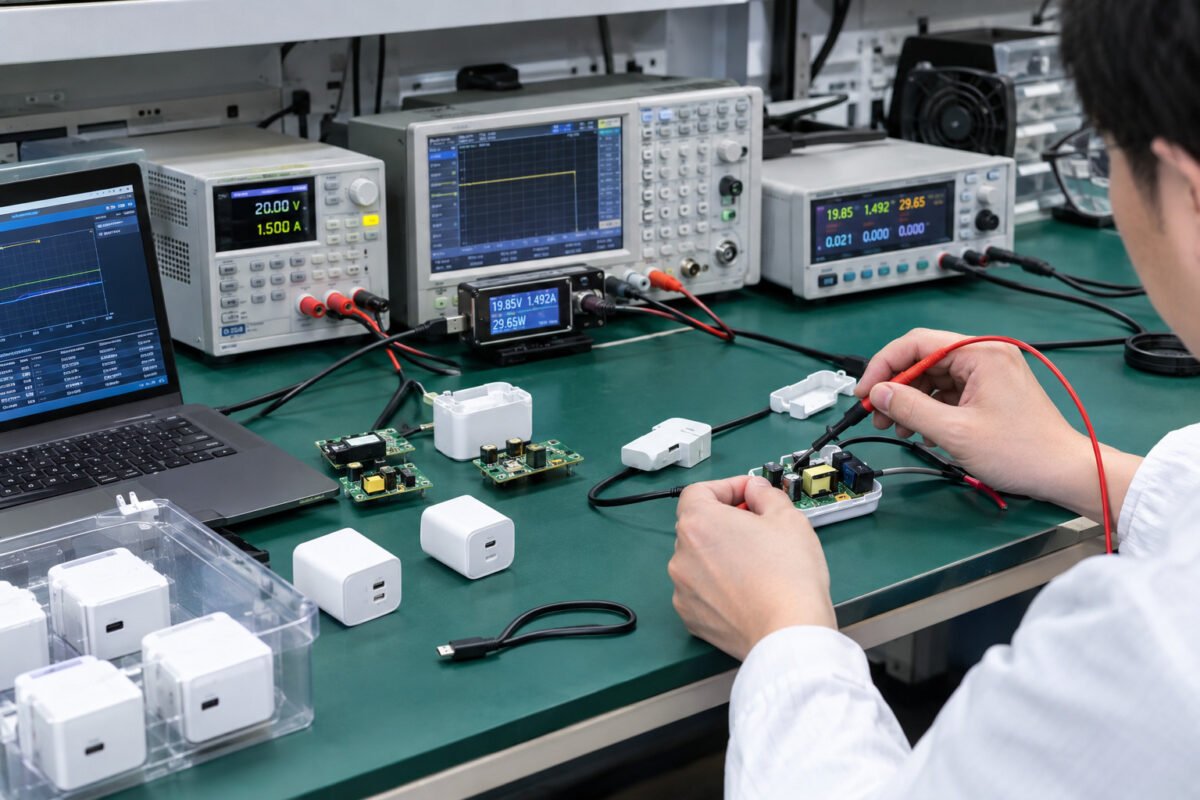
Validation tests the sample against the requirements for output, charging-protocol behavior, thermal performance and mechanical integrity. For a USB charger, this includes confirming the specified power profiles, output under the defined input and load conditions, and power allocation when connected devices or active ports change. Compatibility checks should use the intended device and cable combinations because negotiated power depends on the capabilities of the charger, device and cable.
Where a sample does not meet the requirement, the design is revised and a new sample is reviewed before production is committed. The validated sample and its test results become the reference for the production stage, because production is intended to reproduce the behavior that validation has established rather than to introduce new behavior.
2.4 Production
Production moves the validated design into repeatable output at the required volume. Mass production is controlled through approved specifications, materials, tooling, work instructions and test criteria. The process covers assembly, any required firmware or protocol configuration, production testing, and packaging and labeling. The exact combination of 100% routine tests and sampled inspections depends on the product design, applicable requirements and agreed quality plan.

Quality control is applied to incoming materials, in-process production and finished units. Depending on the control plan, charger checks may include output voltage, load performance, charging-protocol negotiation, protection response, mechanical inspection and the electrical-safety tests required for the model and destination market. Test items and acceptance criteria should be documented for the specific project rather than assumed to be identical across all charger models.
Destination-market requirements and the applicable compliance path are identified during requirement review and confirmed before mass production. Required reports, certificates, declarations, markings or registrations, as applicable, are then verified for the final production configuration before shipment. Shipping documents, labels and packaging are prepared according to the approved order requirements.
3. Related Charger References
The custom development process sits alongside the general resources that describe the charger range. These references frame the specifications and selection against which a custom program is defined, and they give the sourcing team a common technical language.
USB Charger Solutions describes the charger product range and how chargers are selected for different devices and applications. It provides the background for choosing a platform as the starting point of a custom build, whether the project needs a single-port or multi-port unit and whether it will follow a standard, modified or custom path.
The USB Charger Specification Guide covers the performance parameters used to specify a charger, including output ratings, supported protocols and related specifications. It supports the requirement review and validation stages of a custom program by identifying the documented parameters against which a design and its samples are checked.
Together with this manufacturing process overview, these references cover the product context, the specification parameters and the development steps that describe how a custom USB charger is developed from an initial product requirement to a repeatable mass-production state.
Start a Custom USB Charger Project
To assess a custom USB charger project, provide the destination markets, AC input, total and per-port output requirements, supported charging protocols, port arrangement, plug and enclosure requirements, target devices, compliance scope, forecast volume and packaging needs. These details allow the platform choice, development scope, sample plan, validation items and quotation to be defined before development begins.
Submit the project specification to request a feasibility review, sample plan and quotation.
Start Your Custom USB Charger Project
Whether you are a consumer brand, a retail program or an enterprise equipment provider, our team can take your charger requirement through requirement review, engineering design, prototyping and validation, and into mass production with quality control at every stage. From standard platforms to fully custom builds, we support custom charger projects with competitive pricing and flexible MOQ.