

OEM Electronics Product Development Process
2026-09-18
Private Label Charging Product Manufacturing
2026-09-18
Custom Product Configuration Options
Custom Product Configuration Options
Configurable options available for USB cable OEM/ODM projects — covering connector, length, data performance, power capability, video support, materials, environment, color, branding, and packaging.
Customization options may include connector configuration, cable length, data performance, power capability, video support, conductor and shielding construction, jacket material, environmental requirements, color, branding, and packaging. Specific customization feasibility, minimum order quantities, lead times, and pricing are confirmed during the specification and quotation process based on project requirements.
1. Connector
USB cable connectors are specified according to USB Type-C and legacy connector standards. Available options cover USB Type-C, USB Type-A, USB Type-B, Micro-B, and Mini-B configurations.
USB Type-C connectors feature a reversible plug orientation and may be used in USB 2.0, USB 3.2, USB4, and USB Power Delivery implementations, depending on the cable and device configuration. The USB Type-C specification defines connector, electrical, mechanical, and cable requirements, while data performance and power delivery capabilities depend on the applicable USB protocol, cable construction, and connected devices.
For mixed-interface deployment scenarios, cable assemblies bridging different connector types — such as USB Type-C to Type-A or USB Type-C to Micro-B — are available. Connector housing design, including overmolding style, strain relief geometry, and contact plating options, can be configured for particular application requirements.
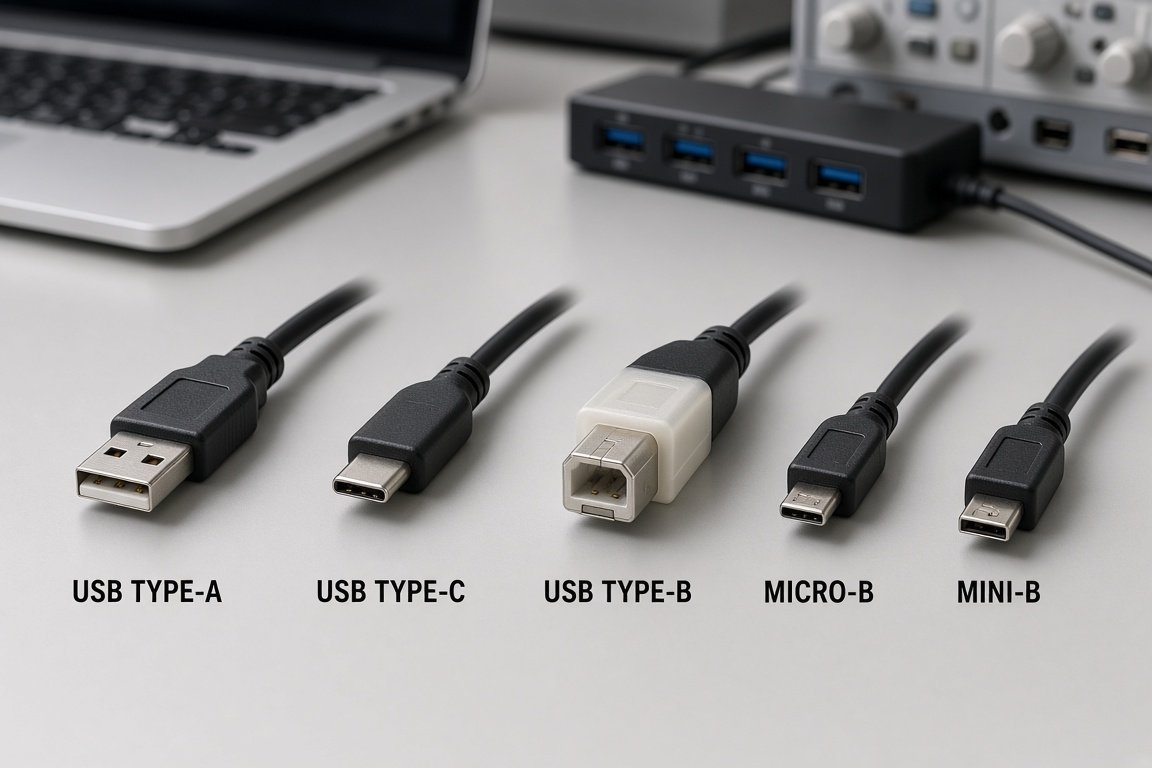
Connector customization parameters include:
- Connector A / B type selection (USB Type-C, Type-A, Type-B, Micro-B, Mini-B)
- Connector housing design and overmolding style
- Strain relief geometry and material
- Contact plating options (e.g., gold-plated, tin-plated)
- Custom pinout configurations for specialized OEM projects where non-standard signal routing is permitted by the target system — subject to electrical, mechanical, safety, and compatibility validation, and not to be interpreted as standard USB-compliant pin assignments
2. Length
2.1 Typical Reference Lengths
Cable length customization accommodates application-specific distance requirements. For high-speed passive USB Type-C cable assemblies, practical length limits generally decrease as signaling speed increases. Typical reference configurations may include approximately 2 m for selected USB 3.2 Gen 1 passive cables and 1 m for USB 3.2 Gen 2 configurations. Higher-speed USB4 configurations generally require shorter passive cable lengths or active cable architectures. Typical USB 2.0 passive cable configurations can support lengths up to 5 m. Actual supported length depends on the cable design, signaling requirements, connector configuration, and applicable USB specification.
Custom length options include:
- Short passive cables for compact device connections
- Standard passive cables for typical desktop and equipment runs
- Long-distance passive cables within supported specification limits
- Active cables for extended high-speed connections
- Specialized active or optical cable solutions for selected long-distance applications
3. Data Performance
Data performance can be selected according to the connected devices and application requirements. Available configurations may include USB 2.0 up to 480 Mbps, USB 3.2 at 5 Gbps, 10 Gbps, or 20 Gbps, and selected USB4 configurations up to 40 Gbps or 80 Gbps for compatible systems and cable configurations.
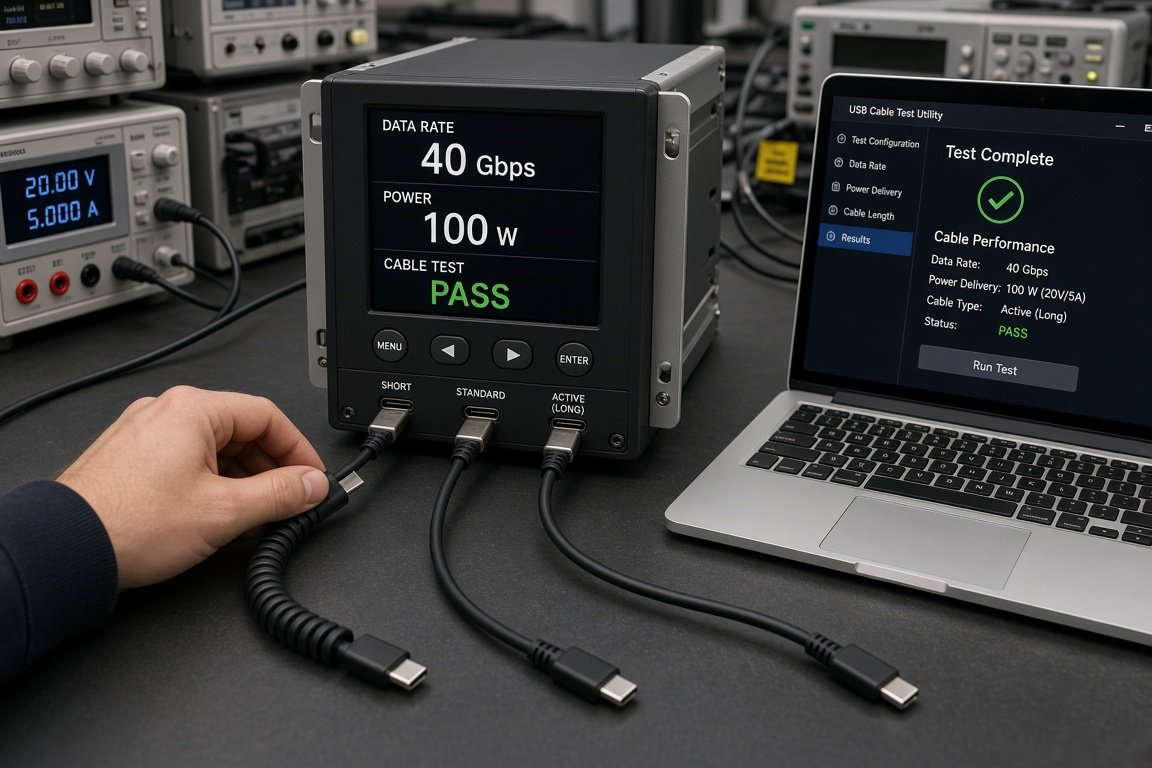
Actual data performance depends on the cable construction, connector configuration, host and device capabilities, and applicable USB specification. Higher-speed configurations may require specific cable architectures and length limitations. Data rate should therefore be specified together with connector type and cable configuration.
USB-IF explicitly states that USB 3.2 defines transfer rate only — it is not a connector type, not USB Type-C, and not USB Power Delivery. This separation means that a USB Type-C cable may carry varying data rate capabilities depending on its internal construction. For accurate cable selection, connector type, data rate, and power capability should be specified as separate requirements.
4. Power Capability
USB Type-C cable assemblies can be configured for different power requirements. USB Power Delivery supports Standard Power Range (SPR) configurations up to 100W and Extended Power Range (EPR) configurations up to 240W when the cable, source, sink, and system configuration support the required power level.
For USB Type-C to Type-C cables participating in the USB-IF Compliance Program, applicable cable power capability markings include 60W or 240W. Specific cable ratings and required markings depend on the cable category and applicable compliance specifications.
For 5A and EPR applications, the cable must meet the relevant current, identification, and compliance requirements. Actual power capability depends on the cable design, conductor and connector configuration, power source, connected device, and applicable USB Power Delivery implementation. Power selection should therefore be based on the required wattage, voltage/current profile, and cable rating rather than the USB-C connector type alone.
5. Video Capability
For applications requiring display connectivity, selected USB Type-C cable configurations can support DisplayPort Alt Mode or DisplayPort tunneling through USB4, depending on the cable and connected devices.
Maximum resolution and refresh rate depend on the cable capability, host device, display, docking device, and supported display protocol. Resolution, refresh rate, and display configuration should be confirmed against the complete system specification rather than inferred from the USB-C connector alone.
Video customization options include:
- No video requirement
- DisplayPort Alt Mode support
- USB4 display applications
- Custom video requirements for particular display and docking configurations
6. Material & Construction
Material customization defines the physical and electrical build of the cable assembly. Conductor material and construction, wire gauge, shielding structure, jacket material, outer diameter and bend radius, and connector overmolding can be specified to match application requirements for signal integrity, durability, and environmental performance.
Conductor options may include bare copper or tinned copper constructions, with conductor size selected according to current requirements, flexibility, and cable design. Shielding structures — including aluminum foil, braided copper, or combination designs — can be configured based on EMI protection requirements. Jacket materials may include PVC, TPE, TPU, and other compounds, with performance varying by formulation and construction. Selection can be based on flexibility, temperature requirements, chemical exposure, abrasion resistance, and application environment.
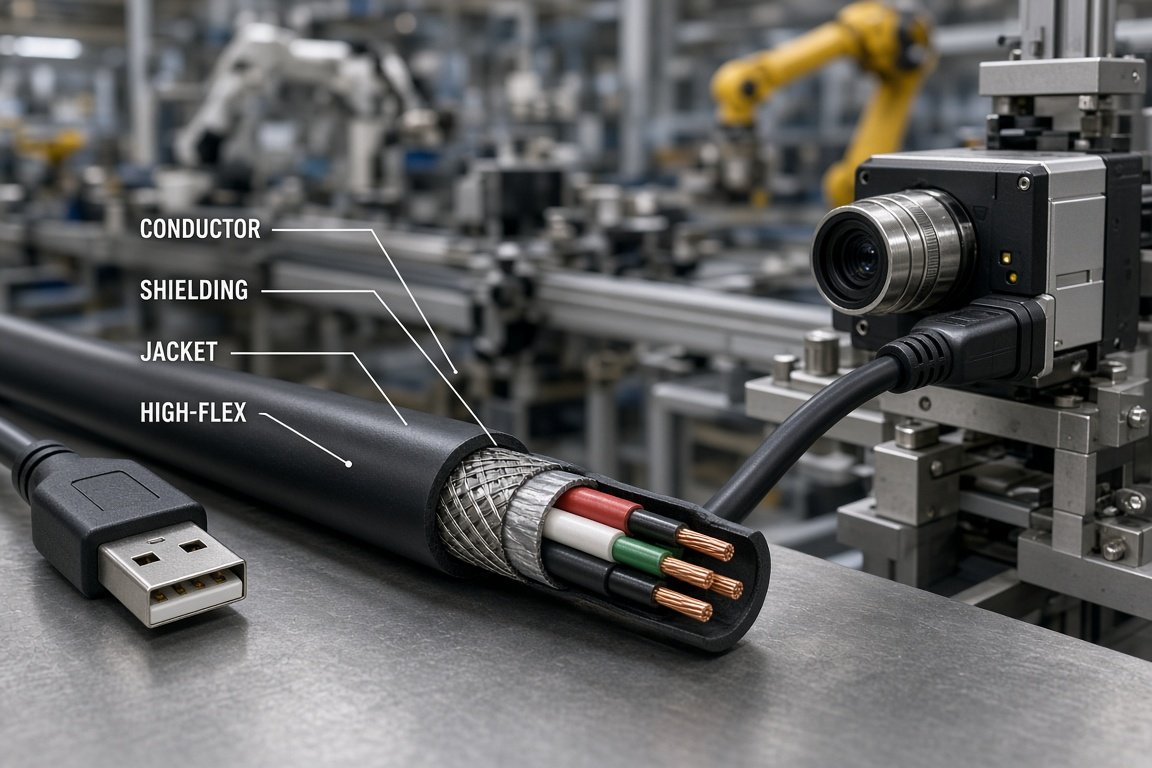
Material and construction parameters include:
- Conductor material and construction (e.g., bare copper, tinned copper)
- Wire gauge selection (e.g., AWG 20 to AWG 30)
- Shielding structure (foil, braid, or combination)
- Jacket material (PVC, TPE, TPU, or other compounds)
- Outer diameter and bend radius specifications
- Connector overmolding material and design
7. Environment
Operating environment defines the conditions under which the cable will be deployed. For B2B and industrial applications, environmental requirements may affect cable material selection, shielding design, and connector construction. Available environment categories include:
- Standard indoor use
- High-flex applications (frequent bending, moving equipment)
- Industrial environments
- High-temperature environments
- Low-temperature environments
- Moisture / water-resistant requirements
- Dust / chemical exposure
- Vibration / mechanical stress
- Medical / machine vision / automation applications
Environmental ratings such as IP classification, temperature range, and flex-life data are provided only for cable configurations with corresponding test data.
8. Color
Cable color customization applies to the jacket, connector overmolding, and strain relief components. Color options can be specified to match brand identity, product line differentiation, or functional color-coding systems used in industrial and enterprise environments. Pantone or RAL color references can be provided for precise color matching during the manufacturing process.
Color customization applies to:
- Cable jacket color (standard and custom Pantone / RAL references)
- Connector overmolding color
- Strain relief color
- Functional color-coding for multi-cable installations
9. Branding & Packaging
Branding and packaging customization covers the visual identity and packaging elements that define how the product is presented to the end user. For OEM/ODM clients and brand integrators, branding and packaging customization can support market differentiation, channel identification, and the placement of required product and regulatory information for target markets.
9.1 Logo
Logo customization includes the application of brand logos, trademarks, and identifying marks on the product surface. Logo application methods include silk-screen printing, pad printing, laser engraving, and embossing / debossing on overmolded surfaces. Logo placement, size, and color can be specified based on the product’s surface area and design.
- Logo application method (silk-screen, pad printing, laser engraving, embossing / debossing)
- Logo placement (cable connector, packaging)
- Logo size and color specifications
- Multi-language label and regulatory information placement
9.2 Packaging
Packaging customization defines the retail, bulk, or OEM packaging configuration for the product. Packaging options range from poly bag and blister pack to custom retail boxes and bulk cartons. Packaging design can incorporate brand graphics, regulatory markings, barcodes, and product information inserts tailored to target markets.
- Packaging type (poly bag, blister pack, custom retail box, bulk carton)
- Package artwork and brand graphics design
- Regulatory markings and compliance labels on packaging
- Barcode and SKU label placement
- Product information inserts and user documentation
- Multi-pack configurations for retail and distribution channels
- Language and region-specific packaging variants
9.3 Appearance
Appearance customization covers the visual and tactile characteristics of the product beyond logo and color. Surface finish, texture, and overmolding design contribute to the product’s visual identity and user experience.
- Surface finish (matte, glossy, soft-touch, textured)
- Texture and tactile design elements
- Connector overmolding style and design variations
10. Customization Summary
The following table summarizes the customization parameters available for USB cable OEM/ODM projects. Specific feasibility, minimum order quantities, and lead times are confirmed during the specification and quotation process.
| Customization Category | Key Parameters | Typical Application |
|---|---|---|
| Connector | Type A/B, housing, overmolding, plating, pinout | USB data and charging cables for OEM/ODM projects |
| Length | Passive, active, specialized long-distance | Application-specific cable run requirements |
| Data Performance | USB 2.0 to USB4, 480 Mbps to 80 Gbps | Matching host and device data requirements |
| Power Capability | Standard USB, SPR 100W, EPR 240W | USB Power Delivery cable configurations |
| Video Capability | DisplayPort Alt Mode, USB4 display | Display, docking, and monitor applications |
| Material & Construction | Conductor, gauge, shielding, jacket | Signal integrity, durability, environment |
| Environment | Industrial, temperature, moisture, flex | B2B and industrial deployment conditions |
| Color | Jacket, overmolding, Pantone / RAL | Brand identity and functional color-coding |
| Branding & Packaging | Logo, packaging, appearance | Market differentiation and retail presentation |
11. Request a Quote
Upon reviewing the customization options, buyers can submit a Request for Quotation specifying the required cable parameters, customization details, target quantities, and project timelines. The RFQ is reviewed by the sales and engineering team, which provides detailed pricing structured by volume tiers, minimum order quantities, sample availability, and production scheduling.
RFQ parameters include:
- Connector A / B type
- Data rate requirement
- Power delivery requirement
- Video requirement
- Length
- Conductor material and wire gauge
- Shielding structure
- Jacket material
- Environmental requirements
- Color specifications (Pantone / RAL references)
- Branding (logo, color coding, custom labeling)
- Packaging requirements
- Quantity
- Target lead time
- Compliance requirements
The RFQ channel connects procurement teams with technical sales representatives who support OEM/ODM customization discussions. Customization capabilities may include cable overmolding, color coding, custom labeling, custom wire gauge, shielding structure, jacket material, custom length, connector housing, strain relief, and application-specific pinout configurations where permitted by the target system and subject to electrical, mechanical, safety, and compatibility validation. The request-a-quote process helps buyers move from parameter specification to commercial engagement within a structured workflow.
Ready to Customize Your USB Cable Project?
Whether you need standard bulk USB cables or fully customized OEM/ODM cable assemblies — with your specified connector configuration, data rate, power delivery, materials, color, branding, and packaging — our engineering team can help you move from parameters to production.