AC/DC Power Adapter Guide: Voltage, Current, Polarity
GUIDE · AC/DC POWER ADAPTERS
AC/DC Power Adapter Guide: Voltage, Current, Polarity
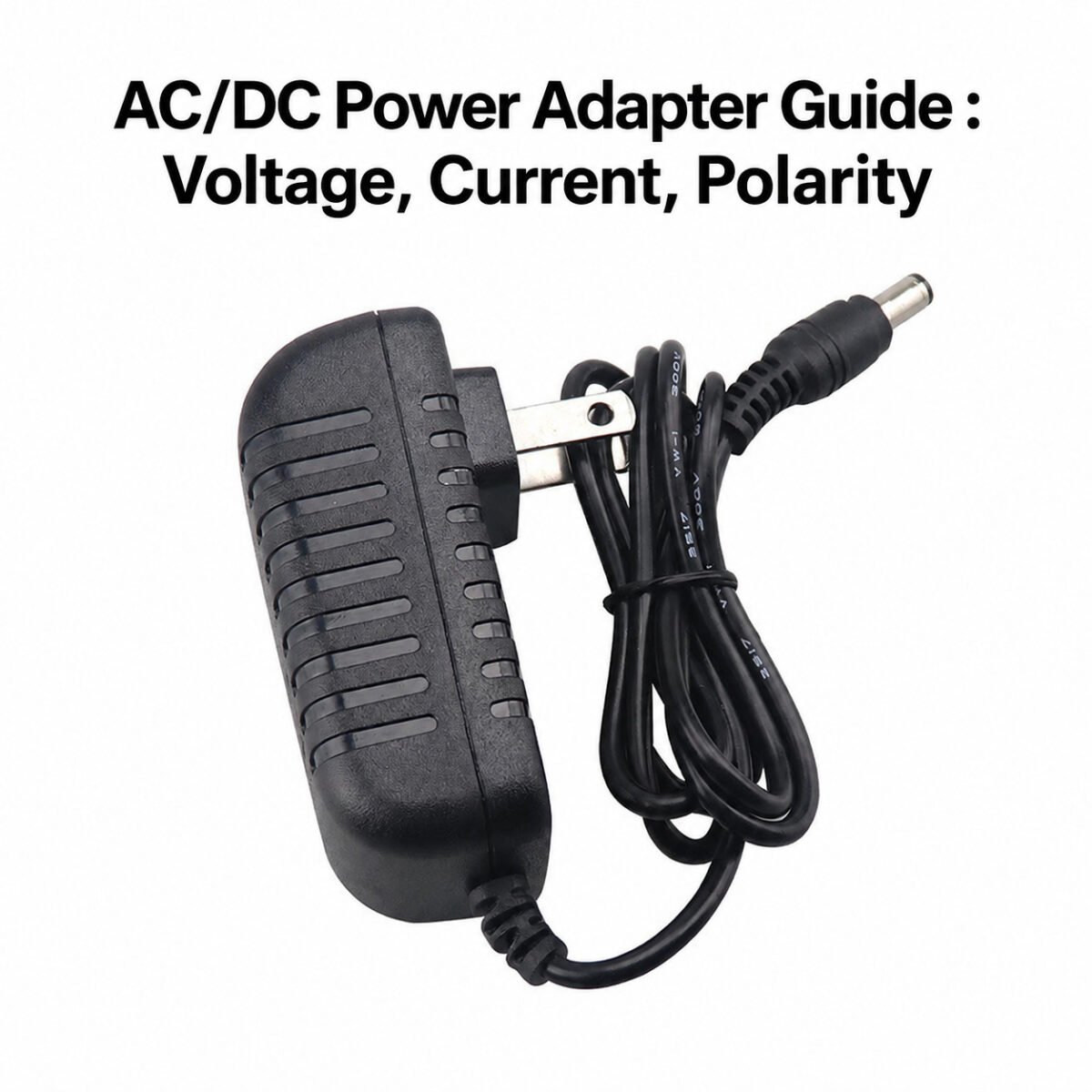
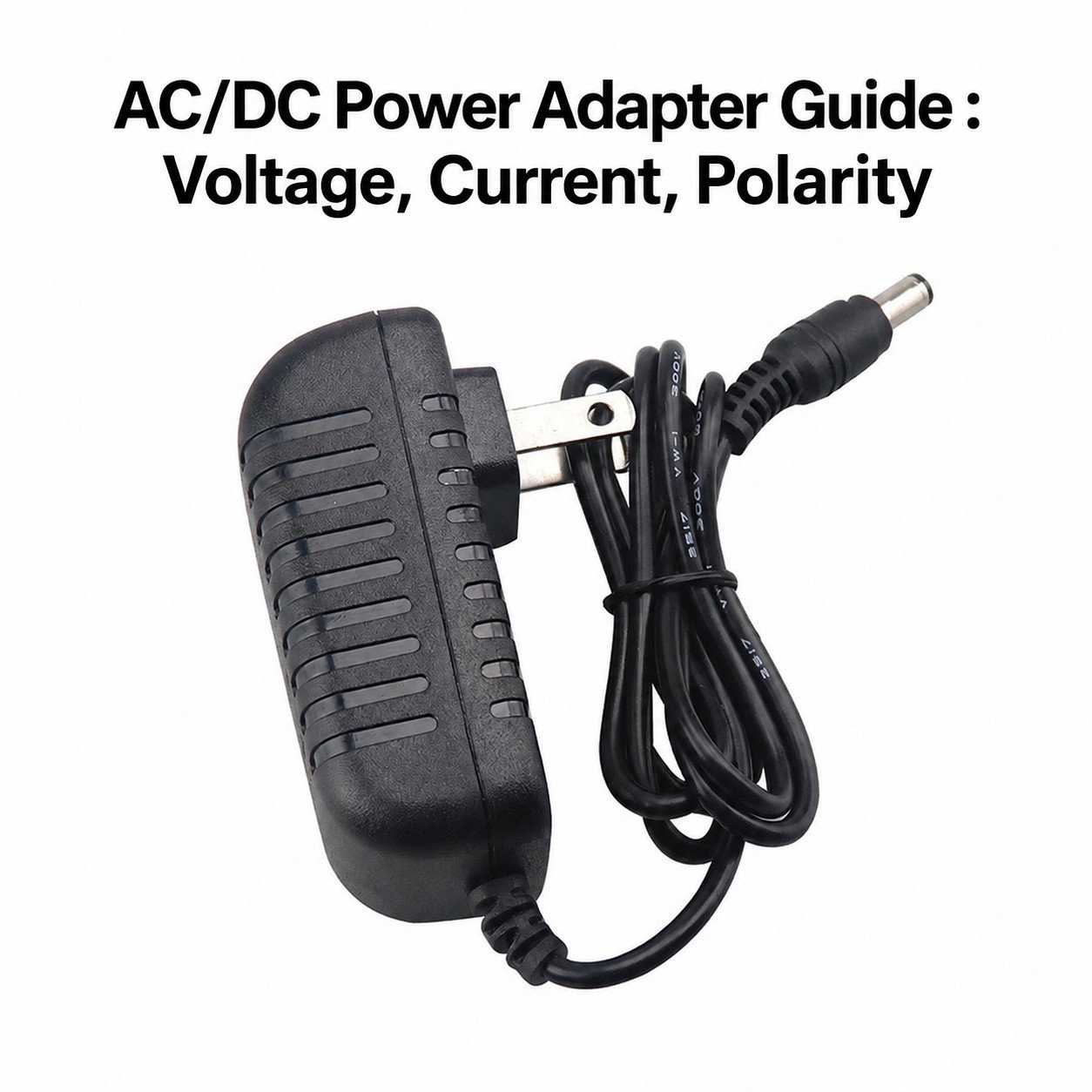
Most AC/DC power adapters look interchangeable, but the ones in a drawer usually are not. Two units with the same barrel plug can differ in voltage by seven volts, in polarity by a sign, and in current by a factor of three.
The label on the adapter carries every number needed to tell them apart, but it is printed in a shorthand that few buyers read closely. Voltage, current, polarity, connector size, and input range are all there, in a few lines of small type and a handful of symbols.
This guide walks through that label line by line, explains what each value controls, and sets out the order of checks that keeps a replacement adapter from damaging the device it is meant to power.
1. Key Takeaways
- Voltage must match the device rating; current must meet or exceed it. Those two rules are not symmetrical, and mixing them up is the most common mistake.
- Polarity and barrel size are mechanical details that can destroy a device just as thoroughly as the wrong voltage.
- A nameplate reading plus an inexpensive multimeter settles almost every question about an unknown adapter.
2. Reading the Nameplate

A typical label carries two lines of interest. The input line reads something like 100–240V~ 50/60Hz 1.5A, and the output line reads 12V ⎓ 2A.
The input line describes what the adapter can accept from the wall. The 100–240V range means it works on both 120V and 230V supplies, the tilde marks alternating current, 50/60Hz covers both mains frequencies, and 1.5A is the maximum current it draws at low line voltage.
The output line describes what it delivers. The solid line over a dashed line is the symbol for direct current, 12V is the regulated output, and 2A is the maximum current the adapter can supply continuously.
2.1 What the Symbols Add
Beside the text, three marks usually appear. The polarity symbol shows which contact of the barrel is positive. The double-square symbol marks Class II construction, meaning the adapter is double-insulated and does not rely on a safety earth. A Roman numeral such as VI states the efficiency level the unit was built to meet.
Certification marks sit nearby, and they answer a different question. UL or ETL indicates testing by a nationally recognized laboratory, while CE records the manufacturer's declaration of conformity with EU directives. None of these marks say anything about whether the adapter suits a particular device; they only say the unit was built and tested to a standard.
2.2 Doing the Arithmetic
Output power is voltage times current. A 12V 2A adapter delivers 24W, a 19V 4.74A unit delivers about 90W, and a 24V 5A unit reaches 120W.
That figure matters less than the two numbers it came from. Two adapters rated at 24W can be 12V 2A and 24V 1A, and only one of them will suit a given device. Power is a summary; voltage and current are the specification.
3. Voltage: The Number That Cannot Be Approximated
Output voltage has to match the device's rated input. A router marked 12V needs 12V, a laptop marked 19V needs 19V, and a switch marked 5V needs 5V.
A device's internal regulator usually tolerates a few percent either side, and that margin exists for adapter tolerance, not for substitution. Feeding 19V into a 12V device is the classic failure: the regulator sees an input well above its rating, and the damage can happen within seconds, before anything inside the device has a chance to protect itself.
Undervoltage is gentler but still disruptive. A 9V adapter on a 12V device may leave it unable to boot, or cause resets whenever the load rises. The device does not fail permanently, but it does not work either.
Laptop adapters sit at 19V or 20V, networking gear mostly at 12V, small switches and hubs at 5V or 9V, and PoE injectors at 48V to 54V. The voltage is a property of the device's design, and it is not negotiable at the connector.
4. Current: Meet or Exceed, Never Underrate
The current rating works in the opposite direction. A device rated 12V 2A needs an adapter that can supply 2A or more, and a 5A unit is fine.
The reason is that the adapter holds voltage and the device decides current. A 12V 2A router connected to a 12V 5A adapter still draws 2A, because the load sets the current and the adapter only sets the ceiling. What the larger adapter provides is headroom: it runs cooler, its voltage sags less under a transient, and it lasts longer.
Undersizing is where failures come from. A 1A adapter feeding a 2A load runs at its limit, its output voltage drops, and the adapter heats up. Many units will shut down on over-temperature protection, and the ones without that protection degrade quickly at the output capacitors.
Devices with motors and drives need more margin than the steady-state rating suggests. A device that averages 2A may draw three times that for a fraction of a second at start-up, and an adapter sized exactly at 2A may trip or drop out. A 50% margin over the average load covers most of these cases.
5. Polarity: Reading the Symbol

The polarity symbol is a small diagram of the barrel connector. It shows a circle for the outer contact, a dot for the center pin, and connects each to a plus or minus sign. When the plus sign connects to the center dot, the adapter is center-positive, which is the common arrangement for networking gear, LED strips, and most consumer electronics.
Center-negative adapters exist, mainly for older audio equipment and some effects pedals, and the symbol is drawn the other way around. Connecting a center-negative adapter to a center-positive device reverses the supply, and because reverse-polarity protection is not universal, the result is often a dead board.
Where the adapter label is missing or illegible, a multimeter settles it in a few seconds. Set the meter to DC voltage, touch the red probe to the inside of the barrel and the black probe to the outside, and read the result. A positive figure means center-positive; a negative figure means center-negative.
One caveat applies to the reading: an unloaded switching adapter often reads a volt or two above its rating. That is normal regulation behavior, not a fault, and the figure under load is the one that matters.
6. Connector Size: Two Dimensions, Not One
Barrel connectors are specified by outer diameter and inner pin diameter, and both have to match. The common sizes are 5.5 × 2.5 mm, 5.5 × 2.1 mm, 4.0 × 1.7 mm, 3.5 × 1.35 mm, and 2.35 × 0.7 mm.
| Size (outer × inner) | Typical use |
|---|---|
| 5.5 × 2.5 mm | Routers, switches, some laptop docks |
| 5.5 × 2.1 mm | Networking gear, LED strips, audio devices |
| 4.0 × 1.7 mm | Small hubs, set-top boxes, cameras |
| 3.5 × 1.35 mm | Mini routers, IP cameras |
| 2.35 × 0.7 mm | Compact devices and accessories |
The 5.5 × 2.1 mm size is the most common, and it causes the most confusion, because a 2.5 mm plug will slide onto a 2.1 mm pin and appear to fit. The contact is loose, the joint heats under load, and the device cuts in and out. A plug that wobbles is the wrong plug, even when it works for a while.
Where the original adapter is gone, the device manual, the silkscreen beside the jack, or a caliper on the socket will give both dimensions. Interchangeable-tip adapters add a second risk on top of size: a tip can be the wrong size for the jack, or the voltage selector can be left on the wrong setting. A fixed-cable adapter removes both failure modes.
7. A Worked Example
Suppose a device label reads 12V 1.5A and the barrel measures 5.5 mm outside with a 2.1 mm pin.
The adapter has to deliver 12V exactly, so 12V it is. The current has to be at least 1.5A, so a 12V 2A unit covers it with a little headroom, and a 12V 3A unit is also acceptable. The polarity has to be center-positive, matching the device's socket. The connector is 5.5 × 2.1 mm. The input should be 100–240V for use on either mains system, and the label should carry a recognized safety mark for the market where it will be sold.
That is the whole specification, and it comes from one label plus one measurement.
8. When an Adapter Is the Wrong Tool
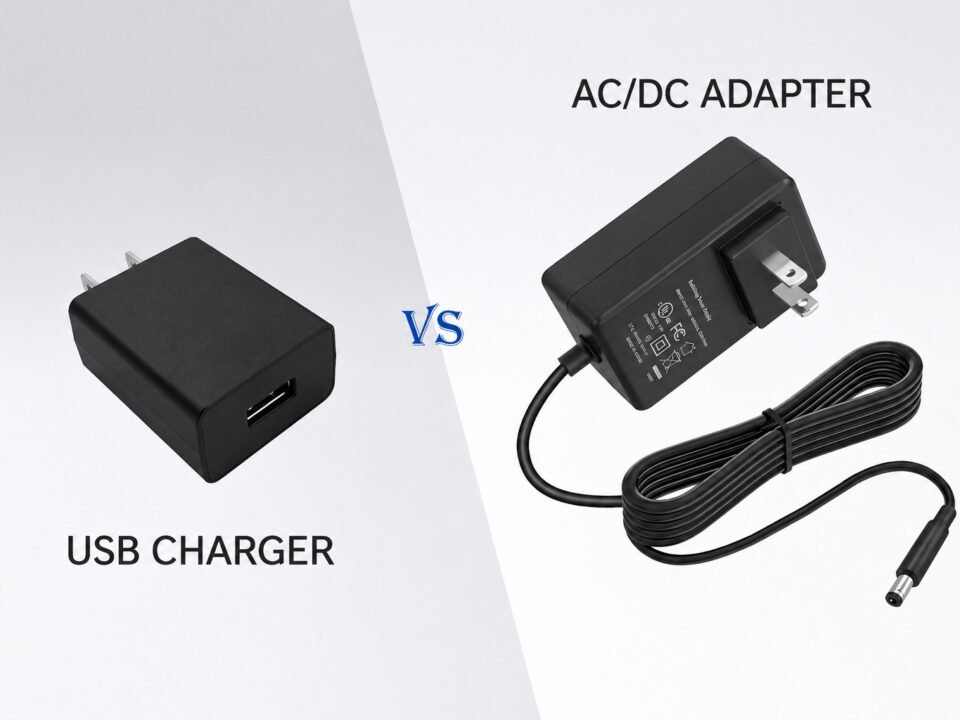
An adapter is the wrong choice when the device expects a charging protocol. A phone or a laptop built around USB Power Delivery needs a USB charger that can negotiate 5V, 9V, 15V, or 20V, and a fixed 12V supply cannot stand in for it.
It is also the wrong choice for a bare lithium cell or a battery pack with no protection board, because a constant-voltage supply will keep pushing current after the cell is full.
Power over Ethernet is a third case. A PoE device expects a supply in the 44V to 57V band and a detection handshake before power is applied, so a plain 48V adapter is not a substitute even though the voltage looks close.
9. Buying Checklist
- Voltage: exact match to the device rating.
- Current: at least the device rating, with 50% margin for motor loads.
- Polarity: center-positive or center-negative, confirmed against the device.
- Connector: outer and inner diameter both checked.
- Input: 100–240V if the unit will travel.
- Marks: a recognized safety mark, plus the efficiency level the market requires.
- Cable: a length that reaches without strain, and a gauge suited to the current.
10. Conclusion
An AC/DC power adapter is specified by four values, and only one of them is flexible. Voltage must match, polarity must match, and the connector must fit. Current is the one number that can safely go up.
Reading the nameplate covers the first three, and a caliper or a multimeter covers the rest. The check takes a couple of minutes, and it is the difference between a replacement that lasts for years and one that ends the device on first contact.
For buyers sourcing adapters in volume, the same four values become the core of a specification sheet, alongside case style, cable length, and the safety marks required by each destination market. Getting those fixed before sampling avoids the most expensive kind of revision, the one that arrives after tooling.
A supplier that states the full electrical and mechanical specification on the datasheet, and can back the marks with test reports, removes most of the remaining risk. Ask for the sample to match the production unit, particularly when the connector, cable, or label is customized.