45W vs. 65W Charger: Key Differences and Which to Choose
45W vs. 65W Charger: Key Differences and Which to Choose
Choosing between a 45W and a 65W charger may seem straightforward, but the right option depends on the devices you use and how you charge them.
A 45W charger provides enough power for many smartphones, tablets, and selected lightweight laptops. A 65W charger offers additional power capacity, making it a more versatile option for compatible laptops and users who charge multiple devices.
However, higher wattage does not automatically mean faster charging. The actual charging speed depends on the device's supported input power, charging protocol, cable specifications, and other operating conditions.
So, which charger should you choose? Let's compare their power output, charging performance, compatibility, and practical applications.

1. What is the difference between 45W and 65W chargers?
The main difference between 45W and 65W chargers is their maximum power output.
A 45W charger can deliver up to 45 watts under supported charging conditions, while a 65W charger can deliver up to 65 watts. This additional capacity can be useful for devices that require more power, particularly compatible laptops.
However, the higher rating does not mean every connected device will automatically charge faster.
1.1 Key Differences Between 45W and 65W Chargers
| Feature | 45W Charger | 65W Charger |
|---|---|---|
| Maximum Power Output | 45W | 65W |
| Best For | Smartphones, tablets, lightweight laptops | Smartphones, tablets, compatible laptops |
| Charging Capacity | Suitable for moderate power requirements | Supports higher power requirements |
| Device Compatibility | Depends on supported charging protocols | Depends on supported charging protocols |
| Multi-Device Charging | Available on selected multi-port models | Available on selected multi-port models |
| Typical Applications | Everyday charging and travel | Laptop charging and versatile use |
A 45W charger is generally sufficient for smartphones, tablets, and laptops designed for this power range.
A 65W charger provides more headroom for compatible laptops that require higher charging power. It can also be a convenient option if you want one charger for several types of devices.
For example, Google's 45W USB-C charger supports USB PD and PPS charging, while many modern laptops have recommended adapter ratings around 65W or higher.
The important point is to check the power requirements of your specific device rather than choosing a charger based only on its wattage.
2. Does a 65W charger charge faster than a 45W charger?
Yes, a 65W charger can charge compatible devices faster than a 45W charger, but the actual difference depends on the device's maximum charging input.
To understand the difference, let's compare how both chargers perform under the same device requirements.
2.1 45W vs. 65W Charging Performance
| Device's Maximum Charging Input | 45W Charger | 65W Charger | Result |
|---|---|---|---|
| 25W Smartphone | Up to 25W | Up to 25W | Similar charging performance |
| 45W Device | Up to 45W | Up to 45W | Similar charging performance |
| 50W Laptop | Up to 45W | Up to 50W | 65W charger provides more power |
| 65W Laptop | Up to 45W | Up to 65W | 65W charger has a clear advantage |
These figures illustrate maximum available charging power under compatible conditions, not guaranteed continuous charging rates.
For a smartphone that supports only 25W charging, both adapters can provide the same maximum power. Choosing a 65W charger will not automatically make the phone charge faster.
The difference becomes more noticeable with laptops. If a laptop can accept 65W but is connected to a 45W charger, the lower-power adapter may limit charging performance. A compatible 65W charger can provide the additional power required.
2.2 How Much Faster Is a 65W Charger?
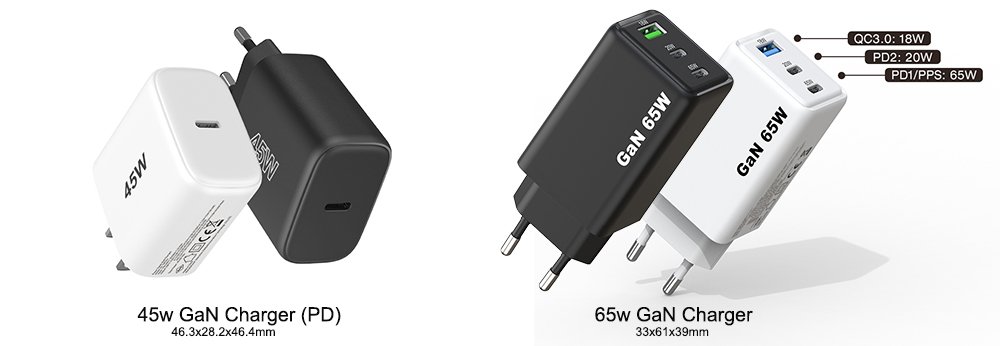
The maximum rated output increases from 45W to 65W, representing approximately 44.4% more power capacity.
However, this does not mean a device will charge 44.4% faster.
For example, consider a laptop that can accept 65W:
- With a compatible 45W charger, the maximum available input is limited to 45W.
- With a compatible 65W charger, the laptop can receive up to 65W when its charging conditions allow.
In this situation, the 65W charger can reduce charging time, particularly when the laptop supports the full output and its battery is at a low charge level.
Actual charging time still depends on battery capacity, charging curves, temperature, and system power consumption.
2.3 Why Higher Wattage Does Not Always Mean Faster Charging
Several factors determine actual charging performance:
- Device power limits: A device cannot use more power than its supported charging system allows.
- Charging protocol: The charger and device must support compatible USB Power Delivery (PD), PPS, or other charging protocols.
- Cable specifications: The cable must support the required voltage, current, and power level.
- Battery condition: Charging speed changes according to battery level and temperature.
- System power consumption: A laptop running demanding applications may use part of the incoming power to operate rather than charge its battery.
2.4 Why Cable Specifications Matter
The charging cable also affects the power a charger can deliver. A standard 3A USB-C cable supports up to 60W at 20V, while a 65W USB-C PD configuration using 20V/3.25A requires a suitable 5A-rated cable with an appropriate E-Marker.
When choosing a 65W charger, check whether the included cable supports the charger's maximum output. The required cable rating depends on the charger's actual voltage and current profiles.
3. Can a 65W charger damage a 45W device?
No. A properly designed and compatible 65W USB-C Power Delivery charger will not force 65W into a device rated for 45W.
This is because USB Power Delivery uses communication between the charger and the connected device to determine an appropriate power output.
The charger advertises its available power profiles, and the device requests a supported configuration.
3.1 How Chargers and Devices Communicate
| Step | Description |
|---|---|
| Power negotiation | The device communicates its supported power requirements |
| Output selection | The charger provides a compatible voltage and current |
| Power adjustment | The device draws power according to its requirements |
| Protection | Appropriate protection mechanisms help manage electrical faults and abnormal operating conditions |
For example, if a device requests a 45W charging configuration, a compatible 65W charger can supply that power without forcing its full rated output into the device.
However, compatibility still matters. A charger must support the device's required charging protocol and output profiles.
3.2 What About Different Charging Protocols?
USB Power Delivery is widely used across modern smartphones, tablets, and laptops, but some manufacturers also use proprietary fast-charging technologies.
A charger that supports USB PD may not provide the maximum advertised charging speed for a device that requires a different protocol or a specific PPS profile.
This does not necessarily prevent charging. It may simply result in a lower charging speed.
When choosing a third-party charger, check:
- USB PD compatibility.
- PPS support when required by the device.
- Supported voltage and current profiles.
- Appropriate safety and regulatory compliance.
- Cable compatibility and power rating.
A higher-wattage charger is generally a flexible option, provided its specifications match the connected device.
4. Which charger is better for laptops and phones?
Choosing between a 45W and 65W charger depends on the devices you use most often.
A 45W charger is suitable for many smartphones, tablets, and lightweight laptops. A 65W charger is a better fit for compatible laptops that require more power.
If you regularly carry a laptop and a phone, a 65W multi-port charger may also reduce the number of adapters you need to carry.
4.1 Which Charger Should You Pick?
| Device Type | Recommended Option | Reason |
|---|---|---|
| Smartphone Only | 45W or 65W | Both can work; actual speed depends on phone support |
| Tablet Only | 45W or 65W | Choose according to the tablet's charging requirements |
| Lightweight Laptop | 45W or 65W | Check the manufacturer's recommended wattage |
| Laptop Requiring 65W | 65W | Better matches its power requirement |
| Laptop + Phone | 65W multi-port charger | More power capacity for compatible devices |
| High-Power Gaming Laptop | Manufacturer-recommended adapter | 65W may be insufficient |
One important point: not every laptop can be charged adequately with a 65W USB-C adapter. Some performance laptops require considerably more power, and certain gaming laptops use dedicated power adapters.
For example, Apple recommends different adapter ratings for different MacBook models. Some MacBook Pro models require 96W or 140W adapters for their recommended charging configurations.
Always check the laptop manufacturer's charging specifications before purchasing an adapter.
4.2 What About Charging Multiple Devices?
A multi-port charger can be convenient if you want to charge a phone, tablet, and laptop using one adapter.
However, the total rated wattage does not necessarily go to a single device when multiple ports are in use.
For example, a 65W multi-port charger may distribute its output between two or more connected devices. The available power on each port depends on the charger's power-allocation design.
Before purchasing one, check:
- Total maximum output.
- Individual USB-C port output.
- Power distribution when multiple ports are occupied.
- Supported PD and PPS profiles.
- Whether the charger can maintain sufficient laptop charging power while charging another device.
5. How to choose between 45W and 65W chargers?
Before purchasing a charger, consider the devices you currently own, their charging requirements, and whether you expect to use the adapter with other products in the future.
A higher-wattage charger may offer more flexibility, but it is not always necessary.
5.1 Things to Consider When Choosing
| Factor | 45W Charger | 65W Charger |
|---|---|---|
| Power Capacity | Suitable for moderate requirements | Supports higher power requirements |
| Portability | Depends on design; often compact | Depends on design and components |
| Cost | Often lower | Often higher |
| Versatility | Suitable for phones, tablets, and selected laptops | Suitable for a wider range of compatible devices |
| Charging Performance | Good for devices within its power range | Better for devices requiring more power |
| Future Compatibility | Suitable for many everyday devices | More headroom for higher-power devices |

5.2 Which One Offers Better Value?
If you mainly charge a smartphone or tablet, a 45W charger may provide everything you need.
If you also use a laptop that requires 65W, purchasing a 65W charger makes more sense. It can provide the power capacity your laptop needs while remaining suitable for many lower-power devices.
Portability and price should also be considered. Some 65W GaN chargers are compact enough for everyday travel, so higher wattage does not necessarily mean a significantly larger adapter.
Ultimately, the best choice is the charger that matches your device requirements without paying for power you are unlikely to use.
6. Conclusion
Choosing between a 45W and 65W charger comes down to power requirements, device compatibility, and everyday charging needs.
A 45W charger is a practical option for many smartphones, tablets, and lightweight laptops. A 65W charger offers additional power capacity and is more suitable for compatible laptops that require higher charging input.
However, a higher wattage does not automatically guarantee faster charging. The device, charging protocol, cable, and power distribution all affect actual performance.
If you mainly charge phones and tablets, 45W may be sufficient. If you also need to charge a compatible laptop or multiple devices, 65W is generally the more versatile option.