

AVS vs PD vs PPS: What Are the Differences?
AVS vs PD vs PPS: What Are the Differences?
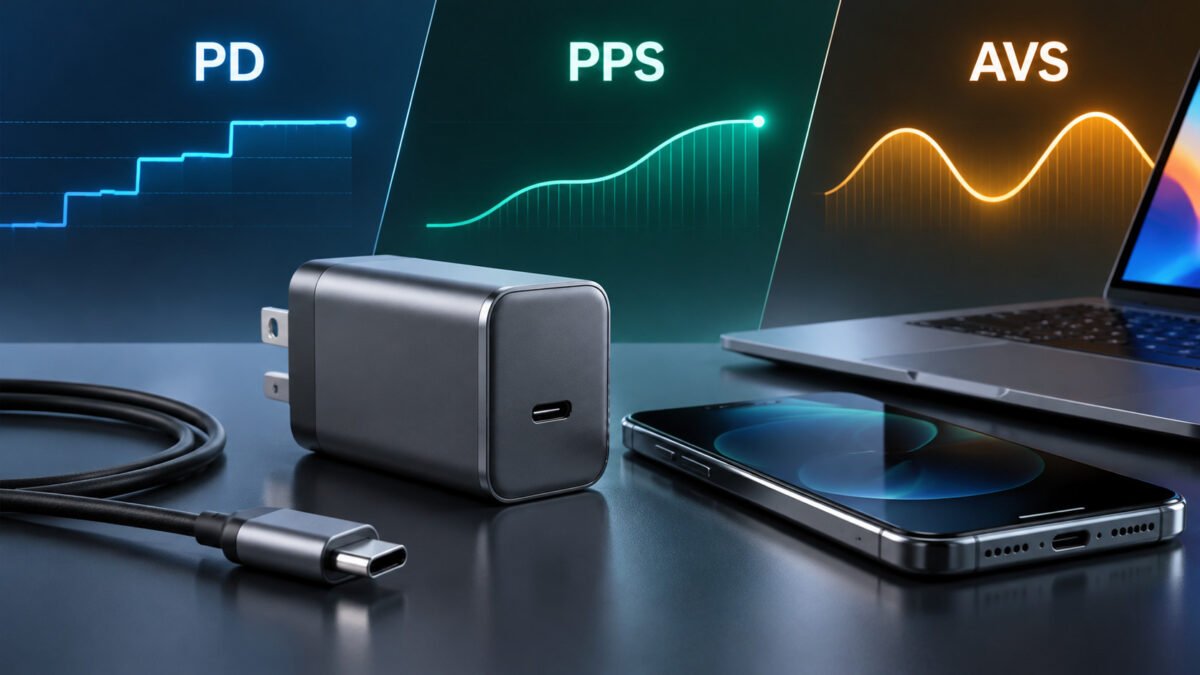
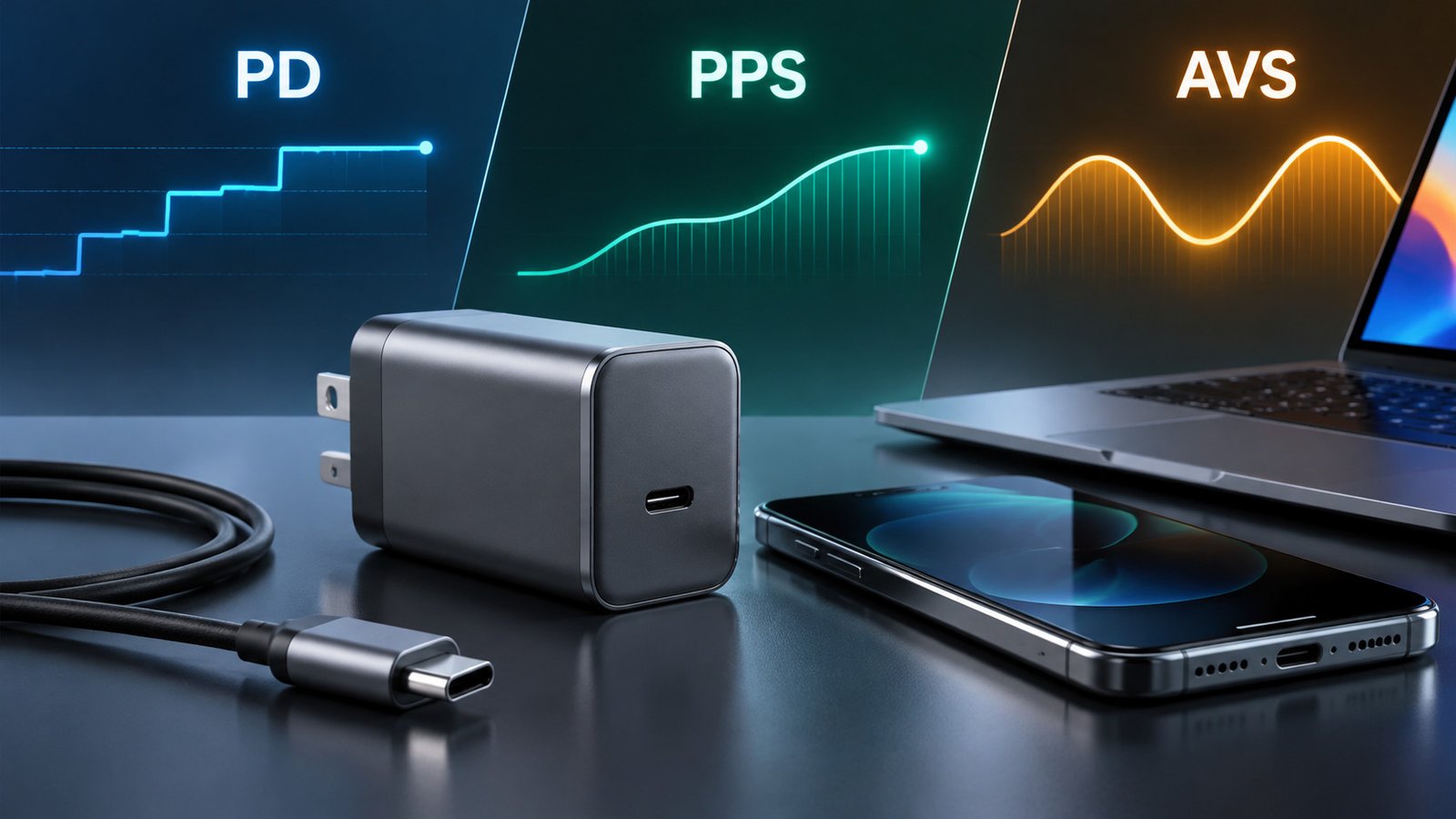
Three letter groups now show up on almost every USB-C charger: PD, PPS and AVS. They are not competing standards, and they are not three names for the same thing. They sit on top of one another, and each one exists to solve a different problem. The short version: standard PD delivers fixed voltage levels; PPS lets the device request voltage in 20mV steps to keep battery heat down; AVS adjusts in 100mV steps and stabilises the voltage feeding a device's whole power rail, which is what high-power systems need. The longer version matters, because the answer to "which is better" changes depending on what you are building — a 45W phone charger, a 140W laptop brick, or a docking station.
1. What are the core differences?
The reason PPS and AVS exist at all is control. Fixed PD gives a device four or five voltage choices. When the device wants something between them, it has to convert the difference internally, and that conversion is where heat comes from.
A useful way to hold the three in your head:
- PD is a switch with a few fixed settings — 5V, 9V, 12V, 15V, 20V
- PPS is a dial that moves continuously in very small increments
- AVS is a regulated supply that holds a stable voltage across a much wider band
| Protocol | Full name | Voltage adjustment | Typical range |
|---|---|---|---|
| PD | Power Delivery | Fixed steps (5V, 9V, 12V, 15V, 20V) | 5–20V |
| PPS | Programmable Power Supply | 20mV steps | 3.3–5.9V up to 3.3–21V |
| AVS | Adjustable Voltage Supply | 100mV steps | 9–20V (SPR), 15–48V (EPR) |
1.1 PD: the baseline
USB Power Delivery works with Fixed Power Objects (PDOs) — the source advertises a menu of voltages and currents, and the sink picks one.
- Simple to negotiate. One exchange, one level, done.
- Predictable. Any compliant device can use any compliant charger at one of the shared levels.
- The limitation is granularity. If a phone's cell wants 4.2V and the nearest fixed level is 5V, the phone drops the extra 0.8V in its own converter. At 3A that is roughly 2.4W of heat generated inside a device that is already warm from charging.
That is why fixed PD, universal as it is, is not the most efficient way to feed a battery directly.
1.2 PPS: the fine tuner
PPS arrived as an optional feature in the PD 3.0 update (added in 2017). Its purpose is narrow and clear: keep the conversion out of the phone.
- 20mV resolution. The sink requests a voltage, and the source can move in 20mV increments instead of volts.
- Direct charging. With steps that small, the charger can track the battery's rising voltage closely enough that some designs feed the cell almost directly, pushing the conversion loss into the adapter instead of the handset.
- Where it lives. Android fast charging — Samsung's Super Fast Charging among others — is built on PPS profiles.
PPS does have an upper limit that is worth knowing: the standard defines several ranges, from 3.3–5.9V up to 3.3–21V, all capped at 5A. It is a phone-and-tablet tool, not a laptop tool.
1.3 AVS: the system optimiser
AVS came first into the Extended Power Range (EPR) of PD 3.1, where it supports sources up to 240W. PD 3.2 (October 2024) then brought a lower-voltage version, SPR AVS, into the standard power range.
- 100mV resolution. Coarser than PPS by design, not by accident — see the next section.
- Stable, not dynamic. AVS holds a constant, well-matched voltage on the device's main input rail while the CPU, screen and peripherals draw from it. PPS chases a battery; AVS feeds a system.
- Wide band. EPR AVS covers 15–28V, 15–36V and 15–48V at up to 5A; SPR AVS covers 9–20V.
- Compliance weight. Under PD 3.2, SPR AVS is part of the required feature set for higher-power SPR sources, which makes it a design consideration rather than an optional extra.
2. How do the voltage steps compare?
The intuitive reading is that 20mV is finer, therefore better. That reading is wrong, because the two step sizes are solving different problems.
PPS's 20mV exists to follow a battery in real time; AVS's 100mV exists to hold a system rail steady across a far wider range. One is a sculptor working on detail, the other is an architect setting the structure.
2.1 Why PPS needs 20mV
A lithium cell's voltage climbs slowly and non-linearly as it fills. To avoid stressing it, the supply voltage has to track that climb closely.
- Matching the curve. 20mV steps let the charger follow the cell's voltage almost exactly through the constant-current phase.
- Heat control. Any mismatch between supply voltage and cell voltage has to be dissipated somewhere. Small steps keep that mismatch, and therefore the heat inside the device, near zero.
- Result. Fast charging that stays cool, which is why PPS phones can hold high current for longer before throttling.
2.2 Why AVS uses 100mV
AVS is not chasing a cell. It is supplying a whole device.
- Stable rail. A laptop running a CPU and a display while charging needs a steady input, not a supply that wobbles with battery state.
- Design simplicity. Across a 48V band, 20mV steps would mean thousands of possible levels and a far longer negotiation table. 100mV is practical at that scale.
- Power loss at high voltage. At 48V, even a small voltage mismatch multiplied by 5A is meaningful loss, so keeping the rail matched matters more than keeping it perfectly fine-grained.
| Protocol | Step size | Adjustment pattern | Best suited for |
|---|---|---|---|
| PPS | 20mV | Continuous, real time | Phones, power banks, small devices |
| AVS | 100mV | Periodic, negotiated | Laptops, monitors, high-power systems |
| PD | Fixed | One-time | Universal compatibility |
3. How does plain PD differ from PPS and AVS?
PD fixes the voltage; PPS and AVS move it. That single sentence covers the distinction, but the version history is where the details sit.
| Generation | Added protocol | Released | Voltage / current range | Step |
|---|---|---|---|---|
| PD 3.0 | PPS (added 2017) | Nov 2015 | 3.3–5.9V to 3.3–21V, up to 5A | 20mV |
| PD 3.1 | EPR AVS | May 2021 | 15–28V, 15–36V, 15–48V, up to 5A | 100mV |
| PD 3.2 | SPR AVS | Oct 2024 | 9–20V, up to 5A | 100mV |
Device support
- PD is the common floor. Every USB-C device above 15W speaks it, and a plain PD charger will run anything.
- PPS is the Android fast-charging path, Samsung's Super Fast Charging being the best-known example. A phone that expects a 4.5A PPS profile will fall back to 25W or less on a charger that only offers fixed PDOs.
- AVS is aimed at high-power systems — laptops, docks, monitors, and the larger Apple power adapters. Support is still limited compared with PPS, so treat it as a specification to design for rather than a feature to advertise widely.
4. Which protocol runs cooler?
Heat is the end-user question and the B2B question at the same time. Less heat means longer component life and fewer returns.
For heat inside a phone, PPS wins. For stability and system-level efficiency at high power, AVS wins. The trade-off is real and it maps onto two different product categories.
Efficiency here means keeping the difference between supply voltage and required voltage small. The loss is roughly (supply voltage − required voltage) × current, so every tenth of a volt that does not need converting is heat that never happens.
4.1 PPS and battery heat
- Minimal mismatch. 20mV steps mean the adapter can sit within a few hundredths of a volt of what the cell needs.
- Heat moves outward. Whatever conversion remains happens in the adapter, which has more surface area and better airflow than a sealed handset. This is why a PPS adapter often feels warmer than the phone during a fast charge — that is the design working.
- Limitation. The gain applies to the battery path only. PPS says nothing about efficiency on a laptop's main rail.
4.2 AVS and system heat
- Rail-level matching. The device reports the voltage its internal converters want, and the adapter supplies it, so those converters work less.
- Relevant at high power. At 48V/5A, a 0.5V mismatch is 2.5W of loss; AVS's whole purpose is to keep that mismatch small across a wide band.
- Limitation. 100mV steps are too coarse to track a single cell, so AVS is not a substitute for PPS in a phone.
5. What does this mean for product specifications?
For anyone writing a charger or cable spec sheet, the three protocols translate into concrete line items:
- Product type decides the protocol. Phones and power banks: PPS at 20mV, up to 21V/5A. Laptops, docks, monitors: AVS, with SPR or EPR depending on the wattage target.
- Wattage decides the range. Anything above 100W has to work in EPR, which means 15–48V AVS and a cable rated for 5A with an E-Marker.
- Protocol support is a bullet, not a slogan. "Supports PPS" is verifiable from the PDO list; "fast charging" is not.
- Fallback behaviour is worth documenting. A 45W PPS adapter on a non-PPS device should degrade to a fixed PD level, and the spec should say which one.
6. Where is this heading?
The direction is convergence under one umbrella, not replacement of one protocol by another.
AVS is becoming the baseline for high-power sources because compliance requires it; PPS stays optional and remains the thing premium phone charging is built on. In practice, a good adapter in two years will list PD as the foundation, AVS for system power, and PPS for handsets.
Beyond the standards themselves, adapters are starting to combine protocol negotiation with temperature and battery-state sensing, adjusting the supply within the legal step size rather than only at the start of a charge. That direction makes both PPS and AVS more useful, not less.
7. Conclusion
The three acronyms answer three different questions:
- PD — can this charger power this device at all?
- PPS — can it charge this phone's battery quickly without cooking it?
- AVS — can it hold a stable, efficient rail for this laptop or high-power system?
Design for the device you are shipping. A phone charger without PPS is leaving fast charging on the table; a 140W laptop adapter without AVS is out of step with PD 3.1 and 3.2.
8. FAQ
1. Is AVS faster than PD or PPS?
No — step size does not set speed. AVS's 100mV resolution is coarser than PPS's 20mV. AVS improves system efficiency at high power, which can translate into more sustained power before thermal throttling, but calling it a faster protocol is a misreading of what it does.
2. Can a PD charger charge a device that supports AVS?
Yes. The pair negotiates down to a fixed PDO and charging continues normally. You lose the fine voltage matching, so the device may run warmer or throttle earlier, but nothing breaks.
3. Which devices actually use AVS today?
Mainly high-power laptops, docks and the larger Apple power adapters, plus a growing number of 140W-class bricks that need EPR. AVS support in phones is rare, because PPS already does the job at that power level.
4. Does PPS still matter now that AVS exists?
Yes. They cover different power ranges. PPS handles 3.3–21V at up to 5A for batteries; AVS handles 9–48V for system rails. A 100W-class laptop adapter has little reason to implement PPS, and a phone charger has no need for EPR AVS — though some multi-port adapters do carry both to serve a mixed load.
5. How can I tell which protocols a charger supports?
Read the PDO list rather than the marketing text. A PPS-capable source shows a PPS APDO with its voltage range and current limit; an EPR AVS source shows the 15–48V AVS ranges. If a listing only says "PD 3.0 fast charging" without ranges, assume fixed PDOs only.