5.5×2.1 vs 5.5×2.5 mm Barrel Plug: Which Fits?
GUIDE · DC BARREL CONNECTORS
5.5x2.1 vs 5.5x2.5 mm Barrel Plug: Which Fits?
The two plugs look identical from arm's length. Same metal barrel, same molded body, same fit into the jack. One powers the device for years; the other cuts out when the cable moves, runs warm, and leaves a mark on the pin.
The pair is 5.5 × 2.1 mm and 5.5 × 2.5 mm. The nominal outer diameter is the same 5.5 mm on both, and the difference sits on the inside, in four-tenths of a millimeter.
La risposta breve: the second number is the mating inner diameter, 2.1 mm or 2.5 mm. The size code does not describe barrel length, polarity, voltage, or current rating. The two sizes are not safely interchangeable.
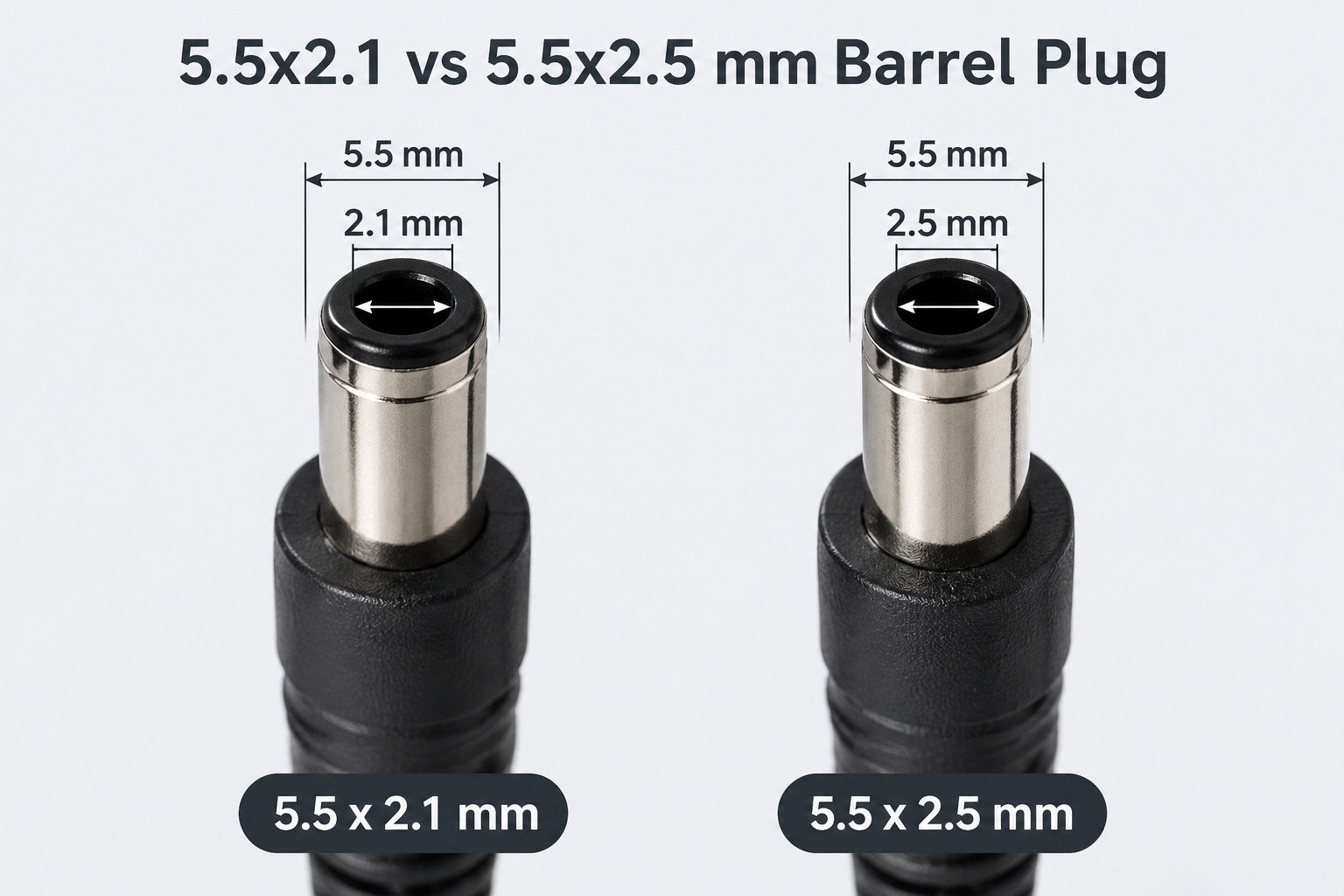
Before ordering, the decision is narrow:
| Device jack | Plug to choose | What not to do |
|---|---|---|
| 2.1 mm center pin | 5.5 × 2.1 | Do not run a 2.5 plug on the smaller pin |
| 2.5 mm center pin | 5.5 × 2.5 | Do not assume a 2.1 plug is "close enough" |
| Not yet confirmed | Check the datasheet or measure | Do not order on the 5.5 mm figure alone |
1. What Do 5.5x2.1 and 5.5x2.5 Mean?
Barrel connector sizes are written as outer diameter × inner diameter. The shorthand is convenient for searching and easy to over-trust, because the two numbers describe only the mating surfaces.
- 5.5 × 2.1: nominal 5.5 mm outer barrel, nominal 2.1 mm inner bore.
- 5.5 × 2.5: nominal 5.5 mm outer barrel, nominal 2.5 mm inner bore.
- DC5521 and DC5525: the same two sizes under their short catalog names.
Listings also show the sizes as 5.5 x 2.1, 5.5*2.1, 5.5/2.1, or 5.5-2.1, and the same variations for 2.5. Those are search formats rather than signs of a different product, and none of them implies interchangeability.
The second number says nothing about plug length, spring contact design, polarity, voltage, or current rating. Each of those has to be checked separately.
Naming also depends on which half of the pair is being sold. On a plug, the inner figure refers to the opening that receives the jack's center pin. On a jack, it refers to the center pin and the spring that grips it. Confirm whether a listing describes a plug or a jack before comparing numbers.
2. The Two Sizes Side by Side
| Articolo | 5.5 × 2.1 | 5.5 × 2.5 | Needs checking |
|---|---|---|---|
| Nominal outer diameter | 5.5 mm | 5.5 mm | Outer barrel fit |
| Nominal inner diameter | 2.1 mm | 2.5 mm | Center pin or mating contact |
| Plug length | Not defined by the code | Not defined by the code | Insertion depth and shoulder gap |
| Polarità | Not defined by the code | Not defined by the code | Center-positive or center-negative |
| Voltaggio | Not defined by the code | Not defined by the code | Device input and supply output |
| Corrente nominale | Not defined by the code | Not defined by the code | The specific part's datasheet |
A 0.4 mm difference looks trivial and is decisive in a contact system. A connector can be badly mated without any visible deformation.
Powering up on the bench proves little about the joint. A mechanically loose contact can hold at no load and fail under load, showing up as an intermittent drop, a voltage sag, or heat at the plug.
3. Can 5.5x2.1 and 5.5x2.5 Be Interchanged?
No. Even when the plug goes in, the pair is not a safe substitute.
| Mismatch | What happens | Common symptoms |
|---|---|---|
| 2.5 plug on a 2.1 jack | The bore is larger than the pin, so contact is loose or partial | Dropouts when moved, rising contact resistance, heat, voltage sag, restarts under load |
| 2.1 plug on a 2.5 jack | The plug cannot wrap the larger pin; forcing it bends the pin or spreads the spring | Will not seat, no power, damaged jack, a plug that was tight before now loose |
Reports that "mixing works" usually describe a partial, unstable contact. Tolerance, spring pressure, wear, and insertion depth make the outcome vary from one device to the next.
Stop using the pair if the plug is loose, needs force, gets warm, or only works when the cable is held at an angle.
4. What Happens With the Wrong Plug
A mismatch does not always fail at once. It often starts as a fault that is hard to trace, and the clues are physical:
- Power cuts out when the cable is moved
- The device restarts when current demand rises
- Charging starts and stops repeatedly
- The plug or jack is warm after a short run
- Voltage at the device is unstable
- The connector has to be pushed sideways to work
- The jack stays loose even after the correct plug is fitted
If one supply works on another device but not on this one, compare the full interface rather than only the output voltage.
5. Does 2.5 mm Always Mean a Higher Current Rating?
No. Neither size code carries a current rating, and the 2.5 figure is not a class label.
Current capacity comes from the specific design: contact material and plating, contact area and spring pressure, plug and jack tolerance, conductor gauge and length, the solder or crimp joint, strain relief, duty cycle, allowed temperature rise, and the manufacturer's test conditions.
A larger nominal bore allows a different contact structure, but it is not a uniform current grade. Parts within either size family carry different ratings, and the datasheet for the exact plug, jack, or cable assembly is the only figure that applies.
Connector makers and distributor measurement guides make the same point from two directions: performance depends on conductor and contact design, and the size should be measured rather than guessed from appearance.
6. Which Size Is More Common?
Both are widely used, and no industry default settles the question.
5.5 × 2.1 appears on general low-voltage equipment: routers, CCTV cameras, LED gear, development board accessories, and a large share of 12V devices.
5.5 × 2.5 appears on a different mix: some older laptops, monitors, audio products, higher-power supplies, specialized industrial equipment, and certain brand-specific power systems.
Popularity is not a compatibility standard. The device documentation outranks any count of which size appears more often online.
7. How to Confirm the Right Size
7.1 Check the Device Documentation
Look for the interface specification in the manual, service information, or datasheet. Search the full size rather than "5.5 mm barrel plug". If the device uses a recessed jack or a custom plug, confirm the barrel length as well.
7.2 Read the Original Adapter Label
The label may list voltage, current, and polarity, and sometimes the plug size. If the size is missing, do not infer it from the adapter's wattage.
7.3 Measure With a Caliper
Three measurements matter:
- The outer barrel diameter of the plug
- The plug's inner opening, or the jack's center pin
- The usable barrel length
Take each reading twice and do not squeeze the jaws. A 0.4 mm difference is small enough that a ruler or a visual estimate produces the wrong answer.
7.4 Without a Caliper, Compare Against a Known Sample
A confirmed 2.1 or 2.5 plug can be compared without force: the larger bore is visibly looser. That is a rough check, not a substitute for a measurement or a datasheet.
Never treat "it can be forced in" as a size test. A plug that needs force is the wrong plug.
7.5 Confirm the Whole Electrical Interface
Before applying power, check the supply voltage, the current capability, center-positive or center-negative polarity, plug and jack dimensions, insertion depth, and conductor gauge for the load.

8. What to Check Before Buying a Replacement
| Articolo | Question to answer |
|---|---|
| Diametro esterno | Is the mating barrel nominally 5.5 mm? |
| Inner diameter | Does the device need 2.1 mm or 2.5 mm? |
| Plug length | Does the plug reach the contact without bottoming out or leaving the barrel exposed? |
| Polarità | Center-positive or center-negative? |
| Voltaggio | Does the supply output match the device input exactly? |
| Attuale | Does the specific connector and cable assembly carry the load with margin? |
| Cavo | Is the conductor gauge right for the current and for voltage drop? |
| Applicazione | Is the part suited to frequent mating, movement, or a fixed install? |
Do not pick a plug because the barrel looks right, and do not assume a higher-wattage supply is automatically safe. A different voltage, polarity, or interface brings its own risk.
9. Choosing the Right 5.5 mm Connector
Work from the device jack outward, not from the adapter you happen to own.
- Device needs a 2.1 mm center contact: specify a 5.5 × 2.1 plug or cable assembly at the device's voltage and current.
- Device needs a 2.5 mm center contact: specify 5.5 × 2.5, and confirm the barrel length if the jack is recessed.
- Converting between known interfaces: use an adapter only when it is rated for the voltage, current, and polarity involved, and keep in mind that it adds a second contact pair.
- Needing a complete cable or harness: specify conductor gauge, length, polarity, and molding rather than the connector alone.
- Needing another DC interface: compare the full family, since 3.5, 4.0, and 4.8 mm barrel systems also exist.
- Needing a custom build: supply the device model, adapter label, and clear photos of both plug and jack so the mating dimensions can be confirmed before production.
A quotation request is more useful when it carries the full interface specification rather than "DC 5.5x2.1" or "DC 5.5x2.5" alone.
10. FAQs
Can a 5.5x2.5 plug go into a 5.5x2.1 jack?
It can enter, because the outer barrel matches. The 2.5 mm bore is larger than the 2.1 mm pin, so the contact is loose or partial, which leads to dropouts, voltage sag, and heat. Fitting is not the same as working.
Can a 5.5x2.1 plug go into a 5.5x2.5 jack?
Usually not properly. The 2.1 mm opening is smaller than the 2.5 mm pin, and forcing it can damage the plug, bend the jack pin, or spread the spring contact. Never use force as a compatibility test.
Is 5.5x2.5 better than 5.5x2.1?
Neither is universally better. Choose the size the device specifies. Current capability comes from the connector's design, materials, contact structure, cable, and manufacturer rating, not from the 2.5 mm figure alone.
Does 2.1 or 2.5 mm describe the center pin?
It describes the nominal mating diameter. On a plug, that is the inner opening or contact; on a jack, it is the center pin and spring. Confirm which part is being described before comparing numbers.
Does 5.5x2.1 include plug length?
No. The two figures do not define length, and products with the same diameters can differ in usable length, which changes how they behave in a recessed jack.
How can 2.1 mm and 2.5 mm be told apart without a caliper?
Compare against a confirmed 2.1 or 2.5 sample without applying force and see which is looser. Because the gap is only 0.4 mm, a caliper, datasheet, or supplier drawing is more reliable.
Can a 2.1 to 2.5 adapter be used long term?
Only when the adapter explicitly supports that direction and meets the required voltage, current, polarity, and operating conditions. A mechanical adapter changes the interface; it does not correct an electrical mismatch.
Is center-positive always the standard?
No. Center-positive is common, but center-negative devices exist. Check the polarity symbol on both the device and the supply, because reverse polarity can damage the electronics.
11. Conclusion
The two sizes look alike because their nominal outer diameter is the same 5.5 mm. The real difference is the 2.1 or 2.5 mm bore, and that difference decides insertion, contact pressure, and reliability.
A correct choice matches inner diameter, plug length, polarity, voltage, and current rating together. If the plug is loose, needs force, or works at only one angle, stop using it and confirm the full interface before buying a replacement.
The practical sequence is short: read the device documentation, measure the jack if the documentation is missing, and order against the measurement rather than the photograph.
A supplier that publishes the bore, barrel length, polarity, and current rating for each part removes the guesswork, which is what separates a first-time fit from a return shipment.